IV Drip and Infusion Pump Simulator
Watch IV drops fall at the real gtt/min for a volume, a time and a 10, 15, 20 or 60 gtt/mL set as the bag empties, then run the order on a pump in mL/h.
Simulator
Drag the scrubber to move through the infusion. With the scene focused, the arrow keys move it a quarter hour (a minute on a short infusion) and Home and End jump to either end. Space plays and pauses.
A gravity drip on a 20 gtt/mL macrodrip set, with drops falling in the drip chamber at 41.67 gtt/min, one every 1.44 s, set as 42. 1000 of 1000 mL left in the bag after 0 min of 8 h.
- Drip rate to set V × DF ÷ t = 1000 × 20 ÷ 480 min = 41.67 gtt/min. Drops are counted whole, so the rate is set to the nearest whole drop, rounded once at the end (Open RN 5.5).
- 42 gtt/min
- Exact drip rate Before rounding. The time goes in as minutes: dividing by hours gives a rate 60 times too high.
- 41.67 gtt/min
- Drops in 15 seconds R ÷ 4, the 15 second check against a watch (OpenStax 13.3). Drops come whole, so a 15 second count reads 10 or 11 here, 40 or 44 gtt/min once multiplied by 4. A full minute reads 41 or 42.
- 10.42 gtt
- One drop every 60 ÷ R, the gap between drops.
- 1.44 s
- Flow rate V ÷ t in hours, the same infusion in the unit a pump is programmed in (Open RN 5.13). On a 60 gtt/mL set it equals the drip rate, because 60 drops make a mL and 60 minutes make an hour.
- 125 mL/h
- Volume infused At the ordered rate, 125 mL/h, from the moment the bag was hung.
- 0 mL
- Left in the bag 1000 mL less what has gone in.
- 1000 mL
- Time remaining Of the ordered 8 h, at the ordered rate.
- 8 h
- Lasts at 42 gtt/min 42 × 60 ÷ 20 = 126 mL/h, so 1000 mL takes 7.937 h: 4 min sooner than the ordered 8 h.
- 7 h 56 min
- Drops in the bag V × DF = 1000 × 20, each drop 1/20 mL on this macrodrip set. US macrodrip sets are 10, 15 or 20 gtt/mL (BD; FDA device records). UK and EU sets are 20 under ISO 8536-4. Microdrip sets are 60. Open RN 5.14 also lists 12, but no 12 gtt/mL set appears in FDA records. Use the factor on the package.
- 20,000 gtt
A teaching model: the drops keep perfect time and nothing changes the flow once it is set. Because of the risk of error with gravity infusions, many agencies require a pump (Open RN 23.2).
Cite this tool
Citing this tool
Last updated . Add the date you accessed it as well, which a citation of a page that can change asks for. If a specific result matters, cite the permalink from the tool’s share row instead of this page: it reproduces the exact parameters.
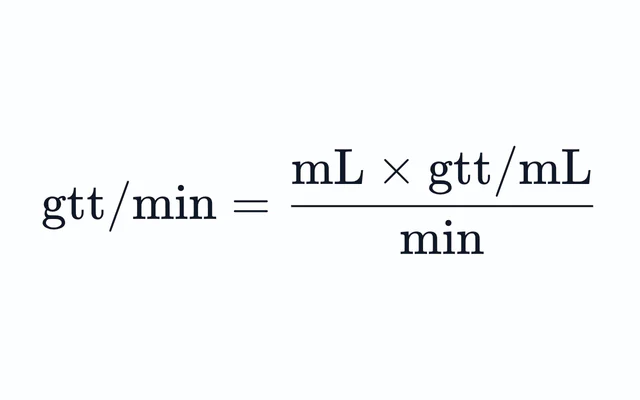
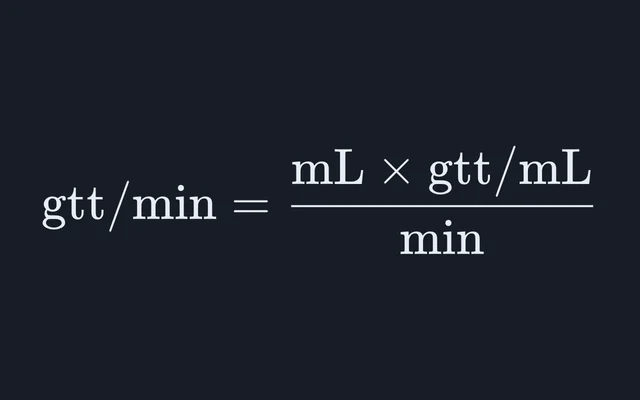
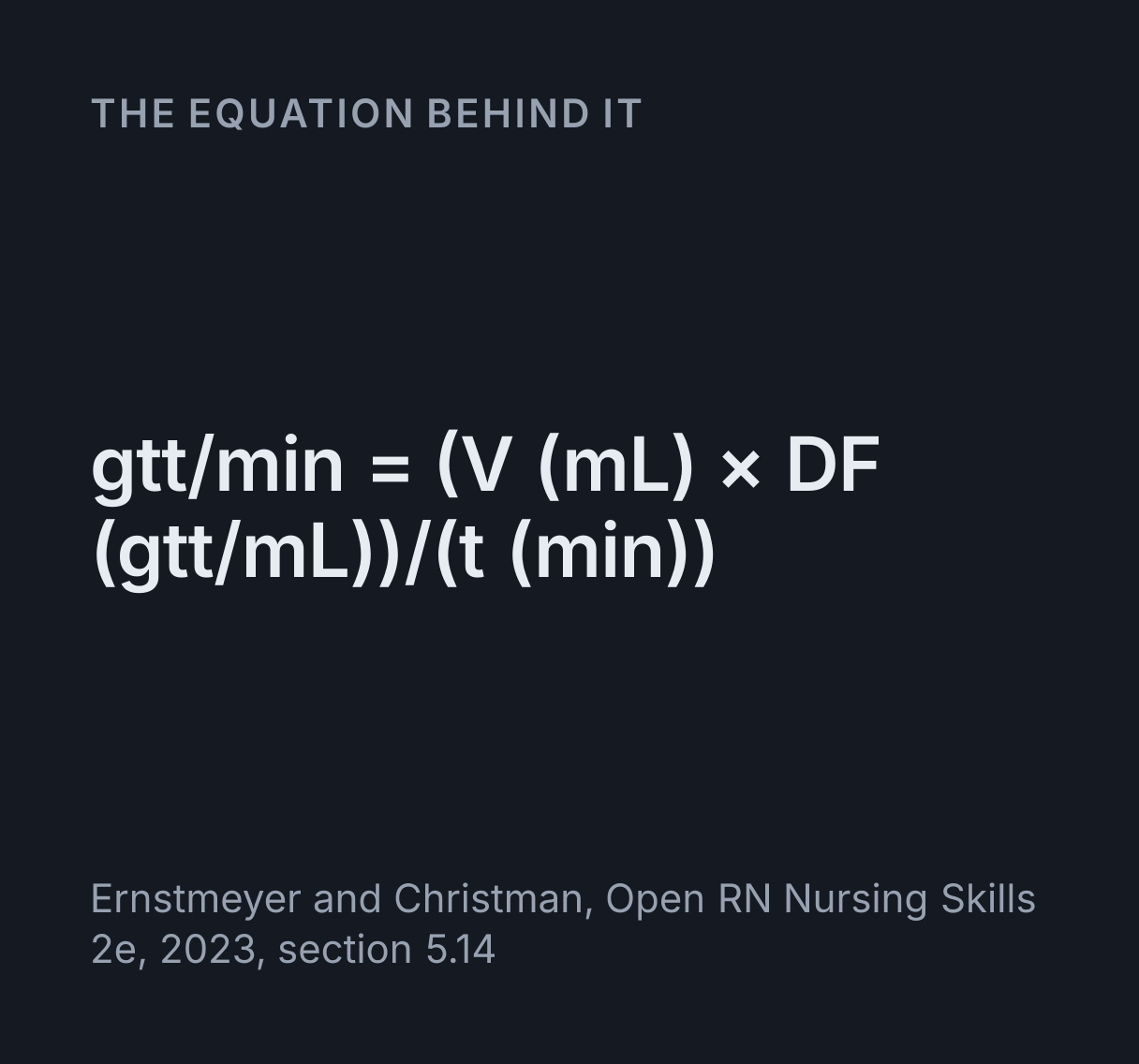
The equation
Ernstmeyer and Christman, Open RN Nursing Skills 2e, 2023, section 5.14
The equation as an image to reuse
What is an IV drip simulator?
An IV drip simulator runs an infusion order in time. Drops fall in the drip chamber at the rate a gravity set needs, drops per minute = volume (mL) × drop factor (gtt/mL) ÷ time (min), while the bag empties over the ordered time. The same order also runs on an infusion pump, set in mL/h.
Every rate here is worked out exactly as the IV drip rate calculator and the IV infusion rate calculator work it out, and rounded the same way, so the working on those pages explains any number on this one.
Using the simulator
Set the volume and the time from the order and, for a gravity drip, the drop factor printed on the tubing package. Play runs the infusion at 1x, which is real time, so the drops fall at the pace a nurse would count them. At 60x a minute passes every second, and at 3600x an hour does, which empties an 8 hour bag in 8 seconds. Drops too fast for the eye to follow are drawn as a stream while it plays.
The scrubber, and the arrow keys with the scene focused, move through the infusion. Count 15 s returns to 1x and counts the drops that leave the tip over the next 15 seconds, the shorter of the two checks OpenStax describes. The enlarged chamber draws each set’s drop to scale as a sphere of 1/DF mL, the nominal size the drop factor gives, so a 60 gtt/mL drop is drawn with a third of the volume of a 20 gtt/mL drop and about 0.69 times as wide. Pump mode runs the same order as a rate in mL/h, with the volume to be infused beside it. The share link keeps the order after the # in its address.
Counting the drops: a full minute or 15 seconds
OpenStax tells the nurse to watch the drip chamber and count the drops for one full minute, and gives the drops in 15 seconds, the rate divided by 4, as the alternative. Drops come whole, so a 15 second count reads the exact rate only when the rate is a whole multiple of 4. At the opening order, 1000 mL over 8 hours on a 20 gtt/mL set, the rate is 41.67 gtt/min: a drop every 1.44 seconds. Any 15 seconds holds 10 or 11 of them, depending on when the count starts, and times 4 that reads 40 or 44 gtt/min against the 42 the clamp is set to. A full minute holds 41 or 42 drops.
The count is always within one drop of the rate divided by 4. Multiplied by 4, that one drop becomes four drops a minute, so a full minute is the closer check; OpenStax’s own example, 19 gtt/min, gives “approximately five drops” in 15 seconds. The Drops in 15 seconds readout gives the rate divided by 4 unrounded, and its note gives the two whole counts a watch can show for the current order.
Why a whole-drop rate finishes early or late
The roller clamp is set to a whole number of drops, so if the clamp held that rate exactly, the rate that ran would be the rounded one. At 42 gtt/min a 20 gtt/mL set delivers 42 × 60 ÷ 20 = 126 mL/h, so the 1000 mL bag empties in 7.937 hours, 7 h 56 min, about 4 minutes before the ordered 8 hours. A rate that rounds down runs late instead: 1000 mL over 11 h 40 min on a 15 gtt/mL set is 21.43 gtt/min, set as 21, which is 84 mL/h and takes 11 h 54 min, 14 minutes over.
The slower the drip, the bigger a share of it one drop is, and the further the finish can move. A rate that is already whole moves nothing: 250 mL over 5 hours on a 60 gtt/mL set is exactly 50 gtt/min. The simulator’s bag empties at the exact ordered rate, and the readout under the volumes gives the finish at the whole-drop rate.
Drops are rounded to the nearest whole number, and only once, at the final answer (Open RN 5.5). An exact half, such as 250 mL over 500 minutes on a 15 gtt/mL set, 7.5 gtt/min, is set here as 8, rounded half up, the rule Open RN 5.5 gives for liquid doses. OpenStax 13.3 rounds up above 0.5 and down below it, which leaves exactly 0.5 open, and Open RN says to follow agency policy for rounding.
A real gravity drip also changes after it is set, which this model leaves out. In a bench test of three makers’ gravity sets the drop rate fell as the bag emptied (Oh and colleagues, 2025). On the medical-surgical wards of one university hospital, for most flow rates and set types, fewer than 15 percent of measured drop rates were within 10 percent of the rate wanted (Crass and Vance, 1985). OpenStax notes that kinks or bends in the tubing may prevent the flow, and says to assess the drops per minute regularly, for example every one to two hours, again if the patient bumps the tubing, and when the patient returns from another department.
Gravity drip or infusion pump
Open RN says that in the United States IV medications are most commonly given through an infusion pump, for patient safety, programmed in mL/h, and OpenStax, citing the Infusion Nurses Society, that electronic pump infusion is recommended in all settings to reduce infusion-related medication errors. Open RN teaches the gravity calculation for the times a pump is not available, and notes that because of the risk of error with gravity infusions many agencies require a pump. On a gravity set the roller clamp regulates the flow or stops it, and the drops are counted in the drip chamber, which Open RN says to keep a quarter to half full; its checklist for hanging a primary bag fills the chamber halfway.
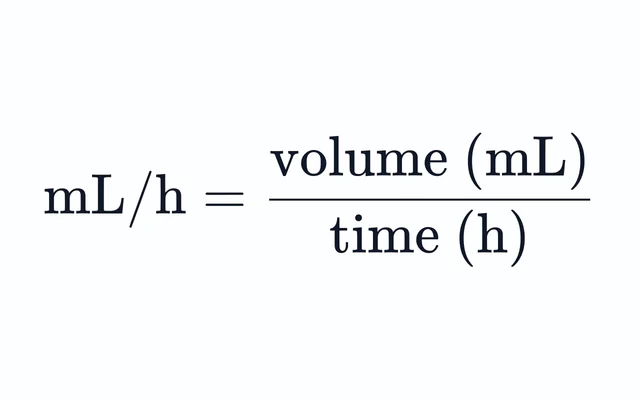
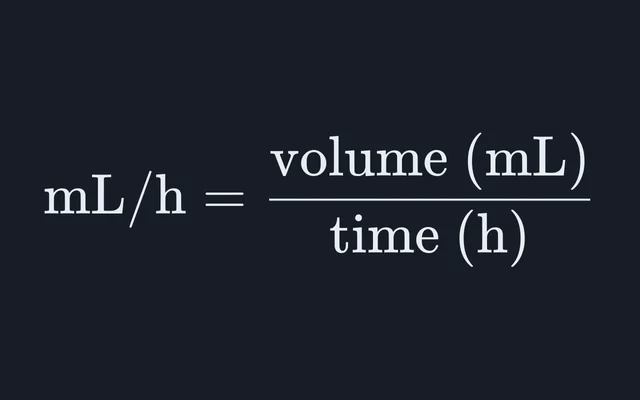
A pump needs only the volume and the time, mL/h = mL ÷ h, so 1000 mL over 8 hours is 125 mL/h and 100 mL over 30 minutes is 200 mL/h. On a 60 gtt/mL microdrip set the drip rate and the pump rate are the same number, because 60 drops make a mL and 60 minutes make an hour. On a macrodrip set the drip rate is a sixth, a quarter or a third of the mL/h figure, for 10, 15 and 20 gtt/mL. The IV drip rate chart gives both figures for 17 common orders and for a 1000 mL bag over each hour from 1 to 24.
Drop factors: macrodrip and microdrip
Open RN’s IV therapy chapter gives macrodrip sets at 10, 15 or 20 gtt/mL, used for routine adult infusions, and microdrip sets at 60 gtt/mL, used in pediatric and neonatal care. Its dosage calculation chapter lists 12 gtt/mL among the macrodrip factors as well, but no 12 gtt/mL set appears in FDA device records, and BD’s flow rate chart covers 10, 15, 20 and 60 gtt/mL. UK and EU sets are 20 gtt/mL under ISO 8536-4, which defines only 20 and 60 (Horiuchi 2020). The simulator offers the four factors the site’s calculators treat as standard, and whatever the set, the factor to use is the one on its package.
Sources
- Ernstmeyer K and Christman E, editors, Nursing Skills, 2nd edition, Open RN, WisTech Open, 2023, sections 5.5, Rounding; 5.13, Intravenous Infusions; 5.14, IV Infusion by Gravity; 5.15, IV Infusion by Pump; 5.16, IV Completion Time; 23.2, Blood Collection and IV Therapy Basics; 23.6, Checklist for Primary IV Solution Administration.
- Christy Bowen, Clinical Nursing Skills (OpenStax, 2024), section 13.3, Intravenous Infusion.
- Crass RE and Vance JR, In vivo accuracy of gravity-flow i.v. infusion systems, American Journal of Hospital Pharmacy, 1985, 42(2):328-31.
- Owen-Falkenberg AP, Møller J and Owen-Falkenberg T, Micro-drop size and intravenous administration of sedative-anaesthetic solutions, Acta Anaesthesiologica Scandinavica, 1984, 28(5):576-7.
- Oh D, Ko MJ, Kim JH, Park Y and Moon S, Enhanced accuracy in gravity-based intravenous infusion using pulse oximeter drop counting and measured single-drop weights, Anesthesia and Pain Medicine, 2025, 20(3):230-41.
- BD, Calculating Flow Rates, BD-17095, 2020.
- US Food and Drug Administration, Global Unique Device Identification Database, device records in AccessGUDID.
- ISO 8536-4, as quoted in Horiuchi K, A study on the change of droplet volume by the increase of flow rate, SN Applied Sciences, 2020, 2:1603.
The drop count and the rechecks of a running drip are from OpenStax 13.3, and the rounding of drops from OpenStax 13.3 and Open RN 5.5. Open RN’s worked examples come out the same here: 500 mL over 4 hours on a 60 gtt/mL set is 125 gtt/min, 250 mL over 2 hours on a 10 gtt/mL set is 20.83 gtt/min, set as 21, 100 mL over 30 minutes is the 200 mL/h of its pump example (5.15), and 500 mL over 6 h 40 min is the 75 mL/h of its completion time example (5.16). The drawings are this site’s own.
Model and assumptions
The method, what it assumes and how accurate it is
- Method
- Exact expression, no time stepping
- Repeatability
- Deterministic. The same link gives the same numbers on any machine.
What it assumes
- The drip rate is the volume times the drop factor over the time in minutes, and the pump rate the volume over the time in hours, the relations the IV drip rate and IV infusion rate calculators solve, rounded the same way.
- Every drop holds exactly 1/DF mL and leaves the tip every 60/R seconds, so the bag empties at a constant rate and is empty at the ordered time, and a count over any window is the floor or the ceiling of the rate times its length.
- The bag empties at the exact ordered rate. The whole-drop rate a clamp is set to is worked out beside it, with the finish time it would give, and does not drive the run.
- Once set, the flow holds: nothing in the model changes it as the bag empties, and the pump delivers its rate exactly.
- The drops are drawn to scale with each other, as spheres of 1/DF mL, and the time each takes to fall and the ripple it leaves are drawn for the eye rather than computed.
Where it stops holding. A real gravity infusion, where anything that changes the flow after the clamp is set is outside the model, so the drops are counted again; drop size itself, which changes with the fluid and the drip rate (Owen-Falkenberg 1984; Oh 2025); and a real pump’s own accuracy, alarms and occlusions, none of which it models. The IV Drip Rate Calculator is the right tool there.
Numerical accuracy
No method error to report: the result is a closed-form expression evaluated directly, with no time stepping to accumulate error. What remains is double-precision rounding, of order one part in 10^16 per operation.
Compare the formulas: IV drip rate chart.
Common questions
How many drops should I count in 15 seconds?
The drip rate divided by 4. OpenStax says to count the drops for one full minute, and gives the 15 second count as its alternative. At 41.67 gtt/min the rate divided by 4 is 10.42, so a 15 second count reads 10 or 11 depending on when it starts, which is 40 or 44 gtt/min once multiplied by 4. A full minute’s count reads 41 or 42, always within one drop of the rate.
Why does a whole-drop rate finish early or late?
Because the clamp is set to a whole drop, and the model assumes it holds that rate exactly. 1000 mL over 8 hours on a 20 gtt/mL set is 41.67 gtt/min, set as 42, which delivers 126 mL/h and empties the bag in 7 h 56 min, about 4 minutes early. A rate that rounds down finishes late instead. A real gravity drip also changes after it is set: OpenStax notes that kinks or bends in the tubing may prevent the flow, and says to assess the drops per minute regularly, for example every one to two hours.
When is gtt/min the same as mL/h?
Only on a 60 gtt/mL microdrip set, where 60 drops make a mL and 60 minutes make an hour, so the two factors cancel. 250 mL over 5 hours is 50 mL/h and 50 gtt/min on that set. On a 20 gtt/mL macrodrip set the same order is 16.67 gtt/min.