Body Surface Explorer
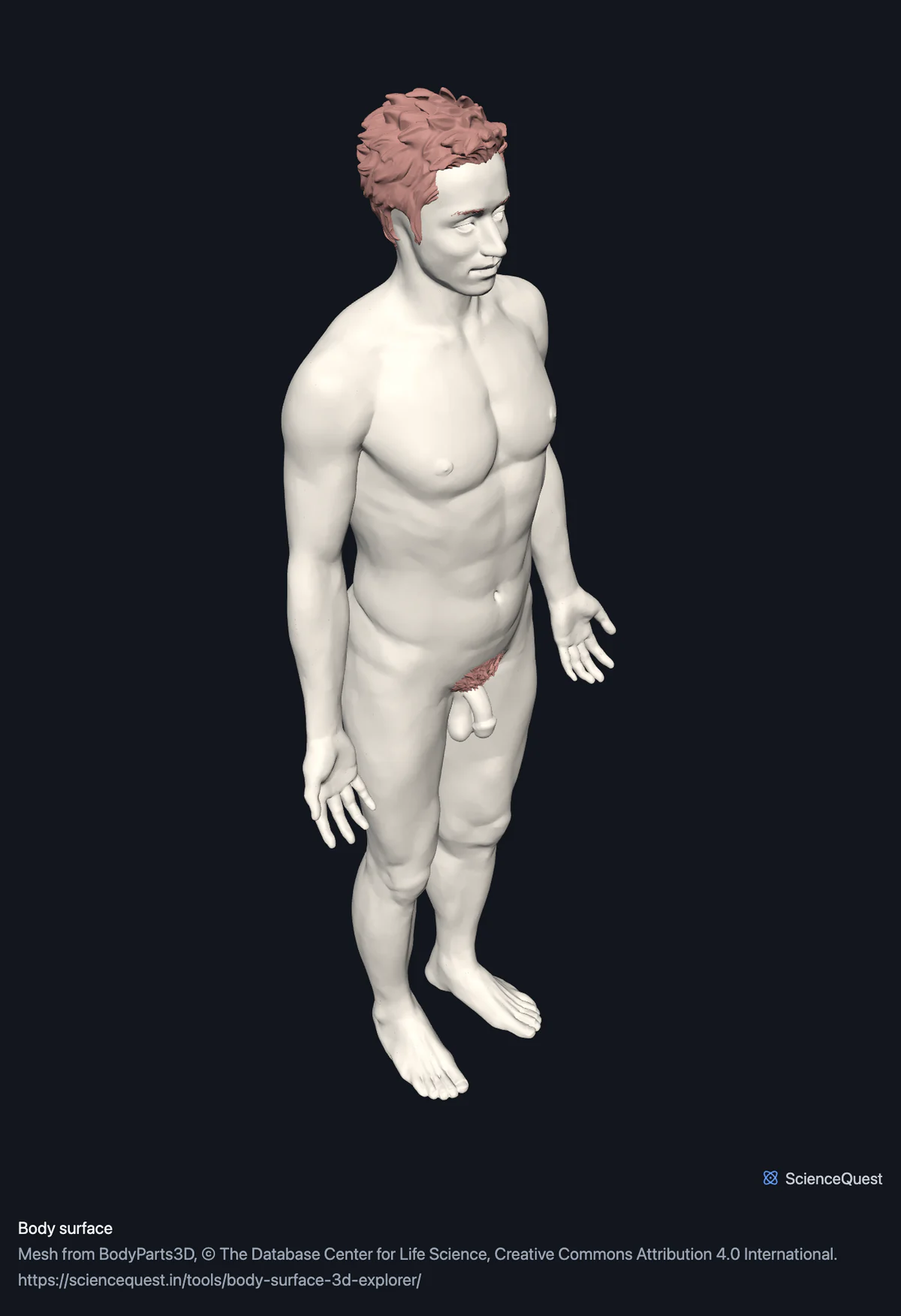
Turn the whole human body surface in 3D: skin segmented as one closed sheet from imaging, with the scalp, eyebrow and body hair published alongside it.
Visualiser
Body surface, 4 structures
Checking this device for a stored copy.
Start here
- Hide the Hair band Three meshes, and they are the least useful thing here. Hidden, you have the body surface on its own.
- Turn on Cut plane and drag it The only way to see that this surface has no inside. A sectioned skin is a closed outline with nothing behind it, which is exactly what this model is and is worth seeing before you rely on it.
- Press Top The shoulders from above, which is the view that shows the surface is a real person’s rather than a symmetrical figure: the two sides do not match.
Skin and hair. No layers at all: no epidermis, dermis or subcutaneous tissue, because this is one surface with no thickness. No follicles, glands, nails or nerve endings. Nothing inside the body, which is the point of the other models.
- 4 structures
- 1708k triangles
- 8300 KB, on request
- 0.0129 mm worst error per axis
- 1 skin
- 3 hair
Where this comes from
Segmented from imaging of one adult male body, not drawn by an artist, so the shapes are measurements. Two consequences worth knowing: it is one person’s anatomy rather than an average, and faint stepping on some surfaces is the resolution of the original scan rather than a rendering fault.
Meshes from BodyParts3D, © The Database Center for Life Science, under Creative Commons Attribution 4.0 International. Names and identifiers are the dataset’s own: Foundational Model of Anatomy identifiers and English labels, as its parts list gives them. Converted meshes are shared under the same licence.
Changes made: Meshes were converted from binary STL to an indexed mesh with 16-bit quantised vertex positions, and surface normals were recomputed from the geometry. No vertex was moved other than by that quantisation, whose worst-case error on any one coordinate is reported on the page.
Latin terms for 1 of the 4 structures come from English Wikipedia anatomy infoboxes, under Creative Commons Attribution-ShareAlike 4.0, joined by Wikidata property P1402, Foundational Model of Anatomy identifier. Only a term a source states for that structure is used, never one constructed from a family name, which is why the rest carry no Latin rather than a guess.
All 4 structures
Every structure the model contains, group by group. Each name opens the viewer with that structure selected, so a link can point at one structure rather than at the whole region.
Skin 1
- skin cutis organ
Hair 3
- set of head hairs other tissue
- set of eyebrows other tissue
- set of pubic hairs other tissue
Citing this tool
Last updated . Add the date you accessed it as well, which a citation of a page that can change asks for. If a specific view matters, cite the page address as it stands in your browser instead: it records what is selected and shown.
Cheaper than the skeleton, and that is not a mistake
The surface of an entire body is 1.71 million triangles. The skeleton inside it needs 2.36 million. Smooth closed volumes are cheap to describe and thin folded shells are expensive: a rib or a scapula encloses almost no volume for its surface area, and the skeleton model is 248 separate meshes, 203 of them bones.
What it is for
Not much on its own, and it is better to say so. This is a body surface with nothing inside it. Its purpose is to be the outer layer of something, because the skin is the thing you hide in order to see what is underneath, and it is here so that it can be hidden.
One reason to look at it anyway: the surface is segmented from imaging rather than modelled by an artist, so the proportions and the asymmetries are one real person’s. Press Top and the two shoulders do not match, which is true of everybody and true of almost no illustration.
The one region that declares which side is left
Every other model here works out its own left and right from a pair of structures, one on each side. This one cannot: all four of its meshes straddle the midline, so every centroid sits at the midline too, and no pair of them can say which side is which. The pair the frame is nominally given, pubic hair to head hair, is the same pair that sets the vertical, so its check comes out at two ten thousand trillionths of a millimetre, which is zero with rounding error on top.
So the direction is stated in the region record instead, and it was checked rather than assumed. Every model on this site is segmented from the same body in the same coordinate frame, so the skin’s frame was compared against the skeleton’s, which does have paired landmarks, and they agree. That check was worth running: without the declaration the sign came out mirrored, so the Left button would have shown the right side, and on a nearly symmetrical surface nothing on screen could ever have given it away.
Common questions
Is this useful on its own?
Honestly, not very. It is a body surface with nothing inside it, so what you get is the shape of one adult man and the eight megabytes it takes to describe him. Its real job is to be the outermost layer of something: the skin is what you hide in order to see what is underneath, and that is what it is here for. It is worth loading now for one reason, which is that the surface is measured rather than modelled, so the proportions are a real person’s rather than an artist’s.
Why is the skin cheaper than the skeleton?
Because it is one smooth closed sheet and a skeleton is 248 intricate ones. The surface of a whole body comes to 1.71 million triangles, where the skeleton needs 2.36 million, and the skeleton has the harder geometry: thin curved shells like the ribs and the scapulae enclose almost no volume, so their surface area is enormous relative to their size. Smooth and convex is cheap. Thin and folded is not.
Why is there hair in an anatomy model?
Because the dataset publishes it under the integumentary system, alongside the skin, and leaving it out would be an edit rather than a choice. You get three meshes: the scalp hair, the eyebrows and the pubic hair, each as a single set rather than as strands, so they read as shaped volumes rather than as hair. They are tagged as other tissue and sit in their own band, so hiding them is one click.
Does it show anything about the skin itself?
No layers, and that is the significant limit. Skin has an epidermis and a dermis, with a subcutaneous layer beneath it, and none of them is here: this is one surface with no thickness at all. There are no hair follicles, no glands, no nails and no nerve endings. What it gives you is the outer boundary of the body, accurately placed in the same coordinate frame as every other model here.