Upper Limb Skeleton Explorer
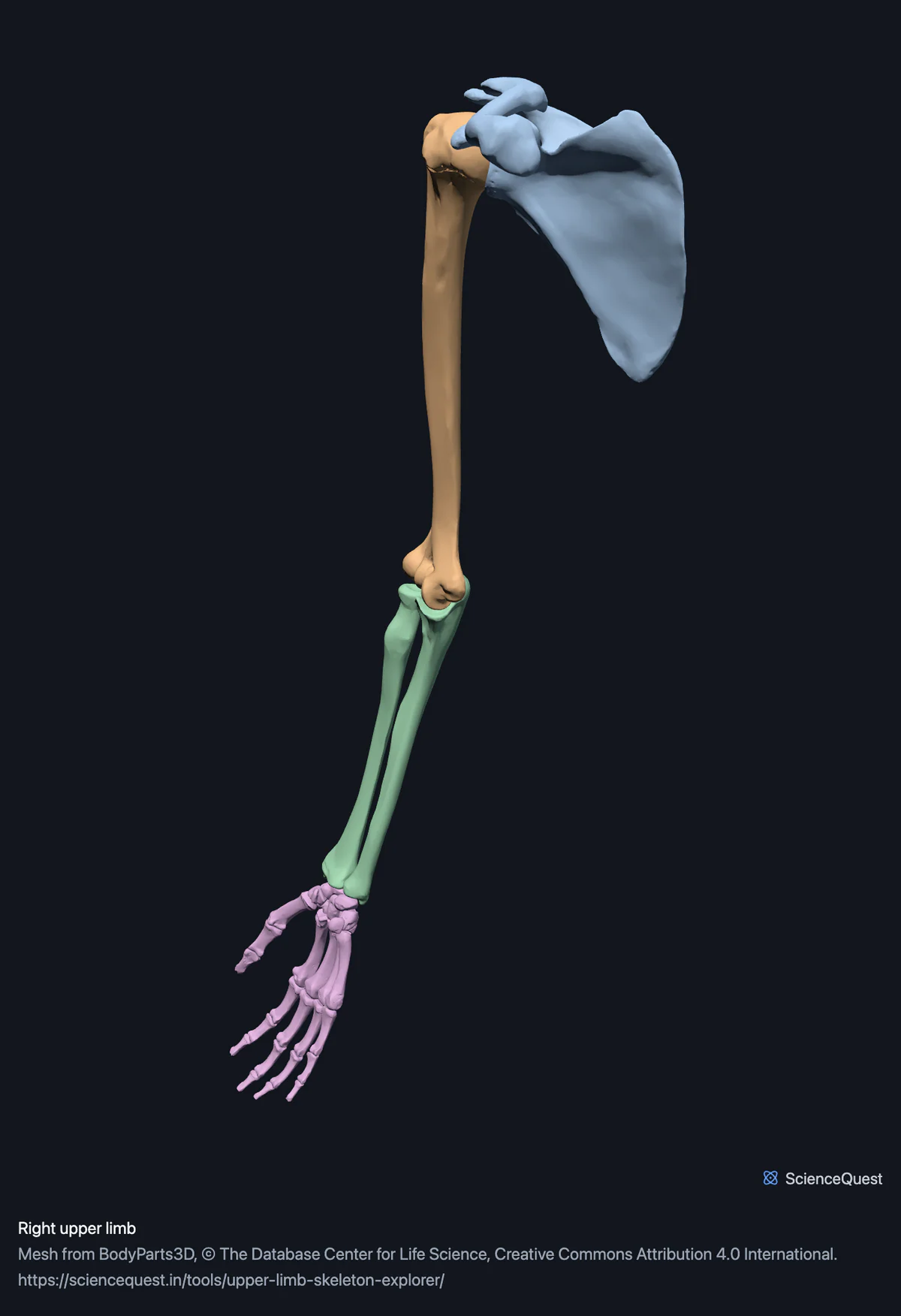
Turn the whole right upper limb in 3D, scapula to fingertips, so the size of the shoulder blade and the length of the levers below it are finally to scale.
Visualiser
Right upper limb, 32 bones
Checking this device for a stored copy.
Start here
- Isolate the scapula and turn it A broad thin plate, and the most detailed bone in this model at 113,256 triangles, more than the frontal bone and both parietals put together.
- Hide the Hand and Forearm groups Leaves the girdle and the humerus, which shows how little bone actually attaches the arm to the trunk: one clavicle.
- Compare Radial and Ulnar The thumb is a separate column of bone set forward of the other four fingers.
Bone only. No muscles, capsule or ligaments, and for a shoulder that is a real limitation rather than a footnote: the joint works because of the soft tissue around it, and what you have here is the frame that tissue acts on. No sesamoid bones in the thumb either, which most people have.
- 32 bones
- 177k triangles
- 940 KB, on request
- 0.00537 mm worst error per axis
- 2 shoulder girdle
- 1 arm
- 2 forearm
- 27 hand
Where this comes from
Segmented from imaging of one adult male body, not drawn by an artist, so the shapes are measurements. Two consequences worth knowing: it is one person’s anatomy rather than an average, and faint stepping on some surfaces is the resolution of the original scan rather than a rendering fault.
Meshes from BodyParts3D, © The Database Center for Life Science, under Creative Commons Attribution 4.0 International. Names and identifiers are the dataset’s own: Foundational Model of Anatomy identifiers and English labels, as its parts list gives them. Converted meshes are shared under the same licence.
Changes made: Meshes were converted from binary STL to an indexed mesh with 16-bit quantised vertex positions, and surface normals were recomputed from the geometry. No vertex was moved other than by that quantisation, whose worst-case error on any one coordinate is reported on the page.
Latin terms for 9 of the 32 structures come from English Wikipedia anatomy infoboxes, under Creative Commons Attribution-ShareAlike 4.0, joined by Wikidata property P1402, Foundational Model of Anatomy identifier. Only a term a source states for that structure is used, never one constructed from a family name, which is why the rest carry no Latin rather than a guess.
All 32 bones
Every structure the model contains, group by group. Each name opens the viewer with that structure selected, so a link can point at one bone rather than at the whole region.
Shoulder girdle 2
- right scapula scapula
- right clavicle clavicula
Arm 1
- right humerus humerus
Forearm 2
- right radius radius
- right ulna ulna
Hand 27
- right scaphoid
- right lunate
- right triquetral os triquetrum, os pyramidale
- right pisiform os pisiforme
- right trapezium os trapezium, os multangulum majus
- right trapezoid
- right capitate
- right hamate os hamatum
- right first metacarpal bone
- right second metacarpal bone
- right third metacarpal bone
- right fourth metacarpal bone
- right fifth metacarpal bone
- proximal phalanx of right thumb
- distal phalanx of right thumb
- proximal phalanx of right index finger
- middle phalanx of right index finger
- distal phalanx of right index finger
- proximal phalanx of right middle finger
- middle phalanx of right middle finger
- distal phalanx of right middle finger
- proximal phalanx of right ring finger
- middle phalanx of right ring finger
- distal phalanx of right ring finger
- proximal phalanx of right little finger
- middle phalanx of right little finger
- distal phalanx of right little finger
Citing this tool
Last updated . Add the date you accessed it as well, which a citation of a page that can change asks for. If a specific view matters, cite the page address as it stands in your browser instead: it records what is selected and shown.
Almost nothing holds the shoulder on
The only bony link between the arm and the trunk is the clavicle, which meets the sternum at one small joint. The scapula is held on by muscle alone and floats on the back of the rib cage. That is why the shoulder moves further than any other joint and dislocates more readily than any other.
Built for reach
- Girdle
- Scapula and clavicle. Mostly muscle attachment, and the reason the shoulder has any range at all.
- Arm and forearm
- Humerus, then radius and ulna as a pair. The radius rotates around the ulna, which is why this page says radial and ulnar rather than medial and lateral.
- Hand
- Eight carpals, five metacarpals and fourteen phalanges. Separate levers, at the cost of strength.
Common questions
Why is the scapula so much bigger than people expect?
Because almost all of it is muscle attachment, and it is mostly hidden under muscle on a living body so you never see its extent. It is also the most detailed bone in this model at 113,256 triangles, more than the frontal bone and both parietals put together, because it is a broad thin curved plate with a complicated edge. Only the left scapula beats it, at 121,816. Isolate it and turn it: the blade is a wide flat sheet, and the only part that joins the rest of the skeleton is the small socket at its corner and the strut that reaches across to the clavicle.
What holds the shoulder onto the body?
Very little bone, which is the point of this model. The only bony connection between the arm and the trunk is the clavicle, which meets the sternum at a small joint at the front. The scapula itself is held on by muscle alone: it floats on the back of the rib cage. That is why the shoulder has more range of movement than any other joint in the body and why it dislocates more readily than any other. Hiding the hand and forearm makes the arrangement easy to see.
Why does the model show only the right limb?
Because BodyParts3D is a single body and the two sides are separate meshes, so a model of both would double the download for anatomy that is a mirror image. The right side is the convention the rest of the site follows. If you need the left, everything here mirrors: radial is still the thumb side and ulnar still the little finger side, which is exactly why the view buttons use those words rather than medial and lateral.
Which bones are missing from this limb?
None of the bones, but all of the soft tissue, and one of those absences matters more than usual here. The shoulder works because of its muscles and its capsule, none of which BodyParts3D publishes in a form this region could carry, so what you have is the frame they act on. There are no sesamoid bones in the thumb either, which are present in most people and absent from this dataset.