Scapula
The scapula, or shoulder blade, is a flat, triangular bone on the back of the shoulder. It joins the clavicle at the acromioclavicular joint and meets the humerus to form the shoulder joint. (OpenStax A&P 2e, 8.1; StatPearls, Scapula and Acromioclavicular Joint; Gray’s Anatomy (1918), Scapula, p. 202)
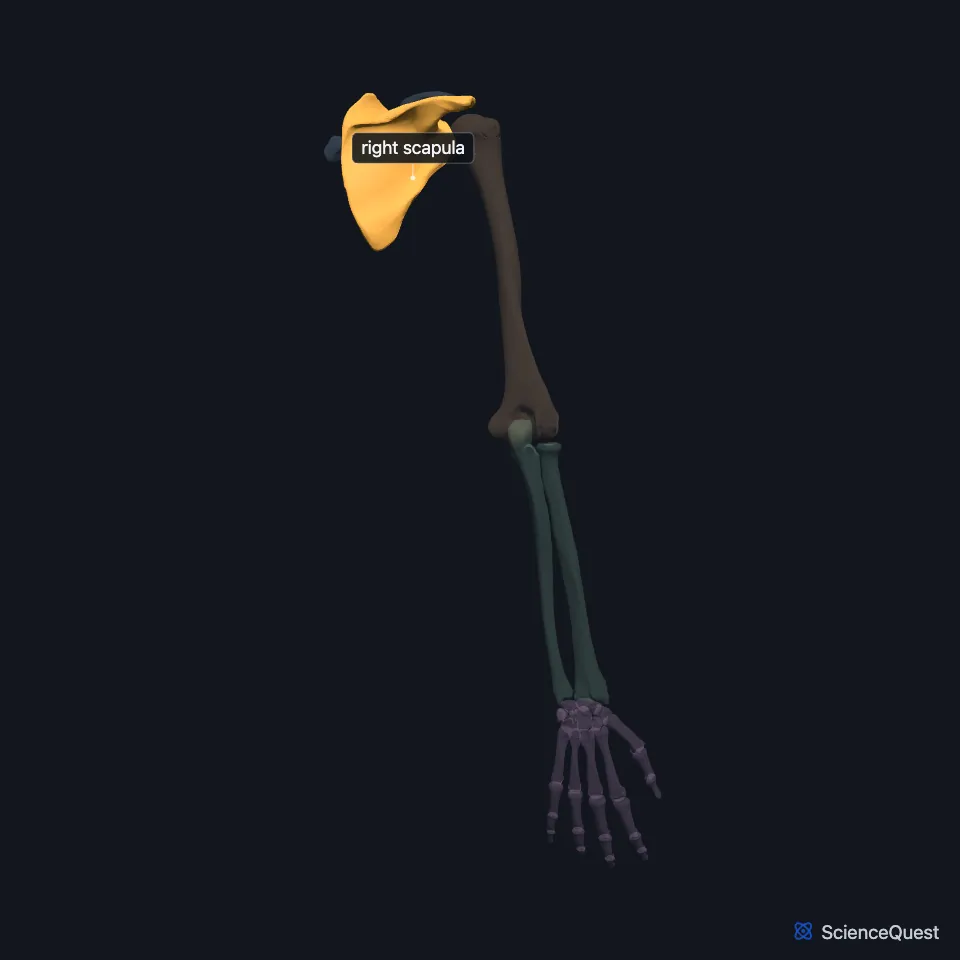
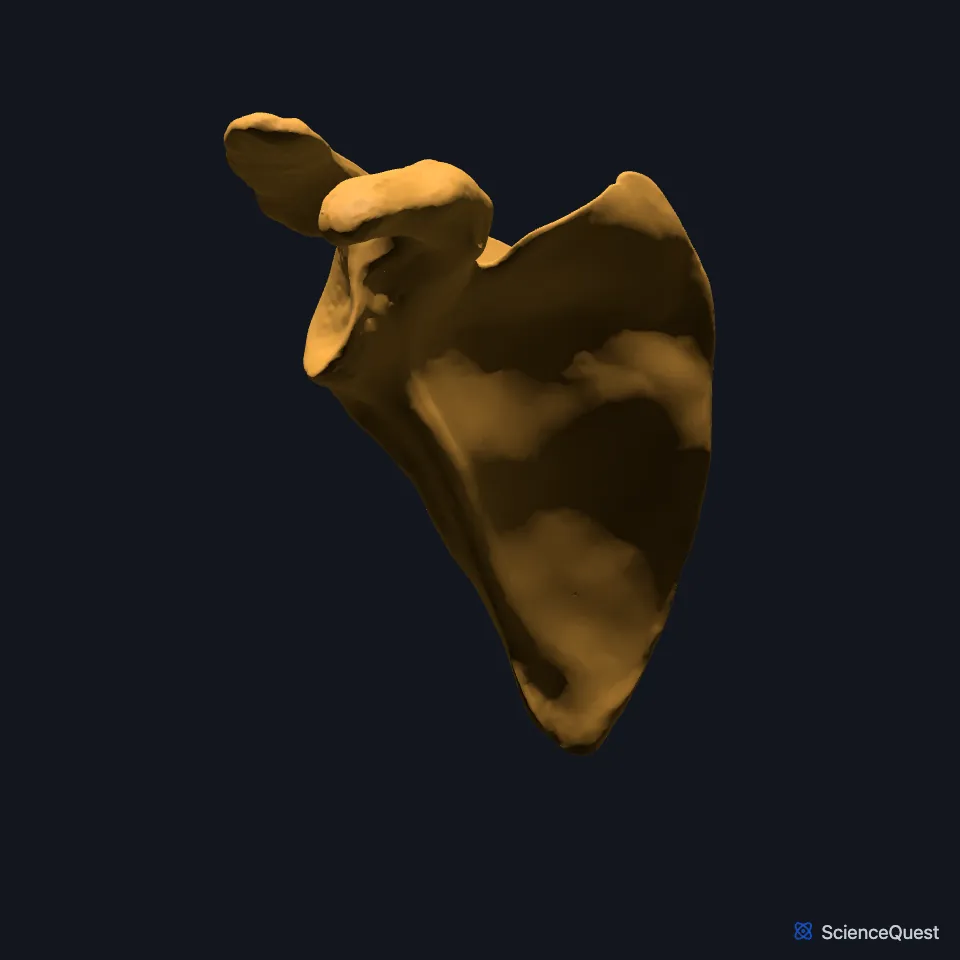
Open it in the Upper Limb Skeleton Explorer See it alone in 3D
Where is the scapula?
The scapula lies on the back of the upper thorax, over the ribs. Muscles cover both its front and its back, so it has no joint with the ribs. (StatPearls, Scapula; OpenStax A&P 2e, 8.1)
What are the parts of the scapula?
Its three borders are the superior, medial and lateral. The superior and inferior angles sit at the two ends of the medial border, and the third corner, between the superior and lateral borders, holds the glenoid cavity. (OpenStax A&P 2e, 8.1; StatPearls, Scapula; Gray’s Anatomy (1918), Scapula, p. 202)
On the back, the spine of the scapula crosses the upper part of the bone and extends sideways as the acromion. The hook-like coracoid process projects forward from the superior border and sits below the lateral end of the clavicle. (OpenStax A&P 2e, 8.1; StatPearls, Scapula; Gray’s Anatomy (1918), Scapula, p. 202 and Clavicle, p. 200)
Three fossae give muscles room: the narrow supraspinous fossa above the spine, the broad infraspinous fossa below it and the subscapular fossa on the front, against the ribs. (OpenStax A&P 2e, 8.1; StatPearls, Scapula)
What does the scapula do?
As part of the pectoral girdle, the scapula anchors the upper limb to the body. Its fossae give broad surfaces to the muscles that cross the shoulder joint to act on the humerus. (OpenStax A&P 2e, 8.1; StatPearls, Shoulder and Scapula)
Seventeen muscles attach to it. Between them they move the scapula six ways: elevation, depression, upward and downward rotation, retraction and protraction. (StatPearls, Scapula)
Each rotator cuff muscle runs from the scapula to the humerus: the supraspinatus to the top of the greater tubercle, the infraspinatus below it, the teres minor to the lowest part of the greater tubercle, and the subscapularis to the lesser tubercle. Together they keep the head of the humerus seated in the glenoid cavity. (OpenStax A&P 2e, 9.6; StatPearls, Scapula, Shoulder Muscles and Glenohumeral Joint)
Which joints does the scapula form?
The glenoid cavity meets the head of the humerus at the glenohumeral (shoulder) joint. The cavity is shallow and much smaller than the head: OpenStax puts it at about a third of the head’s size, and StatPearls gives the head four times its surface area. That mismatch and a loose capsule give the joint its wide range of motion and leave it prone to dislocation. (OpenStax A&P 2e, 8.1 and 9.6; StatPearls, Glenohumeral Joint; Gray’s Anatomy (1918), Shoulder joint, p. 317)
The acromion meets the lateral end of the clavicle at the acromioclavicular joint, and the coracoclavicular ligament ties the coracoid process to the underside of the clavicle. (OpenStax A&P 2e, 8.1; StatPearls, Acromioclavicular Joint; Gray’s Anatomy (1918), Acromioclavicular joint, p. 315)
Small tubercles just above and below the glenoid cavity anchor arm muscles; the long head of the triceps brachii arises from the lower one, the infraglenoid tubercle. (OpenStax A&P 2e, 8.1; StatPearls, Scapula)
The suprascapular nerve passes through the notch at the base of the coracoid process, under the superior transverse scapular ligament, while the suprascapular artery runs just above the ligament. (StatPearls, Scapula)
What variants of the scapula are there?
In os acromiale, a secondary ossification center in the acromion never fuses. Sprengel deformity, a scapula raised from birth, is rare, yet it is the most common variant of the scapula. (StatPearls, Scapula)
| Feature | Detail and source |
|---|---|
| Bone type | Flat bone (OpenStax A&P 2e, 6.2; StatPearls, Scapula; Gray’s Anatomy (1918), Scapula, p. 202) |
| Part of | Pectoral (shoulder) girdle, with the clavicle (OpenStax A&P 2e, 8.1; StatPearls, Shoulder) |
| Articulates with | Humerus (glenohumeral joint); clavicle (acromioclavicular joint) (OpenStax A&P 2e, 8.1; StatPearls, Scapula and Acromioclavicular Joint) |
| Muscles attached | 17 (StatPearls, Scapula) |
Touches in this model
Measured on the BodyParts3D meshes: surfaces within 2 mm of the scapula, nearest first, 12 of 26.
- Right clavicle in contact
- Acromial part of right deltoid in contact
- Ascending part of right trapezius in contact
- Clavicular part of right deltoid in contact
- Long head of right biceps brachii in contact
- Long head of right triceps brachii in contact
- Right coracobrachialis in contact
- Right infraspinatus muscle in contact
- Right latissimus dorsi in contact
- Right levator scapulae in contact
- Right omohyoid in contact
- Right pectoralis minor in contact
Sources
- OpenStax Anatomy and Physiology 2e, section 8.1, The Pectoral Girdle. CC BY-NC-SA 4.0. Read 2026-10-25.
- StatPearls, Anatomy, Thorax, Scapula. Mohammed A. Miniato; Andrew Mudreac; Judith Borger. Last update July 24, 2023. CC BY-NC-ND 4.0. Read 2026-10-25.
- Gray’s Anatomy of the Human Body, 20th US edition (1918), edited by Warren H. Lewis, Osteology, The Scapula (pp. 202 to 209); 1918 names: vertebral border for medial border, axillary border for lateral border, medial angle for superior angle. Henry Gray; Warren H. Lewis (editor). Public domain. Read 2026-10-25.
- StatPearls, Anatomy, Shoulder and Upper Limb, Acromioclavicular Joint. James La Rose; Vivek Tiwari. Last update May 23, 2026. CC BY-NC-ND 4.0. Read 2026-10-25.
- Gray’s Anatomy of the Human Body, 20th US edition (1918), edited by Warren H. Lewis, Osteology, The Clavicle (pp. 200 to 202). Henry Gray; Warren H. Lewis (editor). Public domain. Read 2026-10-25.
- StatPearls, Anatomy, Shoulder and Upper Limb, Shoulder. Mohammed A. Miniato; Prashanth Anand; Matthew A. Varacallo. Last update July 24, 2023. CC BY-NC-ND 4.0. Read 2026-10-25.
- OpenStax Anatomy and Physiology 2e, section 9.6, Anatomy of Selected Synovial Joints. CC BY-NC-SA 4.0. Read 2026-10-25.
- StatPearls, Anatomy, Shoulder and Upper Limb, Shoulder Muscles. Cassidy McCausland; Ethan Sawyer; Benjamin J. Eovaldi; Matthew A. Varacallo. Last update August 8, 2023. CC BY-NC-ND 4.0. Read 2026-10-25.
- StatPearls, Anatomy, Shoulder and Upper Limb, Glenohumeral Joint. Lou-Ren Chang; Prashanth Anand; Matthew A. Varacallo. Last update March 3, 2025. CC BY-NC-ND 4.0. Read 2026-10-25.
- Gray’s Anatomy of the Human Body, 20th US edition (1918), edited by Warren H. Lewis, Syndesmology, Humeral Articulation or Shoulder-joint (pp. 317 to 321). Henry Gray; Warren H. Lewis (editor). Public domain. Read 2026-10-25.
- Gray’s Anatomy of the Human Body, 20th US edition (1918), edited by Warren H. Lewis, Syndesmology, Acromioclavicular Articulation (pp. 315 to 317). Henry Gray; Warren H. Lewis (editor). Public domain. Read 2026-10-25.
- OpenStax Anatomy and Physiology 2e, section 6.2, Bone Classification. CC BY-NC-SA 4.0. Read 2026-10-25.
The values are facts and free to use; this page’s selection and presentation are © 2026 ScienceQuest.