Hamate
The hamate is the wedge-shaped carpal bone at the little-finger end of the distal row. It is named for the hook, the hamulus, that projects from its palm side. (StatPearls, Hand Carpal Bones; Gray’s Anatomy (1918), Hamate bone, p. 227)
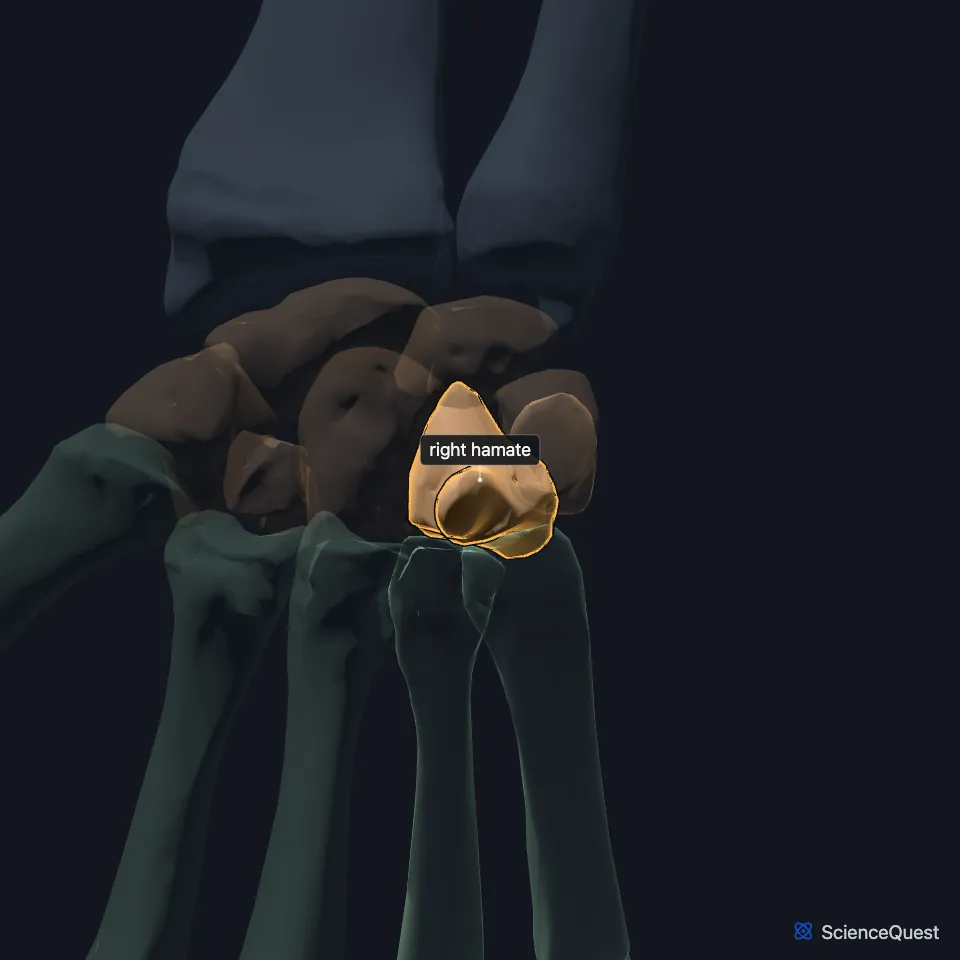
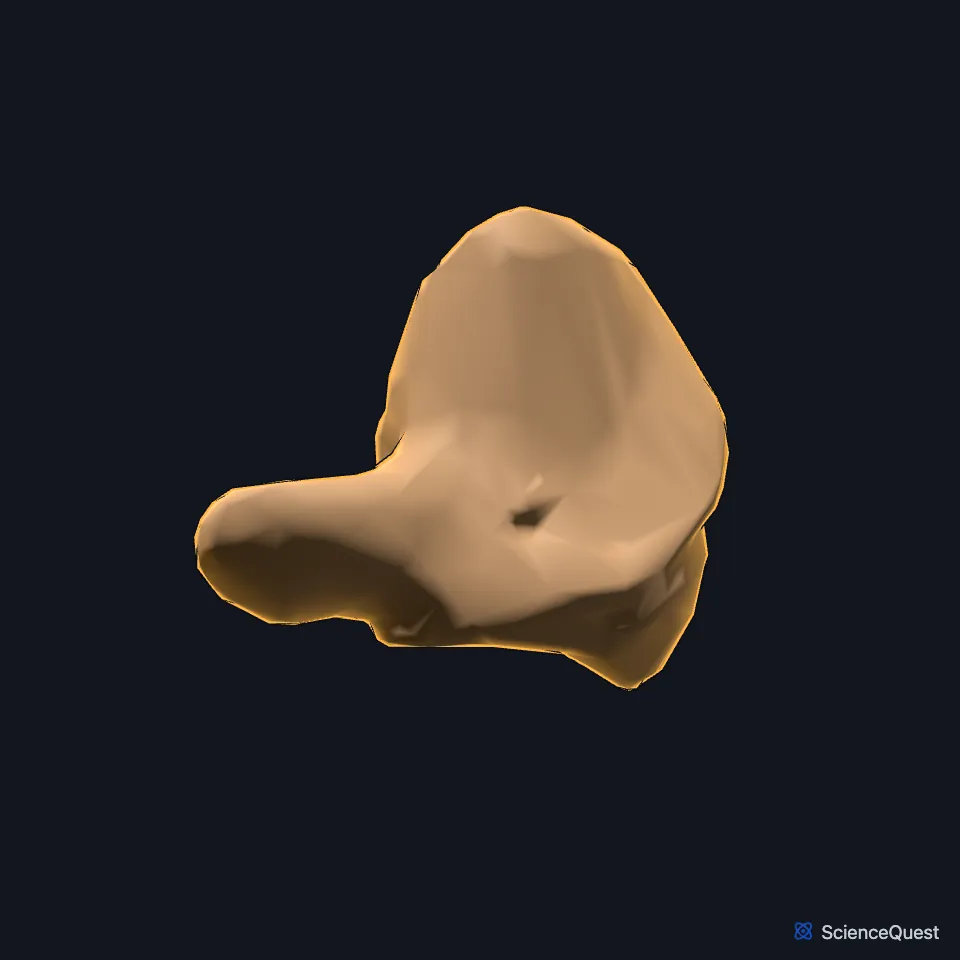
Open it in the Hand and Wrist Skeleton Explorer See it alone in 3D
Where is the hamate?
It sits at the lower, inner corner of the carpus with its base resting on the fourth and fifth metacarpals and its apex pointing up towards the lunate. (Gray’s Anatomy (1918), Hamate bone, p. 227)
Which bones does the hamate meet?
Gray’s Anatomy (1918) lists five: the lunate above, the fourth and fifth metacarpals below, the triquetral on its inner side and the capitate on its outer side. (Gray’s Anatomy (1918), Hamate bone, p. 227; StatPearls, Hamate Fractures)
The ulnar nerve and artery pass through the Guyon canal, between the hook of the hamate and the pisiform. The hook guards them on the canal’s outer side. (StatPearls, Hand Carpal Bones and Guyon Canal Syndrome)
What attaches to the hook of the hamate?
The tip of the hook anchors the transverse carpal ligament and flexor carpi ulnaris, and its inner face takes the little finger’s short flexor and opponens. The flexor tendons run into the palm along a groove on its outer side. (Gray’s Anatomy (1918), Hamate bone, p. 227; StatPearls, Hamate Fractures)
How does the hook of the hamate break?
Hamate fractures make up 2% to 4% of carpal fractures. Hook fractures are frequent in sports that need a firm grip, such as tennis, baseball and golf, from a club or bat driven against the bone. (StatPearls, Hamate Fractures and Hand Carpal Bones)
Patients typically feel pain over the hypothenar eminence and tingling along the ulnar nerve. Treated without surgery, a hook fracture that has not moved fails to unite in half of cases. The standard treatment is to remove the fragment, and excision has returned patients to sport in 6 weeks. (StatPearls, Hand Carpal Bones and Hamate Fractures)
Where the sources differ
Gray’s Anatomy (1918) has the apex of the hamate meeting the lunate. StatPearls’ article on hamate fractures names the capitate, triquetral and the fourth and fifth metacarpals, with the triquetral on its proximal side. Its article on Kienböck disease has the lunate meeting the hamate only occasionally. (Gray’s Anatomy (1918), Hamate bone, p. 227; StatPearls, Hamate Fractures and Kienbock Disease)
| Feature | Detail and source |
|---|---|
| Position | Distal carpal row, little-finger end (StatPearls, Hand Carpal Bones) |
| Articulates with | Lunate, fourth and fifth metacarpals, triquetral, capitate (Gray’s Anatomy (1918), Hamate bone, p. 227) |
| Other name | Unciform bone, in Gray’s Anatomy (1918) (Gray’s Anatomy (1918), Hamate bone, p. 227) |
Touches in this model
Measured on the BodyParts3D meshes: surfaces within 2 mm of the hamate, nearest first, 12 of 15.
- Right capitate in contact
- Right fifth metacarpal bone in contact
- Right triquetral in contact
- Flexor digiti minimi brevis of right hand in contact
- Humeral head of right extensor carpi ulnaris in contact
- Humeral head of right flexor carpi ulnaris in contact
- Humeroulnar head of right flexor digitorum superficialis in contact
- Opponens digiti minimi of right hand in contact
- Right extensor digiti minimi in contact
- Right extensor digitorum in contact
- Right flexor digitorum profundus in contact
- Skin in contact
Sources
Sources read
- StatPearls, Anatomy, Shoulder and Upper Limb, Hand Carpal Bones. Alex Tang; Matthew A. Varacallo. Last update . CC BY-NC-ND 4.0. Read .
- Gray’s Anatomy of the Human Body, 20th US edition (1918), edited by Warren H. Lewis, Osteology, The Carpus, The Hamate Bone (p. 227); 1918 names: unciform bone for hamate, triangular for triquetral, digiti quinti for digiti minimi. Henry Gray; Warren H. Lewis (editor). Public domain. Read .
- StatPearls, Hamate Fractures. Mariano O. Abrego; Adil S. Ahmed; Franco L. De Cicco. Last update . CC BY-NC-ND 4.0. Read .
- StatPearls, Guyon Canal Syndrome. Anterpreet Dua; Erin Gillespie. Last update . CC BY-NC-ND 4.0. Read .
- StatPearls, Kienbock Disease. Layla A. Nasr; Jennifer Koay. Last update . CC BY-NC-ND 4.0. Read .
The values are facts and free to use; this page’s selection and presentation are © 2026 ScienceQuest.