Capitate
The capitate is the largest carpal bone. It sits in the distal row at the centre of the wrist. (StatPearls, Hand Carpal Bones; Gray’s Anatomy (1918), Capitate bone, p. 226)
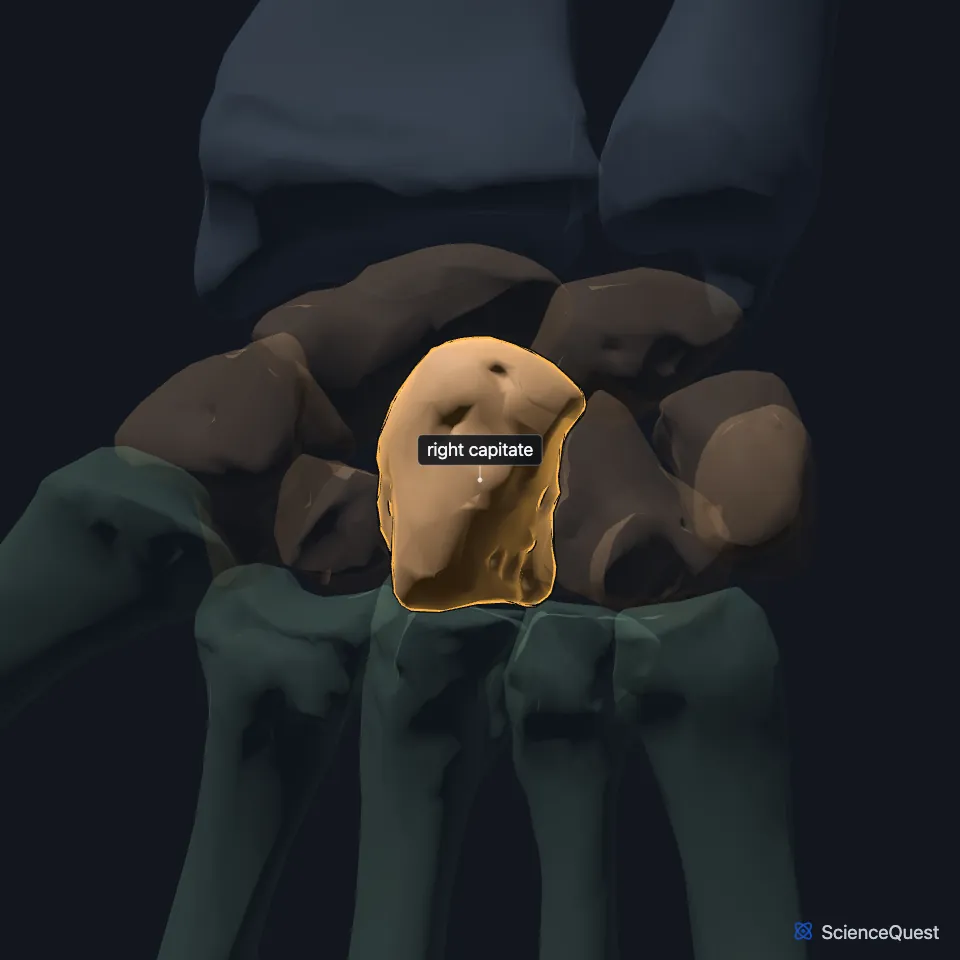
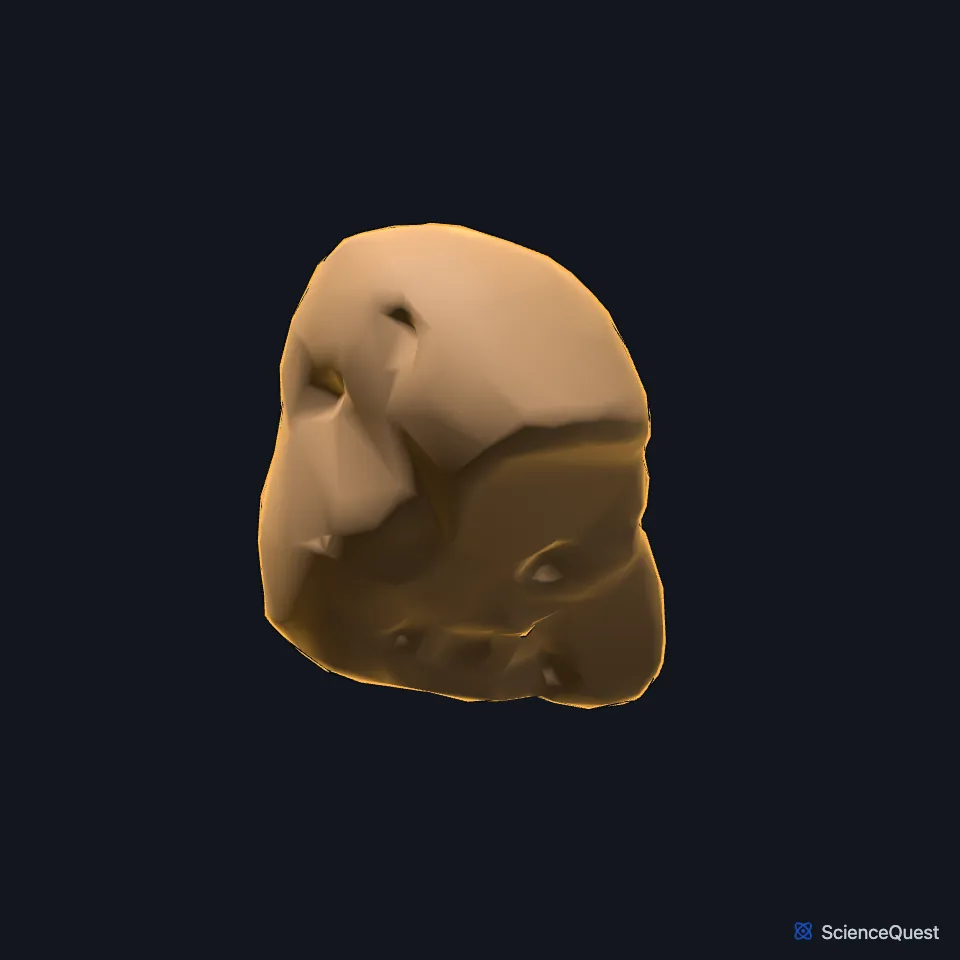
Open it in the Hand and Wrist Skeleton Explorer See it alone in 3D
Where is the capitate?
It is the third bone of the distal row from the thumb side, between the trapezoid and the hamate. Its rounded head rises into the hollow formed by the scaphoid and lunate. (StatPearls, Hand Carpal Bones; Gray’s Anatomy (1918), Capitate bone, p. 226)
What are the parts of the capitate?
Gray’s Anatomy (1918) describes a rounded head above, a narrowed neck and a body below. The lower surface has three facets, for the second, third and fourth metacarpals, the facet for the third being the largest. (Gray’s Anatomy (1918), Capitate bone, p. 226)
Which bones does the capitate meet?
Seven: the scaphoid and lunate above, the second, third and fourth metacarpals below, the trapezoid on its thumb side and the hamate on its little-finger side. (Gray’s Anatomy (1918), Capitate bone, p. 226; StatPearls, Hand Bones)
Several intercarpal ligaments attach to it, and the oblique head of adductor pollicis takes origin from it and from the second and third metacarpals. (StatPearls, Hand Carpal Bones and Hand Bones)
What does the capitate do?
It holds the bases of the index and middle finger metacarpals with the trapezoid, which makes those two metacarpals less mobile than the ring and little finger metacarpals. (StatPearls, Metacarpal Fracture)
The capitate and the hamate are the first carpals to appear as cartilage, early in the eighth week of development. (StatPearls, Hand Carpal Bones)
Why can a broken capitate lose its blood supply?
The capitate is fed by a single vessel inside the bone, as the scaphoid and about 20% of lunates are. StatPearls places those bones apart from the other carpals, which have a lower risk of avascular necrosis after a fracture. (StatPearls, Hand Carpal Bones)
| Feature | Detail and source |
|---|---|
| Position | Distal carpal row, centre of the wrist (Gray’s Anatomy (1918), Capitate bone, p. 226; StatPearls, Hand Carpal Bones) |
| Articulates with | Scaphoid, lunate, second to fourth metacarpals, trapezoid, hamate (Gray’s Anatomy (1918), Capitate bone, p. 226) |
| Other name | Os magnum, in Gray’s Anatomy (1918) (Gray’s Anatomy (1918), Capitate bone, p. 226) |
Touches in this model
Measured on the BodyParts3D meshes: surfaces within 2 mm of the capitate, nearest first, 12 of 14.
- Right hamate in contact
- Right lunate in contact
- Right scaphoid in contact
- Right third metacarpal bone in contact
- Right trapezoid in contact
- Deep head of right flexor pollicis brevis in contact
- Oblique head of right adductor pollicis in contact
- Right extensor digitorum in contact
- Skin in contact
- Right second metacarpal bone 0.7 mm away
- Right extensor carpi radialis brevis 0.7 mm away
- Right fourth metacarpal bone 0.8 mm away
Sources
Sources read
- StatPearls, Anatomy, Shoulder and Upper Limb, Hand Carpal Bones. Alex Tang; Matthew A. Varacallo. Last update . CC BY-NC-ND 4.0. Read .
- Gray’s Anatomy of the Human Body, 20th US edition (1918), edited by Warren H. Lewis, Osteology, The Carpus, The Capitate Bone (pp. 226 to 227); 1918 names: os magnum for capitate, navicular for scaphoid, lesser multangular for trapezoid. Henry Gray; Warren H. Lewis (editor). Public domain. Read .
- StatPearls, Anatomy, Shoulder and Upper Limb, Hand Bones. Daniel G. Arias; Asa C. Black; Matthew A. Varacallo. Last update . CC BY-NC-ND 4.0. Read .
- StatPearls, Metacarpal Fracture. Ryan L. Werntz; Matthew A. Varacallo. Last update . CC BY-NC-ND 4.0. Read .
The values are facts and free to use; this page’s selection and presentation are © 2026 ScienceQuest.