Gibbs Free Energy Calculator
ΔG = ΔH − TΔS: a reaction is spontaneous where ΔG is negative. Solve for ΔG, ΔH, ΔS or T, find the temperature it switches at, and get K from ΔG°.
Calculator
Set it to 0 and solve for T to find the temperature at which the reaction changes direction.
Negative when the reaction gives out heat. From a table: products minus reactants.
Converted to kelvin internally. Tables list ΔH and ΔS at 298.15 K, which is 25 °C.
In joules, as tables give it. The calculator divides by 1000 before combining it with ΔH.
Working, with your numbers
- dG = dH - T dS
- dS = -198.1 J/(mol K) = -0.1981 kJ/(mol K)
- dG = -91.8 - 298.15 x (-0.1981)
- = -91.8 - (-59.064)
- = -32.736 kJ/mol
Values are converted into the units the equation is worked in before the arithmetic.
- At this temperature Spontaneous means ΔG is below zero, so the reaction as written can go forward without outside help. Not spontaneous means the reverse reaction is the one that can. Neither says how fast.
- Spontaneous
- Sign case ΔH negative and ΔS positive: spontaneous at every temperature. ΔH positive and ΔS negative: at none. Both negative: only below ΔH ÷ ΔS. Both positive: only above it.
- ΔH < 0, ΔS < 0
- Spontaneous when ΔG = 0 where T = ΔH ÷ ΔS, with ΔS in kJ/(mol·K). That temperature exists only when ΔH and ΔS share a sign, and it assumes neither changes with temperature.
- Below 463.4 K (190.3 °C)
- K, if ΔG is ΔG° K = e^(−ΔG°/RT). It means something only when ΔH and ΔS are standard values from a table, so that ΔG is ΔG°. It has no units: each gas enters as its pressure in bar and each solute as its concentration in mol/L, while pure solids and liquids drop out.
- 5.43 × 10⁵
Citing this tool
Last updated . Add the date you accessed it as well, which a citation of a page that can change asks for. If a specific result matters, cite the permalink from the tool’s share row instead of this page: it reproduces the exact parameters.
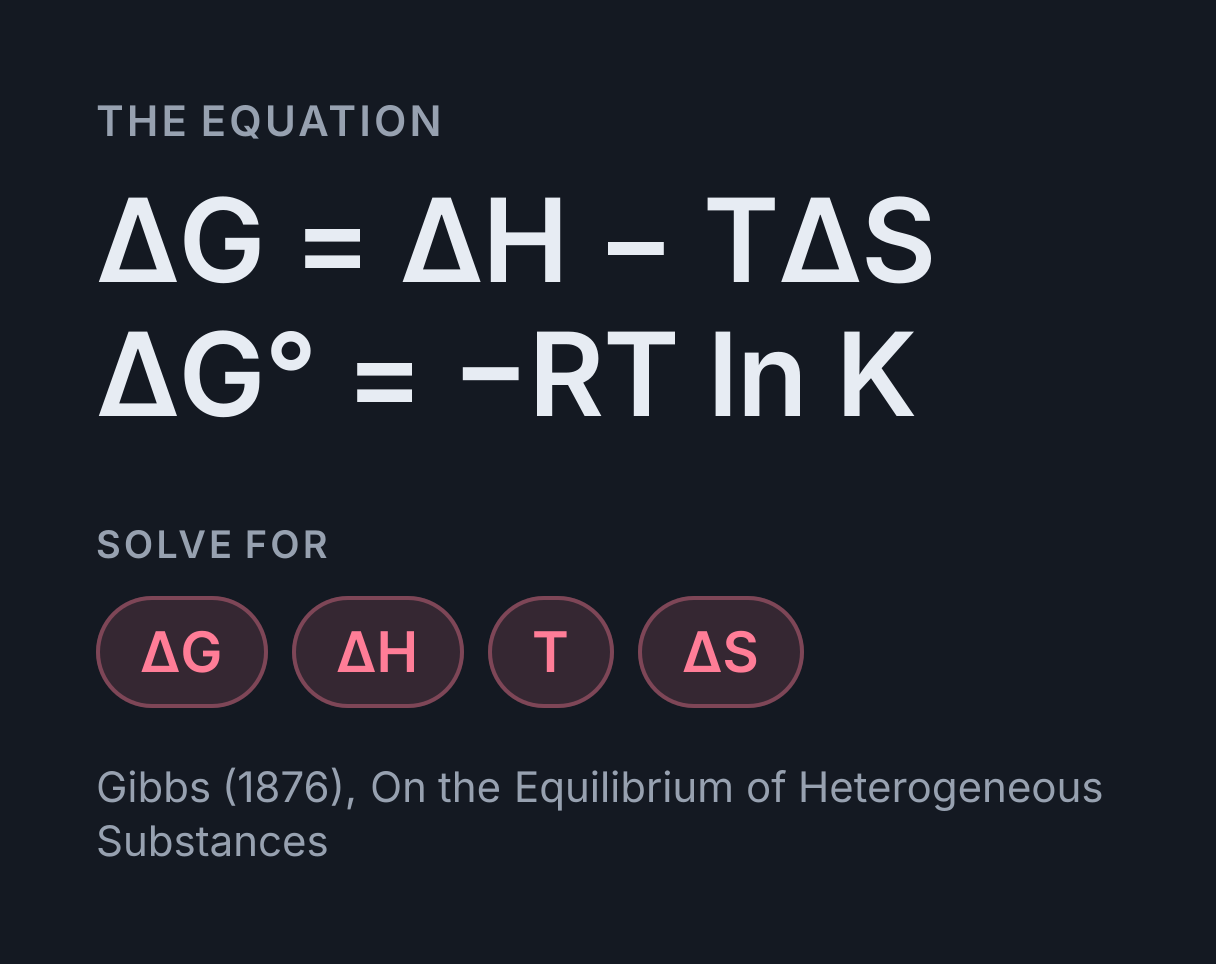
The equation
Gibbs (1876), On the Equilibrium of Heterogeneous Substances
Gibbs free energy decides whether a reaction goes
The Gibbs free energy change of a reaction is ΔG = ΔH − TΔS:
the enthalpy change minus the absolute temperature times the entropy
change. A negative ΔG means the reaction can go forward on its own at
that temperature, a positive ΔG means the reverse reaction is the one
that can, and zero means equilibrium. For the ammonia synthesis loaded
above, N₂ + 3H₂ → 2NH₃ at 298.15 K,
ΔG = −91.8 − 298.15 × (−0.1981) = −32.7 kJ/mol, so it is
spontaneous.
Enter any three of the four values and choose Solve for this on the fourth. ΔH goes in kJ/mol and ΔS in J/(mol·K), the units data tables use, and the calculator divides ΔS by 1000 before combining them, which the working shows. To find the temperature at which a reaction becomes spontaneous, set ΔG to 0 and solve for T. The readouts say whether the reaction is spontaneous at the temperature entered, which of the four sign cases it falls in, the temperatures at which it is spontaneous, and the equilibrium constant a standard ΔG° implies.
ΔG weighs two tendencies against each other. ΔH is the heat the reaction
gives out or takes in, and giving out heat favours a reaction. ΔS
measures how much more spread out matter and energy become, and
spreading out favours it too, by an amount the temperature multiplies.
That is why the temperature matters at all: it sets how much the entropy
term counts against the enthalpy term. IUPAC calls the quantity the Gibbs
energy, G = H − TS, after Josiah Willard Gibbs, who defined
it in 1876. UK A-level courses say feasible where this page says
spontaneous: a reaction is feasible when ΔG is zero or negative.
The four sign cases
Because only the entropy term changes with temperature, the signs of ΔH
and ΔS settle most of the question before any arithmetic. Where they
favour the same direction, no temperature can change the answer. Where
they pull against each other, one temperature, T = ΔH ÷ ΔS,
divides the range where the reaction is spontaneous from the range where
it is not.
| ΔH | ΔS | Spontaneous | Example |
|---|---|---|---|
| Negative | Positive | At every temperature | 2C + O₂ → 2CO: −221.0 kJ/mol, +178.7 J/(mol·K) |
| Positive | Negative | At no temperature | 3O₂ → 2O₃: +285.4 kJ/mol, −137.8 J/(mol·K) |
| Negative | Negative | Below ΔH ÷ ΔS | N₂ + 3H₂ → 2NH₃: −91.8 kJ/mol, −198.1 J/(mol·K), below 463 K |
| Positive | Positive | Above ΔH ÷ ΔS | H₂O(l) → H₂O(g): +44.01 kJ/mol, +118.8 J/(mol·K), above 370 K |
Carbon burning to carbon monoxide gives out heat and turns one molecule of gas into two, so both terms favour it. Oxygen turning into ozone takes in heat and packs three molecules into two, so both oppose it, and ozone forms only where energy is put in from outside, as ultraviolet light does in the upper atmosphere. Freezing, condensing and reactions that give out heat while turning more molecules of gas into fewer are the third case; melting, boiling and decompositions that take in heat and release gas are the fourth.
Worked example: ammonia synthesis
For N₂ + 3H₂ → 2NH₃, the tables give
ΔH° = 2 × (−45.9) = −91.8 kJ/mol and
ΔS° = 2 × 192.8 − 191.6 − 3 × 130.7 = −198.1 J/(mol·K). Is
it spontaneous at 25 °C, and up to what temperature?
-
Convert ΔS first:
−198.1 J/(mol·K) ÷ 1000 = −0.1981 kJ/(mol·K). -
At 298.15 K,
TΔS = 298.15 × (−0.1981) = −59.06 kJ/mol, soΔG° = −91.8 − (−59.06) = −32.74 kJ/mol. Spontaneous, and the readout givesK = 5.43 × 10⁵. -
The crossover is
T = ΔH ÷ ΔS = −91.8 ÷ (−0.1981) = 463.4 K, about 190 °C. Below it ΔG° is negative; above it the entropy term wins, and ammonia tends to break back down into nitrogen and hydrogen.
Industrial plants still run at 400 to 500 °C, well above the crossover,
because the reaction is too slow at lower temperatures even over a
catalyst, and they use pressures of about 150 to 250 atm to push the
equilibrium back towards ammonia (OpenStax Chemistry 2e, section 13.3).
At 450 °C the calculator gives ΔG° = +51.5 kJ/mol and
K = 1.92 × 10⁻⁴. The NIST-JANAF tables, which follow ΔH and
ΔS as they change with temperature, give about +60 kJ/mol there and a K
near 5 × 10⁻⁵, about four times smaller: the size of error to expect from
298 K values used more than 400 K away.
Joules against kilojoules
Tables give enthalpies in kJ/mol and entropies in J/(mol·K), so ΔS has to
be divided by 1000 before TΔS is taken away from ΔH. Leave that out and
the ammonia example gives −91.8 − 298.15 × (−198.1) = +58,972:
the entropy term is a thousand times too big, and even the sign of ΔG
comes out wrong. That one is easy to spot. For a reaction with a small
ΔS the wrong answer can look ordinary: diamond turning into graphite,
with ΔH = −1.89 kJ/mol and ΔS = +3.36 J/(mol·K), comes out at
−1003.7 kJ/mol instead of −2.9. The calculator takes ΔS in joules and
converts it, and it warns when ΔS is under 1 J/(mol·K), which is what a
value already converted to kJ/(mol·K) looks like.
ΔG° and the equilibrium constant
When ΔH and ΔS are standard values, as in a data table, the ΔG they give
is the standard ΔG°, with every gas at 1 bar and every dissolved species
at 1 mol/L, and it fixes the equilibrium constant:
ΔG° = −RT ln K, or K = e^(−ΔG°/RT) with
R = 8.314 J/(mol·K). A negative ΔG° gives K above 1 and a positive one K
below 1, and at 298.15 K every 5.71 kJ/mol is a factor of ten in K.
A positive ΔG° does not mean nothing happens. Water evaporating at 25 °C
has ΔG° = 44.01 − 298.15 × 0.1188 = +8.59 kJ/mol, yet
puddles dry. The K that goes with it is 0.0313, and because liquid water
counts as 1 in K, that is the pressure of water vapour at equilibrium in
bar: 3.13 kPa, close to the 3.17 kPa measured at 25 °C. Evaporation
outpaces condensation until the air above the water holds that much
vapour.
Real mixtures are rarely at standard conditions, and
ΔG = ΔG° + RT ln Q corrects for that, Q being the reaction
quotient built from the actual pressures and concentrations. A cell
potential gives ΔG° as well, through ΔG° = −nFE°, which the
standard reduction potentials
page works through for the Daniell cell.
Common mistakes
- Mixing joules and kilojoules. ΔS from a table is in J/(mol·K) and ΔH in kJ/mol. Divide ΔS by 1000 before multiplying by T, or the entropy term swamps everything else.
- Using Celsius as if it were kelvin. Typing 25 where 298.15 K is meant gives ΔG = −86.8 kJ/mol for ammonia synthesis instead of −32.7, a number that looks just as believable. The unit menu beside T is the guard.
- Reading ΔG° as ΔG. ΔG° describes every species at its standard state. Whether a particular mixture reacts depends on ΔG = ΔG° + RT ln Q, which can have the opposite sign.
- Forgetting that the numbers belong to the equation as written. Halving N₂ + 3H₂ → 2NH₃ halves ΔH, ΔS and ΔG and takes the square root of K; reversing it flips every sign and turns K into 1/K.
- Taking spontaneous to mean fast. Diamond turning into graphite has ΔG° = −2.9 kJ/mol at 25 °C and does not happen on any human timescale. How fast a reaction goes depends on its activation energy, which the Arrhenius equation calculator puts numbers on and the collision theory simulator shows.
- Trusting 298 K values far from 298 K. ΔH and ΔS drift with temperature, and the further a question sits from 25 °C the more the answer is an estimate.
What this calculator does not cover
It holds ΔH and ΔS fixed as the temperature changes, the approximation textbooks make. Water shows its size: its 25 °C values put the boiling point at 370.5 K, but under 1 bar water boils at 99.6 °C, which is 372.8 K. By then the enthalpy of vaporisation has fallen from 44.01 to 40.67 kJ/mol (OpenStax Chemistry 2e, section 10.3) and the entropy of vaporisation from 118.8 to 109.1 J/(mol·K), and their ratio has moved with them. The calculator warns when the temperature is more than 100 K from 298.15 K.
It does not look values up or add them for you. ΔH and ΔS for a reaction are products minus reactants from a table such as OpenStax Appendix G or the NIST Chemistry WebBook; in the lab, ΔH comes from heat measured in a calorimeter, which the calorimetry calculator works out. At a melting or boiling point ΔG = 0, so ΔS = ΔH ÷ T, and the latent heat calculator gives the heat that phase change takes. It also works only with the values entered, not with RT ln Q, and it says nothing about rate.
Converting units first? Use the temperature conversion table.
Worked examples
Each one runs through the calculator above, so the arithmetic here is the arithmetic it does.
What boiling point of water do ΔH and ΔS of vaporisation predict?
- T = dH / dS, where dG = 0
- dS = 118.8 J/(mol K) = 0.1188 kJ/(mol K)
- T = 44.01 / 0.1188
- = 370.45 K (97.3 C)
370.5 K, or 97.3 °C, the temperature at which ΔG = 0 and liquid water is in balance with its vapour at 1 bar. Water really boils at 99.6 °C under 1 bar and 100.0 °C under 1 atm, because these ΔH and ΔS are 25 °C values and both shrink as water warms: ΔH of vaporisation is 40.67 kJ/mol at the boiling point.
Why does water evaporate at 25 °C when its ΔG° of vaporisation is positive?
- dG = dH - T dS
- dS = 118.8 J/(mol K) = 0.1188 kJ/(mol K)
- dG = 44.01 - 298.15 x 0.1188
- = 44.01 - 35.42
- = 8.5898 kJ/mol
+8.59 kJ/mol, which means only that water vapour at 1 bar would condense at 25 °C, not that nothing evaporates. K = 0.0313, and since liquid water counts as 1 in K, that is the vapour pressure at equilibrium in bar: 3.13 kPa, against 3.17 kPa measured. Puddles dry because the air around them holds less vapour than that.
What is the entropy change when ice melts at 0 °C?
- dS = (dH - dG) / T
- = (6.01 - 0) / 273.15
- = 0.022003 kJ/(mol K)
- = 22.003 J/(mol K)
22.0 J/(mol·K). At the melting point ice and water are in equilibrium, so ΔG = 0 and ΔS = ΔH ÷ T: 6.01 kJ/mol over 273.15 K is 0.0220 kJ/(mol·K), which the calculator turns into joules, the unit entropy tables use. Above 0 °C the TΔS term wins and ice melts; below it, water freezes.
Practise this with Thermodynamics Practice Problems, questions generated from this calculator and 8 other calculators in Thermodynamics.
Common questions
What is the Gibbs free energy equation?
ΔG = ΔH − TΔS, where ΔH is the enthalpy change, T the absolute temperature in kelvin and ΔS the entropy change. A negative ΔG means the reaction can go forward on its own at that temperature. Tables give ΔS in J/(mol·K) and ΔH in kJ/mol, so divide ΔS by 1000 first: for ammonia synthesis at 298.15 K, ΔG = −91.8 − 298.15 × (−0.1981) = −32.7 kJ/mol.
How do ΔH and ΔS decide whether a reaction is spontaneous?
Through their signs. With ΔH negative and ΔS positive a reaction is spontaneous at every temperature, and with ΔH positive and ΔS negative at none. When both are negative it is spontaneous only below T = ΔH/ΔS, and when both are positive only above it, because the temperature scales the entropy term and so decides which of the two wins.
How do you find the temperature at which a reaction becomes spontaneous?
Set ΔG to zero and solve ΔH − TΔS = 0, which gives T = ΔH/ΔS with ΔS in kJ/(mol·K). That is the temperature where the reaction changes direction, and it exists only when ΔH and ΔS have the same sign. For water boiling, 44.01 kJ/mol ÷ 0.1188 kJ/(mol·K) = 370.5 K, a few kelvin below the real boiling point because values measured at 25 °C drift as water warms.
How do you calculate ΔG° from an equilibrium constant?
Use ΔG° = −RT ln K, with R = 8.314 J/(mol·K) and T in kelvin, which gives ΔG° in J/mol. For silver chloride, whose solubility product is 1.74 × 10⁻¹⁰ at 25 °C, ΔG° = −8.314 × 298.15 × ln(1.74 × 10⁻¹⁰) = +55.7 kJ/mol. Going the other way, K = e^(−ΔG°/RT), so a negative ΔG° gives K above 1 and a positive one K below 1.
Does a negative ΔG mean a reaction will happen quickly?
No. ΔG says whether a reaction can go and in which direction, not how fast. Diamond turning into graphite has a ΔG° of about −2.9 kJ/mol at 25 °C, yet diamonds do not change on any human timescale, because the carbon atoms would first have to cross a large energy barrier that ΔG does not include. How fast a reaction goes depends on its activation energy, a separate quantity.