Nernst Equation Calculator
Calculate a cell potential with the Nernst equation, E = E° − (RT/nF) ln Q, from two half-reactions or from E°, n and Q, with ΔG°, K and the working.
Calculator
Positive, so copper does not displace hydrogen from acid. The cathode of the Daniell cell and half of almost every worked example.
Pick it as the table writes it, as a reduction. The calculator reverses it, so do not change the sign of its potential yourself.
The Daniell cell anode, and the sacrificial metal in galvanising: zinc corrodes in preference to the iron it covers because it sits below iron here.
Left out of Q as pure solids and liquids, at activity 1: Zn(s), Cu(s).
- Cell potential, E E = E° − (RT/nF) ln Q: the open-circuit voltage at these concentrations and this temperature.
- 1.041 V
- Standard potential, E° E°cathode − E°anode, both read as reductions: the voltage with every species at 1 mol/L or 1 bar.
- 1.10 V
- Electrons, n Electrons transferred in the balanced reaction as written, the lowest common multiple of the two half-reactions.
- 2
- Reaction quotient, Q Products over reactants, each to the power of its coefficient, with solids and water left out.
- 100
- ΔG° −nFE°, per mole of the reaction as written.
- -212.3 kJ/mol
- Equilibrium constant, K exp(nFE°/RT): the value of Q at which E falls to zero.
- 1.54 × 10³⁷
- ΔG −nFE, which is also ΔG° + RT ln Q. Negative means the reaction runs as written.
- -200.9 kJ/mol
- Nernst slope How far E moves for each tenfold change in Q: 2.303RT/nF.
- 29.58 mV per decade
E is positive, so the reaction runs as written and ΔG is negative: as a galvanic cell it would deliver current.
- Overall reaction
Zn(s) + Cu²⁺(aq) → Zn²⁺(aq) + Cu(s)- Reaction quotient
Q = [Zn²⁺] / [Cu²⁺]- Cell diagram
Zn(s) | Zn²⁺(aq) || Cu²⁺(aq) | Cu(s)
Working, step by step
- E°cell = 0.34 - (-0.76) = 1.1 V
- Electrons balance with the cathode half-reaction taken once and the anode half-reaction once, so n = 2.
- Overall: Zn(s) + Cu²⁺(aq) → Zn²⁺(aq) + Cu(s)
- T = 25 + 273.15 = 298.15 K
- RT/nF = 8.3145 x 298.15 / (2 x 96,485) = 0.012846 V
- Q = [Zn²⁺] / [Cu²⁺]
- Q = 1 / 0.01 = 100
- ln Q = 4.6052
- E = 1.1 - 0.012846 x 4.6052 = 1.0408 V
- ΔG° = -2 x 96,485 x 1.1 / 1000 = -212.27 kJ/mol
- ln K = 1.1 / 0.012846 = 85.628
- K = exp(85.628) = 1.5406 × 10³⁷
- ΔG = -2 x 96,485 x 1.0408 / 1000 = -200.85 kJ/mol
Concentrations in mol/L and pressures in bar stand in for activities, and pure solids and liquids are left out of Q. The E° values are the table’s, at 298.15 K.
Citing this tool
Last updated . Add the date you accessed it as well, which a citation of a page that can change asks for. If a specific result matters, cite the permalink from the tool’s share row instead of this page: it reproduces the exact parameters.
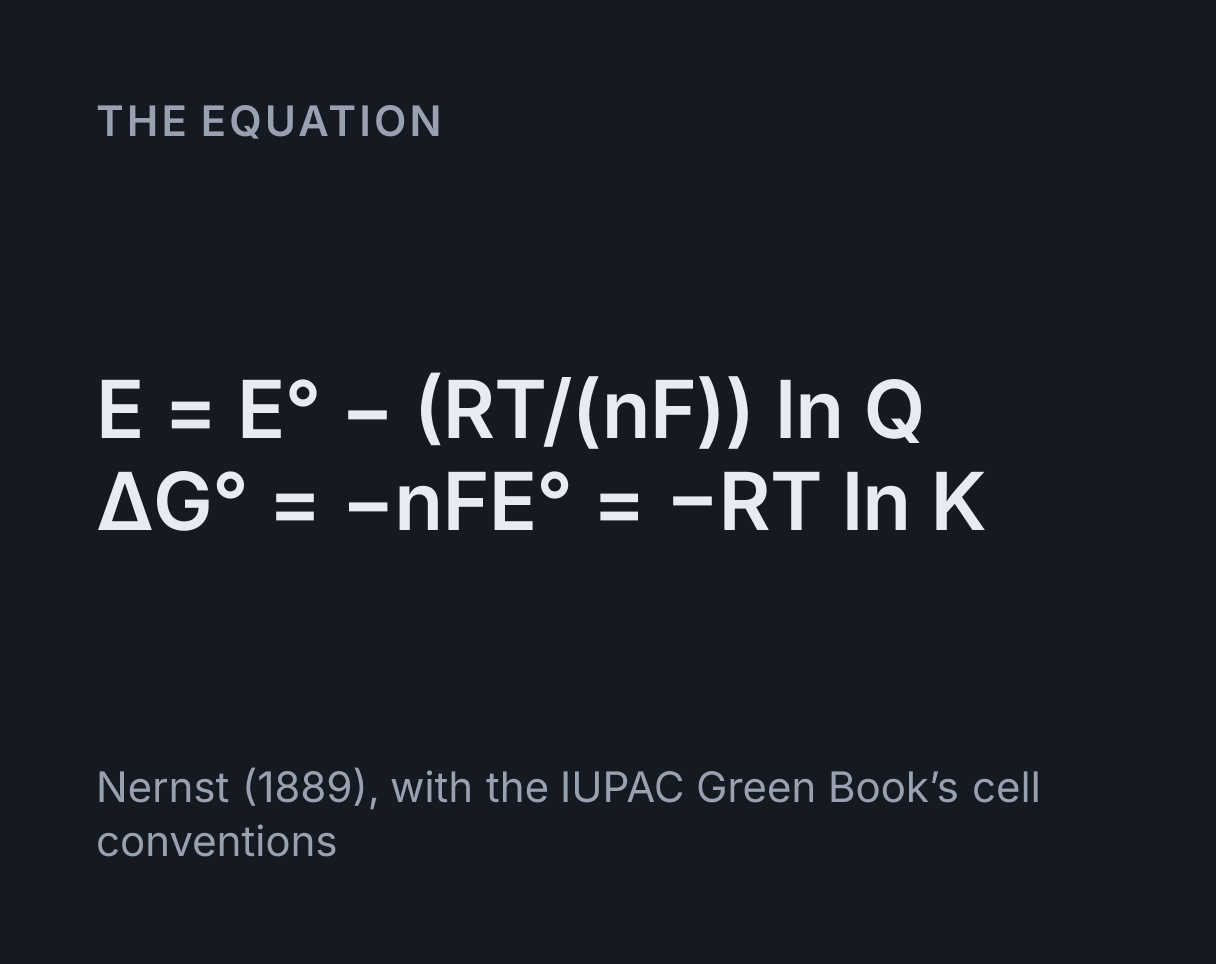
The equation
Nernst (1889), with the IUPAC Green Book’s cell conventions
What the Nernst equation calculates
The Nernst equation gives the voltage of an electrochemical cell when its concentrations are
not standard: E = E° − (RT/nF) ln Q, where E° is the standard cell potential, n
the number of electrons transferred, R the gas constant, T the temperature in kelvin, F the
Faraday constant and Q the reaction quotient. At 25 °C, 2.303RT/F = 0.05916 V,
so the equation is often written E = E° − (0.05916/n) log Q.
The same standard potential gives the reaction’s free energy and its equilibrium constant:
ΔG° = −nFE°, and since ΔG° = −RT ln K,
ln K = nFE°/RT. The equation is Walther Nernst’s, from 1889; the sign
conventions here are those of the IUPAC Green Book (Quantities, Units and Symbols in Physical
Chemistry, 3rd edition, section 2.13), in which the cell potential is the potential of the
right-hand electrode minus that of the left, the same rule the NCERT Class 12 chemistry textbook uses.
How to use the calculator
Pick the cathode, where reduction happens, and the anode, where oxidation happens, from the
42 half-reactions in the
table of standard reduction potentials.
Choose both exactly as the table writes them, as reductions. The calculator subtracts,
E°cell = E°cathode − E°anode, balances the electrons with the lowest common
multiple of the two electron counts, writes the overall reaction, and builds Q from the
species that belong in it.
Then give the concentration of every dissolved species in mol/L and the pressure of every gas in bar, one box per species at each electrode, and the temperature. Solids and water have an activity of 1 and never appear in Q, so they get no box; the line under the boxes lists them. An H⁺ box shows the pH it corresponds to. If a textbook gives a slightly different E° for a couple, use your own E° values. If you already have E°, n and Q as numbers, choose E° and Q as numbers instead.
The results are the cell potential E, E°, n, Q, ΔG°, K, ΔG under your conditions, and the Nernst slope in millivolts per tenfold change in Q, with the overall equation, Q written out, the cell diagram and the working line by line. A positive E means the reaction runs as written; a negative one means it runs the other way, and Swap cathode and anode writes it the way it goes.
Worked example: a Daniell cell with dilute copper
The calculator opens on this cell: copper ions at 0.010 mol/L at the cathode, zinc ions at
1.0 mol/L at the anode, and 25 °C. The overall reaction is Zn(s) + Cu²⁺(aq) → Zn²⁺(aq) + Cu(s),
with E° = 0.34 − (−0.76) = +1.10 V and n = 2.
The reaction quotient is Q = [Zn²⁺] / [Cu²⁺] = 1.0 / 0.010 = 100, and zinc and
copper metal are left out. At 298.15 K,
RT/nF = 8.3145 × 298.15 / (2 × 96,485) = 0.012846 V and
ln 100 = 4.6052, so
E = 1.10 − 0.012846 × 4.6052 = 1.0408 V. In base-ten form it is
1.10 − (0.0592/2) × 2 = 1.0408 V: two decades of Q at 29.6 mV each.
The free energy follows. ΔG° = −2 × 96,485 × 1.10 = −212.27 kJ/mol, with F in
C/mol and E° in volts giving joules, divided by 1000. The concentration term is
RT ln Q = 8.3145 × 298.15 × 4.6052 = 11.42 kJ/mol, so
ΔG = −212.27 + 11.42 = −200.85 kJ/mol, which is also −nFE. For the equilibrium
constant, ln K = 1.10 / 0.012846 = 85.63, so K = exp(85.63) = 1.54 × 10³⁷ and log K = 37.19:
at equilibrium there are about 10³⁷ zinc ions in solution for every copper ion.
Diluting the copper a hundredfold costs 59 mV, which is why a cell’s voltage stays nearly flat for most of its life. Even with 99 percent of the copper used, from both ions starting at 1 mol/L, the cell still gives 1.032 V.
The NCERT textbook rounds the slope to 0.059 V, so it gets
log K = 2 × 1.10 / 0.059 = 37.29 and it quotes K = 2 × 10³⁷. The unrounded
0.05916 V gives 37.19 and 1.54 × 10³⁷. Rounding the slope moves K by about a quarter, and E by
less than a millivolt, which is why a textbook answer for E agrees with this calculator and its
K may not.
Worked example: magnesium against silver ions
NCERT’s Example 2.1 is Mg(s) + 2Ag⁺(0.0001 M) → Mg²⁺(0.130 M) + 2Ag(s). Choose Ag⁺/Ag as the
cathode and Mg²⁺/Mg as the anode: E° = 0.80 − (−2.37) = 3.17 V and n = 2. Two
silver ions take part, so their concentration is squared:
Q = [Mg²⁺] / [Ag⁺]² = 0.130 / (0.0001)² = 1.3 × 10⁷. Then
E = 3.17 − (0.05916/2) × log(1.3 × 10⁷) = 3.17 − 0.02958 × 7.1139 = 2.9596 V,
the textbook’s 2.96 V.
E°, ΔG° and K are one number three ways
ΔG° = −nFE° = −RT ln K, so a positive E° means a negative ΔG° and a K above 1,
and each extra 59 mV per electron multiplies K by ten at 25 °C. The growth is steep: with
n = 2, 0.10 V already makes K about 2,400, and 1.00 V makes it 6.4 × 10³³. That is why a cell
with a volt or more of E° runs essentially to completion.
E is a property of the cell, not of how the equation is written. Double every coefficient and n doubles, ΔG° doubles and K is squared, but E and E° stay the same. The calculator keeps the equation as the electrons balanced it, and says so in the working in the only cells where every coefficient could be divided down: a couple in acid against the same couple in base, where the reaction is neutralisation and log K per mole of water is 14.03, which is pKw. The table quotes its potentials to two decimals, so that lands 0.03 above the measured pKw of 14.00 at 25 °C.
The Gibbs free energy calculator reaches
ΔG° the other way, from ΔH and ΔS, and uses the same ΔG° = −RT ln K to get K.
Why pH moves some potentials
Any half-reaction with H⁺ or OH⁻ in it depends on pH, because those ions enter Q. The oxygen couple, O₂ + 4H⁺ + 4e⁻ → 2H₂O, has as many protons as electrons, so its potential falls by 59 mV per pH unit at 25 °C: from 1.23 V at pH 0 to 0.82 V at pH 7. Permanganate in acid takes eight protons for five electrons, so it falls by about 95 mV for every unit of pH, and dichromate, fourteen protons for six electrons, faster still. A hydrogen electrode in a solution of pH 10 sits at −0.59 V against the standard one.
To set an acid concentration from a pH, or the other way round, the pH calculator gives [H⁺] for strong and weak acids.
The Nernst equation for one ion across a membrane
Physiology uses the same equation with no redox reaction at all: the equilibrium potential of
a single ion across a membrane, E = (RT/zF) ln([ion]out / [ion]in), with z the
ion’s charge. At body temperature, 310.15 K, the slope is 61.54 mV per tenfold ratio for a
singly charged ion, against 59.16 mV at 25 °C. The
resting membrane potential simulator
computes it for potassium, sodium and chloride, and combines them with the Goldman equation.
What this does not cover
Concentrations and pressures stand in for activities, which is exact only at infinite dilution. In a real solution ions shield each other and the effective concentration is lower, by an amount that grows with ionic strength and that this calculator does not compute. The liquid junction potential between the two solutions is taken as zero, as a salt bridge aims to make it, and no current flows, so E is the open-circuit voltage with no internal resistance or overpotential.
The E° values are the table’s, at 298.15 K, and are used unchanged at any temperature you
enter. A standard potential does change with temperature, by dE°/dT = ΔS°/nF,
but the table carries no entropies, so only RT/nF, and with it the correction and K, follows
the temperature. Outside 0 to 100 °C the calculator warns that water is not a liquid at
atmospheric pressure.
The potentials say which way a reaction runs, never how fast. Sodium, potassium, lithium, calcium and barium react with water rather than serving as electrodes in it, so a cell that puts one of them in an aqueous solution is a calculation rather than something to build. To watch a cell run down as the current flows, with the electrodes gaining and losing mass, the galvanic cell simulator works through the same Nernst equation in time.
Common mistakes
- Reversing the anode’s sign before subtracting. The table already gives both values as reductions, and the subtraction does the reversal: 0.34 − 0.76 = −0.42 V turns the Daniell cell’s +1.10 V into −0.42 V.
- Multiplying E° by the coefficients. A potential is an intensive quantity: taking a half-reaction twice doubles its electrons and its ΔG°, but not its E°.
- Taking n from one half-reaction. n is the number of electrons in the balanced overall reaction, which is 6 for aluminium against copper, not 2 or 3.
- Putting solids, pure liquids or water into Q. Their activity is 1.
- Dropping the coefficients from the exponents. Silver against copper is Cu(s) + 2Ag⁺(aq) → Cu²⁺(aq) + 2Ag(s), so Q = [Cu²⁺] / [Ag⁺]².
- Using 0.05916 with ln, or RT/nF with log. The 0.05916 V form already contains the factor ln 10 and goes with base-ten logarithms.
- Leaving the temperature in Celsius. RT/nF needs kelvin: 25 °C is 298.15 K.
The constants are the exact SI values: the gas constant R = 8.314462618 J/(mol·K) and the Faraday constant F = 96,485.33212 C/mol, the Avogadro constant times the elementary charge.
Converting units first? Use the temperature conversion table.
Common questions
What is the Nernst equation?
E = E° − (RT/nF) ln Q: the voltage of an electrochemical cell under any conditions, from its standard potential E°, the number of electrons transferred n, the temperature T in kelvin and the reaction quotient Q. R is the gas constant and F the Faraday constant. At 25 °C it becomes E = E° − (0.05916/n) log Q, so a one-electron cell loses 59 mV for every tenfold rise in Q.
How do you calculate a cell potential from two half-reactions?
Subtract the anode’s standard reduction potential from the cathode’s, both read from the table as reductions: E°cell = E°cathode − E°anode. For the Daniell cell that is 0.34 − (−0.76) = +1.10 V. Then correct for concentration with the Nernst equation: with copper ions at 0.010 mol/L and zinc ions at 1 mol/L, Q = 100 and E = 1.10 − 0.0296 × 2 = 1.041 V.
How do you get the equilibrium constant from a cell potential?
From ln K = nFE°/RT, which is log K = nE°/0.05916 at 25 °C. The Daniell cell, with n = 2 and E° = 1.10 V, has log K = 37.19 and K = 1.54 × 10³⁷. When the reaction has run until Q equals K, the cell potential is zero and the cell can do no more work.
How do you find ΔG from a cell potential?
Multiply the potential by −nF: ΔG° = −nFE° under standard conditions and ΔG = −nFE under any others. For the Daniell cell ΔG° = −2 × 96,485 × 1.10 = −212.27 kJ/mol. A positive potential always goes with a negative ΔG, so the reaction as written is spontaneous.
What goes into the reaction quotient Q?
Every dissolved species at its concentration in mol/L and every gas at its pressure in bar, each raised to the power of its coefficient, products over reactants. Pure solids, pure liquids and the water the reaction happens in are left out, because their activity is 1. For Mg(s) + 2Ag⁺(aq) → Mg²⁺(aq) + 2Ag(s), Q = [Mg²⁺]/[Ag⁺]².
Why does the 0.059 in my textbook give a different K?
Because 0.059 V is a rounding of 2.303RT/F, which is 0.05916 V at 25 °C. The rounding moves E by less than a millivolt but moves K a long way, since K is ten to the power of a large number: for the Daniell cell 0.059 gives log K = 37.29 and K = 2 × 10³⁷, where 0.05916 gives 37.19 and 1.54 × 10³⁷.