Latent Heat Calculator
Calculate the heat a phase change needs from mass and specific latent heat, with the temperature rise the same energy would have produced.
Calculator
Water: 334 to melt, 2260 to boil. Ethanol 108 and 841. Lead 23 and 859.
Working, with your numbers
- Q = m x L
- = 100 g x 334 J/g
- = 33,400 J = 33.4 kJ
Values are converted into the units the equation is worked in before the arithmetic.
- Energy per kilogram Specific latent heat restated in the SI form tables usually quote.
- 334 kJ/kg
- Same energy would warm this water by Using c = 4.184 J/(g·K). This is why a phase change stalls a heating curve.
- 79.83 K
- At 2 kW, time taken A domestic kettle element. Melting is slower than people expect.
- 16.7 s
Citing this tool
Last updated . Add the date you accessed it as well, which a citation of a page that can change asks for. If a specific result matters, cite the permalink from the tool’s share row instead of this page: it reproduces the exact parameters.
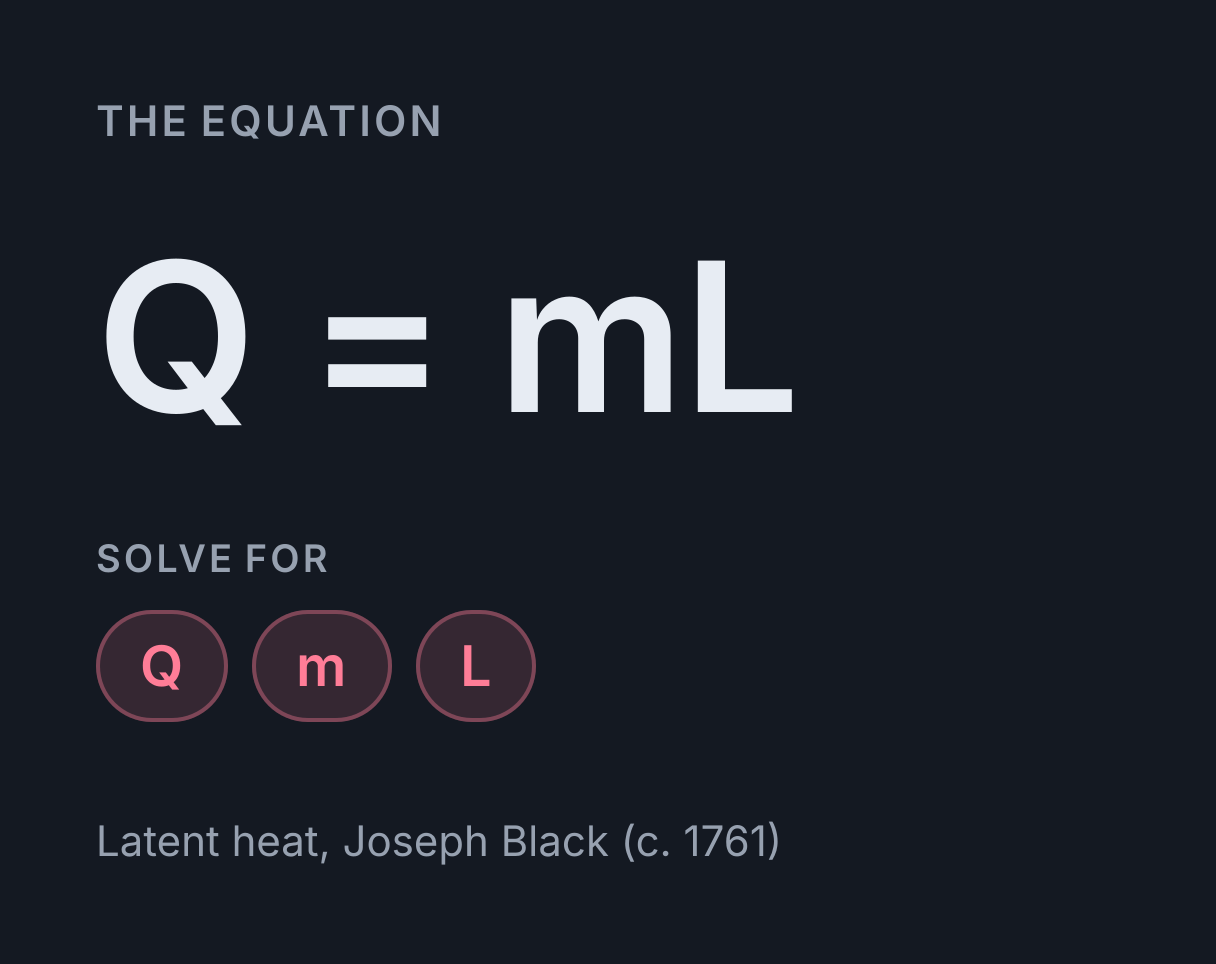
The equation
Latent heat, Joseph Black (c. 1761)
Latent heat is the energy a phase change hides
Heat a block of ice and the thermometer climbs steadily until it reaches 0 °C, and then it stops. It stays at 0 °C while the ice turns to water, and only starts climbing again once the last of the solid has gone. The energy has not stopped arriving. It is going into pulling the crystal lattice apart instead of into faster molecular motion, and temperature only measures the motion.
That hidden energy is the latent heat, and for a given substance it is proportional to how much of it changes state. Melting one gram of ice takes 334 joules, so melting a hundred grams takes 33.4 kilojoules. There is no temperature term in the equation at all, because there is no temperature change to put in it.
Fusion and vaporisation are not the same size
Every substance has two latent heats, and they differ by more than most people expect. Melting only has to loosen a rigid lattice into a liquid whose molecules still touch each other. Boiling has to separate them completely, pushing back the atmosphere as the vapour expands into it. For water the two figures are 334 and 2260 joules per gram, a factor of about 6.8.
This is why a pan of water reaches boiling point in a few minutes and then takes a long time to boil dry, and it is why steam burns are so much worse than hot water burns. A gram of steam condensing on skin delivers 2260 joules before it has cooled by a single degree.
Worked example
Melting 100 g of ice already at 0 °C, with a specific latent heat of fusion of 334 J/g:
Q = m × L = 100 × 334 = 33,400 J, or 33.4 kJ.-
The same 33.4 kJ put into 100 g of liquid water would raise it by
33400 / (100 × 4.184) = 79.8 K, taking it from freezing to nearly boiling. -
A 2 kW kettle element supplies that in
33400 / 2000 = 16.7 s, which is the same order as the time it takes to bring the resulting water to the boil.
That second figure is the one worth remembering. The energy to melt ice is roughly the energy to heat the same mass of water by 80 degrees, which is why a drink with ice in it stays cold for so long: the ice is absorbing far more heat than its temperature suggests it should.
Heating curves need both equations
A problem that takes a substance across a phase boundary cannot be done in one
step. Ice at minus 20 °C becoming steam at 120 °C is five stages: warm the ice
with Q = mcΔT, melt it with Q = mL, warm the water,
boil it, then warm the steam. Each stage uses a different constant, and the two
phase changes together contribute more than all three heating stages combined.
On a graph of temperature against energy supplied, the phase changes appear as flat plateaus and the heating stages as sloped lines. The slope of each line is inversely proportional to the specific heat capacity of that phase, which is why the ice and steam sections are steeper than the liquid water section: water has an unusually high specific heat, about twice that of ice.
Common mistakes
- Putting a temperature change into Q = mL. There is no ΔT in
this equation. If the temperature is changing, you are in the wrong stage of
the problem and want
mcΔTinstead. - Using one equation across a phase boundary. Applying a single
mcΔTfrom minus 20 °C to 120 °C ignores both plateaus and understates the answer by a large factor. - Mixing J/g and J/kg. Tables quote water as 334 J/g or 334,000 J/kg, and both are correct. Pairing the J/kg figure with a mass in grams gives an answer a thousand times too large.
- Confusing fusion with vaporisation. They differ by nearly a factor of seven for water, so using the wrong one is not a small error.
- Assuming the substance is at its transition temperature.
Q = mLonly covers the change of state. Ice at minus 10 °C needs warming to 0 °C first, and that energy is separate.
Converting units first? Use the mass and energy conversion tables.
Worked examples
Each one runs through the calculator above, so the arithmetic here is the arithmetic it does.
How much energy does it take to melt 100 g of ice at 0 degrees?
- Q = m x L
- = 100 g x 334 J/g
- = 33,400 J = 33.4 kJ
There is no temperature term, because none is needed: the ice stays at 0 °C throughout. All 33.4 kJ goes into breaking the bonds holding the crystal together rather than into making anything hotter, which is what latent means.
Why does boiling water away take so much more energy than heating it up?
- Q = m x L
- = 100 g x 2260 J/g
- = 226,000 J = 226 kJ
226 kJ to boil 100 g away, against 33.5 kJ to heat that same water from 20 °C to 100 °C in the first place. Nearly seven times as much, because vaporising has to separate the molecules completely rather than merely loosen them, and it is why steam burns are so much worse than hot water burns.
How much ice can 50 kJ melt?
- m = Q / L
- = 50,000 / 334
- = 149.7 g
About 150 g. Rearranged for the mass, which is the form a question about capacity takes: how much can this much energy do, rather than how much energy does this much need.
Practise this with Thermodynamics Practice Problems, questions generated from this calculator and 8 other calculators in Thermodynamics.
Common questions
Why does the temperature stay constant during melting?
Because the energy is going into breaking the bonds that hold the solid together rather than into faster molecular motion, and temperature measures the motion. Ice at 0 °C and the water it becomes at 0 °C differ by 334 joules per gram of stored potential energy, with no difference in temperature. The thermometer only starts rising again once the last of the solid has gone.
Why is the latent heat of vaporisation so much larger than fusion?
Melting only has to loosen a rigid lattice into a liquid where molecules still touch. Boiling has to separate them entirely against atmospheric pressure. For water the two are 334 and 2260 joules per gram, a factor of about 6.8, which is why a pan of water takes a few minutes to reach the boil and a long time to boil dry.
Do I use Q = mL or Q = mcΔT?
Use mcΔT while the temperature is changing and mL while it is not. A problem that takes ice at minus 20 °C to steam needs five separate stages: warm the ice, melt it, warm the water, boil it, then warm the steam. Adding a single mcΔT across the whole range is the most common mistake, and it understates the answer badly, because the two phase changes contribute more than all three heating stages combined.