Thermal Expansion Calculator
Calculate thermal expansion from length, temperature change and the expansion coefficient, with the strain and the stress if the piece is restrained.
Calculator
Aluminium 23, steel 12, concrete 12, copper 17, glass 9, Invar 1.2, quartz 0.55.
A change, not an absolute temperature. A 10 °C rise is a 10 K rise.
Only used for the restrained-stress readout. Aluminium 69, steel 200, concrete 30, copper 117, glass 70.
Working, with your numbers
- dL = alpha x L0 x dT
- = 23 × 10⁻⁶ x 12 m x 10 K
- = 0.00276 m = 2.76 mm
Values are converted into the units the equation is worked in before the arithmetic.
- Strain Fractional change in length. Independent of how long the piece is.
- 0.023 %
- New length
- 12.0028 m
- Thermal stress if fully restrained σ = E·α·ΔT, using the Young’s modulus you entered. Mild steel yields near 250 MPa.
- 15.87 MPa
Citing this tool
Last updated . Add the date you accessed it as well, which a citation of a page that can change asks for. If a specific result matters, cite the permalink from the tool’s share row instead of this page: it reproduces the exact parameters.
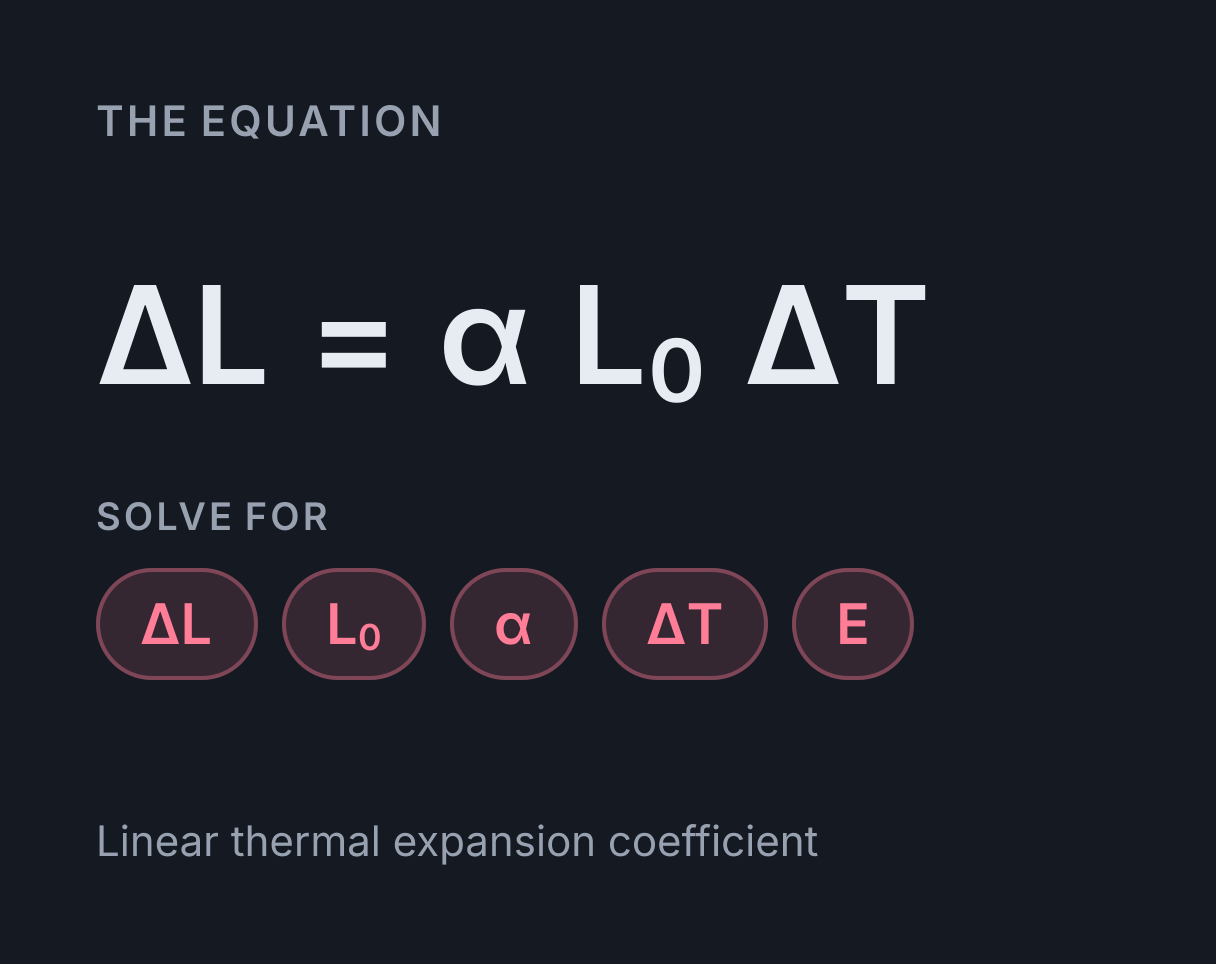
The equation
Linear thermal expansion coefficient
Expansion is a fraction, not a distance
Warm a solid and its atoms vibrate through a slightly larger average spacing, so every dimension grows by the same proportion. That proportion is what the linear expansion coefficient describes: aluminium at 23 parts per million per kelvin grows by 23 millionths of its length for each degree it warms, whether the piece is a centimetre long or a kilometre.
This is why the coefficient carries no length in its units. Doubling the length doubles the movement but leaves the strain untouched, which is the reason a long pipe run needs expansion joints while a short one does not. Nothing about the material has changed; there is simply more of it for the same fraction to act on.
Restrained expansion becomes stress
Expansion that is allowed to happen is harmless. Expansion that is prevented
shows up as stress instead, and this is where the numbers become surprising. The
stress in a fully restrained member is σ = E α ΔT, and crucially
the original length cancels out. A short restrained bar is under exactly the same
stress as a long one.
For steel, with a Young’s modulus near 200 GPa and a coefficient of 12 parts per million per kelvin, every degree of restrained temperature rise adds about 2.4 MPa. A 40 degree swing between a winter night and a summer afternoon is therefore around 96 MPa, which is a large fraction of the roughly 250 MPa yield strength of mild steel, from a temperature change that moves a 12 metre span less than six millimetres.
Worked example
A 12 metre aluminium section warming by 10 °C, with α = 23 × 10⁻⁶ per kelvin:
-
ΔL = α L₀ ΔT = 23e-6 × 12 × 10 = 2.76e-3 m, which is 2.76 mm. -
The strain is
α ΔT = 23e-6 × 10 = 2.3e-4, or 0.023 percent, independent of the 12 metres. -
Restrain it and, with aluminium’s modulus of about 69 GPa, the stress
would be
69e9 × 2.3e-4, about 16 MPa, which is what the restrained-stress readout shows at its defaults. Steel is stiffer, at 200 GPa, but expands only 12 parts per million per kelvin, so restrained through the same 10 °C it would reach about 24 MPa.
Less than three millimetres sounds like nothing. Sixteen megapascals does not. That gap between how the movement feels and how the stress behaves is the whole reason expansion joints, sliding bearings and pipe loops exist.
Linear, area and volume are one coefficient
A square that grows by a fraction in each direction grows in area by very nearly twice that fraction, and a cube grows in volume by three times it. The cross terms are products of numbers around 10⁻⁴ and are negligible for any ordinary temperature change, so the area coefficient is 2α and the volume coefficient is 3α to a good approximation.
Liquids are usually quoted with the volume coefficient directly, since they have no length to speak of, and their values are far larger than solids: mercury is about 181 parts per million per kelvin by volume against roughly 27 for glass, three times its linear 9. That difference, the liquid swelling far more than the glass bore that holds it, is what made mercury thermometers work.
Common mistakes
- Dropping the 10⁻⁶. Tables print aluminium as 23, meaning 23 × 10⁻⁶ per kelvin. Entering 23 as the raw coefficient overstates the expansion by a million times, and this field expects the tabulated figure.
- Using an absolute temperature. The equation takes a change. A component at 40 °C that started at 30 °C has ΔT = 10 K, not 40.
- Assuming the movement is negligible because it is small. Small movements produce large stresses when restrained, and the stress does not depend on the length at all.
- Using the linear coefficient for a volume. A fluid reservoir or a gas gap needs 3α, not α.
- Ignoring that the coefficient itself varies. Published values are averages over a stated range, typically near room temperature. Across hundreds of degrees they drift, and near a phase change they stop applying.
Converting units first? Use the temperature difference and length conversion tables.
Worked examples
Each one runs through the calculator above, so the arithmetic here is the arithmetic it does.
How much does a 500 m steel bridge expand between minus 20 and 40 degrees?
- dL = alpha x L0 x dT
- = 12 × 10⁻⁶ x 500 m x 60 K
- = 0.36 m = 360 mm
360 mm, over a third of a metre, from a 60 degree swing: the change in temperature goes in, not either temperature on its own. A plain gap that wide could not be driven across, which is why long bridges use interlocking toothed or sliding expansion joints at their ends.
What metal is a 1.5 m bar that grows 1.02 mm when heated by 40 degrees?
- alpha = dL / (L0 x dT)
- = 1.02 mm / (1.5 m x 40 K)
- = 0.00102 / 60
- = 17 × 10⁻⁶ per K
17 × 10⁻⁶ per kelvin, which matches copper. Measuring expansion only narrows the field, though: several alloys share similar coefficients, and some stainless steels also sit near 17, so a density or conductivity check is needed to tell them apart.
Practise this with Thermodynamics Practice Problems, questions generated from this calculator and 8 other calculators in Thermodynamics.
Common questions
Why do bridges and pipes need expansion joints?
Because restrained expansion turns into stress instead of movement, and the stress is large even when the movement is small. A 12 metre steel span warming by 10 °C wants to grow about 1.4 mm, which sounds negligible. Prevent it and the stress reaches roughly 24 MPa, and a 40 °C swing takes it near 100 MPa, a substantial fraction of the yield strength of mild steel.
Does the original length change how much a material expands?
It changes the absolute movement but not the fraction. Expansion is proportional to length, so doubling the piece doubles the growth, while the strain stays the same because it is just the coefficient multiplied by the temperature change. That is why the coefficient is quoted per kelvin with no length in it, and why a long pipe run needs joints when a short one does not.
What is the difference between linear, area and volume expansion?
They are the same coefficient counted once, twice or three times. To a good approximation the area coefficient is 2α and the volume coefficient is 3α, because each dimension grows independently and the cross terms are negligible at ordinary temperature changes. So aluminium at 23 parts per million per kelvin expands in volume at about 69 parts per million per kelvin.