Hooke’s Law Calculator
Solve Hooke’s law, F = kx, for force, spring constant or extension, with the elastic energy stored and what happens when you double the stretch.
Calculator
Stiffness. A stiffer spring needs more force for the same stretch.
How far the spring is stretched or compressed from its natural length.
Working, with your numbers
- F = k x
- = 500 x 0.05
- = 25 N
Values are converted into the units the equation is worked in before the arithmetic.
- Energy stored Half k x squared, the area under the force against extension graph.
- 0.625 J
- Doubling the stretch Energy goes as the square of extension, so twice the stretch stores four times the energy.
- 2.5 J
- Force per cm
- 5 N/cm
Citing this tool
Last updated . Add the date you accessed it as well, which a citation of a page that can change asks for. If a specific result matters, cite the permalink from the tool’s share row instead of this page: it reproduces the exact parameters.
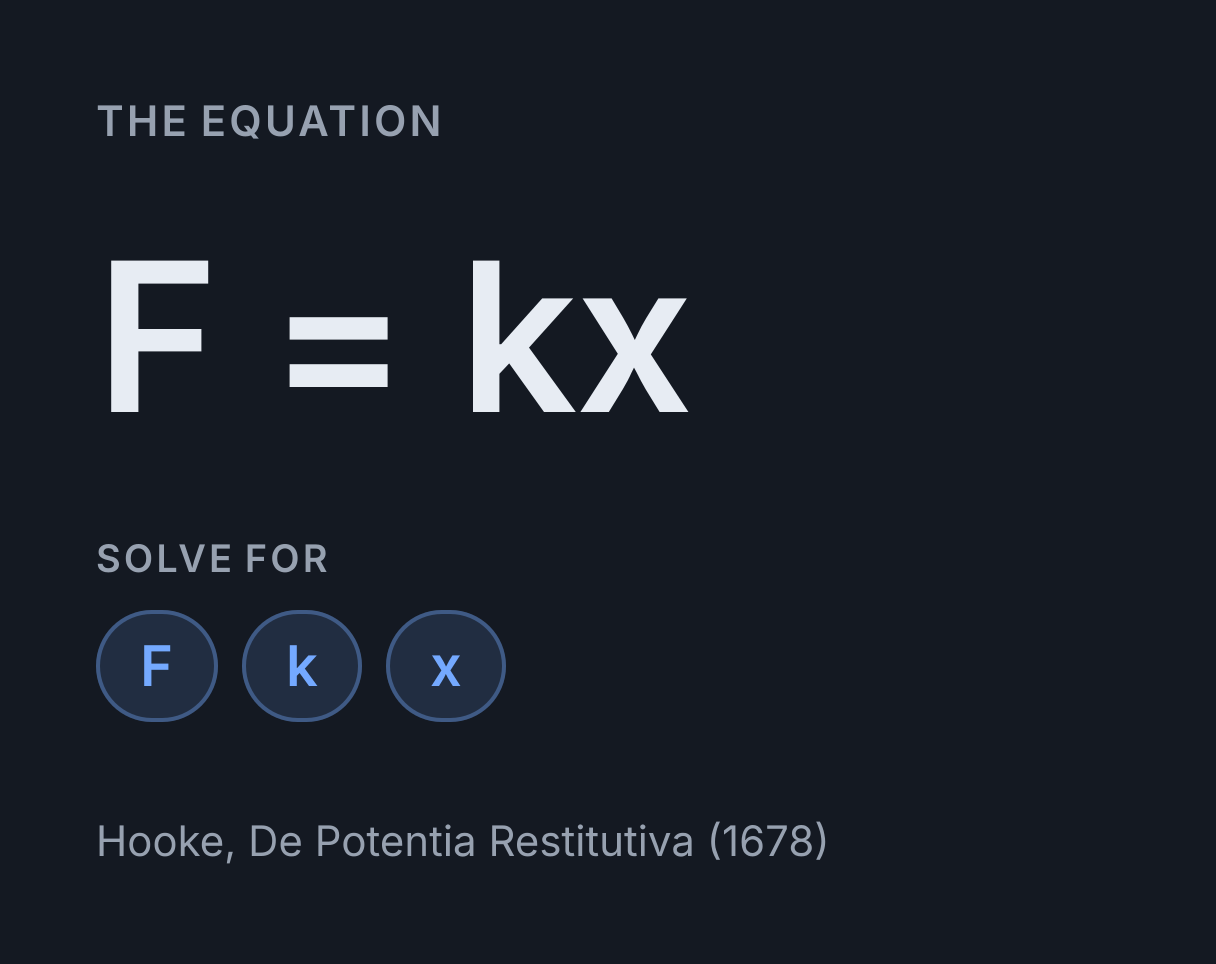
The equation
Hooke, De Potentia Restitutiva (1678)
Stiffness is the slope of a straight line
Hooke’s law says that the force a spring resists with grows in direct
proportion to how far it has been moved from its natural length. Write it as
F = kx and the spring constant k is nothing more
than the slope of that line, measured in newtons per metre. A 500 N/m spring
needs 5 N for every centimetre of stretch, and it needs the same 5 N for the
tenth centimetre as it did for the first. Textbooks often write
F = -kx, where the minus sign records that the spring pulls back
towards its rest position rather than along the displacement. The calculator
works in magnitudes, so the sign is dropped.
The proportionality is a property of the material, not a universal truth. It
holds only up to the limit of proportionality. Past that the line curves
over, and any figure calculated from F = kx will overstate what
the spring can still give back. The elastic limit comes at or after the limit
of proportionality: up to it the spring still returns to its original length
when released, and past it the metal takes a permanent set.
Worked example
A spring of stiffness 500 N/m is pulled 5 cm past its natural length.
- Convert the extension:
5 cm = 0.05 m F = k x = 500 × 0.05F = 25 NE = 0.5 × k × x² = 0.5 × 500 × 0.05²E = 0.5 × 500 × 0.0025 = 0.625 J
So a 25 N pull is held by 0.625 J of stored elastic
energy. Pull the same spring to
10 cm and the force doubles to 50 N while the energy quadruples to
2.5 J. The force per centimetre readout stays at 5 N/cm
throughout, because that figure is just k in other units.
Why the energy is half k x squared
The force is not constant while you stretch a spring. It begins at zero and
only reaches kx at full extension. Work is the area under the
force against extension graph, and because that graph is a straight line
through the origin, the area is a triangle of base x and height
kx. Half base times height gives 0.5 k x². Treating
the final force as though it applied for the whole stretch would give
k x², exactly twice the truth, which is the single most common
error in this calculation.
Because the extension is squared, energy climbs much faster than force. Double the stretch for four times the energy; triple it for nine times. Split a bow’s draw into two halves and the second half stores three times what the first half did.
Combining springs follows from the same reasoning. Two identical springs in series each carry the full load and each stretch fully, so the pair moves twice as far for the same force and the effective constant halves: two 500 N/m springs in series behave as 250 N/m. In parallel they share the load, so the pair is twice as stiff at 1000 N/m. Cutting one spring in half doubles its constant, since half the coils stretch half as far under the same pull.
Common mistakes
- Using the total length rather than the extension. A spring 20 cm long at rest and pulled out to 25 cm has an extension of 5 cm, not 25 cm. Everything in this formula is measured from the natural length.
- Mixing centimetres into a constant quoted in N/m. Feeding
5 into
F = 500xgives 2500 N instead of 25 N, a hundredfold error. The unit selector on the extension field exists to prevent exactly this. - Multiplying
kxbyxfor the energy. That gives 1.25 J here instead of 0.625 J. The factor of one half is not decoration; it is the difference between a triangle and a rectangle. - Extrapolating past the working range. A constant measured over a 5 cm stretch says little about the same spring at 50 cm, where it may already be permanently deformed.
Converting units first? Use the length, force and spring constant conversion tables.
Worked examples
Each one runs through the calculator above, so the arithmetic here is the arithmetic it does.
What force compresses a 500 N/m spring by 5 cm?
- F = k x
- = 500 x 0.05
- = 25 N
25 N, and the centimetres have to become metres because the spring constant is quoted per metre. Using 5 rather than 0.05 gives 2500 N, a hundredfold error, which is the most common mistake with this equation by a wide margin.
What is the spring constant if 12 N stretches a spring 3 cm?
- k = F / x
- = 12 / 0.03
- = 400 N/m
400 N/m. The constant is a property of the spring itself, not of the load you happened to hang on it, so measuring with a different weight must give the same answer. If it does not, the spring has been stretched past its limit of proportionality.
How far does a 250 N/m spring stretch under a 10 N load?
- x = F / k
- = 10 / 250
- = 0.04 m
4 cm. Hooke’s law is linear only up to the limit of proportionality, so doubling the load to 20 N gives 8 cm on a real spring, but 60 N may not give 24 cm. Past that point the constant is no longer constant, and past the elastic limit, which comes at or after it, the spring deforms permanently.
Practise this with Mechanics Practice Problems, questions generated from this calculator and 10 other calculators in Mechanics.
Common questions
Why is the energy stored half kx squared rather than kx squared?
Because the force is not constant while you stretch it. It starts at zero and rises to kx, so the work done is the area under a straight line from the origin, which is a triangle rather than a rectangle. The area of that triangle is half base times height, giving half kx squared.
When does Hooke’s law stop working?
Past the limit of proportionality. Up to that point extension is proportional to force. Beyond it the line curves, so a calculated value for a heavily stretched spring will overestimate the force it can return. The elastic limit comes at or after the limit of proportionality: up to it the spring still returns to its original length, and past it the material deforms permanently.
What happens to the spring constant if I cut a spring in half?
It doubles. Half the coils stretch half as far under the same load, so the stiffness goes up. Two identical springs in series behave like one spring of half the constant, and two in parallel like one of double the constant.