Buoyancy Simulator
Buoyant force is the weight of the fluid displaced. Lower a block into a liquid and see if it floats or sinks, the fraction under and its apparent weight.
Simulator
Drag the scene up or down, or use the up and down arrow keys, to set how far the block is lowered. Space plays and pauses.
- Floats or sinks Its density, 2700 kg/m³, is above the liquid’s 998, so even fully under, the buoyant force is less than its weight.
- Sinks
- Under the surface at rest It does not float, so at rest all of it is under.
- 100 %
- Weight Mass 270 g times g.
- 2.65 N
- Buoyant force, fully under The weight of the 100 cm³ of liquid the whole block pushes aside, 99.8 g of it.
- 0.979 N
- Apparent weight, fully under What the balance reads with the block fully under: its weight less the buoyant force.
- 1.67 N
- Balance reads now The weight less the buoyant force at this depth, and zero once the block floats.
- 2.65 N
- Buoyant force now The weight of the liquid pushed aside so far, which is what has run into the beaker.
- 0 N
- Buoyant force
- Balance reading
- Weight
Citing this tool
Last updated . Add the date you accessed it as well, which a citation of a page that can change asks for. If a specific result matters, cite the permalink from the tool’s share row instead of this page: it reproduces the exact parameters.
The equation
Archimedes, On Floating Bodies, Book I
What buoyancy is
Buoyancy, or upthrust, is the upward force a fluid exerts on anything in it, and it equals the
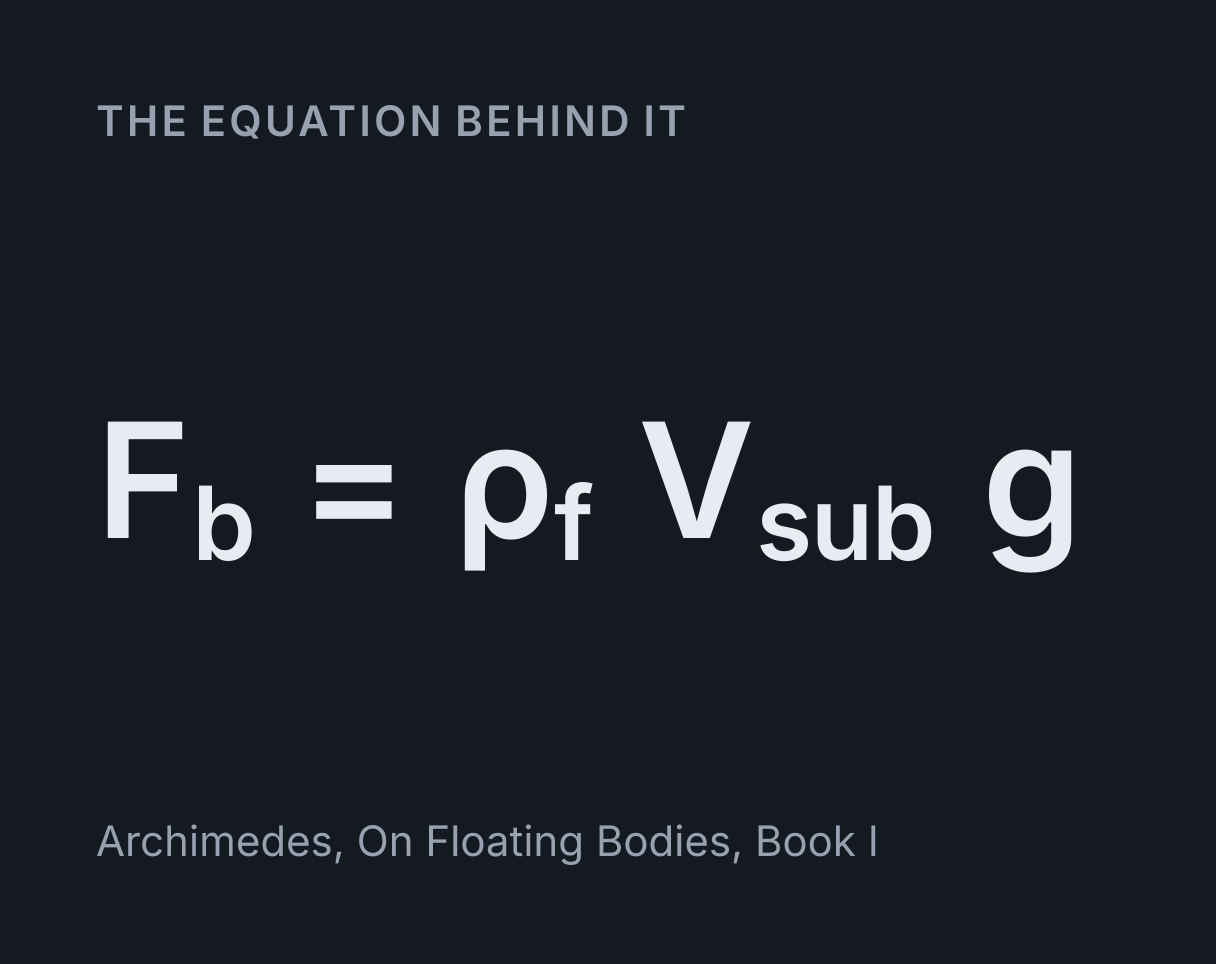
weight of the fluid the object pushes aside. That is Archimedes’ principle, and as a formula it is
F_b = ρ_f × V_sub × g: the density of the fluid times the volume under the surface
times the gravitational field strength. What the object is made of does not appear. Only how
much of it is under, and what it is under, decides the force.
The force comes from pressure. Pressure in a liquid grows with depth, as P = ρgh,
so the liquid presses harder on the bottom of a block than on its top. For a block with flat
faces the difference is the pressure difference across its height, ρ_f g h, times
the area of its base, and height times base area is the block’s volume. Pressure itself is force
per area, which the pressure calculator works out from
P = F/A.
How to use the simulator
Play lowers the block on a spring balance into a can filled to its spout. As it goes in, the liquid it pushes aside runs out of the spout into the beaker, the buoyant force grows, and the balance reading falls by exactly as much, because the balance and the liquid share the block’s weight between them. The arrows on the block show the three forces to one scale, so the two upward ones always add up to the downward one. Drag the scene, use the arrow keys or move the slider under it to hold the block at any depth, and choose a material and a liquid or set either density yourself.
The plot shows the whole run at once. The buoyant force rises in a straight line while the block goes in and then stays level, and the beaker shows why: the liquid caught weighs the same as the buoyant force at every depth. A spring balance measures a force by how far its spring stretches, which is Hooke’s law, and the Hooke’s law calculator works that relationship.
Worked example: an aluminium block in water
The simulator opens on a 100 cm³ block of aluminium, density 2700 kg/m³, lowered into water at 20 °C, density 998 kg/m³, with g = 9.81 m/s².
-
Mass
2700 × 0.0001 = 0.27 kg, so in air it weighs0.27 × 9.81 = 2.65 N. -
Fully under, it displaces 100 cm³ of water, whose mass is
998 × 0.0001 = 0.0998 kg. The buoyant force is that water’s weight,0.0998 × 9.81 = 0.979 N. -
The balance carries the rest:
2.65 − 0.979 = 1.67 N, which is the block’s apparent weight in water. - Half-way in, half the volume is displaced, so the buoyant force is 0.49 N and the balance reads 2.16 N.
The block sinks because 2700 kg/m³ is more than 998, and its size cannot change that. Double the volume and every force doubles, but the water still takes 998 ÷ 2700, or 37 percent, of the weight. The weight itself is mass times g, the same sum the force calculator does for F = ma with the acceleration set to g.
When it floats, and how much is under
A block less dense than the liquid goes in only until the buoyant force has grown to its whole
weight. There it floats, the string goes slack and the balance reads zero. The fraction under
the surface is then the ratio of the densities, V_sub/V = ρ_block/ρ_liquid,
because the liquid displaced has to weigh the same as the block. Choose ice in seawater:
917 ÷ 1025 = 0.895, so 89.5 percent of the ice is under, and the beaker catches 89.5 mL of
seawater, which has the same mass as the ice, 91.7 g. Holding the ice right under would take an
extra push of 0.106 N. In fresh water the same ice floats lower, with 91.9 percent under, and in
ethanol, at 789 kg/m³, it sinks.
Density is all that decides it, which is why iron floats on mercury. At 7874 kg/m³ against 13,534 it floats with 58.2 percent under, lead floats with 83.8 percent under, and gold, at 19,282, sinks. A steel ship floats for the same reason: what counts is the average density of the hull and the air inside it, which is lower than that of water.
Density from two weighings
The same sums run backwards measure density without a ruler. Weigh an object in air and again
hanging in water, and the loss of weight is the buoyant force, the weight of water with the
object’s own volume. So the object’s density is the water’s density times its weight in air
divided by that loss: ρ = ρ_water × W ÷ (W − W_water). For the aluminium block,
998 × 2.65 ÷ (2.65 − 1.67) gives 2700 kg/m³ to three figures. This is Proposition 7
of Archimedes’ On Floating Bodies, and T. L. Heath, in his 1897 translation, took it to be how
Archimedes tested the famous crown. The
density calculator finds density the direct way, from a
mass and a volume.
Does gravity change anything?
The forces, yes; whether it floats, no. Weight and buoyant force are both proportional to g, so at the Moon’s 1.62 m/s² every force here falls to about a sixth of its value on Earth, while the fraction under the surface stays exactly where it was: ice in water still floats with 91.9 percent under. What changes is how little force it takes to push the ice right under.
Common mistakes
- Deciding by weight. Heavy things do not sink because they are heavy; they sink because they are denser than the liquid. A tonne of cork floats and a grain of sand sinks.
- Putting the object’s density into the formula.
F_b = ρ_f V_sub guses the density of the fluid. The object’s own density only enters through its weight. - Using the whole volume for a floating object. Only the part under the surface displaces liquid. A floating object’s buoyant force is simply its weight, and the volume under follows from that.
- Expecting the buoyant force to keep rising with depth. It grows only while more of the object is going under. Once it is fully under, the top and the bottom are both pushed harder by the same amount, so the difference stays put: the flat part of the plot.
- Mixing cubic centimetres and cubic metres. 1 cm³ is 10⁻⁶ m³. Put a 100 cm³ block into the formula as 100 and the buoyant force comes out a million times too big.
- Reading apparent weight as lost mass. The balance reads less because the liquid holds up part of the weight. The mass is unchanged, and lifting the block out brings the full reading back.
What this simulator leaves out
It is quasi-static: the block is lowered slowly and held at each depth, so nothing is ever in motion. Let a real block go and it accelerates, overshoots and bobs, and then drag and the liquid it carries along with it matter too. Surface tension is left out too, which is why a steel pin laid gently on water can rest there although steel is far denser: that is the surface holding it up, not buoyancy. The liquid is taken as incompressible, with the same density at every depth, the balance as perfectly stiff, and the air’s own small buoyancy on the block is not taken off its weight.
The block is flat, twice as wide as it is tall, for a reason. A floating block stays level only if it is wide enough for its density: a cube whose density is between about 21 and 79 percent of the liquid’s is unstable standing level and tips over to float at an angle. A block this flat is stable level at every density, so the level block on screen is where a real one would settle.
Model and assumptions
- Method
- Exact expression, no time stepping
- Repeatability
- Deterministic. The same link gives the same numbers on any machine.
What it assumes
- Quasi-static: the block is lowered slowly enough to be in balance at every depth, so each reading is Archimedes’ principle evaluated at that depth, with no motion to integrate.
- The liquid is at rest and incompressible, so its density is the same at every depth and the buoyant force stops growing once the block is fully under.
- The block is solid and uniform, with a square base twice as wide as it is tall, which keeps it floating level at every density and makes the submerged volume grow in step with the depth.
- The overflow can is filled to its spout, so the surface never moves and the liquid in the beaker is exactly the volume the block displaces.
Where it stops holding. Anything that moves quickly. A released block accelerates, overshoots and bobs, and drag and the liquid it carries along with it then matter, so it does not simply accelerate at the net force over its own mass. Surface tension, which can hold a pin on water, is left out as well.
Numerical accuracy
No method error to report: the result is a closed-form expression evaluated directly, with no time stepping to accumulate error. What remains is double-precision rounding, of order one part in 10^16 per operation.
Common questions
What is the formula for buoyant force?
F_b = ρ_f × V_sub × g: the density of the fluid times the volume of the object below the surface times g. That product is the weight of the fluid the object pushes aside, which is Archimedes’ principle. A 100 cm³ block held fully under water at 20 °C, 998 kg/m³, is pushed up with 998 × 0.0001 × 9.81 = 0.979 N, whatever the block is made of.
How can you tell if an object will float or sink?
Compare its density with the liquid’s: lower and it floats, higher and it sinks, and equal and it stays wherever it is put once it is fully under. Weight alone decides nothing, which is why a tonne of cork floats and a grain of sand sinks. Ice, at 917 kg/m³, floats in water at 998 but sinks in ethanol at 789.
What fraction of a floating object is under water?
Its density divided by the liquid’s density. Ice at 917 kg/m³ in seawater at 1025 gives 917 ÷ 1025 = 0.895, so 89.5 percent of it is below the surface, close to the nine tenths the saying about icebergs has. In fresh water at 20 °C the same ice floats with 91.9 percent under, because fresh water is less dense than seawater.
What is apparent weight?
It is what a spring balance reads when an object hangs in a fluid: its true weight minus the buoyant force. A 100 cm³ block of aluminium, 2700 kg/m³, weighs 2.65 N in air and reads 1.67 N hanging fully under water, because the water pushes up with 0.979 N. An object that floats has an apparent weight of zero.
Does the buoyant force increase with depth?
No, not once the object is completely under. It grows only while more of the object is going below the surface. After that, deeper water presses harder on the top and on the bottom by the same amount, so the difference between them, which is the buoyant force, stays the same. Only the slight compression of water at great depths, which makes it a little denser, changes it.