Pressure Calculator
Solve pressure, force or area from P = F/A across mixed units, with the result shown simultaneously in atmospheres, bar and psi.
Calculator
Working, with your numbers
- P = F / A
- = 500 N / 0.0025 m2
- = 200,000 Pa = 200 kPa
Values are converted into the units the equation is worked in before the arithmetic.
- In atmospheres
- 1.974 atm
- In bar
- 2 bar
- In psi
- 29.01 psi
Citing this tool
Last updated . Add the date you accessed it as well, which a citation of a page that can change asks for. If a specific result matters, cite the permalink from the tool’s share row instead of this page: it reproduces the exact parameters.
The equation
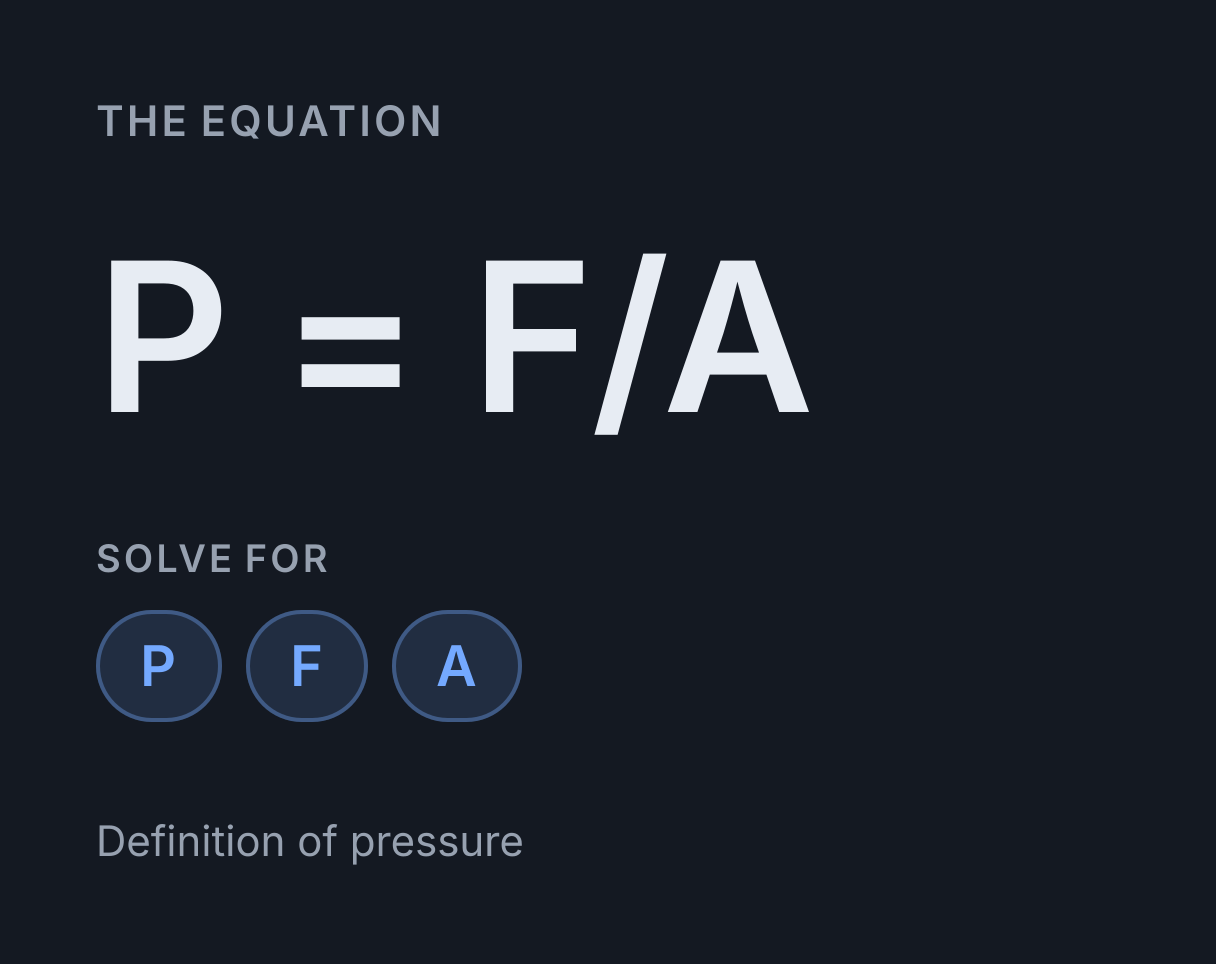
Definition of pressure
Pressure is force spread over an area
P = F/A says nothing about how strong a push is on its own. It
describes how concentrated that push is. The same force delivered through a
needle and through a dinner plate produces wildly different effects, and
pressure is the quantity that captures the difference. One
pascal is one newton spread over one square metre. That is
roughly the weight of a sheet of paper resting on a table, so real
figures are usually quoted in kilopascals or larger units.
The force in the formula must be the component perpendicular to the surface. A force at an angle contributes only its normal component to pressure; the part parallel to the surface is shear stress, which has the same units but a different meaning and causes a different kind of failure. For a weight resting on a flat surface the two coincide, which is why the distinction rarely comes up in introductory problems and matters a great deal in engineering.
Worked example
A clamp applies 500 N through a pad measuring 25 cm². What pressure does the workpiece feel?
- Convert the area:
25 cm² = 0.0025 m² P = F/A = 500 / 0.0025P = 200,000 Pa = 200 kPa
That is 1.97 atmospheres, or 29.0 psi. A car tyre sits at about the same pressure. The readouts show all three at once, because datasheets and gauges rarely agree on which unit to use and converting by hand between psi and kPa is a reliable source of errors.
Why contact area dominates
Force is often fixed by circumstances while area is something you can choose, so area is usually the design variable. Take a 65 kg person, whose weight is 638 N. Standing on flat soles with roughly 300 cm² of contact, the floor feels about 21 kPa. Standing on a single stiletto heel of 1 cm², the same person delivers 6380 kPa. That is 300 times as much, and enough to dent a hardwood floor that shrugs off the flat shoes.
Every design that manages pressure works this lever. Snowshoes and tractor
tyres enlarge the area to stay on soft ground. Knife edges, drawing pins and
hypodermic needles shrink it to concentrate a modest force into something
that penetrates. Fluids follow a slightly different rule, growing with depth
as P = ρgh: ten metres of water adds about 98 kPa, roughly
one more atmosphere. That is why a diver at 10 m is under about twice the
pressure at the surface and at 20 m about three times. Each ten metres adds
the same step; it does not double the pressure again.
Common mistakes
- Entering mass instead of force. A 10 kg block does not press with 10 N. Multiply by g first: its weight is 98.1 N. Newtons in, never kilograms.
- Forgetting to square the length conversion. There are 100 centimetres in a metre but 10,000 square centimetres in a square metre. Dividing by 100 instead of 10,000 is a hundredfold error, and the unit selector here exists specifically to stop it.
- Confusing gauge and absolute pressure. A tyre gauge reads the excess over atmospheric. A gauge showing 32 psi means about 46.7 psi absolute, and gas law calculations need the absolute figure.
- Guessing the contact area. Since pressure is inversely proportional to area, a factor-of-two error in the area is a factor-of-two error in the answer. Real contact patches are usually smaller than they look, because surfaces touch only at high points.
Converting units first? Use the pressure, area and force conversion tables.
Worked examples
Each one runs through the calculator above, so the arithmetic here is the arithmetic it does.
What force does the atmosphere exert on a 1 m² table top?
- F = P x A
- = 101,325 x 1
- = 101,325 N
About 101 kN, the weight of more than ten tonnes, pressing on a table that does not collapse because the air underneath pushes up with the same pressure. Pressure acts on every surface from every side, so only a difference in pressure produces a net force, which is what a suction cup relies on.
What pressure does a 10 N push make under a drawing pin point of 0.1 mm²?
- P = F / A
- = 10 N / (1 × 10⁻⁷ m2)
- = 1 × 10⁸ Pa = 100,000 kPa
100 MPa, nearly a thousand atmospheres, from a push anyone can manage with a thumb. The same 10 N spread over a head of about 1 cm² is only 100 kPa, so the pin concentrates the force a thousandfold. Square millimetres are the trap here: 0.1 mm² is 10⁻⁷ m², not 10⁻⁴.
Practise this with Mechanics Practice Problems, questions generated from this calculator and 10 other calculators in Mechanics.
Common questions
How do pascals, bar, atmospheres and psi relate?
One pascal is one newton per square metre, which is a very small pressure, so kilopascals are usual. One bar is exactly 100,000 Pa. One standard atmosphere is 101,325 Pa, so it is about 1.3 percent larger than a bar. One psi is 6894.76 Pa, making atmospheric pressure about 14.70 psi.
Why does a sharp knife cut more easily than a blunt one?
Because pressure is force divided by area, and a sharp edge concentrates the same force into a far smaller contact area. Halving the contact area doubles the pressure. The same reasoning explains why snowshoes stop you sinking and why a stiletto heel damages a floor that a flat sole does not.
Is this gauge pressure or absolute pressure?
Whatever you put in. P = F/A gives the pressure produced by the force you specified, with no reference to the surroundings. If you need absolute pressure for a gas law, add atmospheric pressure to a gauge reading first, since a tyre gauge showing 32 psi is really at about 46.7 psi absolute.