Combined Gas Law Calculator
Solve the combined gas law for any of the six quantities, with PV over T shown before and after so you can check the sample was really sealed.
Calculator
Converted to kelvin internally. Gas laws are invalid on °C or °F.
Working, with your numbers
- P1 V1 / T1 = P2 V2 / T2
- V2 = P1 V1 T2 / (P2 T1)
- = 1 atm x 2 L x 348.15 K (75 C) / (2 atm x 298.15 K (25 C))
- = 1.1677 L
Values are converted into the units the equation is worked in before the arithmetic.
- PV/T, before and after Constant for a sealed sample. The two figures should agree.
- 679.69 / 679.69 Pa·L/K
- Amount of gas Unchanged by the process; the combined law assumes a sealed sample.
- 0.08175 mol
- Volume ratio
- 0.5839 x
Citing this tool
Last updated . Add the date you accessed it as well, which a citation of a page that can change asks for. If a specific result matters, cite the permalink from the tool’s share row instead of this page: it reproduces the exact parameters.
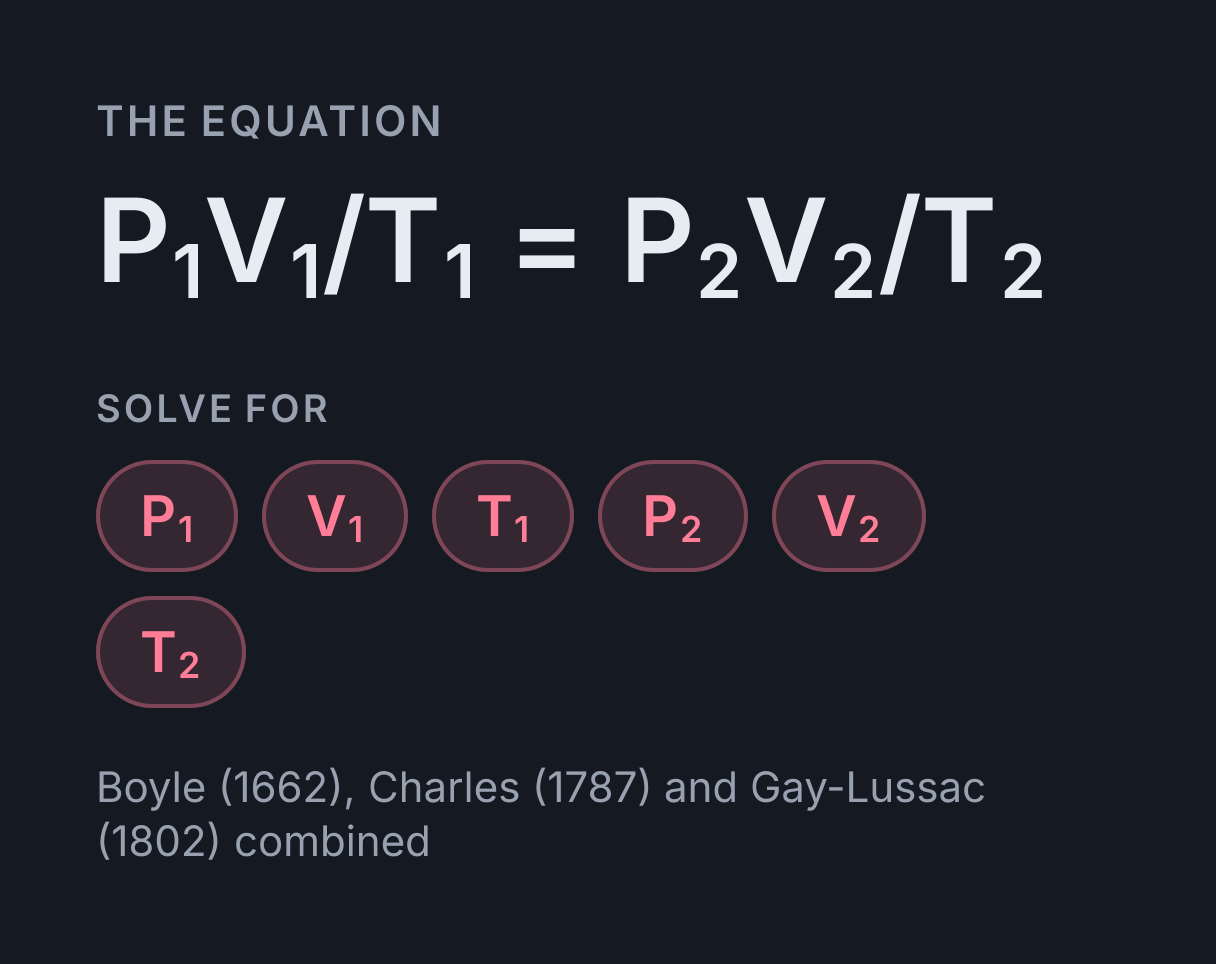
The equation
Boyle (1662), Charles (1787) and Gay-Lussac (1802) combined
One quantity that does not change
For a sealed sample of gas, pressure times volume divided by absolute temperature
stays constant however you squeeze it or heat it. That single statement is the
combined gas law, and writing it for two states gives the familiar
P₁V₁/T₁ = P₂V₂/T₂. Nothing about the gas needs to be known beyond
the fact that the same amount of it is present at both moments.
That is why the amount of gas and the gas constant never appear. Both are on each side of the equation and cancel, which makes this the right tool for a fixed sample moving between two conditions, and the wrong tool for anything that adds or removes gas. Pumping up a tyre is not a combined-law problem, because the amount inside is exactly what is changing.
Boyle, Charles and Gay-Lussac are all this equation
Hold one quantity fixed and it cancels from both sides, leaving one of the three
named laws. Constant temperature gives Boyle’s law, P₁V₁ = P₂V₂.
Constant pressure gives Charles’s law, V₁/T₁ = V₂/T₂. Constant
volume gives Gay-Lussac’s law, P₁/T₁ = P₂/T₂.
There is no reason to memorise the three separately. Write the combined form, set the pair that does not change equal, and cross them out. Doing it that way also makes the direction of each relationship obvious, so there is no need to remember which is proportional and which is inverse.
Kelvin is not optional
The law divides by temperature, so the scale has to begin at absolute zero for the ratio to carry any meaning. Celsius has an arbitrary origin, and dividing by it produces nonsense: at 0 °C the equation would divide by zero, and below freezing it would divide by a negative number and hand back a negative volume.
The size of the resulting error is worth seeing. Warming a gas from 20 °C to 40 °C looks like a doubling and is in fact 293.15 K to 313.15 K, a rise of about 6.8 percent. Anyone using Celsius directly predicts twice the volume where the real answer is a few percent more. This calculator converts internally, so any unit is safe to type, but the conversion is the step to check first when a hand calculation disagrees.
Worked example
Two litres of gas at 1 atm and 25 °C, compressed to 2 atm and warmed to 75 °C:
- Convert first: 25 °C is 298.15 K and 75 °C is 348.15 K.
-
V₂ = P₁V₁T₂ / (P₂T₁) = (1 × 2 × 348.15) / (2 × 298.15) = 1.17 L. - Check it: doubling the pressure alone would halve the volume to 1 L, and the temperature rise of about 17 percent gives most of the remaining 0.17 L back.
The readout above shows PV/T for both states. Since the law says that quantity is unchanged, the two figures agreeing is a direct check on the inputs, and it will catch a temperature left in Celsius immediately.
Common mistakes
- Leaving temperature in Celsius or Fahrenheit. The single largest source of wrong answers with this equation, and it produces results that look plausible rather than obviously broken.
- Mixing pressure units between the two states. P₁ in atm and P₂ in kPa is off by a factor of about 101. The units only need to match each other, not be SI, because the equation is a ratio.
- Using it when the amount of gas changes. Inflating, venting or a reaction that produces gas all break the assumption that n cancels.
- Applying it near condensation. A gas close to its boiling point stops behaving ideally, and once any of it liquefies the sealed-sample assumption fails too.
- Reaching for it when one state is unknown. If you know the amount of gas and only one set of conditions, you want the ideal gas law instead.
Converting units first? Use the volume, pressure and temperature conversion tables.
Worked examples
Each one runs through the calculator above, so the arithmetic here is the arithmetic it does.
What temperature doubles the volume of a gas at 20 degrees and constant pressure?
- P1 V1 / T1 = P2 V2 / T2
- T2 = P2 V2 T1 / (P1 V1)
- = 1 atm x 2 L x 293.15 K (20 C) / (1 atm x 1 L)
- = 586.3 K (313.2 C)
586 K, which is 313 °C. Doubling the volume doubles the absolute temperature, from 293 K to 586 K, so the gas has to be heated through 293 degrees. Doubling the Celsius figure to 40 °C instead would make the gas only about 7 percent bigger.
What volume does a 5 litre balloon at 1 atm and 20 degrees reach at 0.5 atm and minus 20?
- P1 V1 / T1 = P2 V2 / T2
- V2 = P1 V1 T2 / (P2 T1)
- = 1 atm x 5 L x 253.15 K (-20 C) / (0.5 atm x 293.15 K (20 C))
- = 8.6355 L
8.64 L rather than the 10 L that halving the pressure alone would give, because the cold takes back about 14 percent. Both changes act at once, which is the situation the combined law exists for, and half an atmosphere at minus 20 °C is close to the standard atmosphere about 5.5 km up.
Practise this with Thermodynamics Practice Problems, questions generated from this calculator and 8 other calculators in Thermodynamics.
Common questions
Do I have to convert to kelvin?
Always, and it is the single biggest source of wrong answers here. The law divides by temperature, so the scale has to start at absolute zero for the ratio to mean anything. Warming a gas from 20 °C to 40 °C is not a doubling, it is 293 K to 313 K, a rise of under 7 percent. Using Celsius directly would predict twice the volume where the real answer is about 7 percent more.
How does this relate to Boyle’s, Charles’s and Gay-Lussac’s laws?
Each is this equation with one quantity held fixed. Hold temperature and it becomes Boyle’s law, P₁V₁ = P₂V₂. Hold pressure and it becomes Charles’s law, V₁/T₁ = V₂/T₂. Hold volume and it becomes Gay-Lussac’s law, P₁/T₁ = P₂/T₂. Learning the combined form means the other three need no memorising, only setting the unchanged pair equal.
When should I use the ideal gas law instead?
Use the combined law when a fixed sample of gas moves between two states, and PV = nRT when you need the amount of gas itself. The combined law cancels n and R, which is why it never asks how much gas is present, and also why it is wrong for a process that adds or removes gas. Inflating a tyre is not a combined-law problem.