Charles’s Law Calculator
Charles’s law, V₁/T₁ = V₂/T₂: at constant pressure a gas’s volume is proportional to its kelvin temperature. Solve for any value, typed in °C, K or °F.
Calculator
Any scale. Converted to kelvin, because the law divides by absolute temperature.
Working, with your numbers
- V1 / T1 = V2 / T2
- T1 = 20 °C = 293.15 K
- T2 = 40 °C = 313.15 K
- V2 = V1 x T2 / T1
- = 2 L x 313.15 K / 293.15 K
- = 2.1364 L
Values are converted into the units the equation is worked in before the arithmetic.
- V/T, before and after The ratio Charles’s law keeps constant. Worked with Celsius temperatures instead, the two figures would disagree.
- 0.0068224 / 0.0068224 L/K
- T₁ and T₂ in kelvin The numbers the law divides. A Celsius temperature gains 273.15 on the way in, so 20 °C enters as 293.15 K.
- 293.15 and 313.15 K
- Change in volume Always equal to the percentage change in kelvin temperature, never to the change in °C.
- +6.822 %
- Volume at 0 °C The same gas at the same pressure at 0 °C, which is 273.15 K. Each degree Celsius adds 1/273.15 of this volume.
- 1.864 L
Citing this tool
Last updated . Add the date you accessed it as well, which a citation of a page that can change asks for. If a specific result matters, cite the permalink from the tool’s share row instead of this page: it reproduces the exact parameters.
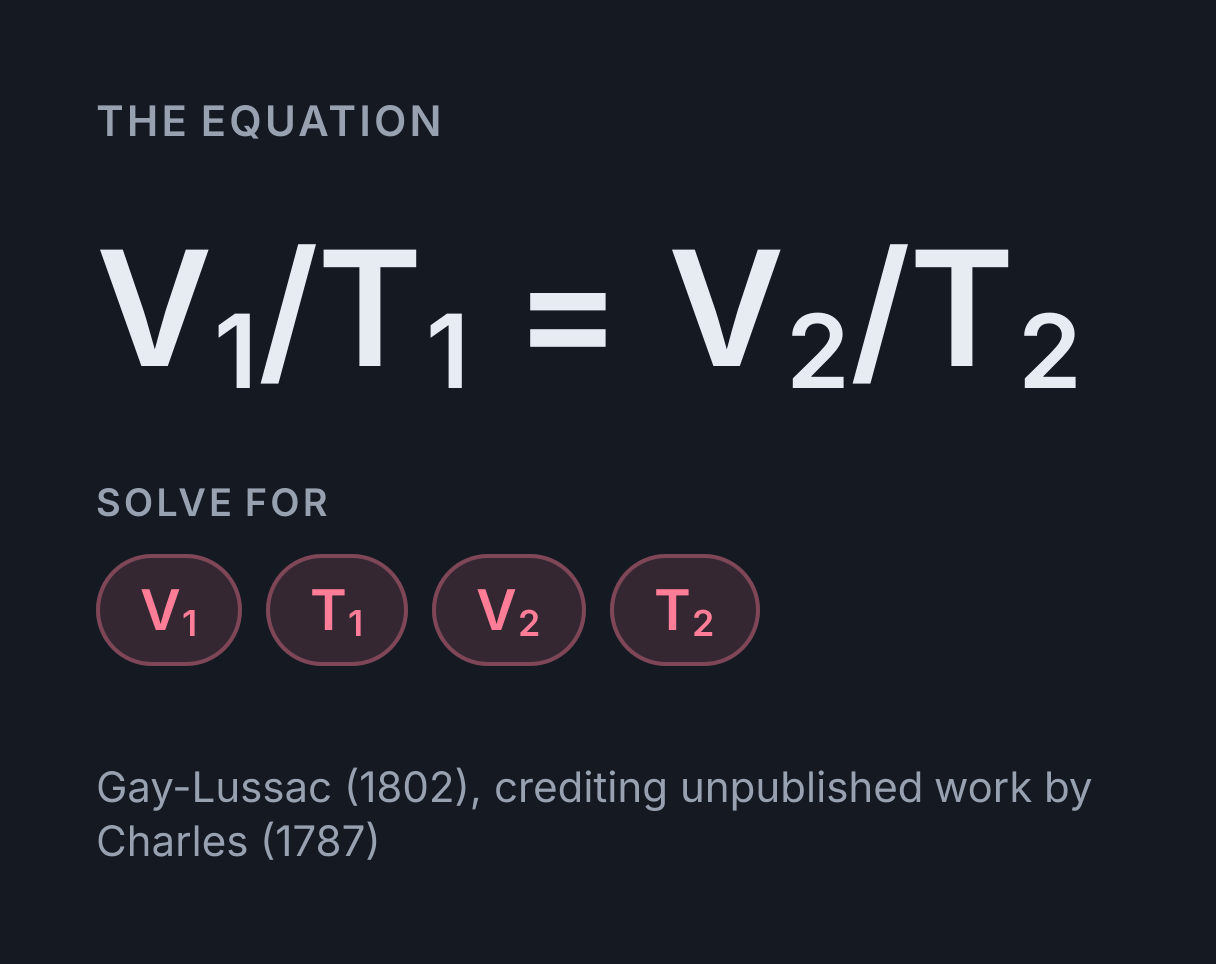
The equation
Gay-Lussac (1802), crediting unpublished work by Charles (1787)
Charles’s law: volume in proportion to absolute temperature
Charles’s law says that for a fixed amount of gas at constant pressure,
the volume is directly proportional to the absolute temperature, so
V₁/T₁ = V₂/T₂ with both temperatures in kelvin. Double the
kelvin temperature and the volume doubles; cool the gas to half its
kelvin temperature and it fills half the space. For the values loaded
above, 2 L of gas at 20 °C warmed to 40 °C,
V₂ = V₁ × T₂ ÷ T₁ = 2 × 313.15 ÷ 293.15 = 2.136 L.
Enter any three of the four values and choose Solve for this on the fourth. The temperatures can be typed in °C, K or °F: each is converted to kelvin before it enters the equation, and the working shows that step on its own line. Alongside the answer the calculator shows V/T for both states, which the law says must be equal, both temperatures in kelvin, the change in volume as a percentage, and the volume the same gas would have at 0 °C.
Why the temperature has to be in kelvin
The volume of a gas is proportional to its temperature measured from absolute zero, and the kelvin scale is the one that starts there. Celsius starts at the freezing point of water instead, so a Celsius figure divided straight into the law gives an answer that is wrong without looking wrong. Warming the 2 L from 20 °C to 40 °C doubles the Celsius number, but the kelvin temperature goes from 293.15 K to 313.15 K, a rise of 6.82 percent, and the volume rises by the same 6.82 percent. Worked in Celsius the gas would appear to double to 4 L.
Cooling shows the mistake more plainly. Take the same gas down to −196 °C and the Celsius arithmetic gives 2 × (−196) ÷ 20 = −19.6 L, a negative volume, while the kelvin arithmetic gives a gas a little over a quarter of its starting size. The V/T readout is the check: worked correctly, V₁/T₁ and V₂/T₂ come out equal, which Celsius figures never manage unless the two temperatures are the same.
Worked example: a helium balloon dipped in liquid nitrogen
A balloon holds 2 L of helium at room temperature, 20 °C, and is lowered into liquid nitrogen at −196 °C, where it cools at the same atmospheric pressure. What is its new volume?
-
Convert both temperatures:
T₁ = 20 + 273.15 = 293.15 KandT₂ = −196 + 273.15 = 77.15 K. -
V₂ = V₁ × T₂ ÷ T₁ = 2 L × 77.15 K ÷ 293.15 K = 0.52635 L, a little over a quarter of the starting volume. -
Check:
V₁/T₁ = 2 ÷ 293.15 = 0.0068224 L/KandV₂/T₂ = 0.52635 ÷ 77.15 = 0.0068224 L/K. The ratio has not changed.
Lift the balloon out and it grows back to 2 L as it warms to room temperature, because no gas escaped: the cold only slowed its atoms, and warming speeds them up again. Helium is the right gas for this: it stays a gas down to 4.2 K, so at 77 K it is still close to ideal. A balloon of air behaves differently, because oxygen turns liquid at 90 K at atmospheric pressure and nitrogen at 77 K. Some of the air condenses into a liquid, and the balloon shrinks further than Charles’s law predicts, then inflates again as the liquid boils off. The calculator warns below 100 K for that reason.
The straight line that points to absolute zero
At constant pressure every gas follows the same straight line: each degree Celsius of warming adds 1/273.15 of the volume the gas has at 0 °C. For 1 L at 0 °C that gives the table below, and each row is the calculator’s own answer for that temperature.
| Temperature | In kelvin | Volume |
|---|---|---|
| −200 °C | 73.15 K | 0.2678 L |
| −100 °C | 173.15 K | 0.6339 L |
| 0 °C | 273.15 K | 1.0000 L |
| 100 °C | 373.15 K | 1.3661 L |
| 200 °C | 473.15 K | 1.7322 L |
Plot volume against Celsius temperature and the points fall on a line
that, extended to the left, reaches zero volume at −273.15 °C. Plot it
against kelvin instead and the same line passes through the origin,
which is all V ∝ T means. No real gas gets there: every gas
but helium has condensed long before, and even helium turns liquid at
4.2 K. The line still marks something real, the temperature at which an
ideal gas would have no volume at all, and it is the zero of the kelvin
scale.
The same proportion appears with the volume held fixed instead of the pressure, where the pressure rises in step with kelvin temperature: that is Gay-Lussac’s law. The kinetic theory gas simulator shows that version as a measurement: leave its Box side slider alone and raising the Temperature slider raises the pressure the atoms’ impacts exert on the walls. For the pressure to stay put, the box would have to grow, and Charles’s law says by how much.
Who found it
The law is named after Jacques Charles, the French scientist and balloon pioneer, who found around 1787 that different gases expand by the same amount when warmed between the same two temperatures, but never published it. Joseph Louis Gay-Lussac measured it carefully and published it in 1802, crediting Charles’s unpublished work, and John Dalton had reported the same equal expansion of gases in 1801. Gay-Lussac found that a gas grew by 1/266.66 of its volume at 0 °C for each degree Celsius, which would put zero volume at −266.66 °C, close to the modern −273.15 °C. In 1848 William Thomson, later Lord Kelvin, gave that point as about −273 °C when he proposed an absolute temperature scale.
Common mistakes
- Leaving the temperatures in Celsius. Add 273.15 first, or let the calculator convert. A Celsius figure of zero, the freezing point of water, would make the law divide by zero.
- Turning the ratio over. The new volume is
V₁ × T₂ ÷ T₁. Warming must give a larger volume and cooling a smaller one, so check the direction before trusting the number. - Using it when the pressure changes. A sealed rigid container cannot expand, so heating it raises the pressure instead, and a gas that is warmed and squeezed at once needs the combined gas law calculator.
- Letting gas in or out. The law follows one fixed amount of gas. A hot-air balloon’s envelope is open at the bottom, so heating it pushes air out rather than stretching the envelope; the law still says how much, as the worked examples below show.
- Converting a temperature change as if it were a temperature. A rise of 20 °C is a rise of 20 K, not 293.15 K. Only the temperatures themselves gain 273.15.
What this calculator does not cover
It treats the gas as ideal and holds the pressure and the amount of gas
fixed. Near the temperature at which a gas condenses, the volume falls
faster than the law predicts, which is why the calculator warns below
100 K. A gas squeezed at one temperature follows
Boyle’s law instead, and one
whose pressure and temperature both change needs the combined law. A party balloon only roughly holds its pressure, because the stretch
of the rubber changes as the balloon grows and shrinks, so a real
balloon follows the law approximately. If the question gives an amount
of gas in moles or asks for one, use the
ideal gas law calculator,
which is Charles’s law with the constant worked out:
V/T = nR/P.
Converting units first? Use the volume and temperature conversion tables.
Worked examples
Each one runs through the calculator above, so the arithmetic here is the arithmetic it does.
How much space does 1000 L of air at 15 °C take up when it is heated to 100 °C?
- V1 / T1 = V2 / T2
- T1 = 15 °C = 288.15 K
- T2 = 100 °C = 373.15 K
- V2 = V1 x T2 / T1
- = 1000 L x 373.15 K / 288.15 K
- = 1295 L
About 1295 L, 29.5 percent more. A hot-air balloon’s envelope is open at the bottom and holds only its own volume, so the extra 295 L spills out and about 23 percent of the air leaves. What stays inside is lighter than the cooler air it displaces, and that difference is the lift.
To what temperature must 1.5 L of air at 25 °C be heated to fill 1.8 L?
- V1 / T1 = V2 / T2
- T1 = 25 °C = 298.15 K
- T2 = T1 x V2 / V1
- = 298.15 K x 1.8 L / 1.5 L
- = 357.78 K = 84.63 °C
357.78 K, which is 84.63 °C. The volume ratio of 1.2 multiplies the kelvin temperature, not the Celsius one: 25 °C times 1.2 would be 30 °C, far short of the real answer, because the Celsius zero is not where a gas would have no volume.
What volume does a 5 L balloon filled indoors at 70 °F have outside at 14 °F?
- V1 / T1 = V2 / T2
- T1 = 21.11 °C = 294.26 K
- T2 = −10 °C = 263.15 K
- V2 = V1 x T2 / T1
- = 5 L x 263.15 K / 294.26 K
- = 4.4714 L
4.47 L, about 11 percent smaller. Both temperatures go into kelvin first, 294.26 K and 263.15 K, since the Fahrenheit zero is no more absolute than the Celsius one. The rubber of a real balloon adds a little pressure that changes with its size, so the balloon follows the law only approximately.
Practise this with Thermodynamics Practice Problems, questions generated from this calculator and 8 other calculators in Thermodynamics.
Common questions
What does Charles’s law state?
That for a fixed amount of gas at constant pressure, the volume is directly proportional to the absolute temperature, so V₁/T₁ = V₂/T₂ with both temperatures in kelvin. Double the kelvin temperature and the volume doubles; halve it and the volume halves. It is the combined gas law with the pressure held fixed.
Why does Charles’s law need temperatures in kelvin?
Because the volume is proportional to temperature measured from absolute zero, and the kelvin scale is the one that starts there. Warming 2 L of gas from 20 °C to 40 °C takes it from 293.15 K to 313.15 K, so it grows to 2.136 L, under 7 percent more, not to the 4 L that doubling the Celsius figure suggests. This calculator converts Celsius and Fahrenheit for you.
How do you find the new volume with Charles’s law?
Multiply the starting volume by the new kelvin temperature and divide by the starting one: V₂ = V₁ × T₂ ÷ T₁. For 2 L of helium at 20 °C cooled in liquid nitrogen at −196 °C, that is 2 × 77.15 ÷ 293.15 = 0.5264 L. The volume comes out in whatever unit V₁ was given in.
How does Charles’s law point to absolute zero?
By extrapolation. Volume against Celsius temperature is a straight line for every gas, and extended to zero volume it meets the temperature axis at −273.15 °C, which is 0 K. No real gas reaches it, since every one condenses first, but the point is the zero of the kelvin scale. Gay-Lussac’s 1802 measurements, taken as a straight line, put it at −266.66 °C.
What are some real-life examples of Charles’s law?
A hot-air balloon is the classic one, and a balloon shrinking in a cold car or a freezer is another. Heating the air in a balloon’s open envelope from 15 °C to 100 °C makes it take up 29.5 percent more space, so about 23 percent of it spills out and the air left inside is lighter than the air it displaced. A helium balloon dipped in liquid nitrogen shrinks to about a quarter of its size and grows back as it warms.
Who discovered Charles’s law?
Jacques Charles found it around 1787 but never published it. Joseph Louis Gay-Lussac published careful measurements in 1802 and credited Charles, which is why the law carries Charles’s name, and John Dalton had reported the same equal expansion of gases in 1801.