Gay-Lussac’s Law Calculator
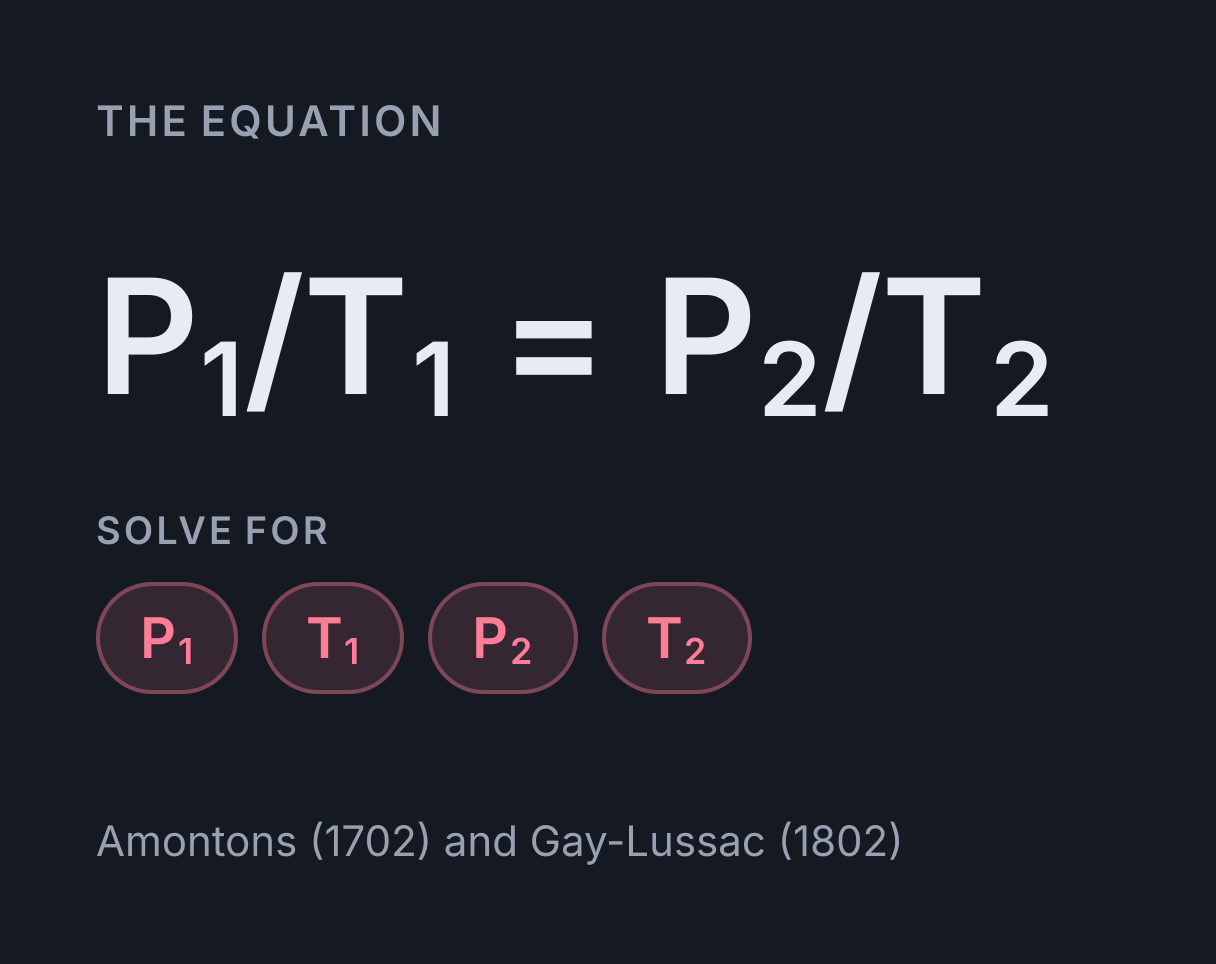
Gay-Lussac’s law, P₁/T₁ = P₂/T₂: heat a sealed, rigid container of gas and its pressure rises in step with its kelvin temperature. Solve for any value.
Calculator
Absolute pressure, measured from vacuum. Add atmospheric pressure, about 1 atm or 14.7 psi, to a gauge reading.
In °C, K or °F. It is converted to kelvin before the division, as the law requires.
Absolute as well. Take atmospheric pressure off it to predict what a gauge will read.
Working, with your numbers
- P1 / T1 = P2 / T2
- T1 = 20 °C + 273.15 = 293.15 K
- T2 = 100 °C + 273.15 = 373.15 K
- P2 = P1 T2 / T1
- = 1 atm x 373.15 K / 293.15 K
- = 1.273 atm = 128,976 Pa
Values are converted into the units the equation is worked in before the arithmetic.
- P/T, before and after The ratio Gay-Lussac’s law keeps constant, and the slope of the pressure against temperature line: the pascals the gas gains for each kelvin, or degree Celsius, that it warms.
- 345.64 / 345.64 Pa/K
- Pressure ratio, P₂/P₁ Always equal to T₂/T₁ with both temperatures in kelvin. The Celsius or Fahrenheit readings give a different ratio, and a meaningless one.
- 1.273 x
- Pressure rise The change a pressure gauge on the vessel would show, as long as the air outside stays at the same pressure: a difference of two pressures is the same whether both are absolute or both are gauge readings.
- 27.65 kPa
Citing this tool
Last updated . Add the date you accessed it as well, which a citation of a page that can change asks for. If a specific result matters, cite the permalink from the tool’s share row instead of this page: it reproduces the exact parameters.
The equation
Amontons (1702) and Gay-Lussac (1802)
Gay-Lussac’s law: pressure rises in step with absolute temperature
Gay-Lussac’s law says that for a fixed amount of gas in a fixed volume,
the pressure is directly proportional to the absolute temperature, so
pressure divided by temperature stays the same:
P₁/T₁ = P₂/T₂, with both temperatures in kelvin. For the
values loaded above, 1 atm at 20 °C heated to 100 °C,
P₂ = P₁T₂ ÷ T₁ = 1 × 373.15 ÷ 293.15 = 1.273 atm. The
pressure rises by 27 percent, although the Celsius reading went up five
times.
Enter any three of the four values, in °C, K or °F and in whatever pressure unit the question uses, and choose Solve for this on the fourth. The working converts each temperature to kelvin on a line of its own. Beside the answer the calculator shows P/T for both states, which the law says must agree and which is also the pressure the gas gains for each kelvin it warms, the pressure ratio, which always equals the kelvin ratio, and the rise or fall in kilopascals, which is the change a gauge on the container would show.
Why heating a sealed gas raises its pressure
A gas presses on its walls because its molecules keep hitting them, and the average kinetic energy of those molecules is proportional to the absolute temperature. Warm a gas that cannot expand and the same number of molecules, in the same space, move faster: each one strikes the walls more often and harder, so the pressure climbs. At absolute zero, in the ideal model, the motion and the pressure would both be gone, which is why the law needs a temperature scale that starts there.
The kinetic theory gas simulator measures pressure from the atoms’ impacts rather than assuming a gas law. Leave its Box side where it is and double the Temperature slider, from 300 K to 600 K, and the measured pressure roughly doubles.
Worked example: a tyre from a cold morning to a hot road
A tyre gauge reads 32 psi on a 10 °C morning. After a drive in the sun the air inside is at 40 °C. What will the gauge read now?
-
The gauge reads the excess over the air outside, so add the atmosphere,
about 14.7 psi:
P₁ = 32 + 14.7 = 46.7 psiabsolute. -
Convert both temperatures:
T₁ = 10 + 273.15 = 283.15 KandT₂ = 40 + 273.15 = 313.15 K. -
P₂ = 46.7 psi × 313.15 K ÷ 283.15 K = 51.6 psiabsolute, which the gauge shows as 36.9 psi, nearly 5 psi more than it read cold. The calculator’s pressure rise readout gives the same change as 34.11 kPa.
Both of the usual mistakes change the answer. Leave the atmosphere out and the tyre seems to rise from 32 to 35.4 psi, only about two thirds of the real gain. Divide the Celsius readings instead and the pressure would quadruple, since 40 is four times 10. That warming is also why The Highway Code says to check tyre pressures when the tyres are cold, because warm or hot tyres may give a misleading reading. The tyre stretches a little as it warms, so the real rise is slightly smaller than the law gives, but the gas itself follows it closely: the NIST Chemistry WebBook puts nitrogen sealed at 46.7 psi and 10 °C at 51.69 psi at 40 °C, within 0.1 percent of the ideal figure.
Worked example: a sealed can heated
A rigid can holds only air at 1 atm and
20 °C, and is left where it reaches
50 °C, the temperature aerosol labels warn against.
P₂ = 1 atm × 323.15 K ÷ 293.15 K = 1.10 atm, a rise of
10 percent. Thrown on a fire at 500 °C the same can would reach 2.6 times
its starting pressure, which is how a sealed container becomes
dangerous.
A real aerosol can is often worse, because many use a liquefied gas such as butane or propane as the propellant. While liquid and vapour share the can, the pressure is the vapour pressure of the liquid, and that climbs much faster than Gay-Lussac’s law. By the NIST WebBook, butane’s vapour pressure goes from 2.08 bar at 20 °C to 4.96 bar at 50 °C, 2.4 times as much, and propane’s from 8.36 bar to 17.13 bar, where a gas on its own would gain 10 percent. That is why the Globally Harmonized System label for aerosols says the container may burst if heated and not to expose it to temperatures above 50 °C.
The line through absolute zero
At fixed volume the pressure is a straight line in temperature that reaches zero at 0 K, which is −273.15 °C. This table follows the 1 atm of gas at 20 °C loaded above and sets each pressure beside what scaling by the Celsius reading would claim.
| Temperature | Kelvin | Pressure by the law | Scaled by the Celsius reading |
|---|---|---|---|
| −73.15 °C | 200 K | 0.6822 atm | −3.66 atm |
| 0 °C | 273.15 K | 0.9318 atm | 0 atm |
| 20 °C | 293.15 K | 1 atm | 1 atm |
| 100 °C | 373.15 K | 1.273 atm | 5 atm |
| 313.15 °C | 586.3 K | 2 atm | 15.66 atm |
Scaling by Celsius puts zero pressure at the freezing point of water and a negative pressure below it, which no gas can have. The real line is what a constant-volume gas thermometer uses: measure a sealed gas’s pressure at two known temperatures and extend the line to zero. From the NIST WebBook’s figures for a sample sealed at 1 atm and 0 °C, nitrogen at 1.3671 atm at 100 °C extends to zero at −272.4 °C, and helium, closer to ideal, at −273.17 °C.
Which law is Gay-Lussac’s law?
The pressure and temperature law carries two names. Guillaume Amontons reported it in a memoir to the Paris Academy of Sciences in 1702: air shut in under 30 inches of mercury and heated from what he called a temperate state to boiling water pushed back with 10 inches more, under 60 inches with 20 more and under 90 inches with 30 more, always about a third. Each load counted the weight of the atmosphere as well. The law gives exactly a third for a start at 279.86 K, about 7 °C, close to the spring or autumn weather the Academy’s summary of his work names as temperate. OpenStax’s Chemistry 2e credits Amontons with first establishing the relationship and Gay-Lussac with determining it more precisely, which is why it is known as either Amontons’s law or Gay-Lussac’s law.
Joseph Louis Gay-Lussac’s own memoir of 1802 is mostly about how gases expand when heated at constant pressure, the result now usually called Charles’s law. His name is also on a different law altogether, the law of combining volumes, which he announced in 1808: gases react in simple whole-number ratios by volume. When a question says Gay-Lussac’s law and gives a sealed, rigid container, it means the pressure law on this page.
Common mistakes
- Using Celsius or Fahrenheit. The law divides by temperature, so the scale has to start at absolute zero. Add 273.15 to every Celsius reading first; the calculator does it for you.
- Using gauge pressure. A tyre gauge reads the excess over the air outside. Add atmospheric pressure, about 1 atm or 14.7 psi, before using it, and take it off again to predict the gauge. The pressure calculator explains the difference.
- Turning the ratio over. The new pressure is
P₁ × T₂ ÷ T₁. A hotter gas must end at a higher pressure; if the answer went down, the temperatures are the wrong way round. - Using it when the volume changes. A balloon or a syringe with a free plunger grows as it warms, so its pressure hardly changes. Use the combined gas law calculator when volume, pressure and temperature all change, or Boyle’s law at constant temperature.
- Letting gas in or out. Pumping up a tyre or a leaking valve changes the amount of gas, and the law follows one fixed sample.
What this calculator does not cover
It treats the gas as ideal. Near atmospheric pressure that is very close, but the drift grows as the gas is squeezed: nitrogen sealed at 200 bar and 15 °C reaches 234.6 bar at 50 °C by the NIST WebBook, where the law gives 224.3 bar, and carbon dioxide, nearer to turning liquid, is already 2.6 percent above the law when sealed at 10 atm and heated from 20 °C to 100 °C. The calculator warns above 10 atm for that reason, and below 200 K, where butane and propane have already condensed at atmospheric pressure and where a temperature typed in the wrong unit usually lands.
It also holds the volume and the amount of gas fixed. A steel vessel grows slightly as it warms, by about three times its linear expansion coefficient per kelvin, so a steel cylinder warmed by 35 K gains about 0.13 percent in volume; the thermal expansion calculator gives the coefficients. And if the question gives the amount of gas in moles or asks for it, use the ideal gas law calculator, since Gay-Lussac’s law cancels the amount and never needs it.
Converting units first? Use the pressure and temperature conversion tables.
Worked examples
Each one runs through the calculator above, so the arithmetic here is the arithmetic it does.
What temperature doubles the pressure of a gas sealed at 27 °C?
- P1 / T1 = P2 / T2
- T1 = 27 °C + 273.15 = 300.15 K
- T2 = T1 P2 / P1
- = 300.15 K x 2 atm / 1 atm
- = 600.3 K = 327.15 °C
600.3 K, which is 327.15 °C, because doubling the pressure of a sealed gas means doubling its kelvin temperature, and 27 °C is 300.15 K. Doubling the Celsius figure to 54 °C would raise the pressure by only 9 percent, the mistake the kelvin conversion exists to prevent.
What pressure is left in a jar sealed at 25 °C once it cools to −18 °C in a freezer?
- P1 / T1 = P2 / T2
- T1 = 25 °C + 273.15 = 298.15 K
- T2 = −18 °C + 273.15 = 255.15 K
- P2 = P1 T2 / T1
- = 1 atm x 255.15 K / 298.15 K
- = 0.8558 atm = 86,711.6 Pa
0.8558 atm, 14.61 kPa below the air outside, so the outside air presses the lid on harder than the gas inside pushes back, one reason a jar closed warm is hard to open cold. Dividing the Celsius readings would give −0.72 atm, a negative pressure no gas can have.
What was the temperature of a sealed gas at 2.5 atm if it reads 3.2 atm at 150 °C?
- P1 / T1 = P2 / T2
- T2 = 150 °C + 273.15 = 423.15 K
- T1 = T2 P1 / P2
- = 423.15 K x 2.5 atm / 3.2 atm
- = 330.59 K = 57.44 °C
330.59 K, which is 57.44 °C. The pressure ratio, 3.2 over 2.5, is 1.28, so the kelvin temperature rose by the same 28 percent, while the Celsius reading rose from about 57 to 150, far more, because the Celsius scale does not start at absolute zero.
Practise this with Thermodynamics Practice Problems, questions generated from this calculator and 8 other calculators in Thermodynamics.
Common questions
What does Gay-Lussac’s law state?
That the pressure of a fixed amount of gas held at constant volume is directly proportional to its absolute temperature, so P₁/T₁ = P₂/T₂ with both temperatures in kelvin. Double the kelvin temperature and the pressure doubles. It is also called Amontons’s law, after Guillaume Amontons, who reported the relationship in 1702.
How do you calculate the new pressure when a gas is heated?
Multiply the starting pressure by the new kelvin temperature and divide by the old one: P₂ = P₁T₂ ÷ T₁. For 1 atm at 20 °C heated to 100 °C, that is 1 × 373.15 ÷ 293.15 = 1.27 atm, a rise of about 27 percent. The answer comes out in whatever pressure unit P₁ was given in, and both pressures must be absolute, not gauge readings.
Do you use kelvin in Gay-Lussac’s law?
Yes, always. The law divides by temperature, so the scale must start at absolute zero, which is −273.15 °C. Dividing Celsius readings instead would say that a gas heated from 10 °C to 40 °C quadruples its pressure, when the kelvin ratio, 313.15 ÷ 283.15, gives a rise of under 11 percent.
Why does tyre pressure go up when the tyres get warm?
Because the air inside is a fixed amount of gas in a nearly fixed volume, so its pressure rises with its absolute temperature. A tyre at 32 psi on the gauge at 10 °C, which is 46.7 psi absolute, reaches about 36.9 psi on the gauge at 40 °C. That is why tyre pressures should be checked when the tyres are cold.
Why do aerosol cans say not to heat them?
Because the pressure inside rises with temperature and a sealed can may burst. Air alone gains only 10 percent from 20 °C to 50 °C, but a liquefied propellant follows its vapour pressure instead, and butane’s rises 2.4 times over the same range. Aerosol labels under the Globally Harmonized System warn against temperatures above 50 °C.
Is Gay-Lussac’s law the same as the law of combining volumes?
No, although both carry his name. This calculator solves the pressure law at constant volume. The law of combining volumes, which Gay-Lussac announced in 1808, says that gases react in simple whole-number ratios by volume. His name is sometimes also given to the constant-pressure law now usually called Charles’s law.