Torque Calculator
Calculate torque from lever arm, force and angle, with the result in newton metres, pound feet and pound inches, plus the perpendicular force.
Calculator
Distance from the pivot to where the force is applied.
90° gives the most torque. Pulling along the arm gives none.
Working, with your numbers
- tau = r x F x sin(theta)
- = 0.3 x 100 x sin(90 deg)
- = 0.3 x 100 x 1
- = 30 N m
Values are converted into the units the equation is worked in before the arithmetic.
- In pound feet
- 22.13 lbf·ft
- In pound inches
- 265.5 lbf·in
- Force at right angles The force that would give this torque applied perpendicular to the arm.
- 100 N
Citing this tool
Last updated . Add the date you accessed it as well, which a citation of a page that can change asks for. If a specific result matters, cite the permalink from the tool’s share row instead of this page: it reproduces the exact parameters.
The equation
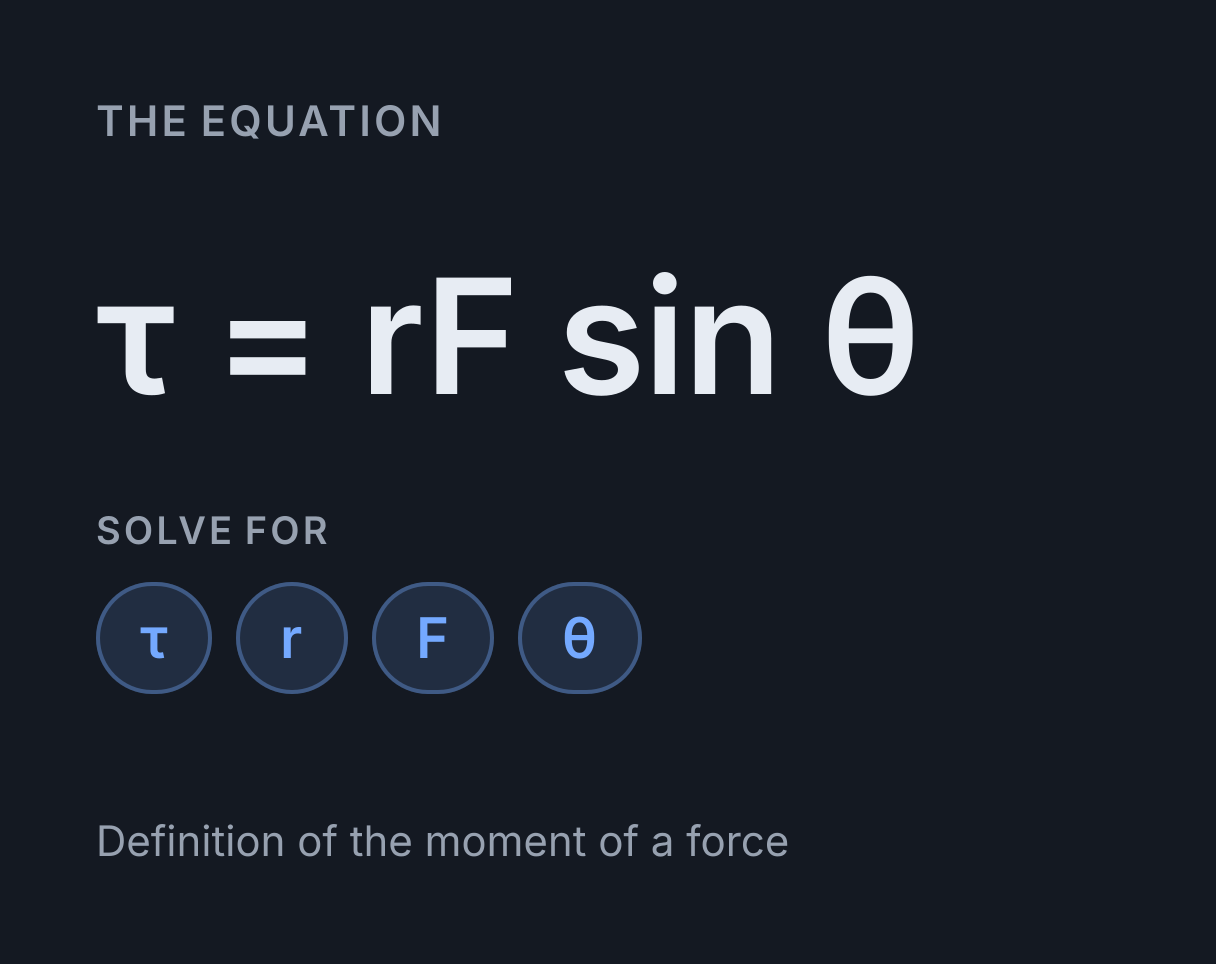
Definition of the moment of a force
Torque is force multiplied by the distance it acts across
τ = rF sin θ measures turning effect rather than push. Two
readings of the sine give the same answer. Read it as
F sin θ, the part of the force acting at right angles to the
lever arm, multiplied by the arm length. Or read it as
r sin θ, the perpendicular distance from the pivot to the line
the force acts along, multiplied by the whole force. Engineers call that
second quantity the moment arm.
Either way the sine sets the efficiency of the push. At 90 degrees the sine is 1 and the force is entirely turning the object. At 45 degrees it is 0.707, so the same grip delivers only 70.7 per cent of the torque it could. At 0 degrees it is zero: a force aimed straight along the arm, towards or away from the pivot, produces no rotation whatsoever. Pushing a door edge-on towards its hinge is the everyday demonstration. Full force, no torque, no movement.
Worked example
A spanner 30 cm long is pulled with 100 N at a right angle to the handle.
- Convert the arm:
30 cm = 0.30 m - The pull is perpendicular:
sin 90° = 1 τ = r F sin θ = 0.30 × 100 × 1τ = 30 N·m30 / 1.3558179483 = 22.13 lbf·ft
The same figure in pound inches is 265.5 lbf·in, twelve
times the pound feet value. Let the hand slip so the pull comes in at 45
degrees instead and the torque falls to
0.30 × 100 × 0.7071 = 21.21 N·m with no change in how hard you
are pulling. Cut the arm to 15 cm and you would need 200 N to recover the
original 30 N·m, which is what the perpendicular force readout is showing.
Getting torque specifications right
Most practical torque work is conversion work, because fasteners are specified in whichever unit the manual’s author preferred. The conversions are exact, not approximate: 1 lbf·ft = 1.3558179483 N·m and 1 kgf·m = 9.80665 N·m. A car wheel nut specified at 110 N·m is 81.13 lbf·ft. A bicycle stem bolt at 5 N·m is 3.688 lbf·ft, which is why carbon parts get a small torque wrench rather than a guess. An older Japanese service manual quoting 3 kgf·m means 29.42 N·m, or 21.70 lbf·ft.
The lever arm is the variable you usually control. Reaching 30 N·m with 100 N
needs 0.30 m of spanner; halve the spanner and the force doubles. That is the
entire argument for a breaker bar, and also the reason breaker bars shear
bolts: a 1 m bar under a 400 N heave delivers 400 N·m, several times what a
typical wheel stud is rated for. Measure r from the pivot to
where your hand actually grips, not to the far tip of the tool, or the
calculated figure will flatter you.
Common mistakes
- Using cosine instead of sine. Work takes the component of the force along the motion, so it uses cosine. Torque takes the component across the arm, so it uses sine. Swap them at 90 degrees and 30 N·m becomes zero.
- Measuring the arm from the wrong point. The distance runs from the axis of rotation to the point where the force is applied. On a wheel nut that is the centre of the nut, not the edge of the socket.
- Reading newton metres as newtons per metre. N·m is a torque or an energy. N/m is a spring constant. They describe unrelated quantities and the dot is doing real work.
- Mixing up pound feet and pound inches. The two differ by a factor of 12, so 30 N·m is either 22.13 lbf·ft or 265.5 lbf·in. Tightening a fastener to a pound inch figure read as pound feet is a reliable way to snap it.
Converting units first? Use the length, force, angle and torque conversion tables.
Worked examples
Each one runs through the calculator above, so the arithmetic here is the arithmetic it does.
How much torque does 100 N on a 30 cm spanner produce?
- tau = r x F x sin(theta)
- = 0.3 x 100 x sin(90 deg)
- = 0.3 x 100 x 1
- = 30 N m
30 N m, which is the most you can get from that force and that spanner, because the sine is at its maximum when you push at a right angle to the arm. Every other angle is this figure multiplied by something less than 1.
Why does pushing a spanner at 30 degrees halve the torque?
- tau = r x F x sin(theta)
- = 0.3 x 100 x sin(30 deg)
- = 0.3 x 100 x 0.5
- = 15 N m
Because sin 30 degrees is exactly one half, the component of your push at right angles to the arm, the only part that turns the bolt, is half the push. The other component, about 0.87 of the push (cos 30 degrees), runs along the handle and does nothing to turn the bolt. This is why a mechanic instinctively positions the handle square to the pull rather than at a convenient angle.
What force on a 15 cm spanner gives 45 N m of torque?
- F = tau / (r x sin(theta))
- = 45 / (0.15 x sin(90 deg))
- = 45 / 0.15
- = 300 N
300 N, three times the force the 30 cm spanner needed for less torque. Halving the arm doubles the required force, which is the whole argument for a longer handle and for the breaker bar that appears whenever a bolt refuses to move.
Practise this with Mechanics Practice Problems, questions generated from this calculator and 10 other calculators in Mechanics.
Common questions
Why does a longer spanner make a bolt easier to turn?
Because torque is the product of force and lever arm. Doubling the length of the spanner doubles the torque for the same hand force, which is why a breaker bar shifts a seized nut that a short spanner will not. It is also why over-length bars snap bolts: the torque climbs faster than most people expect.
Where should I push for the most torque?
At right angles to the lever arm, as far from the pivot as you can. Sin θ is largest at 90 degrees and falls away either side, reaching zero when you push straight along the arm. Pushing a door towards its hinge is the extreme case: full force, no torque, no movement.
Is torque the same as a moment?
The arithmetic is identical. Engineers usually say bending moment when the effect is to bend a beam and torque when the effect is to twist a shaft or turn a fastener, but both are force times perpendicular distance and both are measured in newton metres.