Work and Power Calculator
Calculate work done by a force at any angle to the motion, with average power over a chosen time and the fraction of the force that does work.
Calculator
Straight-line displacement from start to finish, not the path length. The angle accounts for its direction relative to the force.
Zero when the force pushes straight along the motion. 90° does no work at all, and beyond 90° the work is negative.
Only used for the average power readout. It does not affect the work done.
Working, with your numbers
- W = F x d x cos(theta)
- = 50 x 3 x cos(0 deg)
- = 50 x 3 x 1
- = 150 J
Values are converted into the units the equation is worked in before the arithmetic.
- Average power Work divided by the time taken.
- 15 W
- In horsepower
- 0.02012 hp
- Useful fraction How much of the force acts along the motion. Negative when it acts against it.
- 100%
Citing this tool
Last updated . Add the date you accessed it as well, which a citation of a page that can change asks for. If a specific result matters, cite the permalink from the tool’s share row instead of this page: it reproduces the exact parameters.
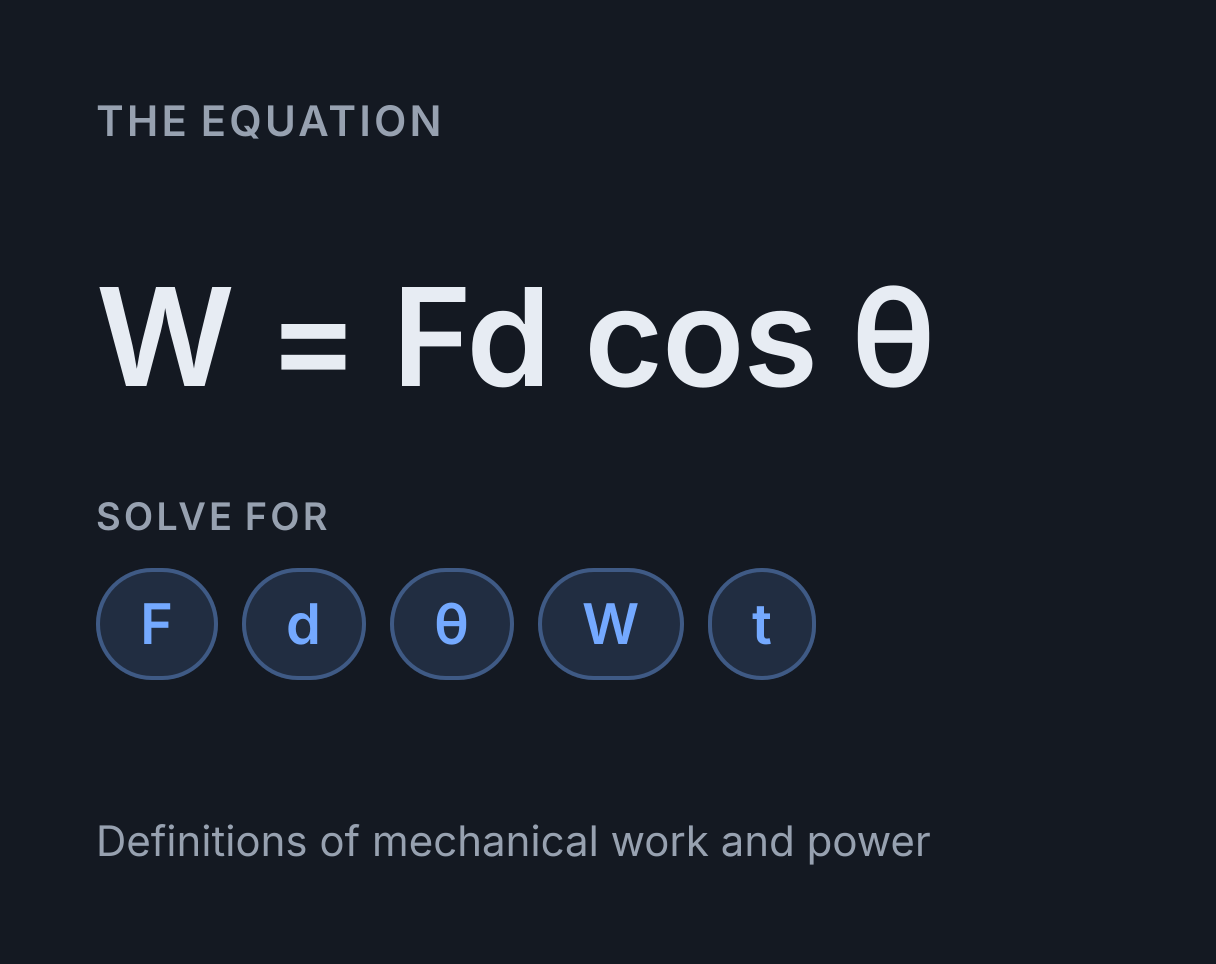
The equation
Definitions of mechanical work and power
Work counts only the force that acts along the motion
In W = Fd cos θ the cosine is the whole point. A force applied
at an angle splits into two parts: F cos θ pointing along the
direction of travel and F sin θ pointing across it. Only the
first part moves the object anywhere, so only the first part transfers
energy. The cosine is not a correction bolted onto Fd. It is
the projection that picks out the component doing the job.
That gives the formula three characteristic values worth memorising. At 0 degrees the cosine is 1 and every newton counts. At 60 degrees the cosine is 0.5 and only half the force acts along the motion. At 90 degrees the cosine is zero and the work is zero however hard you push. Carrying a suitcase along a level corridor is the standard case: you hold it up, it travels forward, and those two directions are at right angles. Your arms ache because muscle fibres cycle tension, not because the suitcase is gaining energy.
Worked example
A rope pulls a crate with 50 N straight along the floor, the crate moves 3 m, and the pull lasts 10 s.
- The rope is aligned with the motion:
cos 0° = 1 W = F d cos θ = 50 × 3 × 1W = 150 JP = W / t = 150 / 10 = 15 W
Fifteen watts is 0.02012 hp, about the output of a small
aquarium pump. Now raise the rope so it pulls at 60 degrees to the floor
while the crate still slides forwards 3 m. The force reading on the rope has
not changed, but the work drops to 50 × 3 × 0.5 = 75 J and the
average power halves to 7.5 W. Changing the angle in the calculator and
watching the useful fraction readout fall is the quickest way to see what
the cosine does.
Same work, very different power
Work says how much energy moved. Power says how fast. Lifting a 20 kg box
onto a shelf 1.5 m up takes 20 × 9.80665 × 1.5 = 294.2 J of
work against gravity whether you do it in one second or in thirty. Only the
power differs: 294 W in the first case and
9.81 W in the second. Motors, engines and athletes are all
rated in watts for this reason. A fit cyclist holds roughly 250 W for an
hour and can touch 1000 W for a few seconds, and the gap between those two
numbers is entirely a matter of rate.
The time input here feeds the power readouts only. Change it and the work
stays at 150 J while the wattage moves, which mirrors the physics: nothing
about W = Fd cos θ mentions time. One mechanical horsepower is
745.7 W, so the horsepower readout is simply the watt figure divided by
that. The power conversion table has the
factor between watts, kilowatts, horsepower and the rest.
Common mistakes
- Entering the distance walked instead of the displacement.
Hauling a load up a winding path covers far more ground than the straight
line between its ends. Only that straight-line displacement belongs in
d, andθaccounts for its direction relative to the force. - Confusing joules with watts. A joule is a quantity of
energy; a watt is one joule per second. A 60 W bulb left on for an hour
consumes
60 × 3600 = 216,000 J. - Assuming effort implies work. Holding a heavy box
stationary does no work on the box at all, because
dis zero. Physical work has a narrower meaning than the everyday word. - Measuring the angle from the wrong reference. θ sits
between the force and the direction of motion, not between the force and
the surface. A sledge rope 30 degrees above level ground gives
cos 30° = 0.866, so 86.6 per cent of the pull is useful.
Converting units first? Use the energy, length, time, force and angle conversion tables.
Worked examples
Each one runs through the calculator above, so the arithmetic here is the arithmetic it does.
How much work is done pushing a 50 N box 3 metres horizontally?
- W = F x d x cos(theta)
- = 50 x 3 x cos(0 deg)
- = 50 x 3 x 1
- = 150 J
150 J, the simple case, because pushing along the direction of motion makes the cosine exactly 1. Every other geometry is this answer multiplied by something smaller, so it is worth treating as the reference the others are compared against.
How much work is done pulling a box at 60 degrees to its motion?
- W = F x d x cos(theta)
- = 50 x 3 x cos(60 deg)
- = 50 x 3 x 0.5
- = 75 J
Half the work for the same force over the same distance, because only the component along the motion counts. At 90 degrees it falls to nothing at all, which is why carrying a heavy bag across level ground does no work on it in the physics sense however tired you get.
What force does 900 J of work over 12 metres?
- F = W / (d x cos(theta))
- = 900 / (12 x cos(0 deg))
- = 900 / 12
- = 75 N
75 N when the push is along the motion. Note that the angle is still needed to answer this: at 60 degrees the same work over the same distance would demand 150 N, because only half of every newton would act along the motion.
Practise this with Mechanics Practice Problems, questions generated from this calculator and 10 other calculators in Mechanics.
Common questions
Why does carrying something horizontally do no work?
Because work counts only the part of the force acting along the motion, and that part is Fcos θ. Holding a bag means pushing up while walking forward, so the angle is 90 degrees, cos 90 is zero, and the work done on the bag is zero. You still get tired, because your muscles burn energy holding the tension, but none of it goes into the bag.
What is the difference between work and power?
Work is how much energy was transferred and power is how fast. Lifting a crate up one flight of stairs does the same work whether you take five seconds or five minutes; only the power differs. One watt is one joule per second, and one mechanical horsepower is 745.7 watts.
Can work be negative?
Yes, when the force opposes the motion. Friction and braking do negative work, removing energy from the object. From 0 to 90 degrees the work is zero or positive; beyond 90 degrees cos θ turns negative and so does the work, and the calculator accepts those angles and shows the negative figure.