Inclined Plane Simulator
Simulate a block on an inclined plane with static and kinetic friction: it slides once tan θ exceeds μs, then accelerates at g(sin θ − μk cos θ).
Simulator
Drag on the scene to tilt the slope, or use the arrow keys. Space plays and pauses.
Forces on a 2 kg block on a 30° slope: weight 19.62 N straight down, normal force 16.99 N out of the slope, kinetic friction 5.097 N up the slope. The block slides down the slope at 2.356 m/s², under a net force of 4.713 N.
- Acceleration down the slope g(sin θ − μk cos θ): 4.713 N of net force down the slope over 2 kg, and the mass cancels.
- 2.356 m/s²
- Net force down the slope ΣF = m a: the forces along the surface added with their directions. Across it the normal force balances m g cos θ, so nothing is left over there.
- 4.713 N
- Kinetic friction Up the slope: μk N = 0.3 × 16.99 N, whatever the speed.
- 5.097 N
- Normal force m g cos θ: the part of the weight pressing into the slope, which the surface pushes back against.
- 16.99 N
- Weight along the slope m g sin θ: the part of the weight pulling the block down the slope.
- 9.81 N
- Critical angle arctan μs. With no push the block stays put on any shallower slope, whatever its mass or gravity.
- 26.57 °
- Push that holds it Any push up the slope in this range keeps the block still. A negative figure is a pull down the slope.
- 1.314 to 18.31 N
- Time to the bottom From rest over the whole 5 m slope: t = √(2d/a).
- 2.06 s
- Speed at the bottom v = √(2ad), from rest over 5 m.
- 4.854 m/s
- Friction on the block
- Most static friction can give, μs N
Energy over the whole slope
- Potential energy released m g h, where h is the height the block drops or climbs: the slope length times sin θ.
- 49.05 J
- Work done by the push F times the distance along the slope. Negative when the push points against the motion.
- 0 J
- Kinetic energy at the bottom ½ m v², at the end of the run.
- 23.56 J
- Heat from friction The 49.05 J of potential energy released becomes 23.56 J of kinetic energy and 25.49 J of heat.
- 25.49 J
- Potential energy released
- Kinetic energy
- Heat from friction
Citing this tool
Last updated . Add the date you accessed it as well, which a citation of a page that can change asks for. If a specific result matters, cite the permalink from the tool’s share row instead of this page: it reproduces the exact parameters.
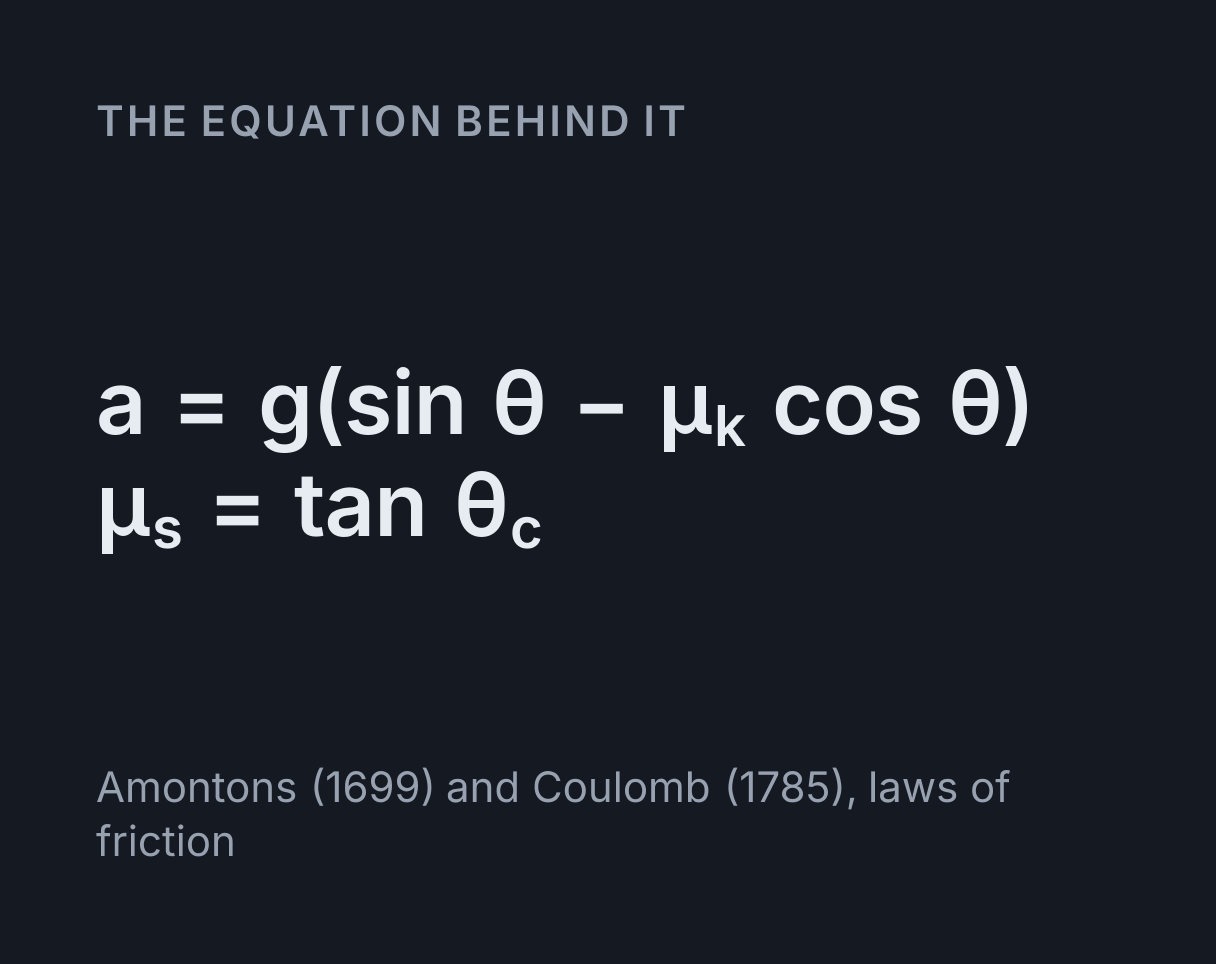
The equation
Amontons (1699) and Coulomb (1785), laws of friction
When a block on a slope slides, and how fast
A block on an inclined plane slides when the pull of gravity down the slope, mg sin θ, is more
than static friction can hold, μs mg cos θ, which happens once tan θ is larger than μs. It then
accelerates down the slope at a = g(sin θ − μk cos θ). Everything follows from
resolving the weight along the slope and into it: mg sin θ drives the block, and mg cos θ
presses it into the surface, which pushes back with the normal force N = mg cos θ that both
kinds of friction are proportional to.
Mass appears in every one of those forces, so it cancels from the acceleration, and a heavy block and a light one of the same material slide together. A push changes that, because a push is not proportional to the mass: the acceleration is still the net force along the slope divided by the mass, as the force calculator works it out for F = ma, but the same push now accelerates a heavy block less than a light one.
The free-body diagram of a block on a slope
Three forces act on a block on a slope: its weight mg, straight down; the normal force N, at right angles to the surface; and friction f, along the surface, against the way the block moves or would move. A push F along the slope makes four. The arrows on the block are that diagram, all drawn to one scale, so a longer arrow is a larger force.
The two dashed arrows are the weight resolved into mg sin θ down the slope and mg cos θ into it. They are the weight, not extra forces, and each lies on the same line as the force it is weighed against: mg cos θ opposite the normal force, which it exactly matches, and mg sin θ on the line friction acts along, so with no push the difference between the two is the net force.
Using the simulator
Drag anywhere on the scene to tilt the slope, or select it and use the arrow keys. The sliders set the mass, the two friction coefficients, a push along the slope (positive pushes up it), the length of the slope and gravity. Play runs the slide from rest, and the scrubber steps through it by hand.
Every force the diagram draws is also read out, so the simulator doubles as an inclined plane calculator. The readouts give the acceleration and the net force, the friction and the normal force, the part of the weight along the slope, the critical angle and the range of pushes that hold the block still. For a block that slides they also give the time and the speed at the end of the slope, and the energy over the whole slope is split into the potential energy released, the work done by the push, the kinetic energy at the end and the heat from friction.
Worked example: a 2 kg block on a 30° wooden slope
The simulator opens on this case: a 2 kg block on a 5 m slope at 30°, wood on wood, with μs = 0.5 and μk = 0.3, and g = 9.81 m/s².
- Weight:
mg = 2 × 9.81 = 19.62 N. -
Along the slope:
mg sin 30° = 9.81 N. Into it:mg cos 30° = 16.99 N, which is the normal force. -
The most static friction can give is
μs N = 0.5 × 16.99 = 8.50 N, less than the 9.81 N pulling the block down, so it slides. Put the other way, tan 30° = 0.577 is above μs. -
Kinetic friction then acts up the slope:
μk N = 0.3 × 16.99 = 5.097 N, leaving a net force of9.81 − 5.097 = 4.713 Ndown it. -
Acceleration: the net force over the mass, which is
a = g(sin 30° − 0.3 cos 30°) = 9.81 × 0.2402 = 2.356 m/s². -
From rest over 5 m:
t = √(2 × 5 / 2.356) = 2.06 sandv = √(2 × 2.356 × 5) = 4.854 m/s, as the kinematics calculator gives for u = 0, a = 2.356 m/s² and s = 5 m.
The energy balances to the joule. The block drops 5 × sin 30° = 2.5 m, which releases
mgh = 19.62 × 2.5 = 49.05 J. Of that, ½mv² = 23.56 J is kinetic
energy at the bottom and the heat is μk N d = 5.097 × 5 = 25.49 J, and
23.56 + 25.49 = 49.05. Those are the energy readouts at the opening settings, where the push
does no work.
Static friction is only as strong as it needs to be
Set the same block on a 20° slope and it stays put, because tan 20° = 0.364 is below μs = 0.5. The static friction readout then shows 6.71 N, exactly the pull down the slope, mg sin 20°, although static friction could give up to μs N = 9.218 N. μs N is the ceiling, not the value: static friction takes whatever size up to that ceiling keeps the block still, and points whichever way that needs, which is down the slope when a push up it is stronger than the pull of gravity along it.
The same is true on level ground, and at an angle of 0 the simulator reproduces Example 6.10 in OpenStax University Physics: a 20.0 kg crate with μs = 0.700 and μk = 0.600, with g = 9.80 m/s². Pushes of 20, 30 and 120 N leave it still, met by static friction of exactly 20, 30 and 120 N, because the most static friction can give is 0.700 × 196 = 137.2 N. At 180 N the crate slides, friction drops to 0.600 × 196 = 117.6 N, and it accelerates at (180 − 117.6) / 20.0 = 3.12 m/s². The book prints 3.10 m/s² because it rounds the friction to 118 N first.
Finding μs from the angle where it slips
With no push the block stays put up to the critical angle, where tan θ = μs, and slides above it. Mechanics texts also call this angle the angle of repose. Neither the mass nor gravity comes into it, since the pull down the slope and the limit of static friction are both proportional to mg, which is why tilting a board until a block slips is the standard way to measure a coefficient of static friction. The critical angle readout is arctan μs: 26.57° for μs = 0.5 and 45° for μs = 1.
Just past that angle the block does not creep away. The friction holding it drops from μs N to μk N the moment it moves, so it sets off with an acceleration of about g cos θ (μs − μk). At 26.5° the default block is held; at 26.6° it slides at 1.761 m/s². The friction plot shows the same thing as a step. The rule tan θ = μk describes something else, a block that keeps sliding at constant speed once it has been started, which a block starting from rest never does.
Pushing a block up the slope
A push up the slope holds the block still anywhere between mg(sin θ − μs cos θ) and
mg(sin θ + μs cos θ), which for the opening block is 1.314 N to 18.31 N, the range the push
readout gives. To start the block moving up the slope, the push has to beat the top of that
range. Once it is moving, kinetic friction takes over, pointing down the slope, and a push of
mg(sin θ + μk cos θ) = 9.81 + 5.097 = 14.91 N keeps it going at a steady speed.
The simulator starts every block from rest, so at 14.9 N it shows the block held, with 5.09 N
of static friction pointing down the slope.
Push harder than 18.31 N and the block accelerates up the slope. At 20 N,
a = 20/2 − g(sin 30° + 0.3 cos 30°) = 10 − 7.454 = 2.546 m/s², and over the 5 m
the push does 100 J of work: 49.05 J becomes potential energy, 25.46 J kinetic energy and
25.49 J heat.
With no friction at all, the push that holds the block, or keeps it moving up at a steady speed, is mg sin θ = mg h/L, where h is the height the slope rises over its length L. That is why a ramp counts as a simple machine: it trades distance for force, with an ideal mechanical advantage of L/h, which is 2 for a 30° slope. Friction takes some of that back, and the opening block needs 14.91 N rather than 9.81 N to keep it moving up.
Where the energy goes
With no push, the potential energy released as the block slides down becomes kinetic energy and
heat: mgh = ½mv² + μk N d. A push adds its work, F times the distance, when it
points along the motion and takes it away when it points against it, the same force times
distance the work and power calculator computes.
The energy plot draws each term against the distance slid. Every line is straight, because every
force is constant, and each gradient is a force: mg sin θ for the potential energy, μk N for the
heat and the net force for the kinetic energy.
That is also why friction costs speed. On a frictionless slope the whole 49.05 J would become kinetic energy and the block would reach √(2gh) = 7.00 m/s, the speed of a straight drop of 2.5 m, which the gravitational potential energy calculator gives from the height alone. With wood on wood it reaches 4.854 m/s, and a little over half the energy has gone into warming the block and the slope.
What this model leaves out
- A block that is launched. The block always starts from rest. One sent up the slope slows with friction pointing down the slope, stops, and then either stays or slides back with friction pointing up it: two accelerations rather than one. A block already sliding down and speeding up has the acceleration shown here with μs set equal to μk.
- A push at an angle. The push here acts along the slope. Tilt it by an angle φ away from the surface and the normal force falls to mg cos θ − F sin φ, taking both frictions down with it.
- Rolling. A ball rolls rather than slides, and a solid ball rolling without slipping accelerates at (5/7) g sin θ, losing no energy to friction at all.
- Real surfaces. The coefficients are constants, the same at any speed and for any area of contact, which is the Amontons and Coulomb model. Lubricated or very fast contacts depart from it, and a real μs varies from place to place along a board.
- A curved track, air resistance and tipping. The slope is straight, there is no drag, and the block never topples, although a tall, narrow one would tip before it slid.
Common mistakes
- Writing N = mg on a slope. The slope only pushes back against the part of the weight pressing into it, mg cos θ. Using mg overstates friction by about 15 percent at 30°.
- Deciding whether it starts to slide with μk. A block at rest starts to move only when the pull beats μs N. μk matters once it is moving.
- Treating static friction as μs N every time. μs N is the most it can give. On a 20° slope the 2 kg block needs, and gets, only 6.71 N.
- Taking tan θ = μk as the angle where it starts to slide. That is the slope on which a moving block keeps a constant speed. The start is set by tan θ = μs.
- Giving friction a fixed direction. Friction opposes the motion, or the motion it is preventing. Push the block up the slope and friction points down it.
- Expecting a heavier block to slide faster. Without a push the mass cancels, and every block of the same material has the same acceleration.
- Leaving the calculator in radians. sin 30 in radians is −0.988, not 0.5.
Model and assumptions
- Method
- Exact expression, no time stepping
- Repeatability
- Deterministic. The same link gives the same numbers on any machine.
What it assumes
- Friction follows the Amontons and Coulomb law: static friction takes any value up to μs N that holds the block, and sliding friction is μk N whatever the speed or the area in contact.
- The block starts from rest, so it either stays put or slides one way at constant acceleration, and its position, speed and energy are exact expressions in time.
- The push acts parallel to the slope, so it changes the balance of forces along the slope but never the normal force, which stays mg cos θ.
- Kinetic friction is used at no more than static friction: a μk set above μs is capped at μs, since a block pushed free into stronger friction would accelerate against the push.
- A block within a billionth of its weight of the limit of static friction counts as at the limit, so it is held on the point of slipping, since no coefficient of friction is known to nine figures.
- The block is rigid and slides without tipping or rolling, on a rigid slope in uniform gravity, with no air resistance.
Where it stops holding. Surfaces whose friction changes with speed, such as lubricated or very fast contacts, and tall blocks that tip before they slide. On a curved track the angle, and with it the normal force, changes from place to place. The Conservation of Energy Simulator is the right tool there.
Numerical accuracy
No method error to report: the result is a closed-form expression evaluated directly, with no time stepping to accumulate error. What remains is double-precision rounding, of order one part in 10^16 per operation.
Common questions
How do you find the acceleration of a block sliding down an incline?
Divide the net force along the slope by the mass, which with no push gives a = g(sin θ − μk cos θ). Gravity pulls down the slope with mg sin θ, kinetic friction pushes back up it with μk N, and the normal force is N = mg cos θ, so the mass cancels. At 30° with μk = 0.3 that is 9.81 × (0.5 − 0.3 × 0.866) = 2.36 m/s².
How do you find the coefficient of static friction from an angle?
Take the tangent of the steepest angle at which the block stays put: μs = tan θ. Tilt the surface slowly until the block just starts to slide; at that angle the pull down the slope, mg sin θ, equals the most static friction can give, μs mg cos θ, and the mass and gravity cancel. A block that starts to slip at 31° has μs = tan 31° = 0.60.
What is the difference between static and kinetic friction on an incline?
Static friction acts on a block that is not moving and takes any value up to μs N, while kinetic friction acts on a sliding block and is always μk N, usually smaller. So μs decides whether a block at rest starts to slide, which with no push it does once tan θ is above μs, and μk decides how fast it then accelerates. The simulator starts every block from rest, so for a textbook block that is already sliding down and speeding up, set μs equal to μk: a snowboarder on a 13° slope with μk = 0.20 then accelerates at 0.2948 m/s² with g = 9.80 m/s², the 0.29 m/s² that OpenStax University Physics gives for it.
What is the normal force on an inclined plane?
N = mg cos θ, the part of the weight pressing into the slope, as long as every other force acts along the slope. It is smaller than the weight, which is why friction on a slope is weaker than on level ground: a 2 kg block presses on a 30° slope with 16.99 N rather than its full 19.62 N.
What force is needed to push a block up an incline?
F = mg(sin θ + μk cos θ) keeps a block moving up the slope at constant speed, and starting it from rest takes more than mg(sin θ + μs cos θ), because static friction holds harder than kinetic friction drags. Any push up the slope between mg(sin θ − μs cos θ) and mg(sin θ + μs cos θ) leaves it still. For a 2 kg block on a 30° slope with μs = 0.5 and μk = 0.3, the steady push is 14.91 N, the push that starts it is over 18.31 N, and anything from 1.314 N to 18.31 N holds it.