Gravitational Potential Energy Calculator
Calculate gravitational potential energy from mass, gravity and height, with the impact speed the drop produces and gravity on other worlds.
Calculator
Earth 9.80665, Moon 1.625, Mars 3.721, Jupiter 24.79.
Vertical distance only. The horizontal part of a path contributes nothing.
Working, with your numbers
- PE = m x g x h
- = 2 x 9.80665 x 10
- = 196.13 J
Values are converted into the units the equation is worked in before the arithmetic.
- Speed on impact In free fall with no air resistance. Independent of mass.
- 14 m/s
- Also
- 50.42 km/h
- In calories
- 46.88 cal
Citing this tool
Last updated . Add the date you accessed it as well, which a citation of a page that can change asks for. If a specific result matters, cite the permalink from the tool’s share row instead of this page: it reproduces the exact parameters.
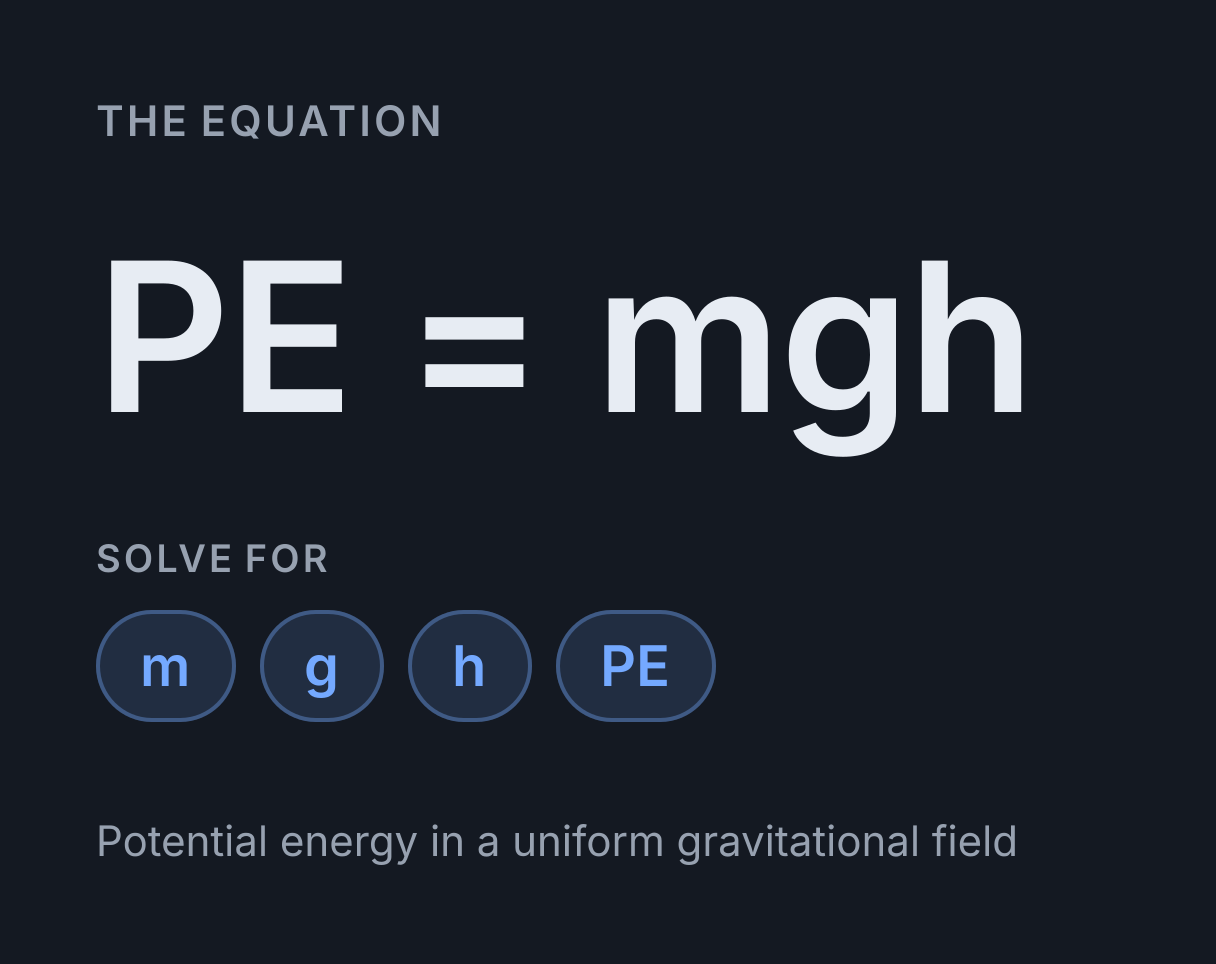
The equation
Potential energy in a uniform gravitational field
Height is work you can get back
PE = mgh is not a separate law. It is the work done against
gravity, written in a form you can look up. Raising a mass steadily needs an
upward force equal to its weight, mg, and carrying that force
through a height h costs mgh of work. Gravity is a
conservative force, so none of that work leaks away: it sits in the
arrangement of the mass and the Earth until the mass is allowed to fall. This
is also why the formula has no term for the route taken. A winding ramp and a
vertical shaft to the same landing store exactly the same energy.
The g in the middle is the local field strength, taken as
9.80665 m/s² by convention on Earth. Swap it and the same
lift costs something quite different: 1.625 on the Moon,
3.721 on Mars and 24.79 m/s² at the cloud
tops of Jupiter. Shelving a crate on Mars therefore takes about 38 per cent
of the energy it takes here, and on Jupiter about 2.53 times as much.
Worked example
A 2 kg mass is raised 10 m on Earth.
PE = m g h = 2 × 9.80665 × 10PE = 196.133 J- Released, all of it becomes kinetic:
mgh = 0.5 m v² v = √(2gh) = √(2 × 9.80665 × 10) = √196.133v = 14.00 m/s
That impact speed is 50.42 km/h, and the stored energy is
46.88 cal. Food labels count in kilocalories, so on a
label that is 0.047 kcal. The two numbers 196.133 J and
196.133 m²/s² look suspiciously alike, and the reason is arithmetic rather
than physics: with a mass of exactly 2 kg the factor 0.5 m
equals 1, so the joule figure and the square of the speed happen to
coincide. Change the mass to 5 kg and the energy rises to 490.3 J while the
impact speed stays at 14.00 m/s.
The fall does not care about the mass
Set mgh = 0.5 m v² and the mass cancels from both sides,
leaving v = √(2gh). Drop a 2 kg ball and a 200 kg ball from
10 m in a vacuum and both arrive at 14.00 m/s. Real air spoils this, and it
spoils it in favour of the heavier object, because drag depends on frontal
area and speed rather than mass. For a human body terminal speed is around
55 m/s, so past about 150 m of drop the square root formula starts to
overstate the arrival speed badly.
The same equation runs the largest energy stores on the grid. Pumped storage
hydroelectricity lifts water into a high reservoir when power is cheap and
lets it back down through turbines when it is not. One tonne of water raised
300 m holds 1000 × 9.80665 × 300 = 2.942 MJ, which is
0.817 kWh, enough to run a 100 W lamp for eight hours. The
volumes make the scheme work: a reservoir holding a million tonnes at that
head stores over 800 MWh.
Common mistakes
- Measuring the height along the slope. Only the vertical
rise belongs in
h. A 5 m ramp inclined at 30 degrees lifts a load 2.5 m, so it stores half the energy a careless reading suggests. - Leaving out
galtogether. Mass times height has units of kilogram metres, which is not energy. The9.80665is what converts a mass into the weight you are actually lifting. - Treating the zero of height as fixed. A book on a desk has one potential energy measured from the desk and another measured from the floor, and both are correct. Only the change carries physical meaning, so choose a reference, state it, and keep it for the whole problem.
- Trusting the impact speed where air matters. The
√(2gh)readout assumes free fall. It is close for a dense object over a few metres and useless for a leaf, a parachute or any long drop.
Converting units first? Use the mass, energy, length and acceleration conversion tables.
Worked examples
Each one runs through the calculator above, so the arithmetic here is the arithmetic it does.
How much potential energy does a 70 kg person gain climbing 20 m?
- PE = m x g x h
- = 70 x 9.80665 x 20
- = 13,729 J
About 13.7 kJ for climbing six storeys, the energy in under a gram of sugar. Muscles are only about a quarter efficient, so the body actually burns three or four grams to do it, and the rest leaves as heat.
How much energy is stored lifting a 500 g book onto a 2 metre shelf?
- PE = m x g x h
- = 0.5 x 9.80665 x 2
- = 9.8067 J
9.81 J, and the number is a coincidence worth not being confused by: it equals g numerically only because the mass and height happen to multiply to 1. The 500 g must become 0.5 kg first, since a joule is defined with kilograms.
What height gives a 2 kg mass 100 J of potential energy?
- h = PE / (m x g)
- = 100 / (2 x 9.80665)
- = 100 / 19.613
- = 5.0986 m
About 5.1 m. Unlike kinetic energy, potential energy is linear in the quantity you solve for here, so doubling the height exactly doubles the energy. That contrast with the square in kinetic energy is why a falling object gains less speed over each successive metre, even though its speed rises steadily with time.
Practise this with Mechanics Practice Problems, questions generated from this calculator and 10 other calculators in Mechanics.
Common questions
Potential energy relative to what?
Whatever height you call zero, and the choice is yours. Only the change in potential energy has physical meaning, so a book on a desk has one value measured from the desk and another measured from the floor. Both are correct. Pick a reference, state it, and stay with it for the whole problem.
Why does the impact speed not depend on mass?
Because mass appears on both sides. Setting mgh equal to half mv squared and cancelling the mass leaves v as the square root of 2gh. A heavy ball and a light one dropped from the same height arrive at the same speed in a vacuum, which is what Galileo was arguing about.
Does the path taken matter?
No. Gravity is a conservative force, so only the vertical change counts. Walking a long zigzag ramp to the top of a hill and climbing straight up give the same change in potential energy. The path changes the force you need and the work against friction, not the potential energy.