Capacitor Energy Calculator
Calculate the energy stored in a capacitor from capacitance and voltage, with the charge held, the electron count and what doubling the voltage does.
Calculator
Working, with your numbers
- E = 0.5 x C x V^2
- = 0.5 x 100 uF x (10 V)^2
- = 0.5 x 0.0001 x 100
- = 0.005 J = 5 mJ
Values are converted into the units the equation is worked in before the arithmetic.
- Charge stored Q = CV.
- 1 mC
- At double the voltage Energy goes as the square of voltage, so twice the volts stores four times the energy.
- 20 mJ
- Electrons moved
- 6.242 × 10¹⁵
Citing this tool
Last updated . Add the date you accessed it as well, which a citation of a page that can change asks for. If a specific result matters, cite the permalink from the tool’s share row instead of this page: it reproduces the exact parameters.
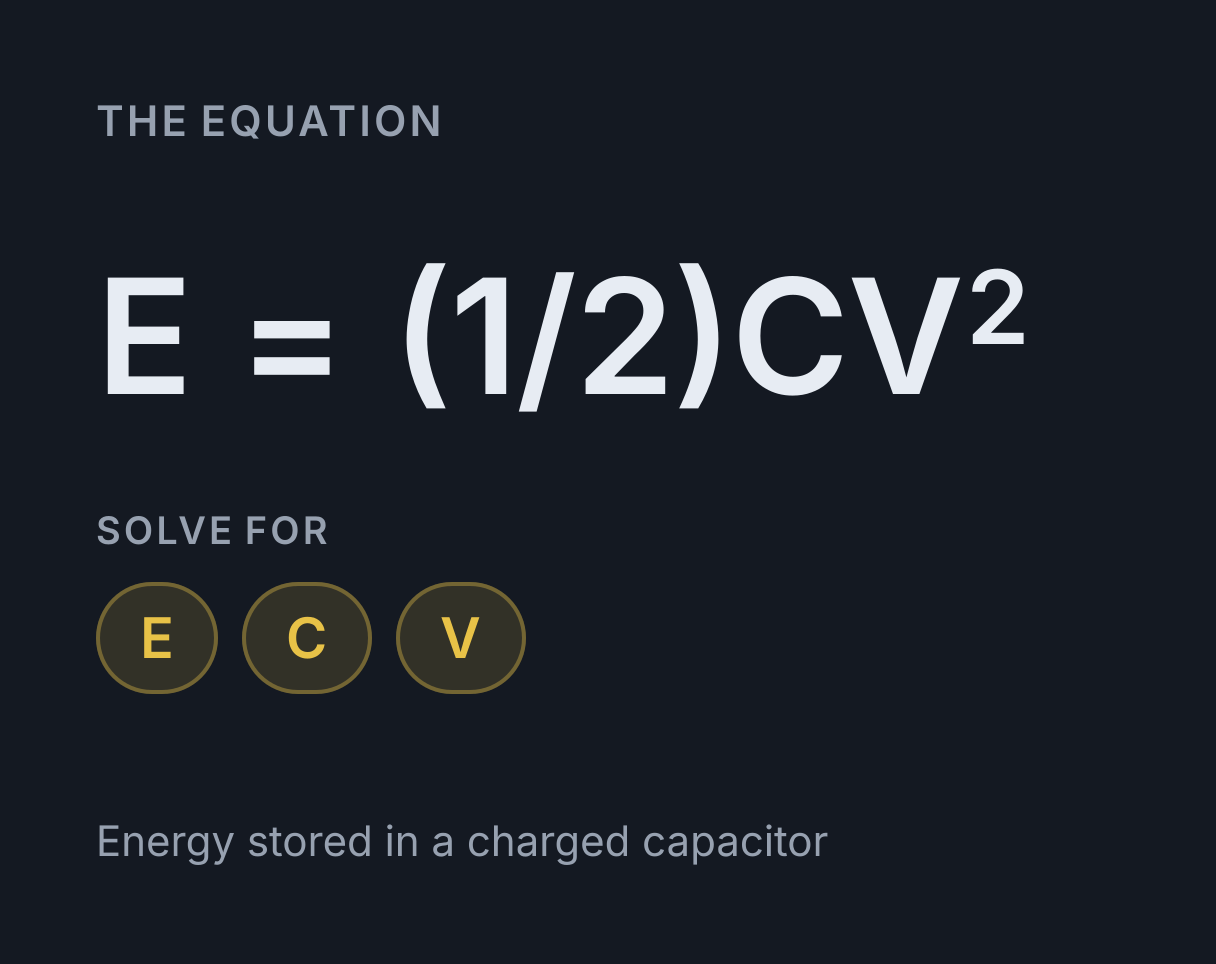
The equation
Energy stored in a charged capacitor
Where the half comes from
A capacitor does not accept charge at a constant voltage. It starts empty,
and every electron you push onto one plate raises the voltage that the next
electron has to climb. The first charge arrives against almost no
opposition, the last against the full voltage V. Averaged over
the whole charging process the opposing voltage is half the final value, and
that average is what the factor of a half records. It is the same
triangular-area argument that gives a stretched spring an energy of
½kx²: the resisting quantity grows linearly from zero, so the
work done is half of what a constant resistance would demand.
Charge itself follows the simpler relation Q = CV, with no half
in sight, because charge accumulates linearly while energy accumulates as
the area under the voltage against charge line. The consequence worth
remembering is that energy goes as the square of voltage.
Double the volts and you store four times the energy on the same capacitor,
which is why voltage rating, not capacitance, is usually the expensive part
of an energy storage design.
Worked example
A 100 µF capacitor is charged to 10 V, the values loaded above.
- Convert the capacitance:
100 µF = 1.00 × 10⁻⁴ F - Square the voltage:
V² = 10² = 100 V² E = ½ × 1.00 × 10⁻⁴ × 100 = 5.00 × 10⁻³ J = 5 mJ- Charge held:
Q = CV = 1.00 × 10⁻⁴ × 10 = 1 mC
Raise the supply to 20 V and the energy becomes
½ × 1.00 × 10⁻⁴ × 400 = 20 mJ, four times as much for twice the
voltage. The charge only doubles, to 2 mC. That 1 mC corresponds to about
6.24 × 10¹⁵ electrons moved from one plate to the other,
which the readouts show alongside the energy.
Why stored energy is a safety number, not a curiosity
Scale the same formula up and the result stops being academic. A
1000 µF capacitor in a mains power supply charged to
400 V holds ½ × 1.0 × 10⁻³ × 400² = 80 J.
That is enough to be lethal, and unlike a battery it can deliver the lot in
milliseconds. Nothing in the physics removes that charge when you switch off:
with no load path, a good capacitor can sit at working voltage for hours.
Equipment with a large reservoir capacitor should be bled through a resistor
and then measured with a meter before anyone reaches inside.
The comparison in the other direction is just as instructive. A single AA cell stores roughly 10,000 J, about two million times the 5 mJ above. Capacitors are poor energy stores by volume and by mass. What they offer is rate: they release their charge in microseconds without the chemistry that limits a battery, which is why they smooth power supplies and fire camera flashes rather than running a torch.
Common mistakes
- Dropping the half. Using
CV²overstates the energy by a factor of two. The half is not a convention, it is the integral of a linearly rising voltage. - Squaring the capacitance instead of the voltage. Only
Vis squared. Energy is linear in capacitance and quadratic in voltage, and the two are not interchangeable when you size a bank. - Missing a prefix. Microfarads, nanofarads and picofarads span six orders of magnitude, and a stray factor of a thousand is the most common source of a wrong answer here. The unit selector exists to remove the conversion step.
- Charging beyond the rated voltage. The formula returns a number for any voltage you type. A real capacitor breaks down past its rating, and an electrolytic can fail violently, so the working voltage is a hard limit rather than a guideline.
Converting units first? Use the energy, voltage and capacitance conversion tables.
Worked examples
Each one runs through the calculator above, so the arithmetic here is the arithmetic it does.
How much energy does a 120 µF capacitor store when charged to 330 V?
- E = 0.5 x C x V^2
- = 0.5 x 120 uF x (330 V)^2
- = 0.5 x 0.00012 x 108,900
- = 6.534 J = 6534 mJ
About 6.5 J, roughly what a compact camera’s flash capacitor holds. The battery charges it over a few seconds and the flash tube empties it in a millisecond or so, a burst of several kilowatts that no small battery could deliver directly. Rate, not capacity, is what the capacitor is for.
What voltage does a 1000 µF capacitor need to store 1 joule?
- V = sqrt(2 E / C)
- = sqrt(2 x 1 / 0.001)
- = sqrt(2000)
- = 44.721 V
About 44.7 V. Because energy goes as the square of voltage, the voltage needed rises only as the square root of the energy, so 4 J would take twice as much, 89 V, not four times. Pick a part rated comfortably above the working voltage, since the formula returns a figure whether the capacitor can survive it or not.
Practise this with Electricity Practice Problems, questions generated from this calculator and 6 other calculators in Electricity.
Common questions
Why is there a half in the formula?
Because the voltage rises as the capacitor charges rather than staying constant. The first electrons arrive against no opposing voltage and the last against the full voltage, so the average is half the final value. Integrating gives half CV squared, the same triangular-area argument as the energy in a stretched spring.
Why do large capacitors stay dangerous after power off?
Because nothing has removed the charge. A 1000 µF capacitor at 400 V holds 80 joules, which is enough to be lethal, and it can sit charged for a long time with no load. Equipment with a large supply capacitor should be discharged through a resistor and measured before anyone touches it.
How does the energy compare to a battery?
It is tiny for the same size. A 100 µF capacitor at 10 V holds 5 millijoules, while a single AA cell holds around 10,000 joules, roughly two million times more. Capacitors win on how fast they can deliver and absorb energy, not on how much they hold.