RC Time Constant Calculator
Calculate the RC time constant, cutoff frequency and settling time from resistance and capacitance, or work backwards from a target time constant.
Calculator
Working, with your numbers
- tau = R x C
- = 10 kohm x 100 nF
- = 10,000 x 1 × 10⁻⁷
- = 0.001 s = 1 ms
Values are converted into the units the equation is worked in before the arithmetic.
- Cutoff frequency f = 1 / (2πRC), the −3 dB point of a single-pole filter.
- 159.2 Hz
- 63% charged at
- 1 ms
- Settled (5τ) After 5 time constants a capacitor is 99.3% charged.
- 5 ms
Citing this tool
Last updated . Add the date you accessed it as well, which a citation of a page that can change asks for. If a specific result matters, cite the permalink from the tool’s share row instead of this page: it reproduces the exact parameters.
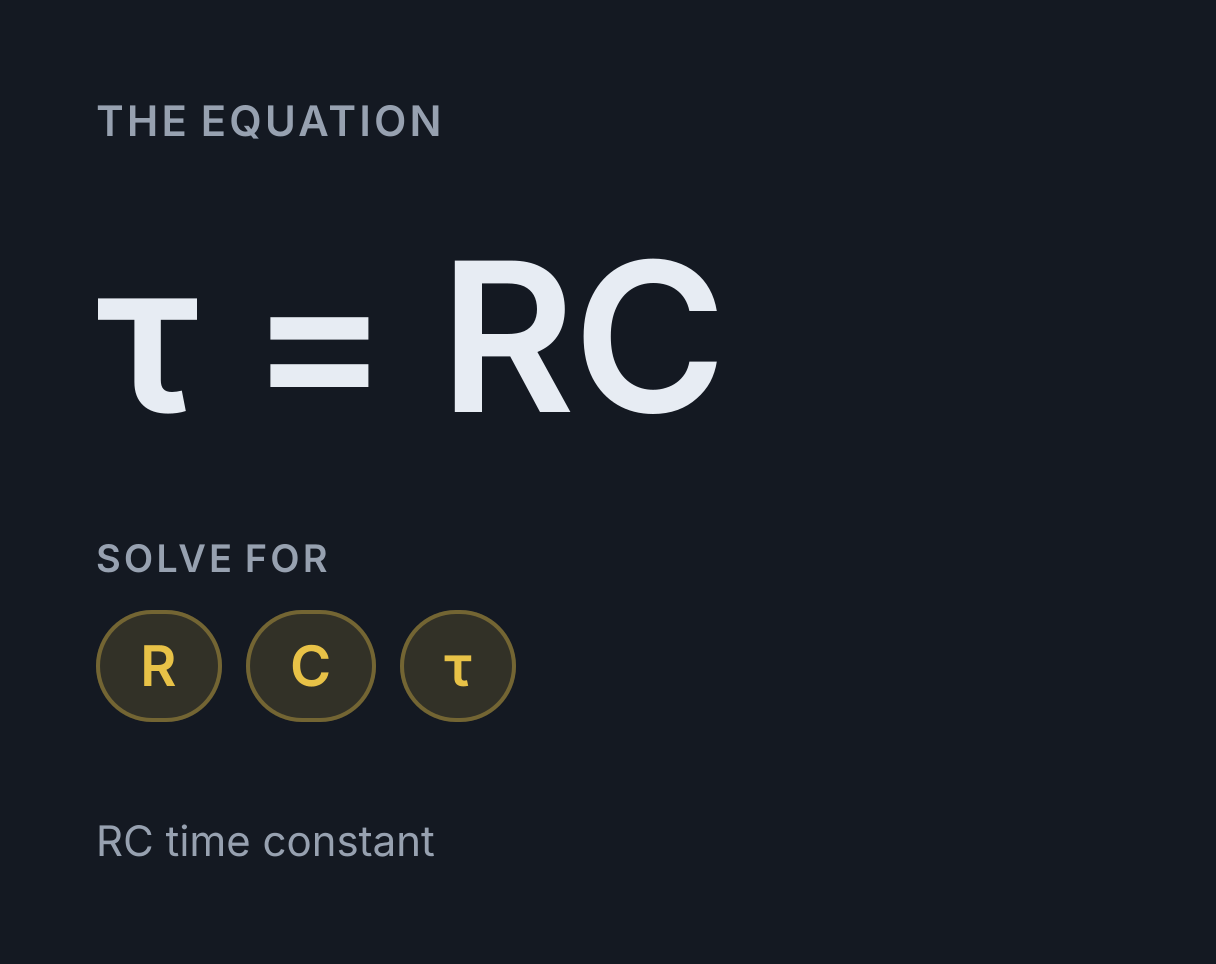
The equation
RC time constant
What the time constant describes
A resistor feeding a capacitor cannot change the capacitor’s voltage
instantly, because the resistor limits how fast charge arrives. The rate is
set by the product of the two components, τ = R × C, which has
units of seconds: ohms times farads. The charging curve is exponential, so
the capacitor closes the remaining gap to the supply voltage by the same
fraction in every interval of one time constant rather than climbing at a
steady rate.
That fraction is 1 - 1/e, or 63.2 percent. After one time
constant the capacitor has reached 63.2 percent of the
supply, after two 86.5 percent, after three
95.0 percent, and after five
99.3 percent, which is the usual engineering definition of
settled. Discharging follows the mirror image: after one time constant the
voltage has fallen to 36.8 percent of where it started.
Worked example
A 10 kΩ resistor drives a 100 nF capacitor.
-
τ = 10000 Ω × 100 × 10⁻⁹ F = 1 × 10⁻³ s = 1 ms -
Cutoff frequency:
f = 1 / (2πRC) = 1 / (2π × 1 × 10⁻³) = 159.2 Hz -
From a 5 V step, the output passes
0.632 × 5 = 3.16 Vafter 1 ms. -
Settling to 99.3 percent takes
5τ = 5 ms.
Time constant and cutoff frequency are one number
τ and f = 1/(2πRC) are two readings of the same
circuit, one in the time domain and one in the frequency domain. A long
time constant means a low cutoff frequency: the network responds slowly to
steps and passes only slow changes, attenuating anything faster. A short
time constant means a high cutoff and a circuit that follows fast edges.
Choosing one fixes the other, which is why a filter cannot both settle
quickly and reject low-frequency noise.
Two everyday uses show the trade-off. A switch debounce network wants a time constant longer than the mechanical bounce, typically a few milliseconds, so the contact chatter is smoothed away while a genuine press still registers without noticeable delay. An anti-aliasing filter ahead of an analogue-to-digital converter wants its cutoff below half the sampling rate, so components are picked from the frequency requirement and the settling time follows from it.
Common mistakes
- Mixing prefixes. Kilohms with microfarads give milliseconds, kilohms with nanofarads give microseconds. Reading a datasheet value in the wrong prefix is a factor-of-1000 error in the answer.
- Assuming one time constant is full charge. One
τreaches 63.2 percent. Allow three for 95 percent and five where the residual error has to be under one percent. - Forgetting the source resistance. The output impedance
of whatever drives the network adds to
R. A 1 kΩ source feeding a 1 kΩ resistor doubles the time constant. - Trusting an electrolytic’s nominal value. Tolerances of −20 to +80 percent are common, and capacitance falls with age, so electrolytics suit power smoothing rather than timing. Use film or C0G ceramic parts where the time constant matters.
Converting units first? Use the time, resistance and capacitance conversion tables.
Worked examples
Each one runs through the calculator above, so the arithmetic here is the arithmetic it does.
What is the time constant of a 1 MΩ resistor with a 10 µF capacitor?
- tau = R x C
- = 1000 kohm x 10,000 nF
- = 1 × 10⁶ x 1 × 10⁻⁵
- = 10 s = 10,000 ms
10 seconds, because megohms times microfarads gives seconds directly, the same cancellation that makes kilohms with nanofarads give microseconds. At a megohm, other paths start to compete with the resistor: a 10 MΩ meter connected across the capacitor cuts the time constant to about 9.1 s, and an electrolytic’s leakage current acts the same way.
What capacitor gives a 0.5 second time constant with a 47 kΩ resistor?
- C = tau / R
- = 500 ms / 47 kohm
- = 0.5 / 47,000
- = 1.064 × 10⁻⁵ F = 10,638 nF
10.6 µF, which is not a value capacitors are sold in. The standard 10 µF gives 0.47 s, 6 percent short, which is inside a typical electrolytic’s tolerance anyway. Where the time matters, fit the 10 µF and adjust the resistor instead, since resistors come in finer steps and much tighter tolerances.
Practise this with Electricity Practice Problems, questions generated from this calculator and 6 other calculators in Electricity.
Common questions
What does the time constant actually mean?
After one time constant a charging capacitor has reached 63.2 percent of the supply voltage, and a discharging one has fallen to 36.8 percent. After five time constants it is within 0.7 percent of its final value, which is the usual engineering definition of settled.
How does the time constant relate to cutoff frequency?
They are two views of the same number: f = 1/(2πRC). A long time constant means a low cutoff frequency and a filter that passes only slow changes. A 10 kΩ resistor with a 100 nF capacitor gives a 1 ms time constant and a 159 Hz cutoff.