Heating Curve Calculator
Total energy to take a substance across its phase changes, stage by stage, showing what a single m c dT across the whole range leaves out.
Calculator
kJ total
5 stages, of which phase changes are 83.8%. A single m c dT would give 58.58 kJ.
| Stage | Type | ΔT, K | Energy, kJ | Share |
|---|---|---|---|---|
| warm the solid | warming | 20 | 4.18 | 1.35% |
| melt | phase change | 0 | 33.4 | 10.8% |
| warm the liquid | warming | 100 | 41.84 | 13.5% |
| boil | phase change | 0 | 226 | 73% |
| warm the gas | warming | 20 | 4.02 | 1.3% |
Working, stage by stage
- warm the solid = 100 x 2.09 x 20 = 4180 J = 4.18 kJ
- melt = 100 x 334 = 33,400 J = 33.4 kJ
- warm the liquid = 100 x 4.184 x 100 = 41,840 J = 41.84 kJ
- boil = 100 x 2260 = 226,000 J = 226 kJ
- warm the gas = 100 x 2.01 x 20 = 4020 J = 4.02 kJ
- total = 4.18 + 33.4 + 41.84 + 226 + 4.02 = 309.44 kJ
- Phase changes are 83.8% of the total. One m c dT across the whole range would give 58.58 kJ.
A phase change happens at constant temperature, so it has no ΔT and needs m L rather than m c ΔT. Missing those is what makes a single m c ΔT so far out.
Citing this tool
Last updated . Add the date you accessed it as well, which a citation of a page that can change asks for. If a specific result matters, cite the permalink from the tool’s share row instead of this page: it reproduces the exact parameters.
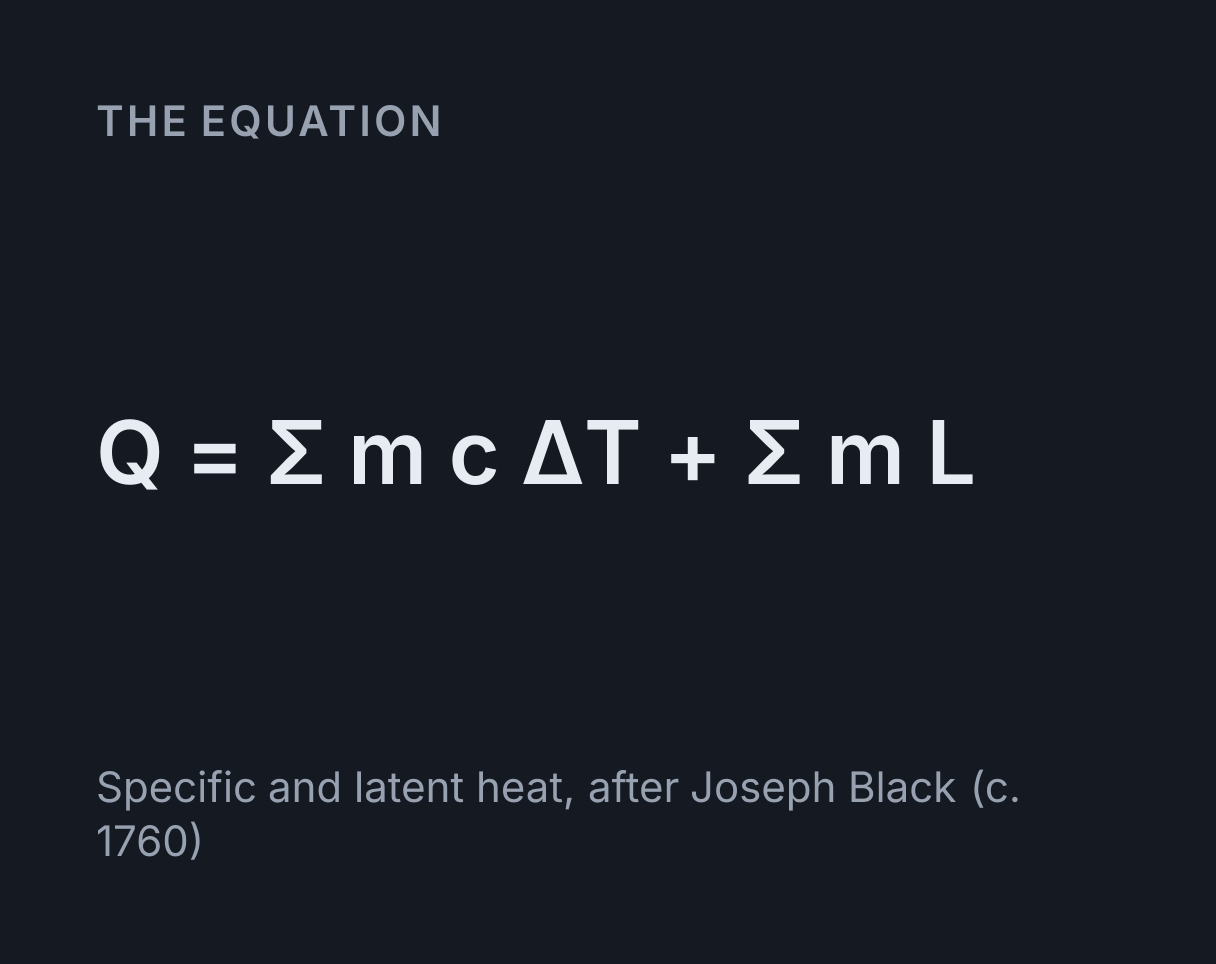
The equation
Specific and latent heat, after Joseph Black (c. 1760)
A heating curve is five calculations, not one
Supply heat to a block of ice at a steady rate and plot temperature against energy supplied. The line climbs, flattens completely at 0 °C, climbs again more gently, flattens for far longer at 100 °C, then climbs once more. Five sections, and the two flat ones are where most of the energy goes.
Each sloped section is Q = m c ΔT with the specific heat of that
phase. Each plateau is Q = m L, with no temperature term at all,
because the energy is breaking bonds rather than speeding molecules up. Nothing
about the arithmetic is hard; the mistake is in the counting.
What a single m c ΔT leaves out
Take 100 g of water from minus 20 °C to 120 °C. The five stages are 4.18 kJ to warm the ice, 33.4 kJ to melt it, 41.8 kJ to warm the water, 226 kJ to boil it, and 4.02 kJ to warm the steam, totalling 309 kJ.
One m c ΔT across the whole 140 K, using the liquid’s specific heat,
gives 100 × 4.184 × 140 = 58.6 kJ. That is 19 percent of the real
answer. Boiling alone is more than the entire naive figure, which is the useful
thing to notice: the plateaus are not a correction to the calculation, they are the
calculation.
Why the slopes differ
Water is 4.184 J per gram per kelvin as a liquid, 2.09 as ice and about 2.01 as steam. The liquid is roughly twice as hard to warm, so on a graph against energy supplied its section is about half as steep as the other two. Using the liquid value everywhere is a common shortcut and it overstates the solid and gas stages by close to a factor of two.
That difference is why the properties are editable above. Tables disagree slightly on the specific heat of steam, which varies with temperature and pressure, and for any substance other than water the values are worth checking against whatever source your course uses rather than trusting a default.
Starting or ending on a boundary
At a melting or boiling point the temperature alone does not say which phase the substance is in, so the question has to. Ice sitting at 0 °C is still ice, and the full latent heat of fusion is owed before the temperature moves again. Taking 100 g of ice at 0 °C to water at 50 °C is 33.4 kJ to melt and 20.9 kJ to warm, and dropping the first term makes the answer about 61 percent too low.
Ending on a boundary usually works the other way round. Water that has just reached 100 °C is still liquid, so heating it to its boiling point costs no latent heat at all: 100 g from 20 °C takes 33.5 kJ. The 226 kJ of boiling is owed only if the question asks for steam, and then that single stage is larger than everything else combined.
By default this calculator includes a phase change whenever the interval reaches its temperature, at either end. A start exactly at a transition is therefore taken as the lower phase, as with ice at 0 °C, and an end exactly at one as the upper phase: an interval ending at 100 °C is answered for steam, 259 kJ for that same water, and one ending at 0 °C includes the melting. Where an end sits exactly on a transition, the calculator asks which phase it is in, starting from that reading, and the working states the one it used.
Common mistakes
- One m c ΔT for the whole range. The single biggest error in thermal physics, and for water across both phase changes it is out by a factor of five.
- Using the liquid specific heat for the solid and the gas. Off by about a factor of two for water in both directions.
- Putting a ΔT into m L. A phase change happens at constant temperature. There is no ΔT to supply.
- Mixing J/g with J/kg. Water’s latent heat of fusion is 334 J/g or 334,000 J/kg. Pairing the per-kilogram figure with a mass in grams is out by a thousand.
- Assuming the answer scales with temperature range. It does not, because the plateaus do not depend on the range at all. Widening the interval by 10 K adds a little; crossing a boiling point adds an enormous amount.
Common questions
Why can I not just use one m c ΔT for the whole range?
Because a phase change absorbs energy at constant temperature, so it contributes nothing to ΔT and everything to the total. Taking 100 g of water from minus 20 °C to 120 °C needs 309 kJ, while one m c ΔT with the liquid’s specific heat gives 58.6 kJ. That is under a fifth of the real figure, and the melting and boiling alone are 84 percent of the total.
Why does each phase have a different specific heat?
Because the energy has different places to go in each. Water is 4.184 J per gram per kelvin as a liquid, 2.09 as ice and about 2.01 as steam, so the liquid stage of a heating curve is roughly half as steep as the solid and gas stages when drawn against energy supplied. Using the liquid value throughout is a common shortcut and it overstates the solid and gas stages by about a factor of two.
What if my substance starts exactly at its melting point?
At its melting point a substance can be solid or liquid, and temperature alone cannot tell them apart, so this calculator lets you choose. Unless you pick the liquid it starts from the solid, so the full latent heat of fusion is counted before the temperature moves again. For 100 g of ice at 0 °C going to 50 °C, that is 33.4 kJ to melt it and only then 20.9 kJ to warm the water, and omitting the first term makes the answer about 61 percent too low.