Albumin Corrected Calcium Calculator
Correct total serum calcium for a low albumin by Payne’s formula, in mg/dL and mmol/L, with the working shown and the formula’s limits stated.
Calculator
Total calcium as the laboratory reports it. Typical reference interval 8.5 to 10.5 mg/dL.
Divide by 10 if your report gives g/L, so 20 g/L is 2.0 g/dL.
Working, with your numbers
- Ca corrected = Ca measured + 0.8 x (4.0 - albumin)
- = 7.5 + 0.8 x (4.0 - 2)
- = 7.5 + 0.8 x 2
- = 7.5 + 1.6
- = 9.1 mg/dL
Values are converted into the units the equation is worked in before the arithmetic.
- Correction applied How much the low albumin was masking. Zero when albumin is exactly 4.0 g/dL, since there is then nothing to correct for.
- +1.6 mg/dL
- Corrected, in SI Calcium in mg/dL divided by 4.008 gives mmol/L. That is the atomic mass of 40.078 divided by 10, for the decilitres in a litre. The valency of 2 only enters for mEq/L.
- 2.27 mmol/L
- Corrected value reads as Against a typical reference interval, which is not your laboratory’s. Compare against the range printed on the report.
- Within 8.5 to 10.5
- Albumin The same albumin in the SI unit most reports outside the United States use.
- 20 g/L
Citing this tool
Last updated . Add the date you accessed it as well, which a citation of a page that can change asks for. If a specific result matters, cite the permalink from the tool’s share row instead of this page: it reproduces the exact parameters.
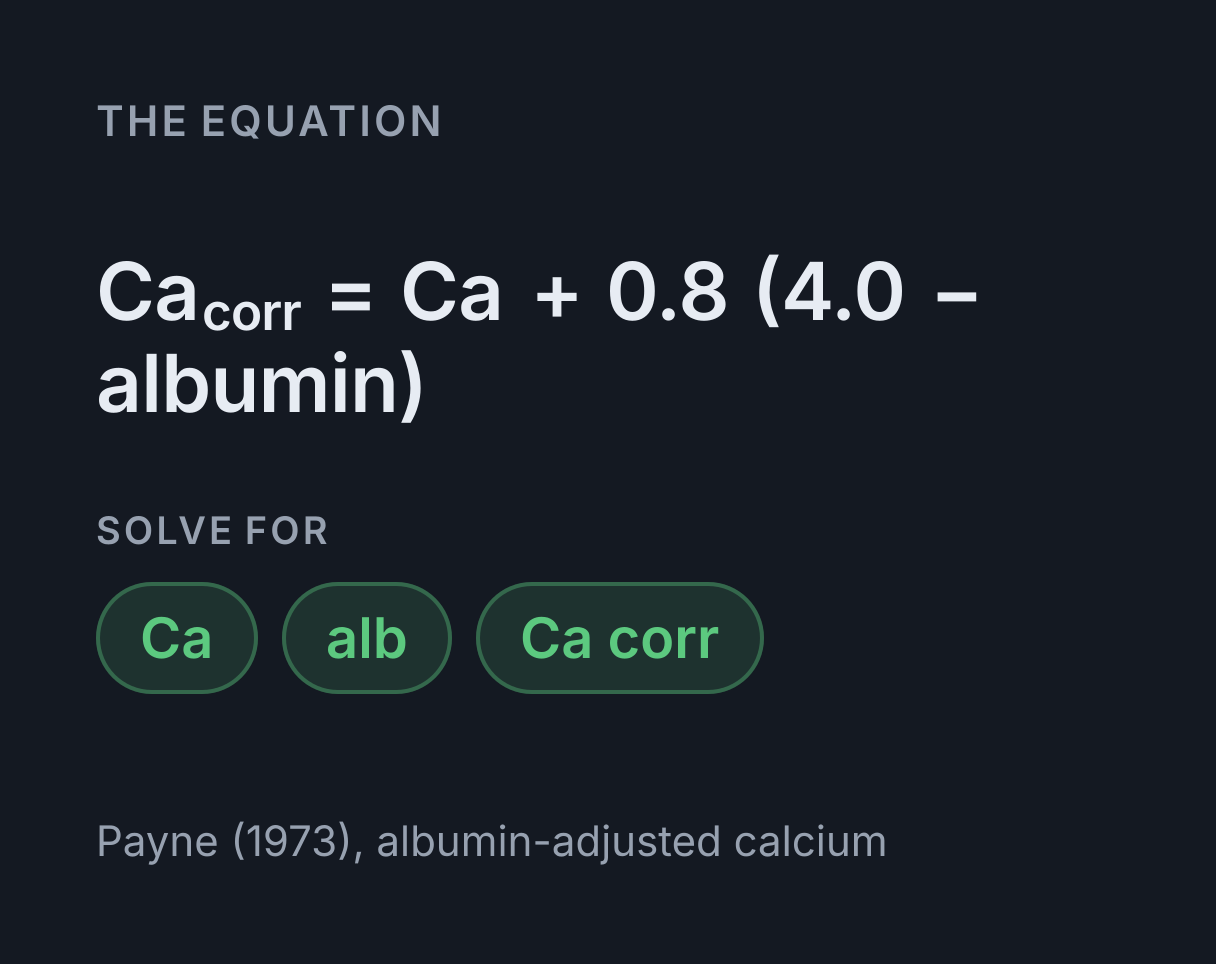
The equation
Payne (1973), albumin-adjusted calcium
Why a total calcium moves with albumin
Albumin corrected calcium estimates what a total serum calcium would read if albumin were
normal, using Payne’s formula,
corrected Ca (mg/dL) = measured Ca + 0.8 × (4.0 − albumin in g/dL). A total
serum calcium adds together pools that behave completely differently. Roughly
45 percent is bound to protein, most of it to albumin and the rest to globulins, and that fraction is
biologically inert. Another 10 percent or so is complexed to citrate, phosphate and
bicarbonate. The remaining 45 percent is free ionised calcium, and that is the only
part that does anything: it sets the threshold for nerve and muscle excitability,
drives cardiac contraction, and is what the parathyroid gland senses.
When albumin falls, the bound pool shrinks with it. The ionised fraction is unaffected, because parathyroid hormone regulates that directly and does not care how much protein is available for binding. So the total falls while the physiologically active concentration stays exactly where it was. A patient with cirrhosis, nephrotic syndrome or simply weeks of poor intake can show a total calcium of 7.4 mg/dL and have entirely normal calcium physiology.
The correction is an attempt to undo that arithmetic: it estimates what the total would have read had albumin been normal, so a low total from hypoalbuminaemia is not treated as hypocalcaemia.
The formula, in both unit systems
Payne and colleagues published it in the British Medical Journal in 1973. The 0.8 is how much total calcium in mg/dL is carried per g/dL of albumin, and 4.0 g/dL is the reference albumin the correction normalises towards.
- Conventional units.
corrected Ca (mg/dL) = measured Ca + 0.8 × (4.0 − albumin in g/dL) - SI units.
corrected Ca (mmol/L) = measured Ca + 0.02 × (40 − albumin in g/L)
These are the same correction with the units carried through, not two different rules. Mixing them is the error to watch for: an Indian or British report gives albumin in g/L, so entering 20 into the mg/dL version produces a correction of minus 12.8 mg/dL instead of plus 1.6. Divide g/L by 10 before using the conventional formula.
To move calcium itself between units, divide mg/dL by 4.008 to get mmol/L. The factor is calcium’s atomic mass, 40.078, divided by the 10 that turns decilitres into litres, so it is specific to calcium: using glucose’s 18 or a generic 10 here is a classic source of nonsense. Valency matters only for mEq/L, where the divisor is 2.004.
Worked reasoning
Take a measured calcium of 7.5 mg/dL with an albumin of 2.0 g/dL.
- Albumin is 2.0 below the reference of 4.0.
- Correction is
0.8 × 2.0 = 1.6 mg/dL. - Corrected calcium is
7.5 + 1.6 = 9.1 mg/dL, comfortably normal. - In SI,
9.1 / 4.008 = 2.27 mmol/L.
So the low total is fully explained by the albumin, and there is no calcium disorder to treat. Giving calcium here would be treating an artefact of the assay.
The correction runs the other way too, which is often forgotten. A calcium of 10.4 mg/dL with an albumin of 5.0 g/dL corrects down to 9.6, moving it from the top of the range into the middle. A high albumin usually means dehydration or a tourniquet left on too long, so it is worth asking whether the sample explains the result before the patient does.
How much to trust it
Less than its popularity suggests. Studies comparing corrected calcium against directly measured ionised calcium find the correction misclassifies a substantial minority of patients, and it fails in predictable directions:
- Chronic kidney disease. It over-corrects, labelling people as hypercalcaemic who are not. Binding is altered by uraemia and by acidosis, and the 1973 coefficient does not describe it.
- Critical illness. Free fatty acids and pH both change how much calcium albumin holds, and both move fast in a sick patient. Acidosis frees calcium from albumin, alkalosis binds more, which is why hyperventilation causes tetany at an unchanged total calcium.
- Extremes of albumin. The relationship is treated as linear across the whole range, and it is not.
- Multiple myeloma and other paraproteinaemias. The binding protein is not albumin, so an albumin based correction does not describe the situation at all.
The practical rule: use the correction to reason about why a total calcium is low, and to answer an examination question. When the answer will change what you do, ask for an ionised calcium, which is the reference standard and is available on most blood gas analysers within minutes.
Common mistakes
- Correcting when albumin is normal. At exactly 4.0 g/dL the correction term is zero, so a genuinely low calcium with a normal albumin is genuinely low. The correction cannot explain it away and looking for a cause is the next step.
- Mixing g/L albumin into the mg/dL formula. The single most common error, and it produces an answer that is wrong by more than 14 mg/dL.
- Ignoring pH. Corrected calcium says nothing about acid base state, yet alkalosis can produce symptomatic hypocalcaemia with a perfectly normal corrected value. This is why the tetany of hyperventilation is invisible to this calculation.
- Treating the corrected value as a measurement. It is an estimate derived from two measurements, and it inherits the error in both.
Worked examples
Each one runs through the calculator above, so the arithmetic here is the arithmetic it does.
Is a calcium of 7.5 mg/dL low if the albumin is only 2.0 g/dL?
- Ca corrected = Ca measured + 0.8 x (4.0 - albumin)
- = 7.5 + 0.8 x (4.0 - 2)
- = 7.5 + 0.8 x 2
- = 7.5 + 1.6
- = 9.1 mg/dL
No. The corrected value is comfortably normal, so the low total is entirely explained by the albumin and there is no calcium disorder to treat. Giving calcium here would be treating an artefact of how the assay adds two different pools together.
How do I correct a calcium of 8.2 mg/dL for an albumin of 2.8 g/dL?
- Ca corrected = Ca measured + 0.8 x (4.0 - albumin)
- = 8.2 + 0.8 x (4.0 - 2.8)
- = 8.2 + 0.8 x 1.2
- = 8.2 + 0.96
- = 9.16 mg/dL
A smaller albumin deficit means a smaller correction, and the relationship is linear at 0.8 mg/dL of calcium per g/dL of albumin. If your report gives albumin as 28 g/L, divide by 10 first, because putting 28 into this formula subtracts 19.2 instead of adding 0.96.
What albumin would make a calcium of 7.0 mg/dL correct to a normal 8.8?
- albumin = 4.0 - (Ca corrected - Ca measured) / 0.8
- = 4.0 - (8.8 - 7) / 0.8
- = 4.0 - 2.25
- = 1.75 g/dL
Working backwards asks how much hypoalbuminaemia would be needed to explain the result, and 1.75 g/dL is profoundly low. If the measured albumin is nowhere near that, the correction cannot explain the calcium and a genuine cause has to be found.
Practise this with Lab and Clinical Calculation Practice Problems, questions generated from this calculator and 9 other calculators in Biology.
Common questions
Why does calcium need correcting for albumin at all?
Because a total calcium measures two different pools added together. Roughly half is bound to protein, mostly albumin, and is biologically inert, while the free ionised fraction is the part that matters for nerve and muscle function. When albumin falls the bound pool shrinks and the total falls with it, even though the ionised fraction is untouched. Correcting estimates what the total would read if albumin were normal, so that a low total caused by low albumin is not mistaken for genuine hypocalcaemia.
How reliable is Payne’s formula?
Not very, and this is worth knowing before relying on it. It was derived in 1973 from a hospital population and it validates poorly against measured ionised calcium. It over-corrects in chronic kidney disease, where it can label people as hypercalcaemic who are not, and it performs badly at the extremes of albumin and in critical illness where binding is altered by pH and free fatty acids. It remains examined and remains useful for reasoning about why a total calcium is low. When the answer will change management, measure ionised calcium instead.
What is the formula in mmol/L?
Corrected calcium in mmol/L equals measured calcium plus 0.02 times (40 minus the albumin in g/L). It is the identical correction with the units carried through, since 0.8 mg/dL of calcium per g/dL of albumin becomes 0.02 mmol/L per g/L. Mixing the two versions is a common error: entering an albumin of 20 g/L into the mg/dL formula produces a correction of minus 12.8 mg/dL rather than plus 1.6.
Should I correct calcium when albumin is high?
Yes, and the correction goes downwards. Above the reference albumin of 4.0 g/dL the bound pool is larger than usual, so the total overstates the ionised fraction. A calcium of 10.4 mg/dL with an albumin of 5.0 g/dL corrects to 9.6, which moves it from the top of the range to the middle. A high albumin usually means dehydration or a tourniquet left on too long, so it is worth asking whether the sample itself explains the result.