Mean Arterial Pressure Calculator
Find mean arterial pressure from a blood pressure reading, with pulse pressure, the kPa equivalent and every line of the substitution shown.
Calculator
Working, with your numbers
- MAP = DBP + (SBP - DBP) / 3
- = 80 + (120 - 80) / 3
- = 80 + 13.33
- = 93.33 mmHg
Values are converted into the units the equation is worked in before the arithmetic.
- Pulse pressure Systolic minus diastolic. A wide pulse pressure points at a stiff aorta or aortic regurgitation, a narrow one at a low stroke volume.
- 40 mmHg
- In kPa 1 mmHg = 0.1333 kPa. European reports often use kPa.
- 12.44 kPa
- Above the 65 mmHg threshold 65 mmHg is the MAP target used in the sepsis guidelines as the point below which organ perfusion is assumed to be at risk. It is a resuscitation target, not a definition of normality.
- Yes
Citing this tool
Last updated . Add the date you accessed it as well, which a citation of a page that can change asks for. If a specific result matters, cite the permalink from the tool’s share row instead of this page: it reproduces the exact parameters.
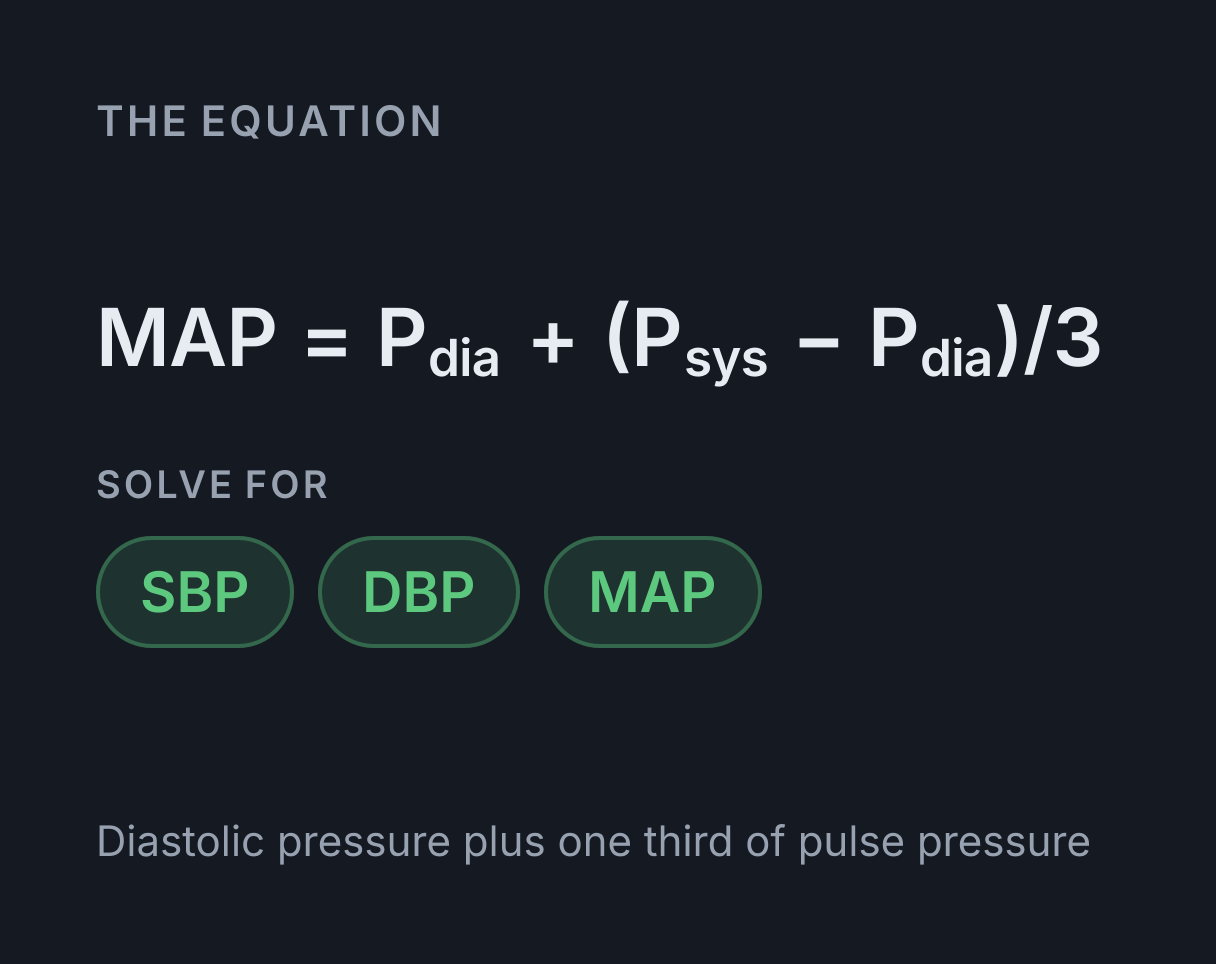
The equation
Diastolic pressure plus one third of pulse pressure
What mean arterial pressure actually is
Mean arterial pressure, MAP, is estimated from a cuff reading as
MAP = diastolic + (systolic − diastolic) / 3, which weights the
diastolic pressure twice as heavily as the systolic. It is the average
pressure in the arteries across one whole cardiac cycle, and it
is the pressure that drives blood into tissue. That makes it the more useful
number of the two you can read off a cuff: perfusion of the kidney, brain and gut
depends on the mean, not on the peak. A systolic pressure of 160 with a diastolic
of 60 and one of 110 with a diastolic of 85 both give a MAP in the low nineties,
and both perfuse similarly, despite looking like very different readings.
The average is not the midpoint, because the heart does not spend equal time at each pressure. At a resting rate, diastole lasts about twice as long as systole, so the pressure sits closer to the diastolic value for most of the cycle. That is the whole content of the formula:
MAP = diastolic + (systolic − diastolic) / 3- which rearranges to
MAP = (systolic + 2 × diastolic) / 3
The second form makes the weighting explicit. Diastole gets two of the three shares. A useful consequence for checking your own arithmetic: adding 3 mmHg to the diastolic pressure moves MAP by 2, while adding 3 to the systolic moves it by only 1.
Where the one third rule fails
The weighting assumes a normal heart rate, and it is the first thing to go in tachycardia. As the rate climbs, diastole shortens far more than systole does, because systole is largely fixed by the mechanics of contraction while diastole is simply whatever time is left over. At 150 beats per minute diastole no longer occupies two thirds of the cycle, so weighting it as though it does underestimates the true mean.
True mean arterial pressure is the time integral of the arterial pressure waveform divided by the cycle length, which is exactly what an arterial line computes and displays. When an arterial trace is available its MAP is the number to trust, and it will not generally equal the value this formula gives from the same systolic and diastolic figures. The formula is for a cuff reading at an ordinary rate, which is the situation it was built for.
Two further situations where the calculated value misleads. In severe aortic regurgitation the diastolic pressure falls away as blood runs back into the ventricle, so the waveform is nothing like the assumed shape. And an automated oscillometric cuff does not measure systolic and diastolic pressure directly at all: it estimates the mean from the point of maximum oscillation and derives the other two, so on many monitors the displayed MAP is the measured quantity and the systolic and diastolic are the estimates, which is the reverse of what most people assume.
Pulse pressure carries separate information
Pulse pressure is systolic minus diastolic, normally around 40 mmHg. It is not a component of MAP so much as an independent reading of what the heart and the aorta are doing, and two patients with the same MAP can have very different pulse pressures and very different problems.
- Wide. A stiff aorta, which is why pulse pressure rises steadily with age and why isolated systolic hypertension is the common pattern in the elderly. Also aortic regurgitation, thyrotoxicosis, anaemia and any other state with a large stroke volume or a fast diastolic run off.
- Narrow. A small stroke volume reaching the aorta: cardiogenic shock, severe aortic stenosis, tamponade, or significant hypovolaemia. A narrowing pulse pressure in someone bleeding is an earlier sign than a falling systolic, because compensatory vasoconstriction holds the diastolic pressure up while the stroke volume is already falling.
The 65 mmHg threshold, and what it is not
A MAP of 65 mmHg is the initial resuscitation target in the sepsis guidelines. It was chosen as roughly the pressure below which autoregulation begins to fail in the kidney and brain of most adults, which is the point at which blood flow starts to follow pressure instead of being held constant.
It is a threshold for acting, not a definition of normality, and it is not universal. Someone with long standing untreated hypertension has their autoregulatory range shifted upwards and may need a higher mean to perfuse the same organs, which is why chasing a single number in that patient can cause the injury it is meant to prevent. A young, fit adult can be perfectly well perfused below it. Read it as a floor worth investigating rather than a target to hit.
Common mistakes
- Averaging systolic and diastolic. The midpoint of 120 and 80 is 100, but MAP is 93.3. The error is small at normal pressures and grows with pulse pressure: at 180 over 60 the midpoint gives 120 against a true MAP of 100.
- Using the formula on an arterial trace that shows its own MAP. The monitor has integrated the actual waveform. Recomputing from the systolic and diastolic throws that away.
- Treating MAP as interchangeable with systolic pressure for stroke risk. Systolic pressure and pulse pressure predict cardiovascular events in older adults better than the mean does. MAP is the perfusion number, not the risk number.
- Comparing a cuff MAP against an arterial line MAP and expecting agreement. They are measuring by different principles and routinely differ by 5 to 10 mmHg, more if the cuff is the wrong size or the limb is not at heart level.
Converting units first? Use the pressure conversion table.
Worked examples
Each one runs through the calculator above, so the arithmetic here is the arithmetic it does.
What is the mean arterial pressure for a blood pressure of 120 over 80?
- MAP = DBP + (SBP - DBP) / 3
- = 80 + (120 - 80) / 3
- = 80 + 13.33
- = 93.33 mmHg
Not 100, which is what averaging the two gives. Diastole lasts about twice as long as systole at a resting rate, so the mean sits nearer the diastolic value and gets two of the three shares.
What is the mean arterial pressure in shock at 85 over 45?
- MAP = DBP + (SBP - DBP) / 3
- = 45 + (85 - 45) / 3
- = 45 + 13.33
- = 58.33 mmHg
Below the 65 mmHg threshold used as a resuscitation target in sepsis, so this is the reading that prompts action. Note the pulse pressure of 40 is normal even though the pressure is not, so pulse pressure alone would have looked reassuring.
What diastolic pressure is needed for a MAP of 65 at a systolic of 90?
- DBP = (3 MAP - SBP) / 2
- = (3 x 65 - 90) / 2
- = 105 / 2
- = 52.5 mmHg
Rearranged for the diastolic rather than the mean, which is the form worth knowing when a monitor shows a MAP and a systolic but the diastolic trace is damped. Solving the other way also shows why a low diastolic pulls the mean down faster than a low systolic does.
Practise this with Lab and Clinical Calculation Practice Problems, questions generated from this calculator and 9 other calculators in Biology.
Common questions
Why is diastolic pressure weighted twice as heavily as systolic?
Because the heart spends about twice as long in diastole as in systole at a normal rate, so arterial pressure sits nearer the diastolic value for most of each cycle. Rearranging the formula shows this directly: MAP = (systolic + 2 x diastolic) / 3. Raising the diastolic pressure by 3 mmHg moves MAP by 2 mmHg, while raising the systolic by 3 mmHg moves it by only 1.
Why does the one third rule break down in tachycardia?
Because diastole shortens far more than systole does as the heart speeds up. The one third weighting assumes diastole occupies roughly two thirds of the cycle, and at 150 beats per minute it no longer does, so the formula underestimates the true mean. True mean arterial pressure is the time average of the whole arterial waveform, which is what an arterial line integrates and reports directly. Use the formula for a cuff reading at a normal rate and the arterial trace when the rate is high.
What does a MAP of 65 mmHg actually mean?
It is the resuscitation target used in the sepsis guidelines, chosen as the pressure below which autoregulation in the kidney and brain begins to fail in most adults. It is a threshold for action, not a definition of normal, and it is not universal. Someone with long standing hypertension has autoregulation set at a higher range and may need more, while a young healthy adult can perfuse perfectly well below it. Treat it as a floor to investigate rather than a number to achieve.
What does a wide or narrow pulse pressure tell me?
A wide pulse pressure points at a stiff aorta, a large stroke volume or blood running off quickly in diastole, and a narrow one at a small stroke volume reaching the aorta. Pulse pressure is systolic minus diastolic, normally about 40 mmHg. It widens with age as the aorta stiffens, and in aortic regurgitation, thyrotoxicosis or anaemia, and it narrows in cardiogenic shock, severe aortic stenosis or tamponade. Two patients can share a MAP of 70 with completely different pulse pressures and completely different problems.