QTc Calculator
Calculate QTc from the QT interval and heart rate by Bazett, Fridericia, Framingham and Hodges at once, and see how far the choice of formula moves it.
Calculator
From the start of the Q wave to the end of the T wave, in the lead where it is longest. At 25 mm/s one small square is 40 ms.
Count the R waves. In atrial fibrillation the rate varies beat to beat, so no single correction is meaningful.
Working, with your numbers
- RR = 60 / HR
- = 60 / 80 = 0.75 s
- QTc = QT / sqrt(RR)
- = 400 / sqrt(0.75)
- = 400 / 0.866
- = 461.9 ms
Values are converted into the units the equation is worked in before the arithmetic.
- RR interval 60 divided by the heart rate. Every correction on this page is a function of it, and at a rate of 60 it is exactly 1, which is why all four then agree with the raw QT.
- 0.75 s
- Fridericia Cube root rather than square root. Preferred in drug safety work because it holds up better at the extremes of rate than Bazett does.
- 440.3 ms
- Framingham A linear correction from the Framingham cohort, QT plus 154 times one minus RR.
- 438.5 ms
- Hodges The only one of the four written in terms of rate rather than interval, QT plus 1.75 times the rate above 60.
- 435 ms
- Bazett reads as Conventional thresholds are 450 ms in men and 460 ms in women, with 500 ms the point at which the risk of torsades de pointes rises steeply.
- Prolonged for either sex
- Spread across the four How much the choice of formula moves the answer. When the spread straddles a threshold, the formula is doing more work than the measurement, and the raw QT and rate are worth reporting alongside.
- 26.9 ms
Citing this tool
Last updated . Add the date you accessed it as well, which a citation of a page that can change asks for. If a specific result matters, cite the permalink from the tool’s share row instead of this page: it reproduces the exact parameters.
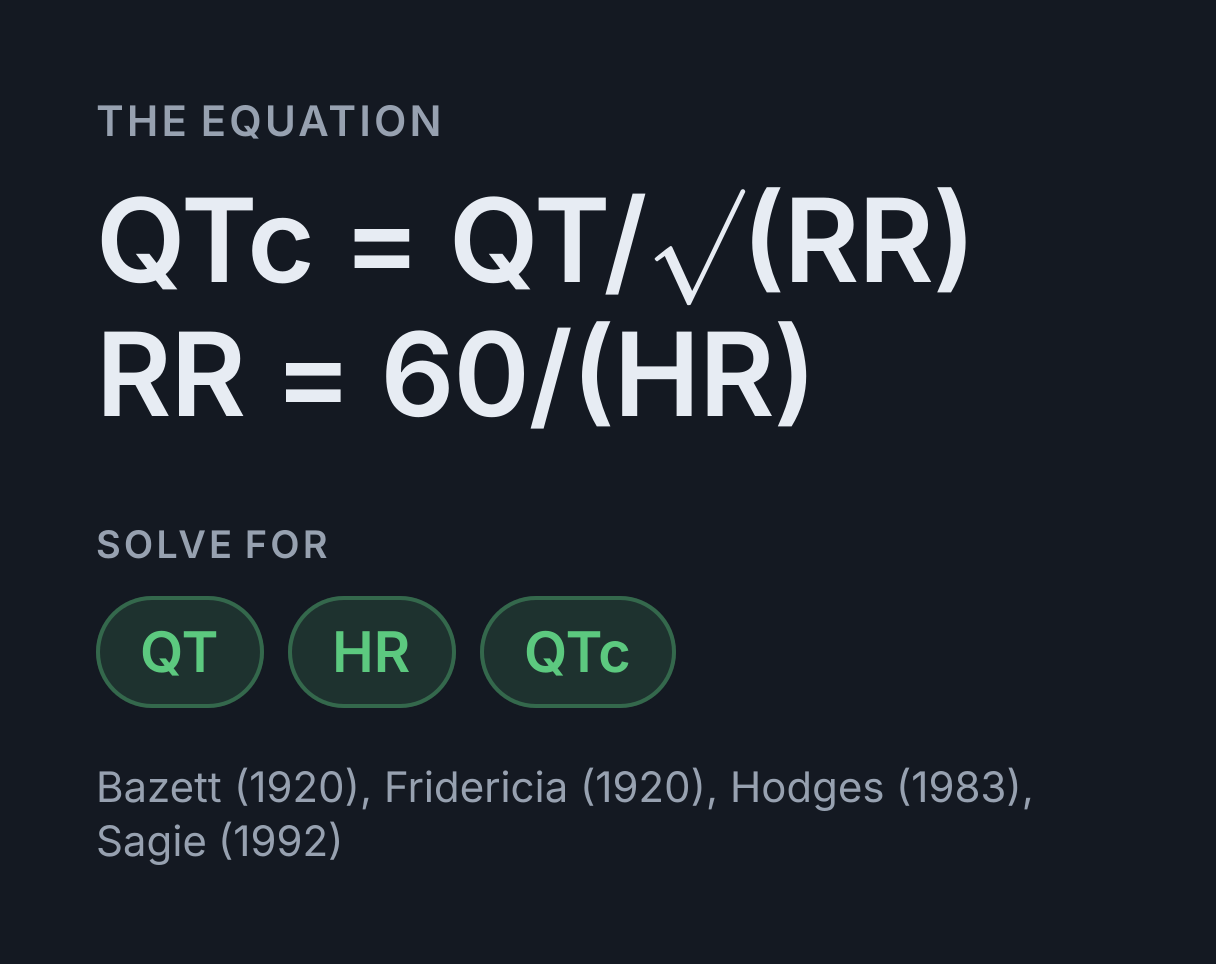
The equation
Bazett (1920), Fridericia (1920), Hodges (1983), Sagie (1992)
Why the QT interval needs correcting
QTc is the QT interval corrected for heart rate to the value it would have at 60 beats per
minute; Bazett’s formula, the default here, is QTc = QT / √RR, with the RR
interval in seconds. The QT interval spans ventricular depolarisation and repolarisation,
so it is roughly the duration of the ventricular action potential as seen from the body
surface. It shortens as the heart speeds up, because repolarisation has less time available
and the ion channel kinetics adapt. A raw QT of 400 ms is unremarkable at 60 beats per
minute and clearly prolonged at 120.
Comparing raw intervals against a fixed threshold therefore mislabels people in both directions: tachycardic patients look normal when they are not, and bradycardic patients look prolonged when they are fine. Every correction answers the same question, which is what this QT would have been had the rate been 60 beats per minute.
That gives a check worth remembering. At a rate of exactly 60 the RR interval is exactly one second, and every formula below collapses to the raw QT. If a correction returns something other than the measured QT at a rate of 60, it has been applied wrongly.
The four corrections
All of them are functions of the RR interval in seconds, where RR = 60 / heart rate.
- Bazett, 1920.
QTc = QT / √RR. The one machines print and examinations ask for. - Fridericia, 1920.
QTc = QT / RR^(1/3). Cube root instead of square root. - Framingham, 1992.
QTc = QT + 154 × (1 − RR). A linear correction fitted to the Framingham cohort. - Hodges.
QTc = QT + 1.75 × (heart rate − 60). The only one written in terms of rate rather than interval.
For a QT of 400 ms at 80 beats per minute the RR interval is 0.75 s, and the four give 461.9, 440.3, 438.5 and 435.0 ms. That is a spread of 27 ms from the same tracing, which straddles the 450 ms threshold. The spread is shown as a readout above precisely because it tells you when the answer is being driven by the choice of formula rather than by the patient.
Which one to use
Bazett is the default here because it is what you will meet on a machine printout and in an examination, not because it is the best. Its flaw is systematic and predictable: the square root over-corrects above 60 beats per minute and under-corrects below.
The reason is arithmetic. Above 60 the RR interval is below 1, and the square root of a number below 1 is smaller than its cube root, further from 1, so Bazett divides by a smaller number and returns a larger QTc than Fridericia. At 80 beats per minute the square root of 0.75 is 0.866 and the cube root 0.909. Below 60 the ordering reverses. In practice this means Bazett exaggerates prolongation in tachycardia, which is exactly the situation in which someone is most likely to be worried about a drug.
Fridericia holds up better at both extremes, which is why regulators and drug safety studies prefer it. If a patient’s rate is between about 50 and 90 the difference rarely matters. Once the rate is outside that band, quote the rate and the raw QT alongside whichever corrected value you report, so that the reader can see how much work the formula did.
Measuring the interval properly
The correction cannot rescue a bad measurement, and the measurement is the harder half.
- Measure from the earliest onset of the QRS to the end of the T wave, in the lead where the interval is longest. Lead II and V5 are conventional.
- At the standard paper speed of 25 mm/s, one small square is 40 ms and one large square is 200 ms.
- For the end of the T wave, take the tangent to the steepest part of its downslope and use the point where that tangent crosses the baseline. Guessing where the T wave flattens out systematically overestimates.
- Do not include a U wave. If the T and U waves merge, the measurement is unreliable and should be reported as such rather than as a number.
- Machine measurements are reasonable most of the time and unreliable exactly when it matters: flat T waves, prominent U waves, wide QRS complexes and artefact. A QTc near a decision threshold is worth measuring by hand.
Thresholds
- Above 450 ms in men and above 460 ms in women counts as prolonged.
- Above 500 ms is where the risk of torsades de pointes rises steeply, and it is usually the threshold for stopping a culprit drug.
- An increase of more than 60 ms from a patient’s own baseline is significant in itself.
The sex difference is real and appears after puberty, which is thought to reflect the effect of testosterone on repolarisation. These are population thresholds, so a single borderline value in a well person matters far less than a value that has clearly lengthened from a previous tracing on the same patient. That is the argument for a baseline electrocardiogram before starting any QT prolonging drug, and it is why the comparison tracing is worth more than the calculator.
Common mistakes
- Correcting in atrial fibrillation from one beat. Every formula depends on a single RR interval, and in atrial fibrillation that changes beat to beat, so the answer depends on which beat you picked. Average the QT and RR over ten or more consecutive beats, or accept that no single value is meaningful.
- Correcting a wide QRS without adjusting for it. In bundle branch block or a paced rhythm, part of the long QT is prolonged depolarisation rather than prolonged repolarisation. A common approach is to subtract the excess QRS duration above 120 ms, and at minimum the QRS width should be reported alongside.
- Entering the RR interval in milliseconds. Every formula here wants seconds. Using 750 instead of 0.75 in Bazett gives a QTc of 14.6 ms.
- Reading a single QTc as the risk. Torsades risk depends on the substrate as well as the interval: hypokalaemia, hypomagnesaemia, hypocalcaemia, bradycardia, female sex, structural heart disease and multiple interacting drugs all matter. A QTc of 480 with a potassium of 2.8 is a different situation from the same interval with normal electrolytes.
Worked examples
Each one runs through the calculator above, so the arithmetic here is the arithmetic it does.
What is the QTc for a QT of 400 ms at a heart rate of 80?
- RR = 60 / HR
- = 60 / 80 = 0.75 s
- QTc = QT / sqrt(RR)
- = 400 / sqrt(0.75)
- = 400 / 0.866
- = 461.9 ms
A raw QT that looks normal becomes borderline once corrected, which is the whole reason the correction exists. At this rate Fridericia gives 440 and Hodges 435, so the three straddle the 450 threshold and the formula is doing as much work as the measurement.
Is a QT of 440 ms prolonged at a heart rate of 110?
- RR = 60 / HR
- = 60 / 110 = 0.5455 s
- QTc = QT / sqrt(RR)
- = 440 / sqrt(0.5455)
- = 440 / 0.7385
- = 595.8 ms
Bazett says 596, which is alarming, but this is exactly where Bazett is least trustworthy: the square root over-corrects above 60 beats per minute. Fridericia gives about 538 on the same tracing. Slow the rate and repeat before stopping a drug on this number alone.
What raw QT does a QTc of 500 ms mean at a heart rate of 45?
- RR = 60 / HR
- = 60 / 45 = 1.333 s
- QT = QTc x sqrt(RR)
- = 500 x 1.155
- = 577.4 ms
577 ms on the paper, because below 60 beats per minute every correction shortens the measured interval, so the raw QT is longer than the corrected one. That is nearly three large squares at 25 mm/s. At this rate Bazett also gives the lowest QTc of the four, 500 against Fridericia’s 525 ms from the same tracing, so a bradycardic patient with a genuinely dangerous QT can look less abnormal than they are.
Practise this with Lab and Clinical Calculation Practice Problems, questions generated from this calculator and 9 other calculators in Biology.
Common questions
Why does the QT interval need correcting for heart rate?
Because it shortens as the heart speeds up. Repolarisation has less time to complete at a fast rate, so a raw QT of 400 ms is unremarkable at 60 beats per minute and distinctly prolonged at 120. Comparing a raw QT against a fixed threshold therefore labels tachycardic patients as normal and bradycardic ones as prolonged. Every correction converts the measured QT into the value it would have had at 60 beats per minute, which is why all four formulas return the QT unchanged at exactly that rate.
Which correction formula should I use?
Bazett is what machines print and what examinations ask for, so it is the default here. It is also the weakest: dividing by the square root of the RR interval over-corrects above 60 beats per minute and under-corrects below, so it exaggerates prolongation in tachycardia. Fridericia uses the cube root and holds up better at both extremes, which is why regulators prefer it in drug safety studies. Framingham and Hodges are linear corrections fitted to cohort data. When the four disagree enough to straddle a threshold, the formula is doing more work than the measurement.
How do I measure the QT interval correctly?
From the start of the Q wave to the point where the T wave returns to the baseline, in the lead where the interval is longest, conventionally lead II or V5. At the standard paper speed of 25 mm/s one small square is 40 ms and one large square is 200 ms. Take the tangent to the steepest part of the T wave’s downslope and use where it crosses the baseline, rather than guessing where the T wave flattens out. Do not include a U wave, and if the T and U merge the measurement is unreliable and should be reported as such.
What QTc counts as prolonged?
Conventionally above 450 ms in men and above 460 ms in women, with 500 ms the point at which the risk of torsades de pointes rises steeply and usually the threshold for stopping a culprit drug. The sex difference is real and appears after puberty. These are population thresholds, so a single borderline value in an otherwise well person matters much less than a value that has clearly lengthened from a previous tracing on the same patient, which is why a baseline electrocardiogram before starting a QT prolonging drug is worth having.
Can I correct the QT in atrial fibrillation?
Not reliably from a single beat. Every correction is a function of one RR interval, and in atrial fibrillation that interval changes from beat to beat, so the answer changes with whichever beat you happen to measure. The usual workaround is to average the QT and the RR across ten or more consecutive beats before correcting, or to measure at a moment when the rate is relatively regular. The same caution applies to any irregular rhythm, and to paced rhythms where the QRS is wide.