Percent Solution Calculator
Convert between percent w/v, grams per litre, mg/mL and ppm, or work out the mass needed for any percent solution and volume.
Calculator
Grams of solute per 100 mL of final solution.
Working, with your numbers
- mass = % w/v x volume / 100, volume in mL
- = 0.9 x 500 / 100
- = 450 / 100
- = 4.5 g
Values are converted into the units the equation is worked in before the arithmetic.
- Equivalent
- 9 g/L
- Also
- 9 mg/mL
- Parts per million For dilute aqueous solutions, 1 mg/L is approximately 1 ppm.
- 9000 ppm
Citing this tool
Last updated . Add the date you accessed it as well, which a citation of a page that can change asks for. If a specific result matters, cite the permalink from the tool’s share row instead of this page: it reproduces the exact parameters.
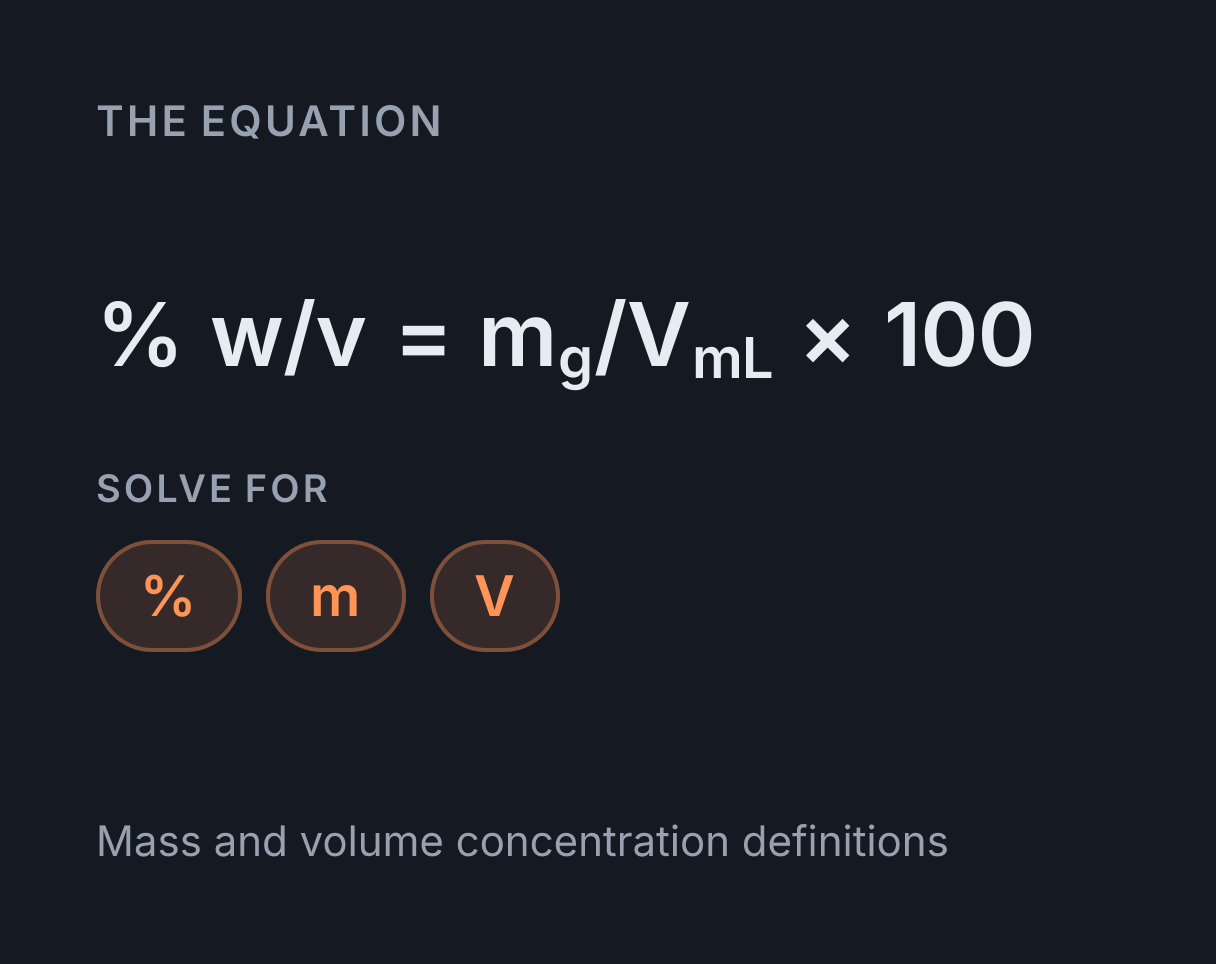
The equation
Mass and volume concentration definitions
What percent w/v means
A percent weight per volume figure is grams of solute per 100 mL of final
solution: % w/v = (mass in g / volume in mL) × 100. A 5% w/v
glucose solution therefore holds 5 g of glucose in every 100 mL. The
denominator is the volume of the finished solution, not the volume of
solvent added at the start.
Strictly, mixing a mass with a volume makes the percentage a convention rather than a true ratio, but it is the convention used throughout biology, clinical work and reagent preparation because it maps directly onto what a balance and a volumetric flask measure.
Worked example
Physiological saline is 0.9% w/v NaCl. How much salt does 500 mL require?
- Rearrange:
mass = % × volume / 100. mass = 0.9 × 500 / 100mass = 4.5 g- Check the equivalences:
0.9% w/v = 9 g/L = 9 mg/mL.
For dilute aqueous solutions, where density is close to 1 g/mL,
1% w/v = 10 g/L = 10 mg/mL = 10000 ppm. Those four
expressions describe the same solution.
Choosing between w/v, v/v, w/w and molarity
The three percent bases differ in what they measure. w/v is mass per volume and suits solids dissolved in liquid. v/v is volume per volume and suits liquid mixtures such as 70% ethanol. w/w is mass per mass, which makes it independent of temperature because neither quantity expands on heating; concentrated acids are usually specified this way.
Percent notation is preferable when molar mass is unknown or meaningless: protein preparations, agar, gelatin, stains and undefined mixtures. Use molarity when the chemistry depends on the number of particles, as with reaction stoichiometry, equilibrium constants, buffer calculations and enzyme kinetics. A 1% w/v solution of two different salts contains different numbers of ions.
Common mistakes
- Confusing w/v with w/w. The two coincide only when density is near 1 g/mL. For a dense solution such as concentrated sulfuric acid the two figures differ substantially.
- Assuming ppm equals mg/L. That equality relies on a solvent density of 1 g/mL. In organic solvents or dense brines, ppm as a mass ratio and mg/L as a mass per volume diverge.
- Filling to the mark too early. Dissolving the solute changes the volume. Dissolve in part of the solvent first, then make up to the final mark.
- Treating % v/v as additive. Ethanol and water contract on mixing, so 70 mL of ethanol plus 30 mL of water gives less than 100 mL. Make up to volume rather than adding measured volumes together.
Converting units first? Use the volume and mass conversion tables.
Worked examples
Each one runs through the calculator above, so the arithmetic here is the arithmetic it does.
How much agarose do I need for 50 mL of a 1% gel?
- mass = % w/v x volume / 100, volume in mL
- = 1 x 50 / 100
- = 50 / 100
- = 0.5 g
0.5 g, because percent w/v means grams per 100 mL, so a 1% gel takes 1 g for every 100 mL and half that for 50. Weigh the flask before heating too: water boils off in the microwave and raises the concentration, and topping back up to the starting weight with water is what keeps a 1% gel at 1%.
What percent w/v is 9 g of sodium chloride in 1 litre of solution?
- % w/v = mass / volume x 100, mass in g and volume in mL
- = 9 / 1000 x 100
- = 0.009 x 100
- = 0.9 % w/v
0.9 percent, the concentration of normal saline. The volume has to go in as millilitres, because percent w/v is defined per 100 mL: 9 divided by 1, times 100, gives 900 percent. The calculator converts the litre itself, and that conversion is the first step to check when a hand calculation disagrees with it.
Practise this with Chemistry Practice Problems, questions generated from this calculator and 6 other calculators in Chemistry.
Common questions
Is 1% w/v the same as 10 mg/mL?
Yes. One percent w/v is 1 g per 100 mL, which is 10 g per litre, which is 10 mg per mL. The three are the same concentration written three ways, and this calculator shows all of them at once.
When should I use percent rather than molarity?
Percent is convenient when the molar mass is unknown or irrelevant, as with mixtures, proteins, agar or stains. Use molarity whenever the chemistry depends on the number of particles, such as reaction stoichiometry or osmolarity, because percent hides how many moles you actually have.