Freezing Point Depression Calculator
Freezing point depression is ΔTf = i Kf m, with Kf = 1.86 K·kg/mol for water. Solve it, or boiling point elevation, for ΔT, molality, i or molar mass.
Calculator
From NCERT Table 1.3.
273.15 K, as NCERT’s own Example 1.9 uses, where its Table 1.3 rounds to 273.0 K.
What you weighed out and dissolved.
Glucose 180.16, sucrose 342.30, urea 60.06, ethylene glycol 62.07, NaCl 58.44.
The solvent alone, not the solution: 10 g of solute in 100 g of water is 100 g of solvent.
1 for a solute that stays as whole molecules. NCERT measures 1.87 for NaCl at 0.1 mol/kg.
A change of 1 K is the same as a change of 1 °C.
Pure water’s own point, moved by the change above.
The solution freezes at −1.03242 °C, 1.03242 K below pure water’s 0 °C.
- Molality Moles of solute per kilogram of solvent, which is what the equation takes, not per litre of solution.
- 0.5551 mol/kg
- Moles of solute The mass of solute divided by its molar mass.
- 0.05551 mol
- Particle molality i × m, the moles of dissolved particles per kilogram. The same number is the osmolality in osmol/kg.
- 0.5551 mol/kg
- Freezing point, in kelvin The same answer on the other scale, since a question may ask for either.
- 272.118 K
Working, with your numbers
- Water: Kf = 1.86 K·kg/mol from NCERT Table 1.3, and pure water freezes at 0 °C (273.15 K).
- mass of solvent = 100 / 1000 = 0.1 kg
- moles of solute = w2 / M2 = 10 / 180.16 = 0.055506 mol
- molality m = n / w1 = 0.055506 / 0.1 = 0.55506 mol/kg
- dTf = i x Kf x m = 1 x 1.86 x 0.55506 = 1.0324 K
- freezing point of the solution = T0 - dTf = 0 - 1.0324 = -1.0324 °C (272.12 K)
Masses are converted to grams of solute and kilograms of solvent before the arithmetic. A change of 1 K is a change of 1 °C.
Citing this tool
Last updated . Add the date you accessed it as well, which a citation of a page that can change asks for. If a specific result matters, cite the permalink from the tool’s share row instead of this page: it reproduces the exact parameters.
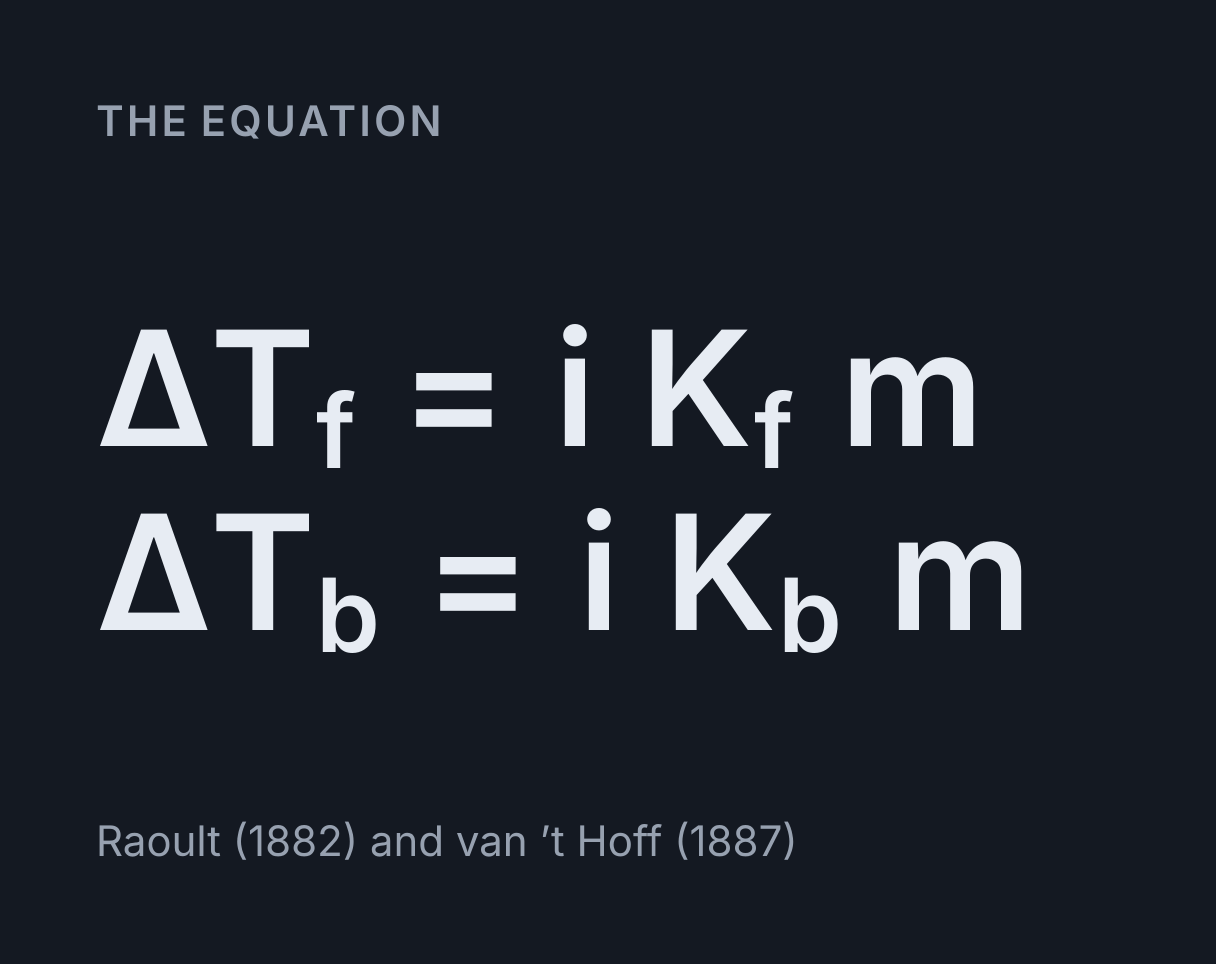
The equation
Raoult (1882) and van ’t Hoff (1887)
How to calculate freezing point depression
Freezing point depression is ΔTf = i × Kf × m: multiply the molality of the
solute by the solvent’s cryoscopic constant and by the van ’t Hoff factor, then subtract the
result from the pure solvent’s freezing point. Boiling point elevation is the same product
with the ebullioscopic constant, ΔTb = i × Kb × m, added to the boiling point.
- m is the molality, moles of solute per kilogram of solvent, in mol/kg.
- Kf and Kb belong to the solvent, in K·kg/mol. Water’s are 1.86 and 0.52 in NCERT’s table.
- i counts the particles each formula unit of solute becomes: 1 for sugar, close to 2 for sodium chloride.
- ΔT comes out in kelvin, and a change of 1 K is the same as a change of 1 °C.
Choose the property and the solvent, give the solute as masses or as a molality, and the calculator gives the change and the new freezing or boiling point. Every term of the equation has Solve for this, so the same fields find a molar mass, a molality, the van ’t Hoff factor, the constant itself, or the mass of solute a target temperature needs. If a question gives the temperature the solution froze at rather than the change, choose Solve for this on the term you want and type that temperature into the solution’s field; the depression follows from it. For the molar mass of a known solute, use the molar mass calculator.
Worked example: 10 g of glucose in 100 g of water
This is the solution the calculator opens with.
- Moles of glucose:
10 / 180.16 = 0.055506 mol. -
Molality:
0.055506 / 0.100 = 0.55506 mol/kg, since 100 g of water is 0.100 kg. - Depression:
1 × 1.86 × 0.55506 = 1.0324 K. - Freezing point:
0 − 1.0324 = −1.0324 °C, or 272.12 K.
Switch to boiling point elevation and the same solution boils
0.52 × 0.55506 = 0.28863 K higher, at 100.29 °C. The two changes differ only by
the constant, so for any solute water’s freezing point moves about three and a half times as
far as its boiling point.
Worked example: molar mass from a boiling point
Rearranged, the equation gives the molar mass of an unknown solute:
M₂ = i × K × w₂ / (ΔT × w₁), with the solute’s mass w₂ in grams and the
solvent’s mass w₁ in kilograms. In NCERT’s Example 1.8, 1.80 g of a non-volatile solute in
90 g of benzene raises the boiling point from 353.23 K to 354.11 K.
- Elevation:
354.11 − 353.23 = 0.88 K. -
Molar mass:
1 × 2.53 × 1.80 / (0.88 × 0.090) = 57.5 g/mol, which NCERT rounds to 58 g/mol.
To reproduce it, choose boiling point elevation and benzene, switch the temperatures to kelvin and type 353.23 as pure benzene’s boiling point, give the two masses, choose Solve for this on the molar mass, and type 354.11 as the solution’s boiling point. A freezing point works the same way: in NCERT’s Example 1.10, 1.00 g of solute in 50 g of benzene freezes 0.40 K lower, which gives 256 g/mol.
Molality, not molarity
Colligative properties are written in molality, moles per kilogram of solvent, where most solution work uses molarity, moles per litre of solution. A mass does not change with temperature and a volume does, and a freezing or boiling measurement is one in which the temperature changes. The kilogram is of solvent alone, so 10 g of glucose in 100 g of water is 0.100 kg of solvent, not 0.110 kg of solution.
For a dilute solution in water the two numbers are close, because a litre of it holds close to a kilogram of water. For a concentrated one they are far apart: NCERT’s Exercise 1.8, 222.6 g of ethylene glycol in 200 g of water with a density of 1.072 g/mL, is 17.9 mol/kg but only 9.10 mol/L. The molarity calculator works in litres of solution; this one works in kilograms of solvent.
The van ’t Hoff factor
A solute that stays as whole molecules, such as glucose, sucrose or urea, has an i of 1. A salt splits into ions, and in the ideal limit i is the number of ions per formula unit: 2 for NaCl and KCl, 3 for CaCl₂ and K₂SO₄. Measured values fall short, because ions of opposite charge attract and some pair up, so they do not act as fully independent particles. NCERT’s Table 1.4 gives NaCl an i of 1.87 at 0.1 mol/kg, 1.94 at 0.01 and 1.97 at 0.001, reaching 2 only as the solution becomes very dilute. Magnesium sulfate’s doubly charged ions pair more strongly: 1.21, 1.53 and 1.82 at the same molalities, against an ideal 2.
So 0.1 mol/kg of NaCl lowers the freezing point of water by
1.87 × 1.86 × 0.1 = 0.348 K, not the 0.372 K the ideal count predicts. Run it
backwards to measure the factor: give the molality, choose Solve for this on
i and type the depression you measured, and 0.348 K returns 1.871.
For a weak electrolyte the factor says how much of it dissociates. With n ions per formula
unit and a fraction α dissociated, i = 1 + α(n − 1). NCERT’s Example 1.13
measures a depression of 0.0205 K for acetic acid at 0.0106 mol/kg, so i = 1.040 and, with two
ions, α = 0.040: 4.0 percent dissociated. NCERT divides by a calculated depression rounded to
0.0197 K and so prints 1.041 and 4.1 percent.
A solute that associates has an i below 1. Acetic acid and benzoic acid pair into dimers in benzene, held by hydrogen bonds, so i approaches 0.5 and a molar mass worked out with an i of 1 comes out close to double the true one. NCERT’s Example 1.12, which takes benzene’s Kf as 4.9 K·kg/mol, finds 242 g/mol for benzoic acid in benzene against the 122 g/mol of its formula, a degree of association of 99.2 percent. A molar mass that comes out too high or too low for this reason is what NCERT calls an abnormal molar mass.
Where the constants come from
Each constant belongs to the solvent alone, fixed by its freezing point and the heat it takes
to melt: Kf = R × M₁ × Tf² / ΔfusH, with M₁ the solvent’s molar mass in kg/mol.
For water, whose enthalpy of fusion NCERT gives as 6.00 kJ/mol (the latent heat the
heating curve calculator counts as ice melts),
Kf = 8.314 × 0.018015 × 273.15² / 6000 = 1.86 K·kg/mol. The enthalpy of
vaporisation gives Kb the same way. Raoult had measured the constant before anyone derived it:
his 1882 paper on the general law of freezing gives a mean molecular lowering of 18.5 for
water with organic solutes, quoted then for one mole of solute in 100 g of solvent, which is
1.85 K·kg/mol in today’s units against the 1.86 the enthalpy gives. The same paper puts the
lowering near 37 for mineral salts, twice as far, which is the van ’t Hoff factor turning up
in a measurement before it had a name.
The table is NCERT’s Table 1.3, the one this calculator uses. Published tables disagree in the last figure. OpenStax Chemistry 2e gives water’s Kb as 0.512 and chloroform’s Kf as 4.68, and NCERT’s own enthalpy of vaporisation for water, 40.79 kJ/mol, puts its Kb at 0.511 rather than the 0.52 in the table, which is why every constant here can be edited to match your course. Three freezing points are not the ones the table prints: water’s is the 273.15 K NCERT’s own Example 1.9 uses, where the table rounds to 273.0 K, and ethanol’s and carbon disulfide’s are the measured 159.0 K and 161.1 K from the NIST Chemistry WebBook, where the table prints 155.7 K and 164.2 K.
| Solvent | Kf | Freezes at | Kb | Boils at |
|---|---|---|---|---|
| Water | 1.86 | 0 | 0.52 | 100 |
| Ethanol | 1.99 | −114.15 | 1.20 | 78.35 |
| Cyclohexane | 20.0 | 6.4 | 2.79 | 80.59 |
| Benzene | 5.12 | 5.45 | 2.53 | 80.15 |
| Chloroform | 4.79 | −63.55 | 3.63 | 61.25 |
| Carbon tetrachloride | 31.8 | −22.65 | 5.03 | 76.85 |
| Carbon disulfide | 3.83 | −112.05 | 2.34 | 46.25 |
| Diethyl ether | 1.79 | −116.25 | 2.02 | 34.65 |
| Acetic acid | 3.90 | 16.85 | 2.93 | 117.95 |
What this does not cover
- Concentrated solutions. ΔT = i K m is the straight line a dilute solution follows, and a concentrated one curves away from it. The calculator adds a caution above 1 mol/kg of dissolved particles; there is no sharp limit, and how far the line holds depends on the solvent and the solute.
- A van ’t Hoff factor that changes with concentration. The calculator uses the i you give it. For a salt, a measured factor at your molality is closer to the truth than the count of ions.
- Volatile solutes. Boiling point elevation assumes the solute stays behind as the solvent boils. A solute that evaporates with it, such as ethanol in water, does not follow the equation.
- Solutes that freeze out with the solvent. Freezing point depression assumes the solid that forms is pure solvent.
- Other pressures. The boiling points are at 1 atm. At another pressure, type the pure solvent’s boiling point at that pressure.
- Vapour pressure lowering and osmotic pressure, the other two colligative properties. The particle molality above, i × m, is the osmolality, which laboratories measure by freezing point depression and the serum osmolality calculator estimates from blood results.
Common mistakes
- Grams of solvent used as kilograms. 100 g is 0.100 kg; leaving it as 100 makes the change a thousand times too small.
- The mass of the solution in place of the solvent. 10 g of glucose in 100 g of water has 100 g of solvent, not 110 g.
- Molarity in place of molality. Close for a dilute aqueous solution, far out for a concentrated one.
- Leaving out i for a salt, or using the ideal count of ions for a concentrated one.
- The wrong direction. A freezing point goes down and a boiling point goes up; both changes are positive numbers.
- Kf in place of Kb. Water’s are 1.86 and 0.52, so swapping them is out by a factor of about 3.6.
- Rounding part way through. NCERT’s Example 1.9 rounds the molality of 45 g of ethylene glycol in 600 g of water to 1.2 mol/kg and gets 2.2 K; carried unrounded it is 2.25 K.
Common questions
What is the formula for freezing point depression?
ΔTf = i Kf m: the depression equals the van ’t Hoff factor times the solvent’s cryoscopic constant times the molality of the solution. For 0.5 mol/kg of glucose in water, with i = 1 and Kf = 1.86 K·kg/mol, the depression is 0.93 K, so the solution freezes at −0.93 °C. Boiling point elevation is the same product with the ebullioscopic constant Kb, 0.52 K·kg/mol for water in NCERT’s table, added to the boiling point.
What is the cryoscopic constant of water?
1.86 K·kg/mol, so a dilute solution in water freezes 1.86 K lower for every mole of dissolved particles per kilogram of water. The figure follows from water’s enthalpy of fusion: Kf = R M Tf² / ΔfusH = 8.314 × 0.018015 × 273.15² / 6000 = 1.86 K·kg/mol. Water’s ebullioscopic constant, for the boiling point, is 0.52 K·kg/mol in NCERT’s table and 0.512 in OpenStax Chemistry 2e.
How do you find molar mass from freezing point depression?
Rearrange ΔTf = i Kf m to M = i Kf w₂ / (ΔTf w₁), with the solute’s mass w₂ in grams and the solvent’s mass w₁ in kilograms. In NCERT’s Example 1.10, 1.00 g of solute in 50 g of benzene lowers the freezing point by 0.40 K, so M = 5.12 × 1.00 / (0.40 × 0.050) = 256 g/mol. Use i = 1 for a solute that stays as whole molecules; for one that splits into ions or pairs up, an i of 1 gives an apparent molar mass rather than the true one.
Why is the measured van ’t Hoff factor less than the number of ions?
Because ions of opposite charge attract, and some pair up, so they do not behave as fully independent particles. Sodium chloride gives two ions, but NCERT lists its measured i as 1.87 at 0.1 mol/kg, 1.94 at 0.01 mol/kg and 1.97 at 0.001 mol/kg, approaching 2 only as the solution becomes very dilute. Doubly charged ions pair more strongly: magnesium sulfate’s i is 1.21 at 0.1 mol/kg, against an ideal 2.
Why do colligative properties use molality instead of molarity?
Because molality, moles of solute per kilogram of solvent, does not change with temperature, and a freezing or boiling measurement is one in which the temperature changes. Molarity counts litres of solution, and a volume expands and contracts. For a dilute solution in water the two numbers are close; for a concentrated one they are not: NCERT’s antifreeze of 222.6 g of ethylene glycol in 200 g of water, with a density of 1.072 g/mL, is 17.9 mol/kg but only 9.10 mol/L.