Percent Yield Calculator
Calculate percent yield from actual and theoretical mass, with the product lost, the fraction lost and the yield you need for a target amount.
Calculator
What you weighed after isolating and drying the product.
What the balanced equation predicts from the limiting reagent.
Working, with your numbers
- % yield = actual / theoretical x 100
- = 4.2 / 5 x 100
- = 84 %
Values are converted into the units the equation is worked in before the arithmetic.
- Product lost The difference between what the equation predicted and what you isolated.
- 0.8 g
- Fraction lost
- 16%
- For 10 g of product Theoretical yield you would need to plan for, at this efficiency.
- 11.9 g predicted
Citing this tool
Last updated . Add the date you accessed it as well, which a citation of a page that can change asks for. If a specific result matters, cite the permalink from the tool’s share row instead of this page: it reproduces the exact parameters.
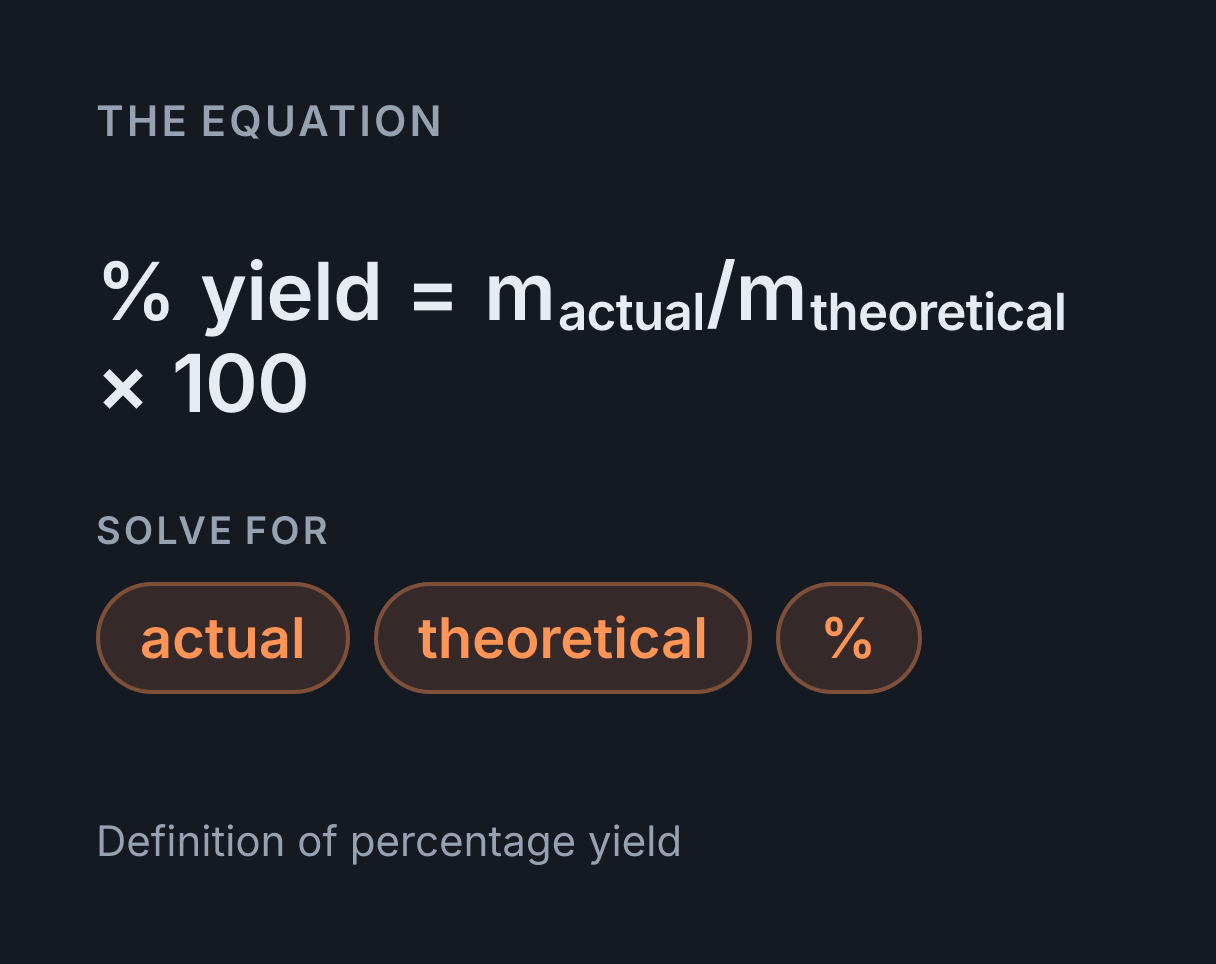
The equation
Definition of percentage yield
A ratio of what you got to what the equation promised
Percent yield is actual ÷ theoretical × 100, and it answers one
question: how much of the product the balanced equation allowed did you
actually end up holding? The theoretical figure is a ceiling set by
stoichiometry. The actual figure is whatever survived the reaction, the
workup, the transfer between vessels, the filtration and the drying. The gap
between them is the part of chemistry that no equation predicts.
Because it is a ratio of two masses, the units cancel and only the consistency of the two figures matters. Both must refer to the same substance, and both must be masses or both must be moles. The result cannot legitimately exceed 100 percent, so a figure above that is not a triumph. It is a measurement telling you the material on the balance is not pure product, and the usual culprit is residual solvent adding mass without adding substance. Unreacted starting material carried through, or an inorganic salt from the workup, does the same. Dry to constant mass and weigh again.
Worked example
A reaction predicts 5 g of product and you isolate 4.2 g after drying. These are the values loaded on screen.
% yield = 4.2 / 5 × 100 = 84%- Product lost:
5 - 4.2 = 0.8 g - Fraction lost:
0.8 / 5 × 100 = 16% -
To plan for 10 g at this efficiency:
10 × 5 / 4.2 = 11.90 g theoretical
That last line is the one worth keeping. If you know a route runs at 84 percent, you can work backwards from the amount you need to the scale you have to charge, rather than running the reaction and discovering the shortfall afterwards.
Where the theoretical figure comes from
The theoretical yield is not a target or an estimate. It follows from the limiting reagent in three steps: convert that reagent’s mass to moles with its molar mass, apply the mole ratio from the balanced equation, convert the resulting moles of product back to a mass with the product’s molar mass. Get the balancing wrong and every yield downstream of it is wrong too.
The limiting reagent is the one that runs out first, which is not necessarily the one present in the smallest mass. Molar mass decides it. Ten grams of a reagent at 20 g/mol is 0.5 mol, while twelve grams of one at 100 g/mol is only 0.12 mol, so the heavier charge is the limiting one. Compare moles after dividing through by the stoichiometric coefficients, never masses.
Yields also multiply along a route rather than averaging. Five
consecutive steps at 80 percent each give 0.8⁵ = 0.32768, which is
32.77 percent overall. A step that looks respectable in isolation is expensive
once it is one of six, and this compounding is why synthetic chemists redesign
routes to remove steps rather than to polish them.
Common mistakes
- Weighing wet product. Solvent trapped in a crystal lattice inflates the mass and can push the yield past 100 percent. Dry to constant mass, meaning two consecutive weighings that agree.
- Picking the limiting reagent by mass. Convert to moles first, then divide by the coefficient from the balanced equation. The smallest result is the limiting reagent, whatever the masses say.
- Using an unbalanced equation. A missing coefficient of 2 halves or doubles the theoretical yield, and the resulting percentage will still look reasonable enough to go unquestioned.
- Comparing against 100 percent. A good yield is defined by the reaction, not by the ideal. Judge the number against the published yield for that specific transformation.
Converting units first? Use the mass conversion table.
Worked examples
Each one runs through the calculator above, so the arithmetic here is the arithmetic it does.
What is the percent yield if 850 mg of product came from a theoretical 1.2 g?
- % yield = actual / theoretical x 100
- = 0.85 / 1.2 x 100
- = 70.833 %
70.8 percent, once both masses are in grams: 0.85 over 1.2. Left as 850 over 1.2 the answer is about 71,000 percent, which at least looks wrong. The quieter slip is dividing the theoretical by the actual, which gives 141 percent and reads exactly like a product that was not dried.
What theoretical yield do I need to make 5 g of product at a 62% yield?
- theoretical = actual x 100 / %
- = 5 x 100 / 62
- = 500 / 62
- = 8.0645 g
8.06 g, found by dividing 5 by 0.62. The tempting shortcut is to add the missing 38 percent, which gives 6.9 g and falls short, since 62 percent of 6.9 g is only 4.28 g. The loss is a fraction of the larger theoretical figure, not of the amount you want to end with.
Practise this with Chemistry Practice Problems, questions generated from this calculator and 6 other calculators in Chemistry.
Common questions
What does a yield above 100 percent mean?
That the product is not pure or not dry, because you cannot make more than the equation allows. Residual solvent is the usual cause, since it adds mass without adding product. Unreacted starting material carried through, or an inorganic salt from the workup, will do the same. Dry to constant mass and weigh again.
How do I work out the theoretical yield?
Find the limiting reagent, convert its mass to moles using its molar mass, apply the mole ratio from the balanced equation, then convert back to mass using the product’s molar mass. The limiting reagent is the one that runs out first, which is not always the one present in the smallest mass.
What counts as a good yield?
It depends entirely on the reaction. A simple precipitation might give 95 percent, while a multi-step synthesis can be respectable at 40 percent in total, because yields multiply: five steps at 80 percent each leave you with 33 percent overall. Compare against the published yield for that specific reaction, not against 100.