Stoichiometry Calculator
Solve stoichiometry from one known amount: type the equation, balanced or not, enter a mass, moles, gas volume or solution, and get every species’ amount.
Calculator
Join species with + and put = or → between the sides. Add (g) after a gas to get its volume. The equation is balanced for you, so any coefficients typed are replaced.
Balanced equation
C₃H₈ + 5O₂ → 3CO₂ + 4H₂O
Mole ratio C₃H₈ : O₂ : CO₂ : H₂O = 1 : 5 : 3 : 4
- Theoretical yield of CO₂
- 29.94 g
- Moles of CO₂
- 680.3 mmol
- Moles of reaction How many times the balanced equation has run: the known moles divided by the known species’ coefficient.
- 226.8 mmol
Every species
| Species | Coefficient | M, g/mol | Moles | Mass |
|---|---|---|---|---|
| C₃H₈ known reactant | 1 | 44.097 | 226.8 mmol | 10 g |
| O₂ reactant | 5 | 31.998 | 1.134 mol | 36.28 g |
| CO₂ product | 3 | 44.009 | 680.3 mmol | 29.94 g |
| H₂O product | 4 | 18.015 | 907.1 mmol | 16.34 g |
Amounts assume the known species is used up and everything else it reacts with is in excess.
Measured amounts of two reactants? Open this reaction in the limiting reagent calculator to find which runs out first.
Working, step by step
- Balanced: C₃H₈ + 5O₂ → 3CO₂ + 4H₂O
- M(C₃H₈) = 44.097 g/mol
- n(C₃H₈) = 10 g / 44.097 g/mol = 0.22677 mol
- n(CO₂) = 0.22677 mol × 3/1 = 0.68032 mol
- m(CO₂) = 0.68032 mol × 44.009 g/mol = 29.94 g
- n(O₂) = 0.22677 mol × 5/1 = 1.1339 mol
- m(O₂) = 1.1339 mol × 31.998 g/mol = 36.281 g
- n(H₂O) = 0.22677 mol × 4/1 = 0.90709 mol
- m(H₂O) = 0.90709 mol × 18.015 g/mol = 16.341 g
The mole map: the known amount into moles, times the ratio of coefficients, then back out of moles into grams or litres.
Citing this tool
Last updated . Add the date you accessed it as well, which a citation of a page that can change asks for. If a specific result matters, cite the permalink from the tool’s share row instead of this page: it reproduces the exact parameters.
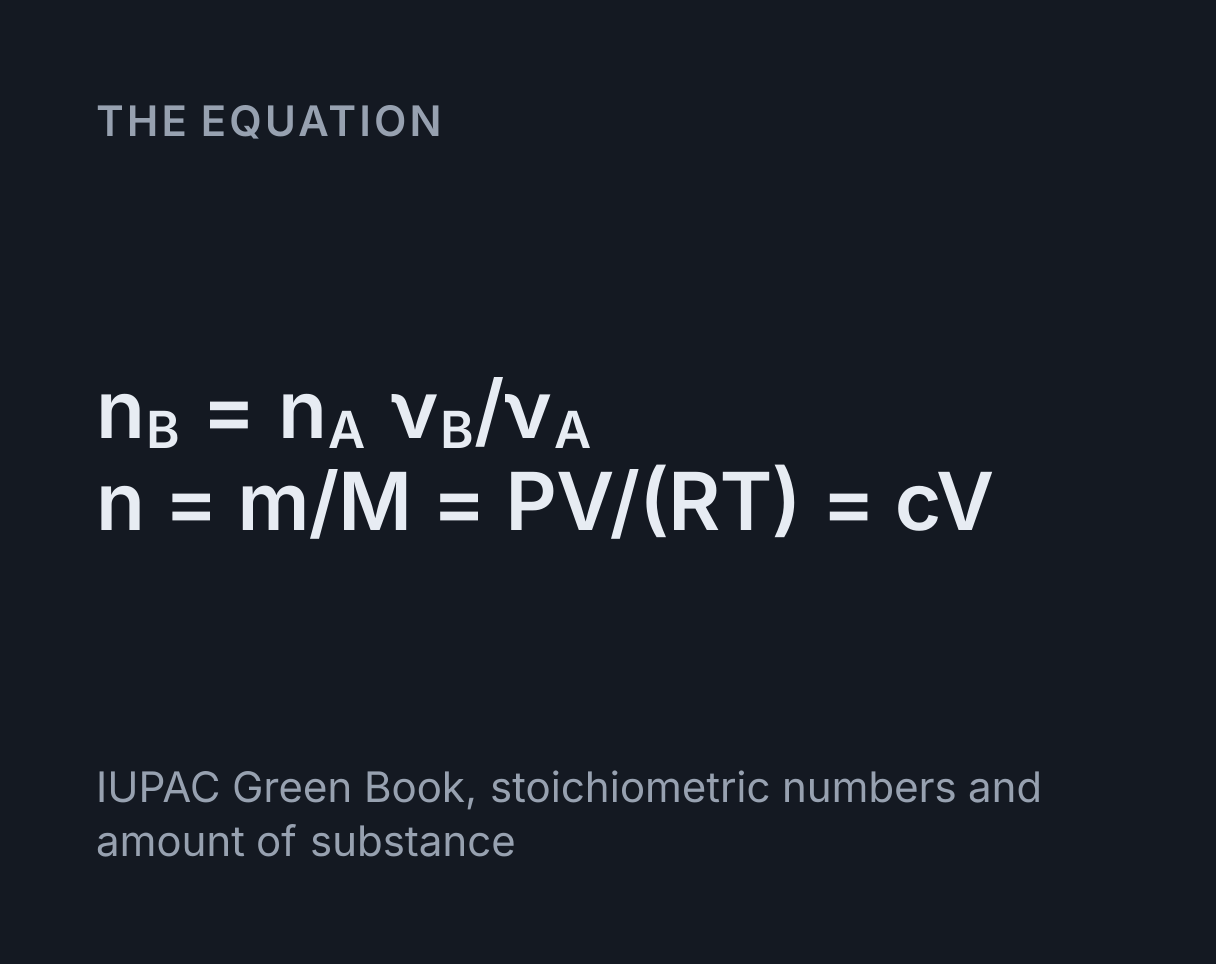
The equation
IUPAC Green Book, stoichiometric numbers and amount of substance
How to solve a stoichiometry problem
Stoichiometry turns a known amount of one substance in a reaction into the amount of any other,
using the balanced equation: convert what you know into moles, multiply by the mole ratio of the
two coefficients, and convert the moles back into grams or litres. In symbols,
n_B = n_A × ν_B / ν_A and then m_B = n_B × M_B, where
n is an amount in moles, ν a coefficient from the balanced equation and
M a molar mass. This is the mole map every chemistry course teaches, and it is the
same three steps whether the question starts from grams, moles, a gas or a solution.
The calculator balances the equation itself, with the same exact algebra as the chemical equation balancer, so you can type the reaction as the question gives it. Choose which species you know an amount of and how it was measured, choose the species you want, and it prints the answer, the amount of every other species in the reaction and the working, line by line.
Four ways into moles
The first step of the mole map depends on how the known amount was measured, and the calculator offers all four:
- A mass.
n = m / M, with the molar mass worked out from the formula. - An amount in moles. Used as it is.
- A gas volume.
n = PV / RT, which is the volume divided by the molar volumeVm = RT / Pat the gas’s temperature and pressure. - A volume of solution.
n = cV, with c the molarity in mol/L.
Mark a species as a gas by typing (g) after it, as in O2(g), and the
table gives its volume as well as its mass. The ideal gas molar volume is 22.711 L/mol at 0 °C
and 100 kPa, the standard temperature and pressure IUPAC recommends, 22.414 L/mol
at 0 °C and 1 atm, the older convention behind the familiar 22.4, and 24.465 L/mol at 25 °C and
1 atm. The first two are the values CODATA lists for the molar volume of an ideal gas.
Worked example: carbon dioxide from 10 g of propane
How many grams of carbon dioxide form when 10 g of propane burns completely? The calculator opens on this question.
-
Balance
C3H8 + O2 = CO2 + H2OtoC₃H₈ + 5O₂ → 3CO₂ + 4H₂O. -
M(C₃H₈) = 3 × 12.011 + 8 × 1.008 = 44.097 g/mol, son(C₃H₈) = 10 / 44.097 = 0.22677 mol. -
The mole ratio of carbon dioxide to propane is 3 to 1, so
n(CO₂) = 0.22677 × 3/1 = 0.68032 mol. -
m(CO₂) = 0.68032 × 44.009 = 29.94 g, the theoretical yield.
The same ratio gives the rest of the reaction: 36.281 g of oxygen is used and 16.341 g of water forms. The reactants total 46.281 g and so do the products, which is conservation of mass and a quick check on any stoichiometry answer. Notice that 10 g of propane makes almost three times its own mass of carbon dioxide, because each carbon atom leaves with two oxygen atoms taken from the air.
Worked example: the volume of hydrogen from 0.500 g of magnesium
Magnesium ribbon dissolves in hydrochloric acid, Mg + 2HCl → MgCl₂ + H₂. What volume
of hydrogen does 0.500 g of magnesium give at 25 °C and 1 atm?
n(Mg) = 0.500 / 24.305 = 0.020572 mol.- One hydrogen per magnesium, so
n(H₂) = 0.020572 mol. -
Vm = 8.3145 × 298.15 / 101.325 = 24.465 L/mol, soV(H₂) = 0.020572 × 24.465 = 0.5033 L, which is 503.3 mL.
The acid needed is twice the magnesium, 0.041144 mol, or 41.14 mL of 1.00 M acid by
V = n / c. Type the equation as Mg + HCl = MgCl2 + H2(g) to see the
volume, since only a species marked (g) is given one.
What this does not cover
- Two or more reactant amounts. The answer here assumes the known species runs out and everything it reacts with is in excess. When you have measured amounts of two reactants, one of them limits the reaction, and the limiting reagent calculator finds which. For a reaction with two or more reactants and no ions, the link under the results opens it there with the balanced coefficients filled in.
- Actual yields. The product amounts are theoretical. Compare what you collected with the percent yield calculator.
- Real gases and equilibria. Gas volumes use the ideal gas law, which is close for oxygen, nitrogen or hydrogen at room conditions and poorer for easily condensed gases. A reaction that stops at equilibrium makes less than the equation says.
- Equations with more than one balance.
H2 + O2 = H2O + H2O2is two reactions written as one, so it fixes no single mole ratio, and the calculator says so rather than choosing one.
Common mistakes
- Using the ratio on grams. Coefficients count particles, so the ratio applies to
moles only. In
N₂ + 3H₂ → 2NH₃, a mole of nitrogen gives two moles of ammonia, but 28.014 g of nitrogen gives 34.062 g of ammonia, not twice its mass. - Turning the ratio upside down. The coefficient of the species you want goes on
top:
ν_B / ν_A, with B wanted and A known. - Working from an unbalanced equation. Every ratio is then wrong. That is why this calculator balances the equation before it uses a coefficient.
- Using 22.4 L/mol at the wrong conditions. It holds at 0 °C and 1 atm only. At room temperature a mole of gas takes about 24.5 L, near a tenth more.
- Writing oxygen as O. Oxygen, hydrogen, nitrogen and the halogens are diatomic:
O2, notO, or the molar mass is halved.
For a gas law on its own, without a reaction, use the ideal gas law calculator.
Converting units first? Use the concentration, volume, mass, amount of substance, pressure and temperature conversion tables.
Common questions
How do you solve a grams to grams stoichiometry problem?
Convert the known mass to moles, multiply by the mole ratio from the balanced equation, and convert the result back to grams. For 10 g of propane burning, C₃H₈ + 5O₂ → 3CO₂ + 4H₂O, the moles are 10 / 44.097 = 0.22677 mol, the ratio of carbon dioxide to propane is 3 to 1, giving 0.68032 mol, and 0.68032 × 44.009 g/mol is 29.94 g of carbon dioxide.
What is a mole ratio?
It is the ratio of two coefficients in a balanced equation, which is the ratio in which those two substances react or form, counted in moles. In N₂ + 3H₂ → 2NH₃ the ratio of hydrogen to ammonia is 3 to 2, so 1.5 mol of hydrogen makes 1 mol of ammonia. It never applies to grams directly: 28.014 g of nitrogen makes 34.062 g of ammonia, not twice its mass.
Is the product amount the theoretical yield?
Yes, when the known amount is a reactant that runs out first, with everything it reacts with in excess. That is what this calculator assumes. If you have measured amounts of two reactants, one of them limits the reaction, so find it with the limiting reagent calculator, and compare the mass you collected with the theoretical yield to get the percent yield.
How do I use a gas volume in a stoichiometry problem?
Divide the volume by the molar volume at the gas’s temperature and pressure, Vm = RT / P, to get moles. For an ideal gas that is 22.711 L/mol at 0 °C and 100 kPa, 22.414 L/mol at 0 °C and 1 atm, and 24.465 L/mol at 25 °C and 1 atm. Gases in the same reaction at the same conditions have volumes in the ratio of their coefficients, so 1 L of nitrogen makes 2 L of ammonia.
Do I need to balance the equation first?
Not here: the calculator balances the equation you type before it uses any coefficient, with the same exact method as the chemical equation balancer. By hand you must, because every mole ratio comes from the coefficients, and an unbalanced equation gives a wrong ratio and a wrong answer. Coefficients you type are checked and replaced by the smallest whole numbers.