Limiting Reagent Calculator
Find the limiting reactant from masses and coefficients, then the theoretical yield and percent yield, with the extent of every reactant shown.
Calculator
Limiting reagent Al
g theoretical
| Reactant | M, g/mol | Moles | Extent | Left over, g |
|---|---|---|---|---|
| Fe2O3 | 159.69 | 1.002 | 1.002 | 0.2065 |
| Al limiting | 26.982 | 2.0013 | 1.0007 | 0 |
Working, step by step
- M(Fe2O3) = 159.69 g/mol
- M(Al) = 26.982 g/mol
- n(Fe2O3) = 160 / 159.69 = 1.002 mol
- n(Al) = 54 / 26.982 = 2.0013 mol
- extent from Fe2O3 = 1.002 / 1 = 1.002 mol
- extent from Al = 2.0013 / 2 = 1.0007 mol
- Al gives the smallest extent, so it is the limiting reagent.
- n(Fe) = 1.0007 x 2 = 2.0013 mol
- theoretical mass of Fe = 2.0013 x 55.845 = 111.76 g
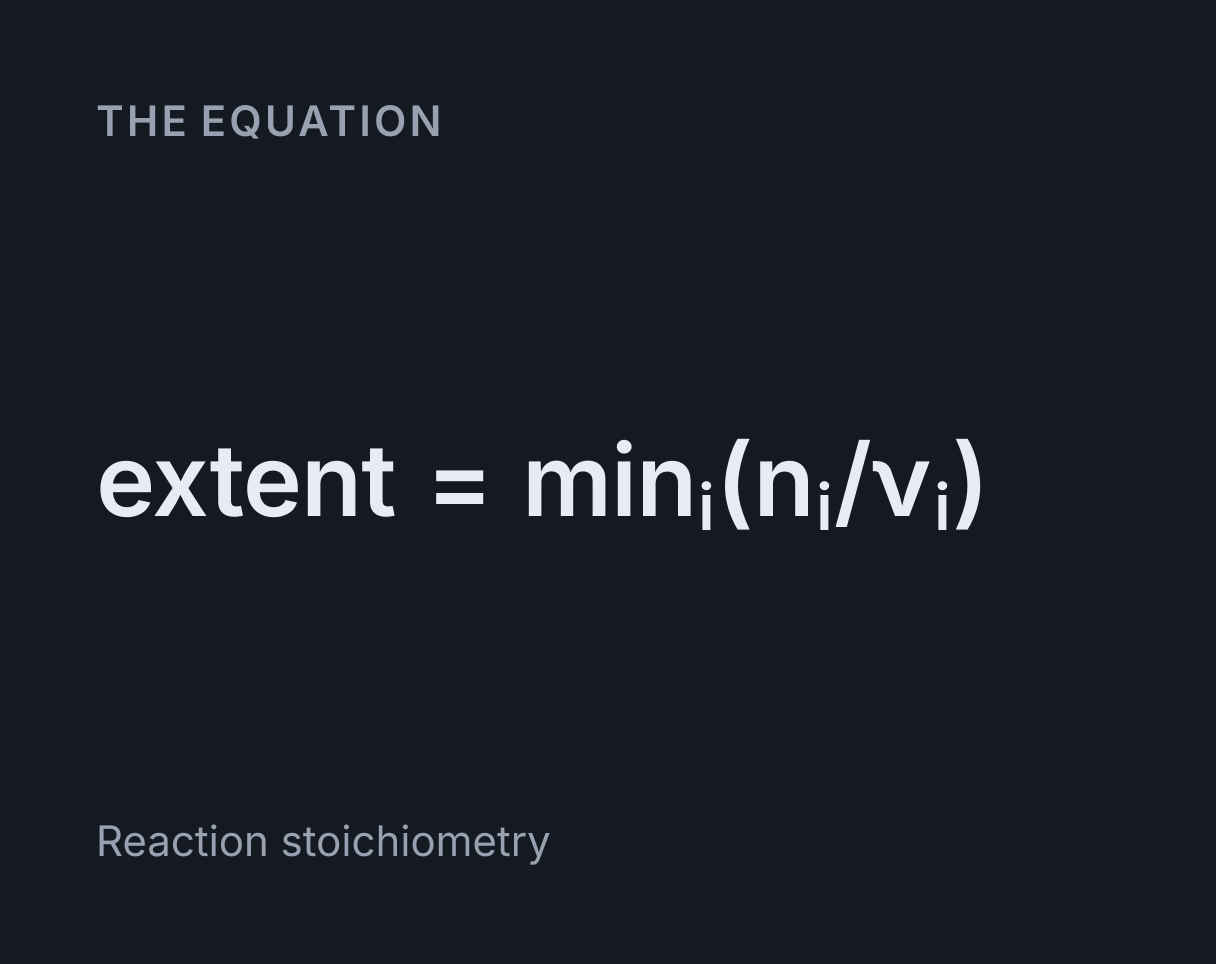
Extent is moles divided by the coefficient: how far the reaction could go on that reactant alone. The smallest one limits everything.
Citing this tool
Last updated . Add the date you accessed it as well, which a citation of a page that can change asks for. If a specific result matters, cite the permalink from the tool’s share row instead of this page: it reproduces the exact parameters.
The equation
Reaction stoichiometry
The reagent that runs out first decides everything
The limiting reagent is the reactant that runs out first and so sets how much product can form: divide each reactant’s moles by its coefficient in the balanced equation, and the one with the smallest result is limiting. A balanced equation fixes the ratio in which reactants are consumed. Supply them in any other ratio and one is exhausted while the others still have material left, and from that moment nothing more can form. The product mass is set entirely by whichever ran out, which is why finding it is the first step of every yield calculation and not an optional refinement.
The comparison people reach for is which reactant has fewer moles, and it is wrong. What matters is how far the reaction could proceed on each reactant alone, which is its moles divided by its coefficient. That figure is called the extent here, and the smallest one wins.
Why moles alone mislead
Consider the oxidation of ammonia, 4 NH3 + 3 O2, with one mole of
ammonia and 0.9 moles of oxygen. Ammonia is the more plentiful of the two, and it
is still the limiting reagent: each turn of the reaction eats four ammonia and only
three oxygen, so ammonia supports an extent of 1/4 = 0.25 while oxygen supports
0.9/3 = 0.3. The reaction stops at 0.25.
The reverse trap is just as common. For 2 H2 + O2 with 4 g of
hydrogen and 32 g of oxygen, taking whole-number atomic masses (H 1, O 16), the
moles are 2 and 1, so oxygen looks limiting. Both extents are 1: they are supplied
in stoichiometric proportion and are exhausted together, with nothing left over.
Comparing moles would have named a limiting reagent where there is not one. With
the atomic masses this calculator uses, 1.008 and 15.999, hydrogen in fact runs
out first by 0.8 percent, which is the lesson of the worked example below in
miniature.
Worked example
The thermite reaction, Fe2O3 + 2 Al giving 2 Fe, starting
from 160 g of iron oxide and 54 g of aluminium:
-
M(Fe2O3) = 159.687 g/mol, son = 160 / 159.687 = 1.00196 mol, and the extent is1.00196 / 1 = 1.00196. -
M(Al) = 26.982 g/mol, son = 54 / 26.982 = 2.00133 mol, and the extent is2.00133 / 2 = 1.00067. -
Aluminium gives the smaller extent by a whisker, so it limits. The product is
1.00067 x 2 = 2.0013 molof iron, which is2.0013 x 55.845 = 111.76 g.
Those two extents differ by about a tenth of a percent, which is the useful part of the example: near stoichiometric proportions, which reactant limits can turn on the third significant figure of a molar mass. That is a good reason to let the arithmetic decide rather than guessing from the masses.
What the leftover column tells you
Every reactant except the limiting one has material remaining once the reaction stops. The amount consumed is the extent multiplied by that reactant’s coefficient, and the rest is excess. It is worth checking, because a large excess is usually deliberate, either to drive an equilibrium forward or because the reagent is cheap, and an unintended one means the quantities were wrong.
For the limiting reagent the leftover is zero by definition. If the calculator shows two reactants at zero, they were supplied in exact stoichiometric proportion.
Common mistakes
- Comparing moles instead of extents. The single most common error, and it fails in both directions, as the two examples above show.
- Using an unbalanced equation. The coefficients are the whole basis of the comparison. Balance first, with the chemical equation balancer if the equation is not already balanced, or every extent is wrong by a ratio.
- Applying the product coefficient to the wrong quantity. The product moles are the extent multiplied by the product coefficient, not the limiting reactant’s moles multiplied by it.
- Forgetting hydrates. Copper sulfate pentahydrate is
CuSO4·5H2Oat 249.68 g/mol, not 159.60. Weighing the hydrate and using the anhydrous mass overstates the moles by 56 percent. - Reporting a yield above 100 percent. The theoretical figure is a ceiling. Exceeding it means the product was wet, impure, or weighed with the container.
Common questions
Why compare moles divided by the coefficient instead of just moles?
Because a reactant needed twice over runs out twice as fast. Dividing moles by the coefficient gives the extent, meaning how many times the reaction could proceed on that reactant alone, and the smallest extent is what limits everything. Take 4 NH3 + 3 O2 with 1 mol of ammonia and 0.9 mol of oxygen: ammonia has more moles but an extent of 0.25 against oxygen’s 0.3, so ammonia limits despite being more plentiful.
Can two reactants both be limiting?
Yes, when their extents are equal, which means they are exhausted at the same moment and neither is left over. That is what stoichiometric proportions means. For 2 H2 + O2 with 4.032 g of hydrogen and 31.998 g of oxygen, which is 2 mol and 1 mol, both give an extent of 1, and comparing moles alone would wrongly single out oxygen because 1 mol is fewer than 2.
Why is my actual yield below the theoretical one?
Almost always for practical reasons rather than arithmetic ones: product lost on the filter or the glassware, a reaction that has not gone to completion, a competing side reaction, or product still wet when it was weighed. A yield above 100 percent means the product was not dry or not pure, since the theoretical figure is a hard ceiling set by the limiting reagent.