Chemical Equation Balancer
Balance any chemical equation, ions and electrons included: Fe + O₂ = Fe₂O₃ becomes 4Fe + 3O₂ → 2Fe₂O₃, with the algebra and an atom count for each side.
Calculator
Join species with + and put = or → between the sides. Write a charge after a caret, as in Fe^3+ or SO4^2-, and an electron as e-. Any coefficients you type are checked, then replaced.
Balanced equation
Smallest whole-number coefficients, in the order typed: 4, 3, 2
Atom count
| Element | Reactants | Products |
|---|---|---|
| Fe | 4 × 1 = 4 | 2 × 2 = 4 |
| O | 3 × 2 = 6 | 2 × 3 = 6 |
Each entry is coefficient × atoms per formula, and every row totals the same on both sides.
Working, step by step
- Let the coefficients be a, b and c: a Fe + b O₂ → c Fe₂O₃
- Fe: a = 2c
- O: 2b = 3c
- Taking c = 1: a = 2, b = 3/2
- Multiplying by 2 clears the fractions: a = 4, b = 3, c = 2
- 4Fe + 3O₂ → 2Fe₂O₃
- Check: Fe 4 = 4, O 6 = 6
Each element gives one equation in the unknown coefficients, and the charge gives one more when ions or electrons are present. Setting one coefficient to 1 and clearing the fractions gives the smallest whole numbers.
Citing this tool
Last updated . Add the date you accessed it as well, which a citation of a page that can change asks for. If a specific result matters, cite the permalink from the tool’s share row instead of this page: it reproduces the exact parameters.
The equation
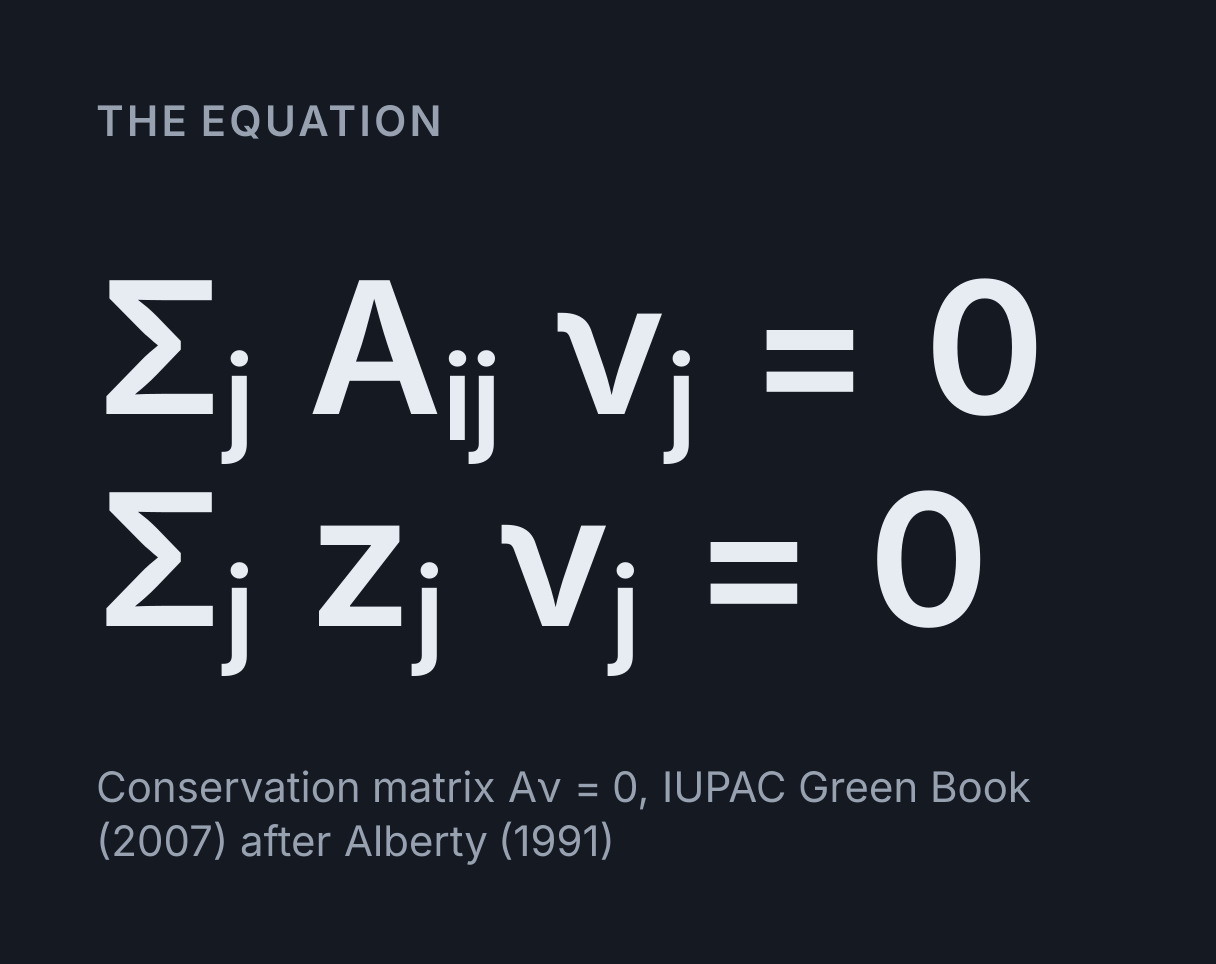
Conservation matrix Aν = 0, IUPAC Green Book (2007) after Alberty (1991)
How to balance a chemical equation
To balance a chemical equation, put a whole-number coefficient in front of each formula
so that every element has the same number of atoms on both sides, and for ions the same
total charge: Fe + O2 = Fe2O3 balances as 4Fe + 3O₂ → 2Fe₂O₃,
with 4 iron atoms and 6 oxygen atoms on each side. In symbols, every element obeys
Σ_j A_ij ν_j = 0, where A_ij is the number of atoms of element
i in one formula of species j and ν_j is that species’ coefficient, counted
negative for a reactant and positive for a product. Charge adds
Σ_j z_j ν_j = 0, with z_j the charge on each species.
Only the coefficients change. A subscript is part of a formula, so changing one changes the substance: H₂O₂ is hydrogen peroxide, not a way of writing more water. Type an equation above, with or without coefficients, and the calculator returns the smallest whole numbers that balance it, the algebra that found them, and an atom count you can check line by line.
Typing an equation
Write each formula as you would on paper, Ca(OH)2 or
CuSO4·5H2O, join the formulas with +, and put = or
→ between the reactants and the products. -> works too, and
⇌ or <=> marks an equilibrium, which the answer keeps.
State symbols go last and are carried through, as in Zn(s) + Cu^2+(aq);
write them in lower case, because (S) would be sulfur.
Write a charge after a caret: Fe^3+, SO4^2-,
NH4^+, and for a complex ion after its bracket,
[Cu(H2O)6]^2+. Braces and brackets work as well, Fe{3+} and
Fe(3+), and so do pasted superscripts, Fe³⁺, and the older
Fe+3 and Ca++. A bare sign is a charge of one after a letter
or a bracket, Na+ and OH-, and after the single-digit subscript
of a polyatomic ion, NO3- and NH4+. What the calculator
refuses is a sign straight after the digit of a lone element, after two digits, or after
a digit that follows a complex ion’s bracket, Fe3+, SO42- or
[Cu(H2O)6]2+, because there the digit could be either the charge or a
subscript, and the two readings are different ions. One common formula is ambiguous
even with a single digit: VO2+ reads as VO₂⁺, so write the vanadyl ion,
VO²⁺, as VO^2+. However the charge is typed, the answer writes it the way
IUPAC recommends, number before sign, as in Al³⁺; IUPAC’s Green Book lists Al+3 and
Al+++ as obsolete forms.
An electron is e-, or just e. Write iron(III) as
Fe^3+ rather than Fe(III), which a formula parser reads as iron
with three iodine atoms, so the calculator refuses it. Coefficients you type, whole,
decimal or written as 1/2, are checked before they are replaced: the answer
says whether yours balance and whether they are the smallest whole numbers.
Worked example: propane burning in oxygen
Balance C3H8 + O2 = CO2 + H2O. Give each species an unknown coefficient,
a C₃H₈ + b O₂ → c CO₂ + d H₂O, and write one equation for each element,
atoms on the left equal to atoms on the right:
C: 3a = cH: 8a = 2dO: 2b = 2c + d
Three equations in four unknowns fix the ratios but not the size, so set one coefficient
to 1. Taking d = 1 gives a = 1/4, b = 5/4 and
c = 3/4. Multiplying by 4, the smallest number that clears the fractions,
gives C₃H₈ + 5O₂ → 3CO₂ + 4H₂O. The check is to count: 3 carbon, 8 hydrogen
and 10 oxygen atoms on each side, the 10 on the right being 3 × 2 in the carbon dioxide
and 4 × 1 in the water.
That is the working the calculator prints, line for line. It is also why the method never fails on an equation that has an answer: each element is one linear equation, and the coefficients are the solution of all of them together.
Balancing by inspection, and why the algebra always works
By hand, the quicker route is inspection. Balance first an element that appears in only
one formula on each side, then work outwards, and leave hydrogen and oxygen, which
usually turn up everywhere, until last. For Fe + H2O = Fe3O4 + H2, Fe₃O₄
needs 3 iron, so write 3Fe; its 4 oxygens need 4H₂O; and the 8 hydrogens in 4H₂O need
4H₂. The result, 3Fe + 4H₂O → Fe₃O₄ + 4H₂, is what the algebra gives too.
Inspection slows down when every element sits in several formulas.
KMnO4 + HCl = KCl + MnCl2 + H2O + Cl2 balances as
2KMnO₄ + 16HCl → 2KCl + 2MnCl₂ + 8H₂O + 5Cl₂, which takes some trial and
error by hand, and an equation such as
K4Fe(CN)6 + KMnO4 + H2SO4 = KHSO4 + Fe2(SO4)3 + MnSO4 + HNO3 + CO2 + H2O
needs coefficients of 10, 122, 299, 162, 5, 122, 60, 60 and 188. The algebra does not
care how many there are. It solves every element equation at once, in exact fractions
rather than decimals, so 299 comes out as 299 and never as 298.99999.
In matrix form the element equations are Aν = 0. A, which the IUPAC Green
Book calls the conservation or formula matrix, holds the atom counts with one row per
element and one column per species, and the balanced coefficients are its null space.
The number of independent reactions an equation contains is the number of species minus
the rank of A. That number, with the signs of the solutions, is how the calculator knows
whether an equation has one answer, none, or more than one (IUPAC, Quantities, Units
and Symbols in Physical Chemistry, 3rd edition, 2007, section 2.10.1, p. 53, after
R. A. Alberty, 1991).
Ionic equations and half-equations
An ionic equation has to balance charge as well as atoms, and the calculator treats
charge as one more quantity to conserve.
MnO4^- + Fe^2+ + H^+ = Mn^2+ + Fe^3+ + H2O balances as
MnO₄⁻ + 5Fe²⁺ + 8H⁺ → Mn²⁺ + 5Fe³⁺ + 4H₂O, the reaction in a permanganate
titration of iron(II). The charge is +17 on each side: −1 + 10 + 8 on the left, and 2 +
15 on the right.
A half-equation includes its electrons. Cr2O7^2- + H^+ + e- = Cr^3+ + H2O
gives Cr₂O₇²⁻ + 14H⁺ + 6e⁻ → 2Cr³⁺ + 7H₂O. Leave the electrons out and the
atoms still balance while the charge cannot, which the calculator recognises: for
Fe^3+ = Fe^2+ it reports the mismatch and shows the half-equation with
electrons added, Fe³⁺ + e⁻ → Fe²⁺.
By hand, a redox equation is balanced in halves. Write the reduction and the oxidation
separately; in each, balance the atoms other than oxygen and hydrogen, then oxygen with
H₂O, hydrogen with H⁺ and the charge with electrons. Scale the two halves to the same
number of electrons and add them, so that the electrons cancel. For the titration above
the halves are MnO₄⁻ + 8H⁺ + 5e⁻ → Mn²⁺ + 4H₂O and
Fe²⁺ → Fe³⁺ + e⁻: five of the second carry the five electrons the first
takes, and their sum is the titration equation. In alkaline solution, finish by adding
as many OH⁻ to both sides as there are H⁺, so that each H⁺ and OH⁻ make water, and
cancel the water that then appears on both sides.
All 42 half-reactions in the
table of standard reduction
potentials balance here as written, electrons included, and one of them shows why a
half-equation is chemistry as well as counting. Ozone’s,
O₃ + 2H⁺ + 2e⁻ → O₂ + H₂O, is balanced, but so are
O₃ + 6H⁺ + 6e⁻ → 3H₂O and 2O₃ → 3O₂, and any mixture of them,
so atoms and charge alone cannot fix the number of electrons. The table’s 2 belong to the
reduction that gives oxygen gas.
When oxygen or hydrogen appears on one side only of an ionic equation, the usual fix in water is to add H₂O for the oxygen and H⁺ for the hydrogen, or OH⁻ and H₂O in alkaline solution, and the calculator suggests that. The charges of the common ions are in the polyatomic ions table.
When there is no answer, or more than one
Some equations cannot be balanced as written, and the calculator says why instead of
forcing numbers onto them. An element on one side only is the plainest case: in
NaCl = Na2O the chlorine has nowhere to go. A species can be on the wrong
side: H2O2 = H2 + H2O balances only as H₂O₂ + H₂ → 2H₂O. Or a
species can take no part, like the Cl₂ in NaOH + HCl = NaCl + H2O + Cl2,
where the rest balances only with none of it.
Other equations balance in more than one way, because they are two or more reactions
written as one. H2 + O2 = H2O + H2O2 is 2H₂ + O₂ → 2H₂O and
H₂ + O₂ → H₂O₂ added together, and any mixture of the two is balanced, so
the atoms cannot choose the coefficients. The calculator says so and lists the simplest
reactions the equation is made of.
A case worth knowing is H2O2 + KMnO4 + H2SO4 = K2SO4 + MnSO4 + O2 + H2O. It
contains a reaction of permanganate alone,
4KMnO₄ + 6H₂SO₄ → 2K₂SO₄ + 4MnSO₄ + 5O₂ + 6H₂O, and the decomposition of
the peroxide, 2H₂O₂ → O₂ + 2H₂O, so both
5H₂O₂ + 2KMnO₄ + 3H₂SO₄ → K₂SO₄ + 2MnSO₄ + 5O₂ + 8H₂O and
7H₂O₂ + 2KMnO₄ + 3H₂SO₄ → K₂SO₄ + 2MnSO₄ + 6O₂ + 10H₂O are balanced. The
first is the one the half-equation method gives, because it assumes every oxygen
molecule comes from a peroxide molecule being oxidised. That is chemistry the atom count
cannot see.
What the calculator does not do
It balances the equation you give it. It does not predict products, and a balanced equation says only that the atoms add up, not that the reaction happens, goes to completion or runs at a useful rate. It does not assign oxidation states or split a redox reaction into half-equations either, though it balances any half-equation you type.
Formulas are read literally, by the same parser as the molar mass calculator. Abbreviations such as Ph or Et are not understood, and one that is also an element symbol is read as the element, so AcOH is actinium, oxygen and hydrogen rather than acetic acid. An isotope label such as 13C reads as a coefficient, Roman numerals are refused, and every element symbol has to start with a capital letter. The coefficients count moles or particles, never grams. To turn a mass of reactant into a mass of product, take the balanced equation to the limiting reagent calculator, and then to the percent yield calculator to compare the result with what you actually made.
Common mistakes
- Changing a subscript. Writing H₂O₂ where the product is water balances the hydrogen and oxygen at a stroke and describes a different substance. Change coefficients only.
- Writing an element as single atoms. Oxygen, hydrogen, nitrogen and
the halogens exist as diatomic molecules.
Fe + O = Fe2O3balances as2Fe + 3O → Fe₂O₃, but the oxygen that reacts is O₂, and written with it the equation balances as4Fe + 3O₂ → 2Fe₂O₃. - Miscounting inside brackets. A subscript after a bracket multiplies
everything inside it, so Ca₃(PO₄)₂ holds 2 phosphorus and 8 oxygen atoms.
Ca(OH)2 + H3PO4 = Ca3(PO4)2 + H2Obalances as3Ca(OH)₂ + 2H₃PO₄ → Ca₃(PO₄)₂ + 6H₂O. - Stopping at fractions or at a common factor.
H2 + 1/2O2 = H2Oand4H2 + 2O2 = 4H2Oboth balance, but the convention is the smallest whole numbers,2H₂ + O₂ → 2H₂O. Type yours in and the calculator says which you have. - Forgetting the charge. In
Fe^2+ + Cl2 = Fe^3+ + 2Cl^-the atoms balance, but the charge is +2 on the left and +1 on the right. Balanced, it is2Fe²⁺ + Cl₂ → 2Fe³⁺ + 2Cl⁻, with +4 on each side. - Putting a species on both sides. A catalyst or a spectator ion written on both sides cancels out, so there is no coefficient to find for it. Leave it out of the equation.
Common questions
How do you balance a chemical equation?
Put a coefficient in front of each formula so that every element has the same number of atoms on both sides, and never change a subscript. Fe + O₂ = Fe₂O₃ becomes 4Fe + 3O₂ → 2Fe₂O₃, with 4 iron and 6 oxygen atoms on each side. By hand, balance an element that appears in only one formula on each side first and leave hydrogen and oxygen until last. This calculator writes one equation per element and solves them all at once, which finds the smallest whole numbers whenever the equation has a single answer.
How do you balance an ionic or redox equation?
Balance the charge as well as the atoms, so that the total charge is the same on both sides. MnO₄⁻ + 5Fe²⁺ + 8H⁺ → Mn²⁺ + 5Fe³⁺ + 4H₂O carries +17 on each side. By hand, split a redox equation into half-equations; balance each for every atom but oxygen and hydrogen, then oxygen with H₂O, hydrogen with H⁺ and charge with electrons, as in Cr₂O₇²⁻ + 14H⁺ + 6e⁻ → 2Cr³⁺ + 7H₂O; and scale the halves so the electrons cancel when they are added. Here, type a charge after a caret, as in Fe^3+ or SO4^2-, and an electron as e-.
Why can you not change subscripts to balance an equation?
Because a subscript is part of the formula, so changing it changes the substance. In H₂ + O₂ = H₂O, turning H₂O into H₂O₂ balances hydrogen and oxygen at a stroke, but the equation then describes hydrogen peroxide, not water. Only the coefficients in front of each formula say how much of it reacts or forms, and here they give 2H₂ + O₂ → 2H₂O.
What does it mean when an equation balances in more than one way?
That it is two or more independent reactions written as one, so the atoms alone cannot fix the coefficients. H₂ + O₂ = H₂O + H₂O₂ combines 2H₂ + O₂ → 2H₂O with H₂ + O₂ → H₂O₂, and any mixture of the two is balanced. The calculator lists those simplest reactions instead of picking one. Which mixture really forms is a question of chemistry: a measured ratio of products settles it, and for a redox reaction so does the half-equation method, once you decide what each species is oxidised or reduced to.
What does it mean when an equation cannot be balanced?
That no set of positive coefficients conserves every element, and the charge where there are ions, so a formula is wrong, a species is missing, or one is on the wrong side. In NaCl = Na₂O the chlorine has nowhere to go. A half-equation typed without its electrons fails on the charge: Fe³⁺ = Fe²⁺ balances only once an electron is added, as Fe³⁺ + e⁻ → Fe²⁺, and the calculator shows that fix.