Percent Error Calculator
Compare a measured value against the accepted one for percent error, absolute error and signed relative error, so systematic bias stays visible.
Calculator
The true or textbook value you are comparing against.
Working, with your numbers
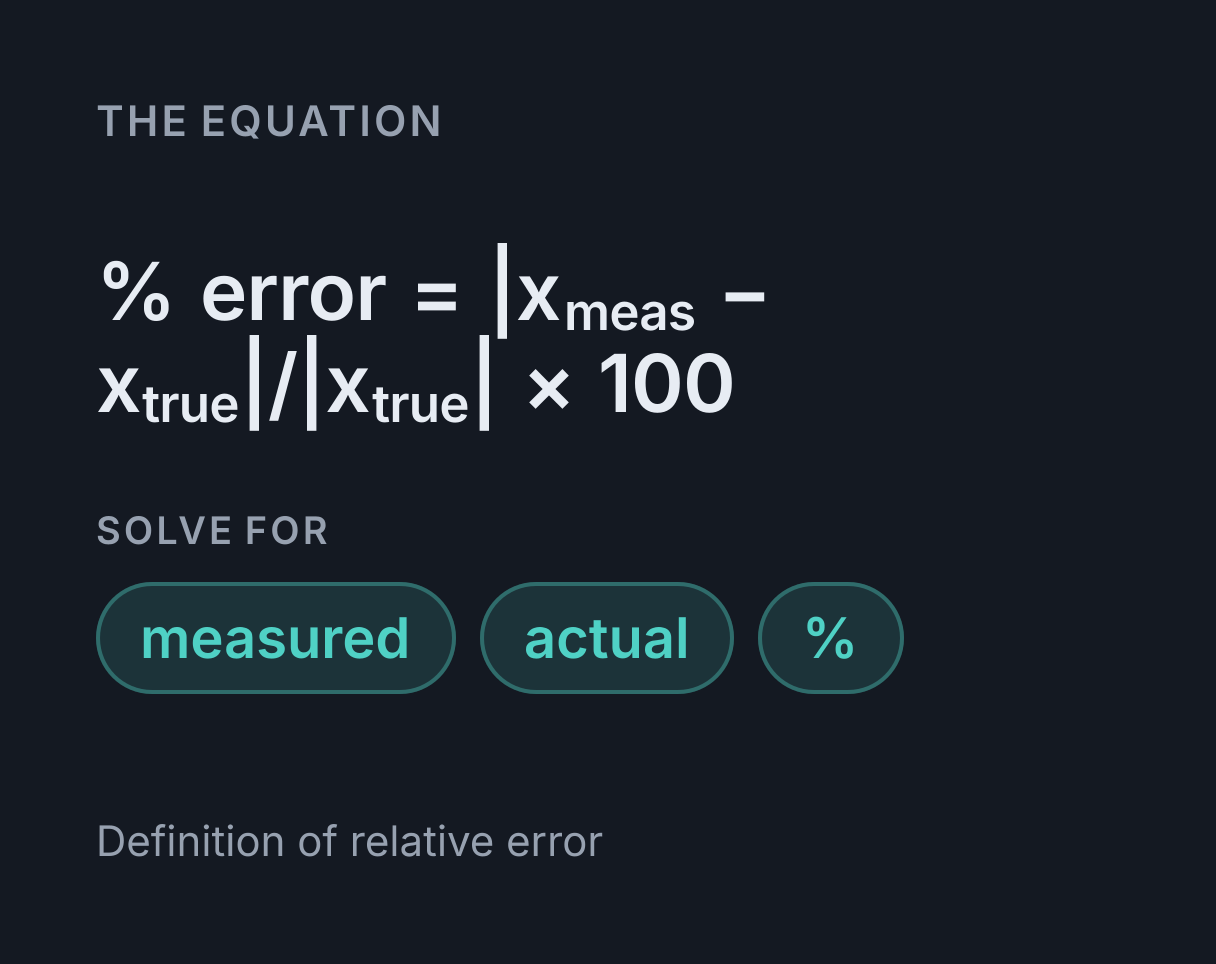
- % error = |measured - actual| / |actual| x 100
- = |9.75 - 9.81| / |9.81| x 100
- = 0.06 / 9.81 x 100
- = 0.6116 %
Values are converted into the units the equation is worked in before the arithmetic.
- Absolute error The raw difference, in whatever units you are working in.
- 0.06
- Direction
- Measured is low
- Signed relative error Keeps the sign, so a systematic bias is visible.
- -0.6116%
Citing this tool
Last updated . Add the date you accessed it as well, which a citation of a page that can change asks for. If a specific result matters, cite the permalink from the tool’s share row instead of this page: it reproduces the exact parameters.
The equation
Definition of relative error
Accuracy, not precision
Percent error answers one question: how far is my measurement from the value everyone agrees is correct, expressed as a fraction of that correct value. It measures accuracy. It says nothing about precision, which is how tightly your repeated readings cluster together. Those are independent. A balance that always reads 0.5 g heavy is precise and inaccurate; a shaky one that averages out to the right answer is accurate and imprecise.
Dividing by the accepted value is what makes the number portable. Being out by 2 cm is trivial when measuring a corridor and disqualifying when measuring a bearing, and the percentage captures that without you having to explain the context. This calculator reports the raw absolute error too, because when the accepted value is small the percentage can look alarming while the physical discrepancy is negligible.
Worked example
A class measures gravitational acceleration with a pendulum and gets 9.75 m/s². The accepted local value is 9.81 m/s².
absolute error = |9.75 − 9.81| = 0.06 m/s²% error = 0.06 / 9.81 × 100% error = 0.6116%
Under one percent from a piece of string and a stopwatch is a good result. The signed relative error is −0.61%, and the minus sign is the interesting part: if every group in the room came out low, something systematic is happening. Stopping the watch late would do it, or measuring the string rather than the distance to the bob’s centre of mass.
Percent error, percent difference, percent change
Three similar formulas get confused constantly. Use percent error when one value is authoritative and you divide by it. Use percent difference when comparing two measurements of equal standing, dividing by their mean, because neither has a claim to be the denominator. Use percent change when something has moved over time, dividing by the starting value and keeping the sign, since a rise and a fall are genuinely different outcomes.
Picking the wrong one changes the answer. Two readings of 8 and 10 differ by 25% as a percent error against 8, by 20% against 10, and by 22.2% as a percent difference. State which you used whenever the numbers are close enough for the distinction to matter.
The percent difference calculator works out the other two for any pair of values, with the percent change in both directions.
Common mistakes
- Dividing by the measured value. The denominator is the accepted value. Using your own reading makes the result depend on the error you are trying to quantify, and two labs comparing the same discrepancy would report different percentages.
- Discarding the sign. The magnitude goes in the report, but check the sign first. Consistent one-way error means a calibration problem you can fix; scattered signs mean random noise you can only average down.
- Using it when the accepted value is zero. The percentage is undefined and unstable near zero. Quote the absolute error, or normalise against the instrument’s full-scale reading instead.
- Over-reporting digits. If your measurement has three significant figures, a percent error of 0.611621% is false precision. Two significant figures on the error is almost always enough.
Worked examples
Each one runs through the calculator above, so the arithmetic here is the arithmetic it does.
What is the percent error if you measure g as 9.75 instead of 9.81?
- % error = |measured - actual| / |actual| x 100
- = |9.75 - 9.81| / |9.81| x 100
- = 0.06 / 9.81 x 100
- = 0.6116 %
0.61 percent, and the denominator is the accepted value rather than your measurement. Dividing by 9.75 instead gives 0.615 percent, which is close enough here to hide the mistake and far enough off to matter when the two values differ a lot.
What is the percent error in a titration reading 24.6 mL not 25.0?
- % error = |measured - actual| / |actual| x 100
- = |24.6 - 25| / |25| x 100
- = 0.4 / 25 x 100
- = 1.6 %
1.6 percent from being 0.4 mL out, which is about eight drops from a burette. A class B burette reads to 0.05 mL, so an error this size is a technique problem rather than an instrument limit, most often a misjudged endpoint.
What measurement would be 3 percent above a true value of 9.81?
- measured = actual x (1 +/- % / 100)
- = 9.81 x (1 + 3 / 100)
- = 9.81 x 1.03
- = 10.1043, or 9.5157 on the low side
10.10, and note there are two answers. A 3 percent error is equally consistent with 9.52 on the low side, because percent error takes an absolute value and throws the direction away. Quote the signed difference too if the direction of the bias matters.
Common questions
What is the difference between percent error and percent difference?
Percent error compares a measurement against a known accepted value and divides by that value, while percent difference compares two measurements when neither is authoritative and divides by their mean. Use percent error in a lab where a textbook value exists, and percent difference when comparing two independent trials.
Should percent error ever be negative?
Conventionally no, because the standard formula takes the absolute value. But the sign is genuinely informative: a set of readings that are all high points to a systematic bias, such as an uncalibrated balance, while scattered signs point to random error. This tool reports the signed relative error separately so you do not lose that.
Why can I not use an accepted value of zero?
Because dividing by zero makes the percentage undefined, and near zero it explodes without meaning anything. When the accepted value is zero or very close to it, quote the absolute error instead, or normalise against the instrument’s full-scale reading.