NMR Splitting Pattern Visualiser
Build NMR splitting patterns from up to three sets of neighbours: draw the splitting tree, name the multiplet and list every line in Hz and ppm.
Visualiser
Splitting tree for one proton at 4.12 ppm on a 400 MHz spectrometer, split by set A, 3 neighbours with J = 7.1 Hz, into a quartet: 4 lines in the ratio 1:3:3:1, 21.3 Hz from the outer line on one side to the outer line on the other. Under the tree, the lines stand on a ppm axis with frequency rising to the left, inside the line shape a spectrum would show.
The CH₂ of ethyl acetate, next to a CH₃: a quartet at 4.12 ppm with J = 7.1 Hz.
- Multiplet Named from the largest coupling down. Each word is what one group of equivalent neighbours makes: n of them give n + 1 lines, and each further group splits every one of those lines again.
- Quartet
- Shorthand How a peak list writes it, couplings largest first: δ 4.12 (q, J = 7.1 Hz), followed by the integral, such as 2H.
- q
- Lines The n + 1 rule for each set, multiplied: (3 + 1) = 4.
- 4
- Intensity ratio Each line’s share of the 8 equally likely spin arrangements of the 3 neighbours. One set of n neighbours gives row n of Pascal’s triangle.
- 1:3:3:1
- Width Outer line to outer line, the sum of n × J over the sets: 3 × 7.1 = 21.3 Hz. The same on every spectrometer.
- 21.3 Hz
- Width in ppm 21.3 Hz ÷ 400 MHz. A stronger magnet narrows a multiplet in ppm but never in hertz.
- 0.05325 ppm
- Centre from TMS δ × spectrometer frequency: 4.12 ppm × 400 MHz = 1648 Hz above the TMS signal.
- 1648 Hz
- Peaks seen Maxima of the summed line shape at a line width of 1.0 Hz. Two equal lines closer than the width ÷ √3, here 0.5774 Hz, merge into one peak, which is how a doublet of doublets with nearly equal couplings passes for a triplet.
- 4
| Line | Offset (Hz) | From TMS (Hz) | δ (ppm) | Intensity |
|---|---|---|---|---|
| 1 | +10.65 | 1658.65 | 4.1466 | 1 |
| 2 | +3.55 | 1651.55 | 4.1289 | 3 |
| 3 | −3.55 | 1644.45 | 4.1111 | 3 |
| 4 | −10.65 | 1637.35 | 4.0934 | 1 |
Citing this tool
Last updated . Add the date you accessed it as well, which a citation of a page that can change asks for. If a specific result matters, cite the permalink from the tool’s share row instead of this page: it reproduces the exact parameters.
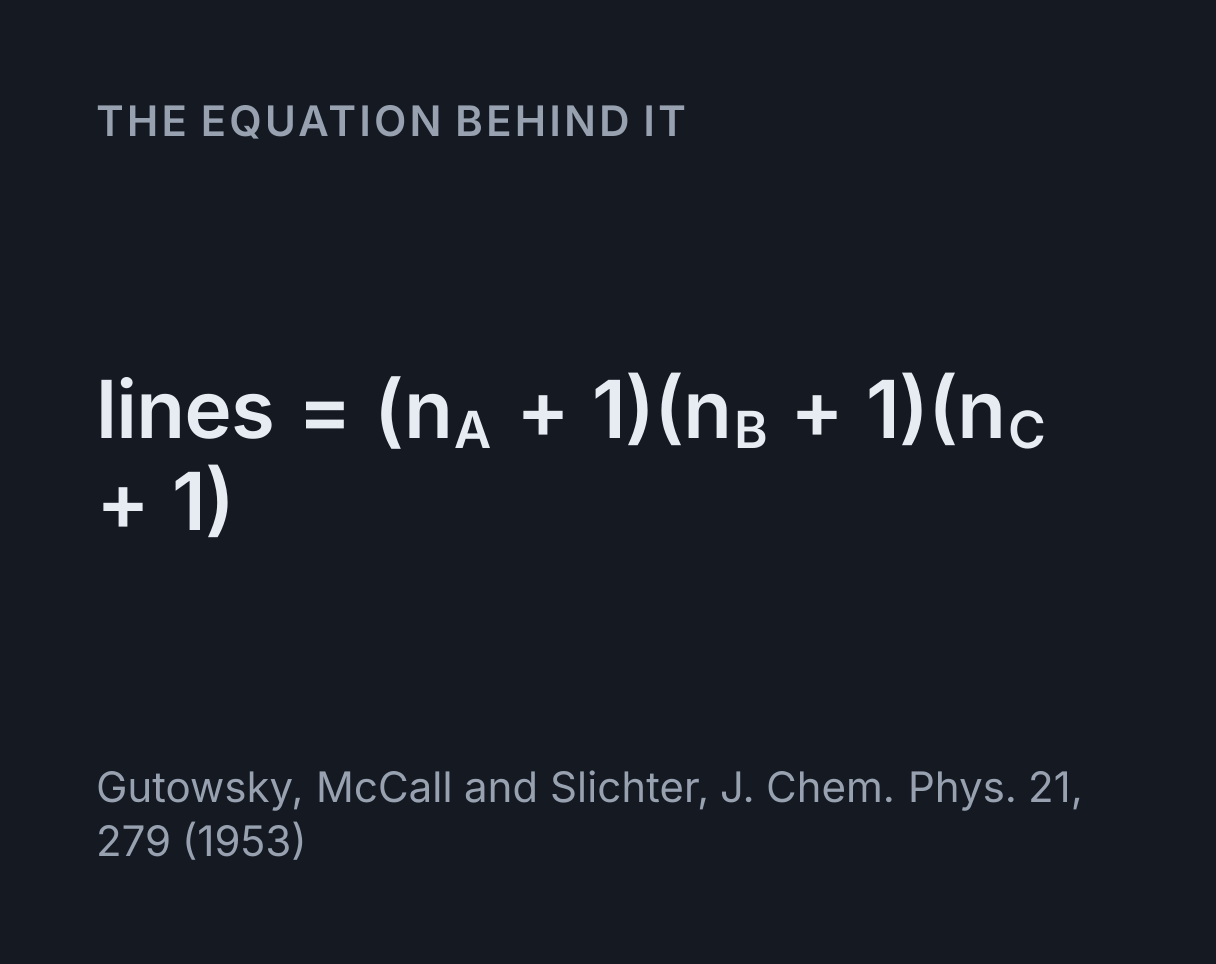
The equation
Gutowsky, McCall and Slichter, J. Chem. Phys. 21, 279 (1953)
What are NMR splitting patterns?
In a proton NMR spectrum a signal is often not one line but a cluster of lines, called a
multiplet. The splitting comes from spin-spin coupling: each nearby proton is a tiny magnet that
lines up with or against the spectrometer’s field, and it moves the frequency of the proton being
observed up or down by half a coupling constant, J/2. For one set of n
equivalent neighbours sharing one coupling constant, the result is the n + 1 rule,
number of lines = n + 1, spaced J hertz apart.
The heights of the lines follow row n of Pascal’s triangle, because they count the
ways the neighbours’ spins can be arranged. One neighbour gives a doublet, 1:1, two a triplet,
1:2:1, three a quartet, 1:3:3:1, and six, as round the CH of an isopropyl group, a septet,
1:6:15:20:15:6:1. In ethyl acetate the CH₂ next to the CH₃ is a quartet at 4.12 ppm and the CH₃
next to the CH₂ is a triplet at 1.26 ppm, both with J = 7.1 Hz.
When a proton has two or three sets of neighbours with different coupling constants, each set
splits every line made by the one before, so the counts multiply:
lines = (n_A + 1)(n_B + 1)(n_C + 1). A proton split by two others with different
couplings is a doublet of doublets. This first-order analysis goes
back to Herbert Gutowsky, David McCall and Charles Slichter, who explained NMR multiplets in
liquids in 1953, and it holds when the coupled protons are far apart in shift compared with J.
Using the visualiser
Give each of up to three sets of neighbours, A, B and C, a number of equivalent protons and a coupling constant, then set the chemical shift, the spectrometer frequency and the line width. The presets under the tree load the CH₂ of ethyl acetate, the CH of cumene (isopropylbenzene) and the CH= of styrene.
The tree starts with the unsplit line at the chemical shift. Each level below it is one
neighbour: every line splits into two, J/2 either side, in the colour of that
neighbour’s set. Branches that land on the same frequency become one line, and the numbers beside
the lines add as they go, so a single set writes out the rows of Pascal’s triangle. The bracket on
the right marks each set’s levels with its count and its J. At the bottom the multiplet stands as
sticks on a ppm axis, inside the line shape a spectrum would show. As on a real spectrum,
frequency and δ rise to the left.
The readouts name the multiplet in words and in peak-list shorthand, count its lines, and give their intensity ratio, the width in hertz and in ppm, and the centre in hertz above TMS. Peaks seen counts the maxima of the line shape, which is fewer than the lines when some are closer together than the line width. The table lists each line’s offset, frequency above TMS, chemical shift and intensity.
Worked example: the CH₂ quartet of ethyl acetate at 400 MHz
The visualiser opens on the CH₂ group of ethyl acetate, CH₃COOCH₂CH₃, which sits next to a CH₃:
three equivalent neighbours with J = 7.1 Hz, at 4.12 ppm on a 400 MHz spectrometer.
- Three neighbours give
3 + 1 = 4lines: a quartet, shorthand q. -
Row 3 of Pascal’s triangle gives the heights,
1:3:3:1, out of2³ = 8spin arrangements, so each outer line carries 12.5 percent of the area and each inner line 37.5 percent. -
The lines sit at
±J/2 = ±3.55 Hzand±3J/2 = ±10.65 Hzfrom the centre, so the quartet is3 × 7.1 = 21.3 Hzwide. -
The centre is
4.12 × 400 = 1648 Hzabove TMS, so the lines are at1648 + 10.65 = 1658.65 Hz, 1651.55 Hz, 1644.45 Hz and1648 − 10.65 = 1637.35 Hz. -
Dividing by 400 turns them back into ppm:
1658.65 / 400 = 4.1466 ppm, then 4.1289, 4.1111 and 4.0934 ppm. The whole quartet covers21.3 / 400 = 0.05325 ppm. -
At a line width of 1 Hz, lines 7.1 Hz apart are far more than
1/√3of the width apart, so Peaks seen shows all 4.
The CH₃ on the other side of that coupling has two neighbours, so it is a triplet,
1:2:1, at 1.26 ppm, with lines ±7.1 Hz from its centre at
1.26 × 400 = 504 Hz. Its J is the same 7.1 Hz, because a coupling is shared by the
two protons it joins: matching J values is how you pair up neighbouring groups.
Reading a splitting tree
A splitting tree, or tree diagram, draws the splitting one neighbour at a time. Each neighbour
moves every line of the level above by +J/2 or −J/2, so after
n neighbours with one J the lines are J apart and there are n + 1 of
them, not 2ⁿ, because most branches land on the same frequency as another and merge.
Counting the branches that arrive at each line gives 1 1, then 1 2 1, then 1 3 3 1: each number is
the sum of the two above it, which is how Pascal’s triangle is built.
The tree is drawn with the largest coupling at the top. The final lines are the same in any
order, but largest first keeps the branches of the common patterns from crossing and matches the
way multiplets are named. Two facts help on paper: the multiplet is symmetric about the chemical shift, so δ is its centre even when no line sits there, and its
outermost lines are Σ nJ apart, which the Width readout gives.
Doublet of doublets, triplet of doublets and other names
A proton coupled to two protons with different coupling constants is a doublet of doublets, dd.
The CH= proton of styrene, near 6.72 ppm, is the classic example: it couples to the CH₂= proton
trans to it with J = 17.6 Hz and to the one cis to it with J = 10.9 Hz.
Its four lines are equal in height and sit (17.6 + 10.9)/2 = 14.25 Hz and
(17.6 − 10.9)/2 = 3.35 Hz either side of the centre. To read the couplings off a dd,
measure from the first line: to the second is the smaller J, 10.9 Hz, and to the third the larger,
17.6 Hz. The outer lines are 17.6 + 10.9 = 28.5 Hz apart.
Names are built from the largest coupling down, and every word after the first is plural. A doublet of triplets, dt, has its large coupling to one proton and a smaller one to two: with couplings of 10 Hz and 4 Hz its six lines are in the ratio 1:2:1:1:2:1. Swap the counts, so the 10 Hz coupling is to two protons and the 4 Hz one to a single proton, and it becomes a triplet of doublets, td, in the ratio 1:1:2:2:1:1. A peak list gives the couplings in the order of the letters, so the vinyl proton is reported as δ 6.72 (dd, J = 17.6, 10.9 Hz, 1H).
Typical coupling constants
A coupling constant is quoted in hertz because it does not depend on the magnet. Its size depends on the bonds between the protons and their geometry. Typical couplings between protons are:
- Neighbouring carbons that rotate freely, H-C-C-H: about 7 Hz, usually 6 to 8 Hz, as in ethyl and isopropyl groups.
- Across a C=C double bond: 12 to 18 Hz for protons trans to each other and 6 to 12 Hz for protons cis, which is how the geometry of an alkene is assigned.
- Two protons on the same sp2 carbon, =CH₂: 0 to 3 Hz.
- On a benzene ring: 7 to 10 Hz between ortho protons, 1 to 3 Hz between meta protons and under 1 Hz between para protons.
- Two different protons on the same sp3 carbon: often 12 to 15 Hz in size.
Couplings across three bonds depend on the dihedral angle between the two C-H bonds, largest near 180° and smallest near 90°, a relationship Martin Karplus described in 1959. So two axial protons on neighbouring carbons of a cyclohexane chair, at a dihedral angle of 180°, couple at about 8 to 13 Hz, while an axial and an equatorial proton, at about 60°, couple at 2 to 5 Hz. The Cyclohexane Chair Conformation Explorer shows which positions are which. The two protons of a CH₂ next to a stereocentre are not equivalent either; the R and S Configuration Explorer shows how such a centre is assigned.
Why a stronger magnet changes ppm but not hertz
A chemical shift in ppm is a frequency in hertz divided by the spectrometer frequency in
megahertz, so 1 ppm is 60 Hz at 60 MHz and 400 Hz at 400 MHz, while couplings stay fixed in hertz.
The 21.3 Hz quartet covers 21.3 / 60 = 0.355 ppm at 60 MHz but only 0.05325 ppm at
400 MHz and 0.0213 ppm at 1000 MHz: a stronger magnet makes multiplets narrower, so they overlap
less. Change the frequency and the ppm axis stretches while the tree stays the same.
A stronger magnet also makes spectra more first order. The rule of thumb is that the shift
difference between two coupled protons, in hertz, should be at least about ten times their J.
Ethyl acetate’s CH₂ and CH₃ are 2.86 ppm apart: 2.86 × 60 = 171.6 Hz at 60 MHz,
already 24 times J, and 1144 Hz at 400 MHz, 161 times J. Styrene’s CH= and the CH₂= proton trans
to it are about 0.97 ppm apart, 0.97 × 60 = 58.2 Hz at 60 MHz, only 3.3 times their
17.6 Hz coupling, so at that field the vinyl pattern is visibly second order; at 400 MHz the 388
Hz gap is 22 times J. All these frequencies are radio waves, the long-wavelength end of the range
the Electromagnetic Spectrum Explorer
covers.
When lines merge
Lines that land on one frequency add, which happens in two ways. Sets with exactly
the same J act as one set: the middle CH₂ of a propyl group, between a CH₃ and a CH₂ with nearly
equal couplings, has five neighbours and so 5 + 1 = 6 lines. Set A to 3 neighbours
and set B to 2 with the same J to see that sextet, 1:5:10:10:5:1. Lines also coincide by
accident: a doublet of triplets with couplings of 10 Hz and 5 Hz has two of its six lines on one
frequency, leaving five in the ratio 1:2:2:2:1.
The line width merges lines too. Two equal lines of full width at half height w show a dip
between them only when they are more than w/√3 = 0.577w apart. A doublet of doublets
with couplings of 7.2 Hz and 6.8 Hz has its middle lines 0.4 Hz apart, so at a line width of 1 Hz
they merge and Peaks seen reads 3: the pattern passes for a 1:2:1 triplet.
Narrow the lines to 0.3 Hz and all 4 appear. Small lines get lost too: the outer lines of a septet
are a twentieth of the height of its centre line, and in a noisy spectrum a septet is easily
miscounted as a quintet.
What this model leaves out
- Second-order effects. When coupled protons are closer in shift than about ten times J, the inner lines grow and the outer ones shrink, an effect called roofing, and very close shifts give AB and ABX patterns with extra lines. The first-order pattern is then only an approximation.
- Magnetic inequivalence. Protons with the same shift can still couple differently to one neighbour, as in a para-disubstituted benzene ring, whose AA′XX′ pattern is not two simple doublets. Here every proton in a set couples identically.
- Exchange. OH and NH protons often swap between molecules faster than their coupling can show, giving broad singlets that split nothing; leave them out of the counts unless their coupling shows.
- Neighbours with other spins. The sets are spin-1/2 nuclei, which includes ¹⁹F
and ³¹P as well as ¹H, so a CH₂ next to a CF₃ group has three neighbours. A nucleus of spin I
gives
2nI + 1lines instead: the CHD₂ left in acetone-d₆, with two deuterium neighbours of spin 1, is a 1:2:3:2:1 quintet at 2.05 ppm. - The sign of J. Couplings can be negative, as most geminal ones on sp3 carbons are, but the sign moves no line of a first-order spectrum, so only the size is entered.
- The rest of a real spectrum. There is no noise, no ¹³C satellites and no second compound. A mixture overlays every component’s multiplets, one reason samples are purified first, often by the methods the HPLC and GC Chromatography Simulator models.
Common mistakes
- Counting the protons on the same carbon. Equivalent protons, such as the three of a CH₃, do not split each other. Count the neighbours on the next carbons, not the protons on the carbon you are looking at.
- Adding neighbours with different couplings. The n + 1 rule only adds neighbours that share one J. A CH between a CH₃ and another CH, with two different couplings, has eight lines, not the five of a quintet.
- Calling a doublet of doublets a quartet. Both have four lines, but a dd’s lines are equal, 1:1:1:1, and evenly spaced only when one J is twice the other, while a quartet’s are 1:3:3:1 and always evenly spaced.
- Quoting J in ppm. J is a frequency. Measure the spacing in ppm and multiply by the spectrometer frequency in MHz: lines 0.01775 ppm apart at 400 MHz are 7.1 Hz apart.
- Reading the number of protons from the lines. The lines count the neighbours; the area of the multiplet counts the protons in the group. Areas give only ratios, so the molecular formula is needed to turn them into numbers, and the Molar Mass Calculator gives the mass of any formula you propose, to check against a mass spectrum.
- Expecting the pattern to change with the magnet. J in hertz is the same at every field. Only the width in ppm changes, and second-order distortions fade as the field grows.
Common questions
What is the n + 1 rule in NMR?
A proton with n equivalent neighbours, all coupled to it with the same coupling constant J, is split into n + 1 lines spaced J hertz apart, with heights from row n of Pascal’s triangle. The neighbours are usually the protons on the adjacent carbons, three bonds away, and protons equivalent to the one observed do not split it. In ethyl acetate the CH₂ has three neighbours and is a 1:3:3:1 quartet at 4.12 ppm, and the CH₃ has two and is a 1:2:1 triplet at 1.26 ppm, both with J = 7.1 Hz. The rule holds for first-order spectra, and only for neighbours that share one J.
What is a doublet of doublets in NMR?
It is the pattern of a proton coupled to two other protons with different coupling constants: four lines of equal height. The first coupling makes a doublet, and the second splits each of its lines again. The CH= proton of styrene couples to the CH₂= proton trans to it with J = 17.6 Hz and to the cis one with J = 10.9 Hz, so its lines sit 14.25 Hz and 3.35 Hz either side of the centre. Measured from the first line, the second is the smaller J away and the third the larger. If the two couplings are equal, the middle lines coincide and it becomes a 1:2:1 triplet, and with couplings of 7.2 Hz and 6.8 Hz and lines 1 Hz wide it already looks like one.
How do you find the coupling constant J from a spectrum?
Measure the distance between two adjacent lines of the multiplet in ppm and multiply by the spectrometer frequency in MHz, which gives hertz: lines 0.01775 ppm apart on a 400 MHz spectrometer are 7.1 Hz apart. In a doublet, triplet or quartet any two adjacent lines are J apart; in a doublet of doublets, measure from the first line to the second and to the third. Two multiplets with the same J are usually coupled to each other, because a coupling is shared by the two protons it joins. J is the same in hertz on every spectrometer, so at 60 MHz the same 7.1 Hz spacing is 0.1183 ppm.
What is the difference between a doublet of triplets and a triplet of doublets?
Which coupling is larger. Multiplets are named from the largest coupling down, so a doublet of triplets (dt) has its larger J to one proton and a smaller J to two, while a triplet of doublets (td) has its larger J to two protons and the smaller to one. Both have six lines when none coincide, but the patterns differ: with couplings of 10 Hz and 4 Hz a dt is 1:2:1:1:2:1 and a td is 1:1:2:2:1:1. A peak list gives the couplings in the same order as the letters, as in dt, J = 10.0, 4.0 Hz.
Does a stronger NMR magnet change the splitting pattern?
Not in hertz. Coupling constants do not depend on the field, so a multiplet keeps the same lines and spacings in hertz on every spectrometer while its width in ppm shrinks: ethyl acetate’s 21.3 Hz CH₂ quartet covers 0.355 ppm at 60 MHz and 0.05325 ppm at 400 MHz. Shift differences grow in hertz with the field instead, so a stronger magnet separates multiplets and makes spectra more first order. The CH₂ and CH₃ of ethyl acetate, 2.86 ppm apart, are 24 times J apart at 60 MHz and 161 times at 400 MHz.