Cyclohexane Chair Conformation Explorer
Turn a cyclohexane chair conformation in 3D and flip it to swap axial and equatorial. Add cis or trans groups and get ΔG and the ratio from A-values.
Visualiser
Drag the ring to turn it, or use the arrow keys. Play flips it to the other chair. Space plays and pauses.
Chair A: methyl axial on C1. It has two 1,3-diaxial interactions. Strain 7.6 kJ/mol. A ring flip gives chair B: methyl equatorial on C1, with 0.0 kJ/mol.
- Chair B lower by ΔG° = G(B) − G(A) = 0.0 − 7.6 = −7.6 kJ/mol, or −1.816 kcal/mol. Negative, so chair B is lower.
- 7.6 kJ/mol
- Lower chair has Chair B: methyl equatorial on C1.
- methyl equatorial
- Equilibrium constant K = [B]/[A] = e^(−ΔG°/RT), with RT = 8.314 × 298.15 J/mol = 2.479 kJ/mol at 25 °C.
- 21.45
- Molecules in chair A 1/(1 + K): the share of molecules in chair A at any moment, at 25 °C.
- 4.454 %
- Molecules in chair B K/(1 + K): the share in chair B. The two shares always add up to 100 percent.
- 95.55 %
- Strain in chair A The methyl on C1 is axial and meets the axial hydrogens on C3 and C5: 2 × 3.8 = 7.6 kJ/mol.
- 7.6 kJ/mol
- Strain in chair B Every group is equatorial and none are gauche neighbours, so no strain is counted.
- 0 kJ/mol
- Bare ring flip rate Eyring estimate for cyclohexane itself: k = (k_B T/h) e^(−ΔG‡/RT), with ΔG‡ = 45 kJ/mol. Each chair lasts about 12.3 µs at 25 °C.
- 8.121 × 10⁴ /s
- At 25 °C
Citing this tool
Last updated . Add the date you accessed it as well, which a citation of a page that can change asks for. If a specific result matters, cite the permalink from the tool’s share row instead of this page: it reproduces the exact parameters.
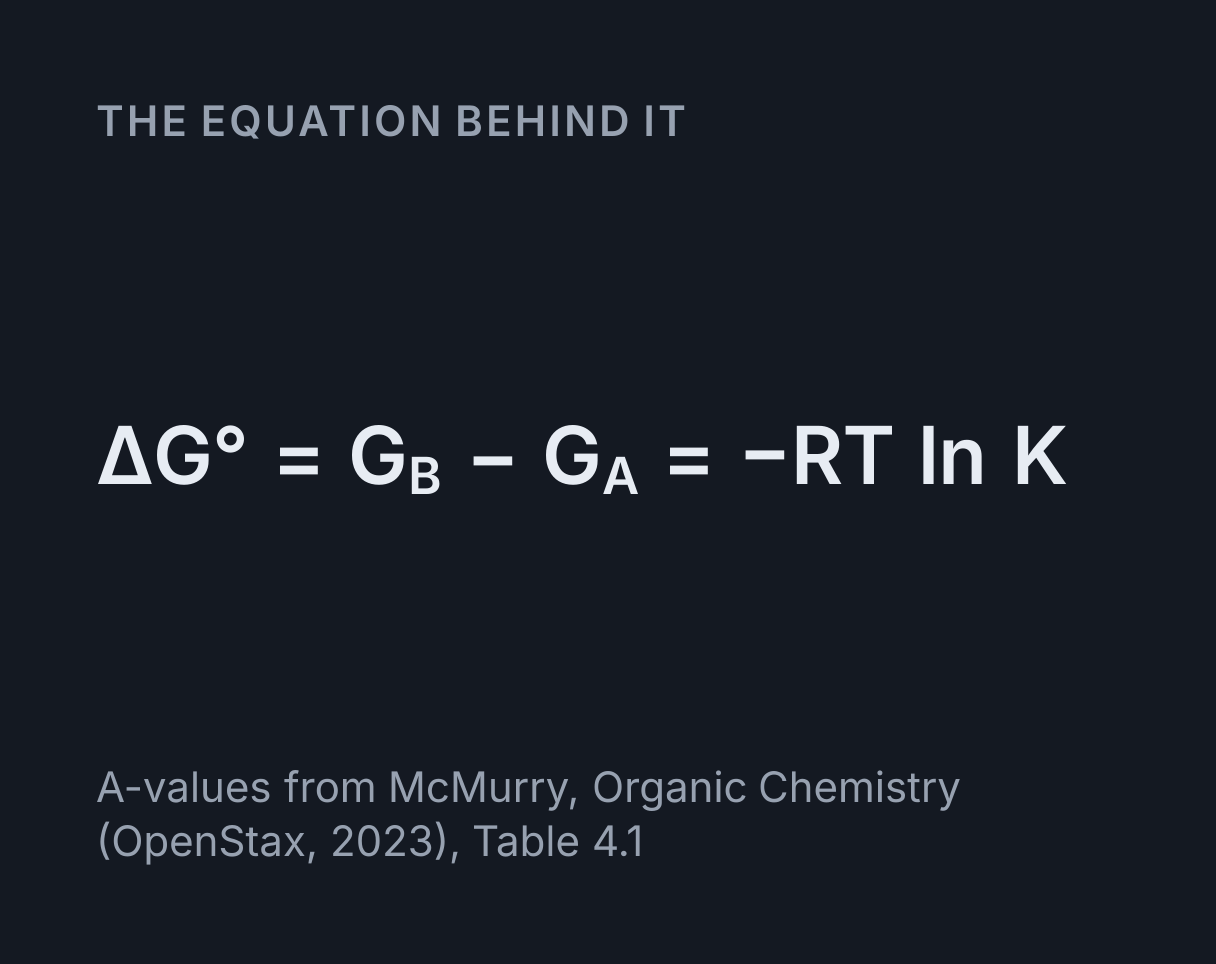
The equation
A-values from McMurry, Organic Chemistry (OpenStax, 2023), Table 4.1
What is the chair conformation?
The chair conformation is the shape cyclohexane takes almost all the time: a puckered ring in which
four carbons lie in a plane, one carbon sits above that plane at one end and one sits below it at the
other. Its C−C−C angles are 111.5°, close to the tetrahedral 109.5°, and every C−H bond is staggered
against its neighbours, so the chair has almost no angle strain and no torsional strain. The
twist-boat, the next most stable shape, sits about 23 kJ/mol above the chair. For a ring with groups
on it there are two different chairs, and the free-energy difference between them and the share of
molecules in each follow from one line, ΔG° = G(B) − G(A) = −RT ln K.
Here G of each chair is the sum of the A-values of the groups it puts axial, plus 3.8
kJ/mol for each pair of alkyl groups on neighbouring carbons that are gauche to each other, and
K = [B]/[A] is the ratio of molecules in chair B to chair A at equilibrium. The explorer
works out ΔG°, K and both percentages for a ring with one or two groups on
it, from −150 °C to 150 °C.
Axial and equatorial positions
Each carbon in a chair makes two bonds outside the ring. One is axial: it runs parallel to the ring’s axis, pointing straight up or straight down. The other is equatorial: it points outwards, roughly in the plane of the ring, tilted a little the opposite way to the axial bond on the same carbon. That gives six axial positions and six equatorial ones, and they alternate. On the top face of the ring, carbons 1, 3 and 5 have axial bonds and carbons 2, 4 and 6 have equatorial ones, and on the bottom face it is the other way round.
Up and down are the two faces of the ring, and they are what cis and trans mean: two groups on the same face are cis, two on opposite faces are trans. Axial and equatorial answer a different question, about which way a bond points in one particular chair.
The tetrahedral angle itself comes from the four electron domains round each carbon, the same argument the VSEPR molecular geometry visualiser makes for methane. A flat hexagon would force 120° angles on those carbons, and the chair is how six of them join up in a ring without bending their bonds.
The ring flip
A ring flip turns one chair into the other by holding the middle four carbons in place and folding the two end carbons the opposite way. Every axial bond becomes equatorial and every equatorial bond becomes axial, but nothing changes face: a group that was axial and up becomes equatorial and still up. That is why a ring flip can never turn a cis isomer into a trans one, and why it switches a group’s axial strain on and off.
The flip is fast. Its barrier is about 45 kJ/mol, the energy of the half-chair the ring passes on the
way, and beyond it the ring dips into the twist-boat, about 23 kJ/mol above a chair, before climbing
out to the other chair. The Eyring equation, k = (k_B T/h) e^(−ΔG‡/RT), turns that barrier
into about 8.12 × 10⁴ flips a second at 25 °C, so each chair lasts about 12 µs. Press Play
to watch the same journey slowly; the label beside the scrubber names each shape as it passes.
Using the explorer
Choose the group on C1 and, for a disubstituted ring, a second group, its carbon and cis or trans. The C1 group is always on the top face, so it is axial in chair A and equatorial in chair B. Play, or Space on the focused canvas, flips the ring, and pressing it again flips it back. The scrubber stops the flip anywhere, and dragging or the arrow keys turn the ring.
Each axial group is joined by dashed lines to the axial atoms it crowds, labelled with each interaction’s strain in kJ/mol, and gauche alkyl neighbours by a dotted line. Each chair’s strain readout adds up its labels. The energy difference is the gap between them, and K, the percentages and the plot follow at the temperature you set. The plot shows the share of molecules in the lower chair against the energy difference, with your ring marked. Cautions about the counting appear under the parameters.
Worked example: methylcyclohexane at 25 °C
The explorer opens on methylcyclohexane in chair A, with the methyl group axial on C1. Each step below should match a readout.
-
In chair A the axial methyl meets the axial hydrogens on C3 and C5, two 1,3-diaxial interactions of
3.8 kJ/mol each:
2 × 3.8 = 7.6 kJ/mol. - In chair B the methyl is equatorial and meets neither:
0 kJ/mol. -
The energy difference is
ΔG° = 0 − 7.6 = −7.6 kJ/mol, or−1.816 kcal/mol. It is negative, so chair B is lower. - At 25 °C,
RT = 8.314 × 298.15 = 2479 J/mol, which is 2.479 kJ/mol. -
K = e^(7.6/2.479) = e^3.066 = 21.45, so about 21 molecules sit in chair B for every one in chair A. -
Chair B holds
21.45/(1 + 21.45) = 95.55%of the molecules, and chair A the remaining4.454%.
OpenStax rounds the same result to about 95 percent equatorial. Change the group to tert-butyl and the difference becomes 22.8 kJ/mol, and chair B holds 99.99 percent: only about one molecule in 10,000 has its tert-butyl group axial at any moment, which is why tert-butyl is said to lock the ring.
1,3-diaxial interactions and A-values
An axial group points straight out of the ring’s face, alongside the two axial hydrogens on the same face two carbons along: C3 and C5 for a group on C1. They are close enough to crowd each other, and that steric strain is a 1,3-diaxial interaction. An equatorial group points out away from the ring and has no such neighbours, which is why it is the lower-energy position.
For a methyl group the strain is the same as a gauche butane interaction. The axial methyl is gauche to C3 and to C5 of the ring, each worth 3.8 kJ/mol, while the equatorial methyl is anti to both. A group’s A-value is the free-energy cost of putting it axial in a monosubstituted ring, so it is two of those interactions. The explorer uses Table 4.1 of McMurry’s Organic Chemistry (OpenStax, 2023), doubled, and the last column below is the share each group leaves equatorial at 25 °C.
| Group | One interaction | A-value | Equatorial at 25 °C |
|---|---|---|---|
| Cyano | 0.4 kJ/mol | 0.8 kJ/mol | 58% |
| Fluorine | 0.5 kJ/mol | 1.0 kJ/mol | 59.95% |
| Chlorine, bromine | 1.0 kJ/mol | 2.0 kJ/mol | 69.14% |
| Hydroxyl | 2.1 kJ/mol | 4.2 kJ/mol | 84.48% |
| Methyl | 3.8 kJ/mol | 7.6 kJ/mol | 95.55% |
| Ethyl | 4.0 kJ/mol | 8.0 kJ/mol | 96.18% |
| Isopropyl | 4.6 kJ/mol | 9.2 kJ/mol | 97.61% |
| Phenyl | 6.3 kJ/mol | 12.6 kJ/mol | 99.38% |
| tert-Butyl | 11.4 kJ/mol | 22.8 kJ/mol | 99.99% |
The order is worth reading closely, because size alone does not set it. Bromine is a bigger atom than chlorine, yet the two share a value, because the longer C−Br bond holds the bromine further from the axial hydrogens. Cyano comes in below fluorine because it is a thin rod pointing out along its own bond. And tert-butyl stands apart: an ethyl or isopropyl group can turn so that a hydrogen points back at the ring, but one of the three methyls of a tert-butyl group always points straight at the axial hydrogens. Other tables differ a little, by solvent and method, and methyl is often quoted at 7.3 kJ/mol (1.74 kcal/mol).
Cis and trans disubstituted rings
With two groups, first work out where each one is in each chair, then add up each chair’s strain. The pattern depends only on how far apart the two carbons are and on cis or trans:
- 1,2 and 1,4 rings: cis puts one group axial and one equatorial in each chair; trans puts both axial in one chair and both equatorial in the other.
- 1,3 rings: the other way round. Cis is diaxial or diequatorial, and trans is one of each in both chairs.
OpenStax works the 1,2-dimethylcyclohexanes this way, and the explorer reproduces both. In the cis
isomer each chair has one axial methyl, 2 × 3.8 = 7.6 kJ/mol, plus one gauche interaction
between the two methyls, so both chairs carry 7.6 + 3.8 = 11.4 kJ/mol and the ring splits
50 to 50. In the trans isomer the diaxial chair has four 1,3-diaxial interactions,
4 × 3.8 = 15.2 kJ/mol, and the diequatorial chair only the gauche interaction, so the
diequatorial chair is lower by 15.2 − 3.8 = 11.4 kJ/mol and holds 99.0% of the molecules
at 25 °C. The methyls are not gauche in the diaxial chair, because one points straight up and the
other straight down.
When the two groups pull different ways, the larger A-value wins. In cis-1-tert-butyl-4-chlorocyclohexane
one of the two must be axial. With tert-butyl axial the chair carries 2 × 11.4 = 22.8 kJ/mol,
and with chlorine axial it carries 2 × 1.0 = 2.0 kJ/mol, so the chair with chlorine axial is
lower by 22.8 − 2.0 = 20.8 kJ/mol, the figure in OpenStax’s worked example, and holds
99.98% of the molecules. Set the first group to methyl and the second to tert-butyl, cis on C4, and the
explorer shows the same rule forcing the methyl axial: chair A is lower by 15.2 kJ/mol, because an
axial methyl costs 7.6 kJ/mol where an axial tert-butyl costs 22.8. In 1,2 and 1,3 rings the two
substituted carbons are stereocentres as well, and naming them R or S is the job of the
R and S configuration explorer.
Temperature and the equilibrium ratio
The explorer treats A-values as fixed free energies and lets temperature act through RT
alone. Cooling makes the same energy difference count for more. At −80 °C,
RT = 8.314 × 193.15 = 1606 J/mol, and methylcyclohexane is 99.13% equatorial
instead of 95.55%. Heating does the opposite: at 150 °C, the top of the range, 10.34% of the molecules
have the methyl axial, more than twice as many as at 25 °C.
Temperature sets the speed of the flip far more steeply. The Eyring estimate that gives
8.12 × 10⁴ flips a second at 25 °C gives about 2.7 a second at −80 °C, slow enough for an
NMR spectrometer to see the two chairs as separate species. That is how many A-values were measured:
cool the sample until the flip freezes out, then compare the signals from the axial and the equatorial
molecules. What those signals look like, split by their neighbours, is the subject of the
NMR splitting pattern visualiser. The
Gibbs free energy calculator runs the same
ΔG° = −RT ln K in either direction for any equilibrium.
Drawing a chair by hand
The opening view is the one textbooks draw, and the ring takes three steps. Draw two parallel lines slanting down to the right for the middle four carbons. Add a carbon above and to the right of them, joined to both lines, then a carbon below and to the left, joined to both. Next come the axial bonds: straight up from the carbon at the raised right-hand tip and from every second carbon after it, and straight down from the other three. Last come the equatorial bonds. Each one runs parallel to the ring bonds one carbon away from it, and slants slightly down wherever the axial bond on that carbon goes up. Turn the explorer’s ring to match your drawing and check each bond.
What this model leaves out
- Clashes between two axial groups. Two groups axial on the same face of C1 and C3 push on each other. Additive A-values count that as two ordinary 1,3-diaxial interactions, which is too little, and the explorer says so.
- Gauche interactions beyond alkyl groups. The 3.8 kJ/mol gauche figure belongs to two alkyl groups. For a hydroxyl or a halogen beside another group it is not counted, because polar groups side by side do not follow the butane figure, and the explorer says so.
- Entropy and solvent. Each A-value is one fixed number, so its small drift with temperature is ignored, and hydroxyl has a single figure although it grows in solvents that hydrogen-bond to it.
- Electronic effects. Dipole repulsion, hydrogen bonds within the molecule and the anomeric effect in sugars can outweigh steric strain, and none of them is counted.
- Twist-boats as resting states. When both chairs must put a tert-butyl group axial, the ring may settle in a twist-boat instead, as cis-1,4-di-tert-butylcyclohexane does in part. The explorer compares only chairs, and warns when this case arises.
- The real flip pathway. The animation passes the half-chair and the twist-boat, the stations of the real flip, but it is not a computed trajectory, and the flip rate is for cyclohexane itself.
- Iodine and other groups. Only groups in the cited table are offered, so iodine, which it does not list, is left out.
Common mistakes
- Thinking a ring flip turns up into down. It turns axial into equatorial. Every group keeps its face, so cis stays cis and trans stays trans.
- Counting 1,3-diaxial interactions on the wrong carbons. An axial group on C1 meets the axial atoms on C3 and C5 on its own face, never those on C2, on C6 or on the far face.
- Assuming both groups can always be equatorial. In cis-1,2, trans-1,3 and cis-1,4 rings one group is axial in every chair, and the ring flips to put the group with the larger A-value equatorial.
- Mixing units in ΔG° = −RT ln K. With R = 8.314 J/(mol K), ΔG° must be in J/mol and T in kelvin. Putting in 7.6 instead of 7600 gives K = 1.003, which would leave methylcyclohexane at about 50 percent equatorial.
Common questions
What is the chair conformation of cyclohexane?
It is the puckered shape cyclohexane spends almost all its time in, with four carbons in a plane, one above that plane at one end and one below it at the other. Its C−C−C angles of 111.5° are close to the tetrahedral 109.5°, and the C−H bonds on neighbouring carbons are all staggered, so the chair has almost no angle or torsional strain. Each carbon has one axial bond, parallel to the ring’s axis, and one equatorial bond pointing outwards. The next most stable shape, the twist-boat, is about 23 kJ/mol higher.
How do you tell which chair conformation is more stable?
Add up the strain in each chair and take the lower. Each axial group costs its A-value, two 1,3-diaxial interactions with axial hydrogens, and two alkyl groups gauche to each other on neighbouring carbons add 3.8 kJ/mol. In cis-1-tert-butyl-4-chlorocyclohexane one group must be axial: the chair with tert-butyl axial carries 22.8 kJ/mol and the one with chlorine axial 2.0 kJ/mol, so the chlorine-axial chair is lower by 20.8 kJ/mol. As a rule, the group with the larger A-value goes equatorial.
What happens to axial and equatorial groups in a ring flip?
They swap: every axial bond becomes equatorial and every equatorial bond becomes axial. Nothing changes face, so a group on the top face stays on the top face and a cis ring is still cis. The flip passes through a half-chair, about 45 kJ/mol above the chair, and at 25 °C a cyclohexane ring flips about 8 × 10⁴ times a second, so each chair lasts about 12 µs.
What are 1,3-diaxial interactions?
They are the steric strain between an axial group and the two axial hydrogens on the same face two carbons along, on C3 and C5 for a group on C1. For a methyl group each costs 3.8 kJ/mol, the same as a gauche butane interaction, so an axial methyl costs 7.6 kJ/mol. At 25 °C that leaves 95.55% of methylcyclohexane molecules with the methyl equatorial and 4.454% with it axial. An equatorial group points away from the ring and has none.
What is an A-value?
It is the free-energy difference between the axial and equatorial chairs of a monosubstituted cyclohexane, G(axial) − G(equatorial), so it measures how much a group dislikes being axial. From McMurry’s OpenStax Organic Chemistry, doubled, fluorine is 1.0 kJ/mol, chlorine and bromine 2.0, hydroxyl 4.2, methyl 7.6, isopropyl 9.2 and tert-butyl 22.8. Tables in kcal/mol divide by 4.184, so methyl’s 7.6 kJ/mol is 1.8 kcal/mol. Through ΔG° = −RT ln K, 22.8 kJ/mol leaves only about 1 molecule in 10,000 with tert-butyl axial at 25 °C.
Why is one group always axial in some disubstituted cyclohexanes?
In cis-1,2, trans-1,3 and cis-1,4 rings each chair has one group axial and the other equatorial, so no chair puts both groups equatorial. The ring then favours the chair with the larger A-value equatorial. In cis-1-tert-butyl-4-methylcyclohexane the methyl is forced axial, costing 7.6 kJ/mol against 22.8 for an axial tert-butyl, so that chair is lower by 15.2 kJ/mol.