Moment of Inertia Calculator
Find the moment of inertia of a rod, disk, cylinder, sphere, hoop, plate or point mass, with the parallel axis theorem for an offset axis.
Calculator
The radius of a hoop, disk, cylinder or sphere, or the full length of a rod. For a plate turning about its centre at right angles to it, the diagonal.
Point mass, hoop or thin-walled tube 1; solid cylinder or disk 0.5; solid sphere 0.4; hollow sphere 0.6667; rod about one end 0.3333; rod or plate about its centre 0.08333.
Distance from the axis to a parallel axis through the centre of mass. 0 when the axis passes through the centre of mass, and for the rod about one end, whose factor already includes the offset.
Working, with your numbers
- I = k x m x r^2
- = 0.5 x 2 x 0.3^2
- = 0.5 x 2 x 0.09
- = 0.09 kg m^2
Values are converted into the units the equation is worked in before the arithmetic.
- Shape About its own axis, with r the radius. A thin hoop turning about a diameter has the same factor.
- Solid cylinder or disk
- Shape term k m r², about the axis the factor is quoted for, before the parallel axis theorem adds m d². That axis passes through the centre of mass for every standard shape but the rod about one end.
- 0.09 kg·m²
- Parallel axis term m d². Zero when the axis passes through the centre of mass.
- 0 kg·m²
- Radius of gyration How far from the axis the whole mass would sit, as a point, to have the same moment of inertia.
- 0.2121 m
Citing this tool
Last updated . Add the date you accessed it as well, which a citation of a page that can change asks for. If a specific result matters, cite the permalink from the tool’s share row instead of this page: it reproduces the exact parameters.
On the syllabus: AP Physics 1, Unit 5: Torque and Rotational Dynamics.
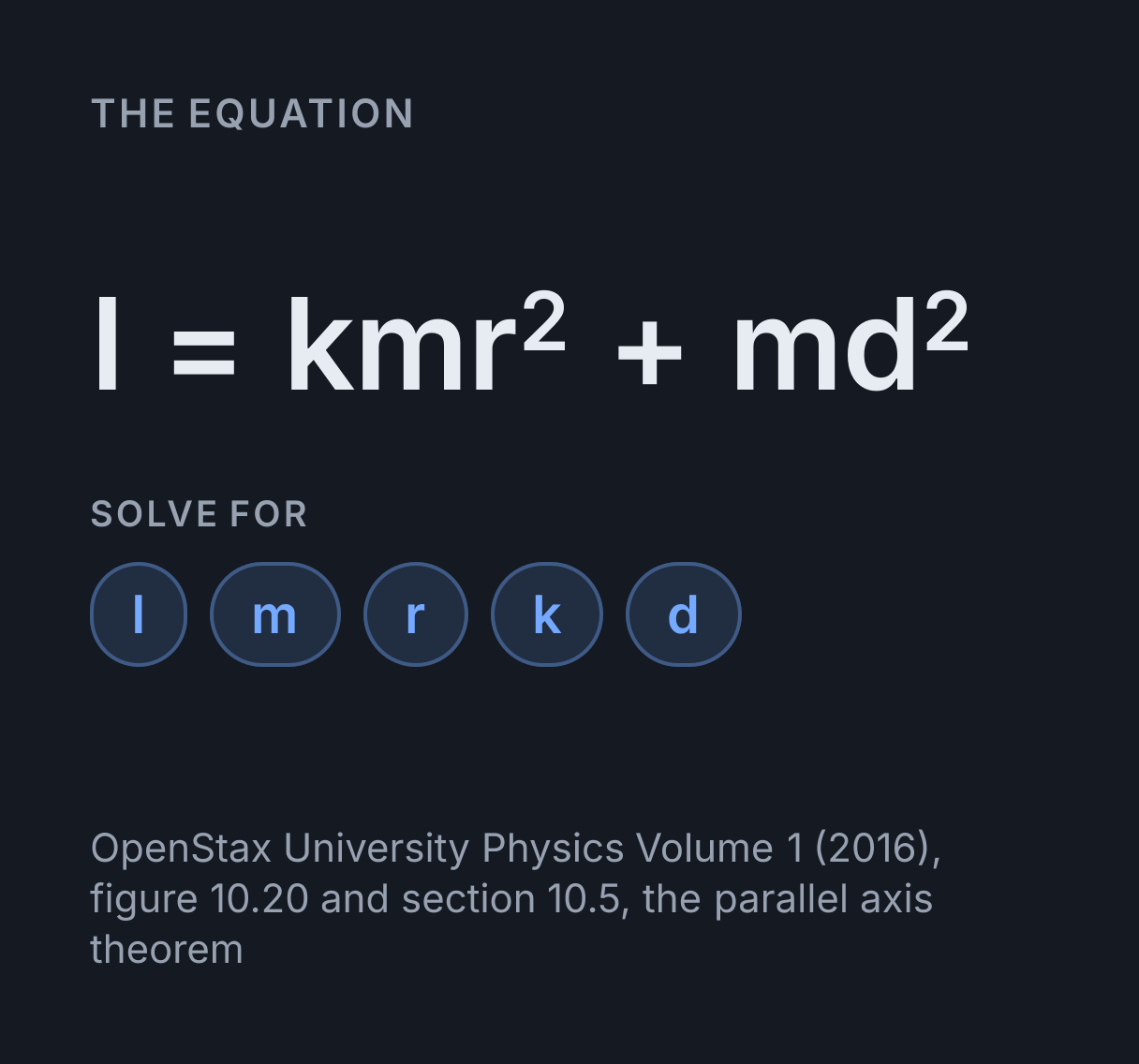
The equation
OpenStax University Physics Volume 1 (2016), figure 10.20 and section 10.5, the parallel axis theorem
What is the moment of inertia formula?
The moment of inertia formula is I = Σmr²: each mass m times the square of its distance r from the axis, summed, in kg·m². A standard shape gives I = kmr², with k = 1 for a hoop and ½ for a solid disk. The parallel axis theorem adds md² for an axis a distance d from the centre of mass.
Moment of inertia of common shapes
Rotational inertia depends on where the mass sits as well as on how much of it there is,
because a piece twice as far from the axis counts four times as much. The shape factor
k carries that in one number: it is the fraction of m r² the body
actually has, 1 when all of the mass is at distance r and less when some of it
is closer in. Pick the row for your body, enter its factor, and measure r the
way the last column says.
| Shape and axis | I | k | Enter as r |
|---|---|---|---|
| Point mass | m r² | 1 | Distance to the axis |
| Thin hoop or thin-walled hollow cylinder, about its axis | m r² | 1 | Radius |
| Solid cylinder or disk, about its axis | ½ m r² | 0.5 | Radius |
| Thick-walled hollow cylinder, about its axis | ½ m (R₁² + R₂²) | 0.5 | √(R₁² + R₂²) |
| Thin hoop about a diameter | ½ m r² | 0.5 | Radius |
| Thin disk about a diameter | ¼ m r² | 0.25 | Radius |
| Solid sphere about a diameter | ⅖ m r² | 0.4 | Radius |
| Thin hollow sphere about a diameter | ⅔ m r² | 0.6667 | Radius |
| Thin rod about its centre | (1/12) m L² | 0.08333 | Length L |
| Thin rod about one end | ⅓ m L² | 0.3333 | Length L |
| Rectangular plate about an axis through its centre, at right angles to it | (1/12) m (a² + b²) | 0.08333 | Diagonal √(a² + b²) |
| Rectangular plate about one edge, such as a door on its hinges | ⅓ m a² | 0.3333 | Width a |
The rod, hoop, cylinder, sphere, shell and plate results are those of figure 10.20 in
OpenStax University Physics Volume 1. Two rows are derived from them: the thin disk
about a diameter is that figure’s cylinder about a central diameter with its length taken to
zero, and the plate about an edge is the rod about one end applied strip by strip. The thick
tube is the one shape with two radii, inner R₁ and outer R₂, so it
goes in as a factor of 0.5 on the root of the sum of their squares. The Shape readout names
the row a factor belongs to, so a mistyped factor shows up as a custom one.
How the parallel axis theorem works
Every factor in the table is quoted about an axis through the centre of mass except three:
the point mass, the rod about one end and the plate about an edge. To turn any of the others
about a parallel axis, add the mass times the square of the distance between the two axes,
I = Icm + m d², and enter that distance as the axis offset. The term
only ever adds, so for a given direction the axis through the centre of mass is the one with
the smallest moment of inertia.
A rod shows the theorem at work. About its middle it has (1/12) m L². Its end
is L/2 away, so about the end it has
(1/12) m L² + m (L/2)² = (1/3) m L², which is the factor in the table. That is
also why the offset stays at 0 when the factor is ⅓: the offset is already inside it, and
the calculator cautions if both are set. The radius of gyration readout runs the other way,
giving the distance at which the whole mass, gathered into a point, would have the same
moment of inertia.
Adding up a system of objects
Moments of inertia about one axis add. A merry-go-round with a child at its rim is the
disk’s ½ M R² plus the child’s m r², treating the child as a point
mass, and a dumbbell is two point masses plus the bar between them. Work out each part here
about the same axis and sum the results. This is the calculation AP Physics 1 asks for: the
College Board’s course description limits it to systems of five or fewer objects and says
the rotational inertia of extended bodies, such as rods and disks, will be given in the exam.
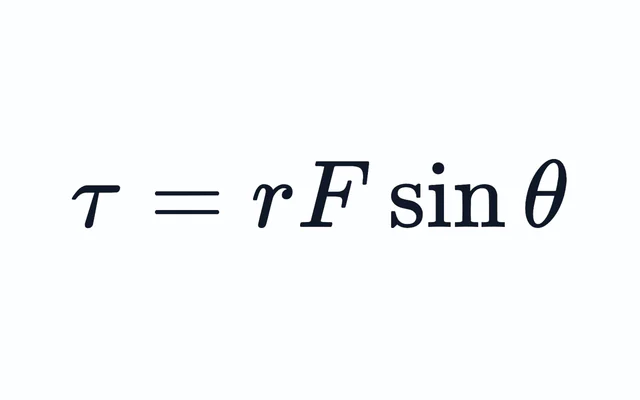
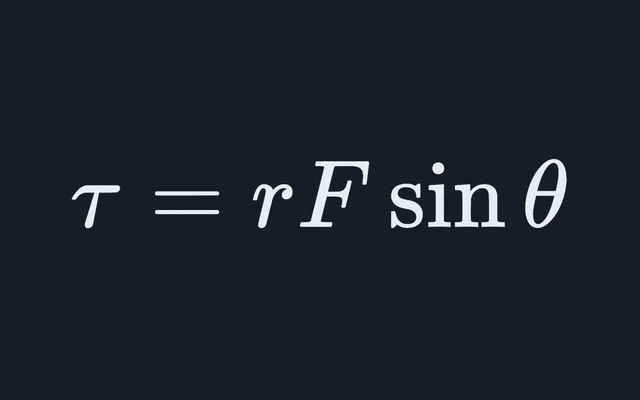
Moment of inertia does for rotation what mass does for straight-line motion. A net torque
gives an angular acceleration α = τ / I, and the
torque calculator finds τ from the force
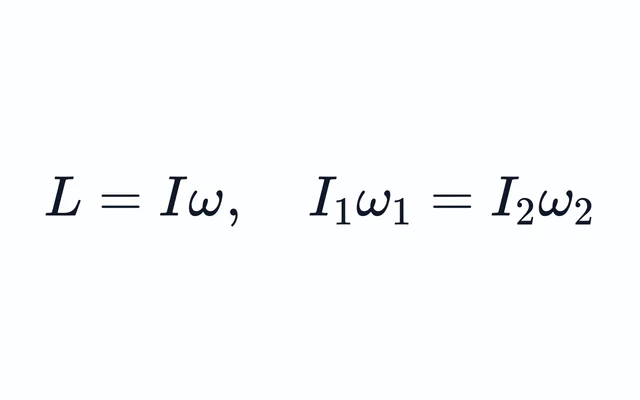
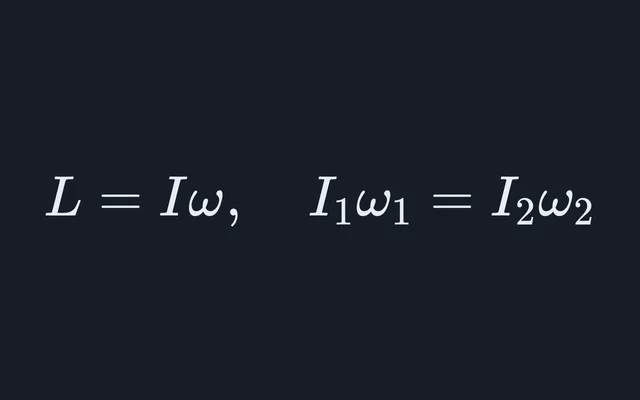
and lever arm. The same I sets how much a spinning body carries: the
angular momentum calculator takes it into
L = Iω and its conservation, and the
rotational kinetic energy calculator
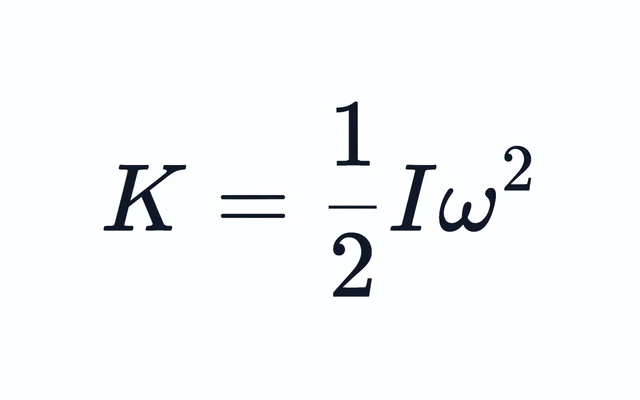
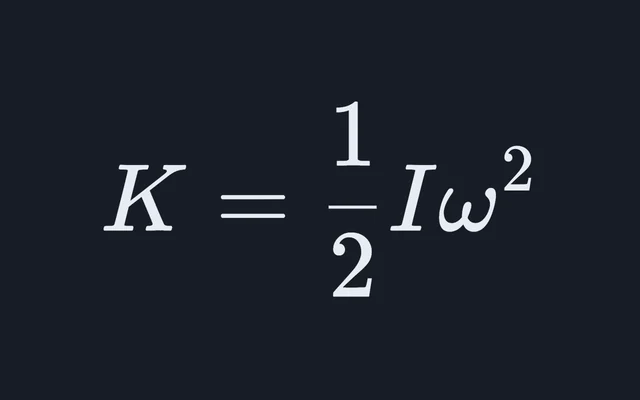
into K = ½ I ω².
Common mistakes
- Entering the diameter as r. The radius is squared, so a diameter in its place makes the moment of inertia four times too large.
- Typing centimetres into a metre field. A 30 cm radius entered as 30 m is 100 times too long and gives a moment of inertia 10,000 times too large. Choose cm in the unit menu instead of converting by hand.
- Shifting from the wrong axis. The parallel axis theorem starts from the
axis through the centre of mass. Adding
m d²to a value already quoted about an end counts the offset twice. - Taking the right shape about the wrong axis. A disk spinning like a wheel
has
½ m r²; the same disk flipping end over end about a diameter has half of that. - Treating a thick tube as a hoop. A factor of 1 assumes all of the mass is at the outer radius. A pipe with a thick wall has less, and its row in the table gives it.
Converting units first? Use the mass and length conversion tables.
How to calculate moment of inertia
- Write down the formula:
I = k m r² + m d² -
Gather the values it needs. The calculator above starts with these:
- Mass: m = 2 kg
- Radius or length: r = 30 cm
- Shape factor: k = 0.5
- Axis offset: d = 0 cm
-
Substitute them and work through the arithmetic:
- I = k x m x r^2
- = 0.5 x 2 x 0.3^2
- = 0.5 x 2 x 0.09
- = 0.09 kg m^2
-
To find one of the other values instead, rearrange the formula for it:
- Mass:
m = I ÷ (k r² + d²) - Radius or length:
r = √((I ÷ m − d²) ÷ k) - Axis offset:
d = √(I ÷ m − k r²)
- Mass:
Worked examples
Each one runs through the calculator above, so the arithmetic here is the arithmetic it does.
What is the moment of inertia of a 5 kg solid sphere 20 cm across?
- I = k x m x r^2
- = 0.4 x 5 x 0.1^2
- = 0.4 x 5 x 0.01
- = 0.02 kg m^2
0.02 kg m². The 20 cm is the diameter, so r is 10 cm, and putting the diameter in for r would give 0.08 kg m², four times too much, because r is squared. A hollow sphere of the same mass and size, k = 2/3, has 0.03333 kg m², two thirds more, because all of its mass is at the surface.
What is the moment of inertia of a 0.6 kg, 1.2 m rod about one end?
- I = k x m x r^2 + m x d^2
- = 0.083333 x 0.6 x 1.2^2 + 0.6 x 0.6^2
- = 0.072 + 0.216
- = 0.288 kg m^2
Worked by the parallel axis theorem: the rod’s value about its middle, (1/12)mL² = 0.072 kg m², plus m d² for an end half a length away, 0.216 kg m². The total is (1/3)mL², the rod-about-one-end factor, so k = 1/3 with no offset gives the same 0.288 kg m².
What radius gives a 4 kg solid disk a moment of inertia of 0.5 kg m²?
- r = sqrt(I / (k x m))
- = sqrt(0.5 / (0.5 x 4))
- = sqrt(0.25)
- = 0.5 m
0.5 m. The moment of inertia grows with the square of the radius, so a disk of the same mass twice as wide has four times as much, 2 kg m², and one half as wide has a quarter, 0.125 kg m². Spreading mass outward is the cheapest way to add rotational inertia.
Practise this with Mechanics Practice Problems, questions generated from this calculator and 18 other calculators in Mechanics.
Common questions
Why does a hoop have more moment of inertia than a disk of the same mass?
Because all of a hoop’s mass sits at the rim, the full radius from the axis, while a disk spreads its mass from the axis outward. Each piece of mass counts by the square of its distance, so the hoop’s factor is 1 and the disk’s is one half: for the same mass and radius the hoop has twice the moment of inertia.
What is the parallel axis theorem?
I = Icm + md². The moment of inertia about any axis equals the value about a parallel axis through the centre of mass, Icm, plus the mass times the square of the distance between the two axes. The extra term is never negative, so for a given direction the axis through the centre of mass gives the smallest moment of inertia.
Do I need to memorize moment of inertia formulas for AP Physics 1?
Not for extended objects. The College Board’s course description says students do not need to know the rotational inertia of extended rigid systems, because it will be provided in the exam. What is expected is I = mr² for a point mass, the sum of those for systems of up to five objects, and the parallel axis theorem for a shifted axis.