Nucleic Acid Quantification Calculator
Turn an A260 reading into DNA or RNA concentration using the right extinction factor, with dilution applied and the volume needed for a target mass.
Calculator
Blank against the same buffer. Keep the reading between 0.1 and 1.0.
A₂₆₀ of 1 equals: dsDNA 50, ssDNA 33, RNA 40, short oligo 33 µg/mL.
1 if you read the sample neat. 10 if you diluted 1 part in 10.
Working, with your numbers
- c = A260 x factor x dilution
- = 0.15 x 50 x 10
- = 75 ng/uL
Values are converted into the units the equation is worked in before the arithmetic.
- Also
- 75 µg/mL
- In 50 µL Yield if your whole sample is 50 µL.
- 3.75 µg total
- For 500 ng
- 6.667 µL needed
Citing this tool
Last updated . Add the date you accessed it as well, which a citation of a page that can change asks for. If a specific result matters, cite the permalink from the tool’s share row instead of this page: it reproduces the exact parameters.
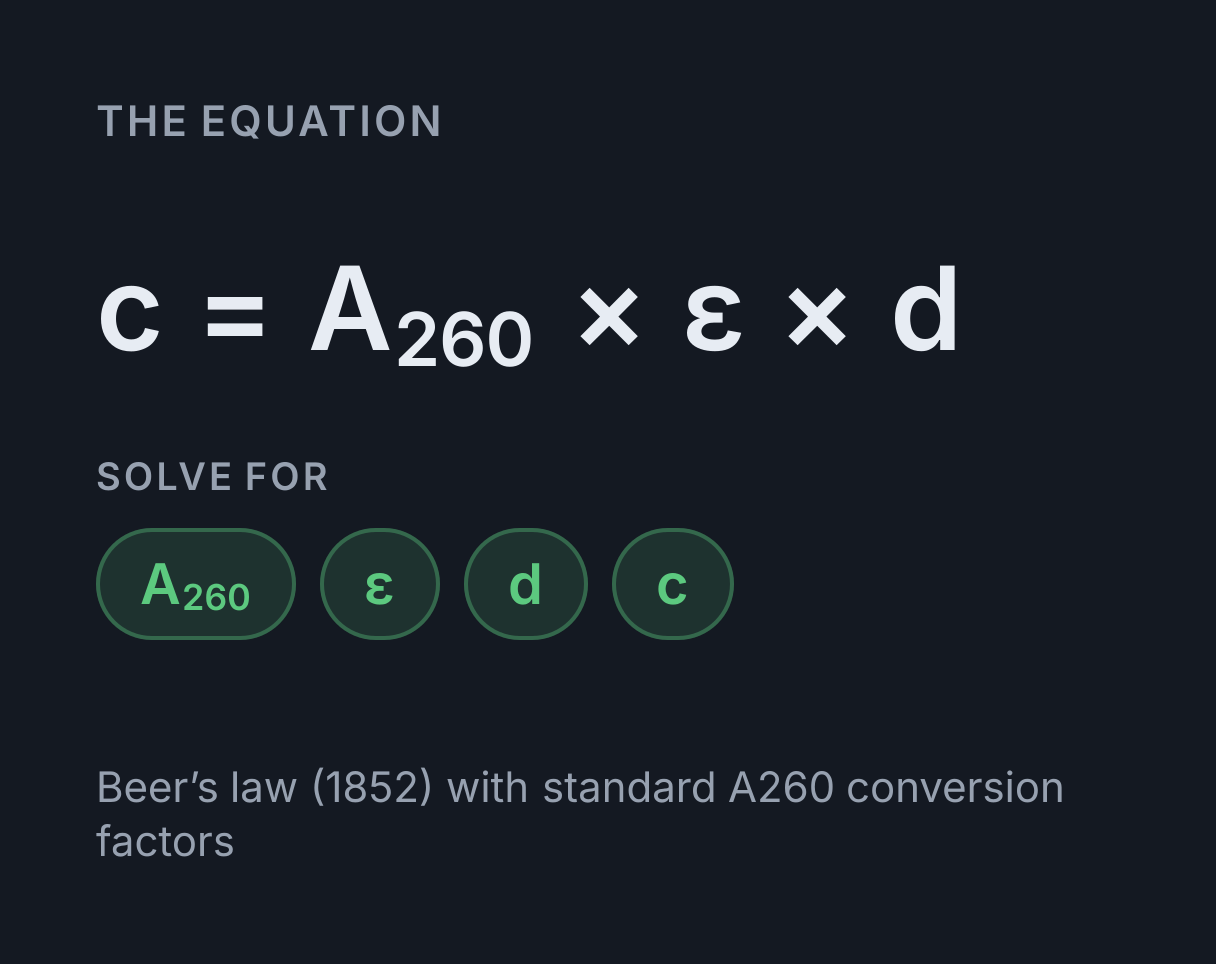
The equation
Beer’s law (1852) with standard A260 conversion factors
Why A260 gives a concentration
The aromatic rings in nucleotide bases absorb ultraviolet light with a peak near 260 nm. Beer’s law makes that absorbance proportional to how much nucleic acid the beam passes through, so a spectrophotometer reading converts straight into a concentration once you know the proportionality constant. That constant is the extinction factor: the concentration in µg/mL that would give an absorbance of exactly 1.0 in a 1 cm path.
The factor depends on what you have, because base stacking in a double helix suppresses absorbance (hypochromism); melting the helix removes it, which is the hyperchromic effect. Double-stranded DNA takes 50, single-stranded DNA 33, RNA 40 and short oligonucleotides about 33. Multiply by your dilution factor and you have the concentration of the original stock. Because 1 µg/mL and 1 ng/µL are the same number, no scaling is needed between the two units people quote.
Worked example
A genomic DNA prep is diluted 1 in 20 and reads A₂₆₀ = 0.184 against a buffer blank.
c = A₂₆₀ × factor × dilutionc = 0.184 × 50 × 20c = 184 ng/µL, equivalently 184 µg/mL
If the whole prep is 50 µL, that is 9.2 µg of DNA in total. To load 500 ng into a reaction you would take 2.72 µL. Both figures appear in the readouts, because those are the two numbers you actually need at the bench and both are easy to fumble at 9 pm.
Purity ratios, and what absorbance cannot see
The concentration is only meaningful if the absorbance is coming from your nucleic acid. Two ratios check that. A260/A280 near 1.8 indicates reasonably clean DNA and near 2.0 reasonably clean RNA; a lower value means protein or phenol, both of which absorb strongly at 280 nm. A260/A230 below about 2.0 points to guanidine, EDTA or carbohydrate carried over from the extraction.
What absorbance fundamentally cannot do is tell one nucleic acid from another. Free nucleotides, degraded fragments, residual RNA in a DNA prep and your intact target all absorb at 260 nm, so a UV reading is a total rather than a specific measurement. That distinction matters for library prep, and for quantifying DNA in an RNA background. In those cases use a dye-based fluorometric assay, which only lights up when bound to its intended target.
Common mistakes
- Using 50 for RNA. RNA’s factor is 40, so applying the dsDNA factor overstates the concentration by 25 percent. This is the most frequent error in this calculation and it propagates into every downstream reaction.
- Reading outside the linear range. Keep A₂₆₀ between about 0.1 and 1.0. Below 0.05 the reading is mostly instrument noise; above 1.0 too little light reaches the detector and the response stops being linear. Dilute and re-read rather than trusting a high number.
- Blanking against the wrong solution. Blank with the exact buffer the sample is in. Blanking water against a TE-suspended sample leaves a baseline offset that hits low-concentration samples hardest.
- Forgetting the dilution factor. A tenfold dilution left at 1 in the calculator understates the stock by a factor of ten. Enter 1 only when you read the sample neat.
Worked examples
Each one runs through the calculator above, so the arithmetic here is the arithmetic it does.
What is the RNA concentration if the A260 is 0.25 on a 1 in 50 dilution?
- c = A260 x factor x dilution
- = 0.25 x 40 x 50
- = 500 ng/uL
500 ng/µL, using the RNA factor of 40. The dilution is what made the reading usable: read neat, this sample would give an absorbance of 12.5, far outside the 0.1 to 1.0 window where the instrument responds linearly. The DNA factor of 50 used by mistake would report 625 ng/µL.
What dilution makes a 2000 ng/µL DNA sample read 0.5 at 260 nm?
- dilution = c / (A260 x factor)
- = 2000 / (0.5 x 50)
- = 80 x
1 in 80, worked backwards from the reading you want before measuring anything. A 1 in 100 dilution is easier to pipette accurately and would read 0.4, still comfortably inside the linear range, so an estimate like this saves a wasted reading of a sample too strong to trust.
Practise this with Lab and Clinical Calculation Practice Problems, questions generated from this calculator and 9 other calculators in Biology.
Common questions
Which extinction factor applies to my sample?
An A260 of 1.0 in a 1 cm path corresponds to roughly 50 µg/mL for double-stranded DNA, 33 for single-stranded DNA, 40 for RNA and 33 for short oligonucleotides. Using the dsDNA factor of 50 on an RNA sample overstates the concentration by about 25 percent, which is a common and easily missed error.
Why should A260 stay between 0.1 and 1.0?
Below about 0.05 the signal sits in the instrument’s noise, so the relative error is large. Above 1.0 most spectrophotometers stop being linear, because too little light reaches the detector. Dilute a strong sample and read it again rather than trusting a high number.
What do the 260/280 and 260/230 ratios tell me?
A 260/280 ratio near 1.8 indicates reasonably pure DNA and near 2.0 reasonably pure RNA; a lower value suggests residual protein or phenol. A 260/230 ratio below about 2.0 points to contamination from guanidine, EDTA or carbohydrate. Neither ratio changes the concentration this tool reports, but a poor ratio means the concentration is measuring something other than your nucleic acid.