Ligation Calculator
Insert mass for a ligation is the molar ratio × vector mass × insert length ÷ vector length. Enter ng and bp to get the insert to add, with pmol of each.
Calculator
Linearised vector going into the reaction. NEB’s and Promega’s protocols both use 50 ng.
Length of the cut vector in base pairs, leaving out any fragment you removed. 3 kb is 3000.
Length of the fragment going in, such as a PCR product, in base pairs. 0.5 kb is 500.
Insert molecules per vector molecule. 3 means 3:1, which NEB’s ligase protocol writes as 1:3 vector to insert.
What to add for the ratio above. Solve for the ratio instead to check a mix already made.
Working, with your numbers
- mi = R x mv x Li / Lv
- = 3 x 50 ng x 500 bp / 3000 bp
- = 3 x 50 ng x 0.1667
- = 25 ng
Values are converted into the units the equation is worked in before the arithmetic.
- Vector Mass ÷ (length × 650 g/mol per base pair). Other calculators use 607 to 660, so their pmol can differ by up to about 7 percent; the insert mass does not depend on it.
- 0.0256 pmol
- Insert The vector’s pmol times the ratio.
- 0.0769 pmol
- Total DNA NEB suggests keeping total DNA under 10 ng/µL, which is 200 ng in a 20 µL reaction.
- 75 ng
- Insert at 1:1 One insert per vector. Multiply by any ratio to plan a series.
- 8.333 ng
Citing this tool
Last updated . Add the date you accessed it as well, which a citation of a page that can change asks for. If a specific result matters, cite the permalink from the tool’s share row instead of this page: it reproduces the exact parameters.
The equation
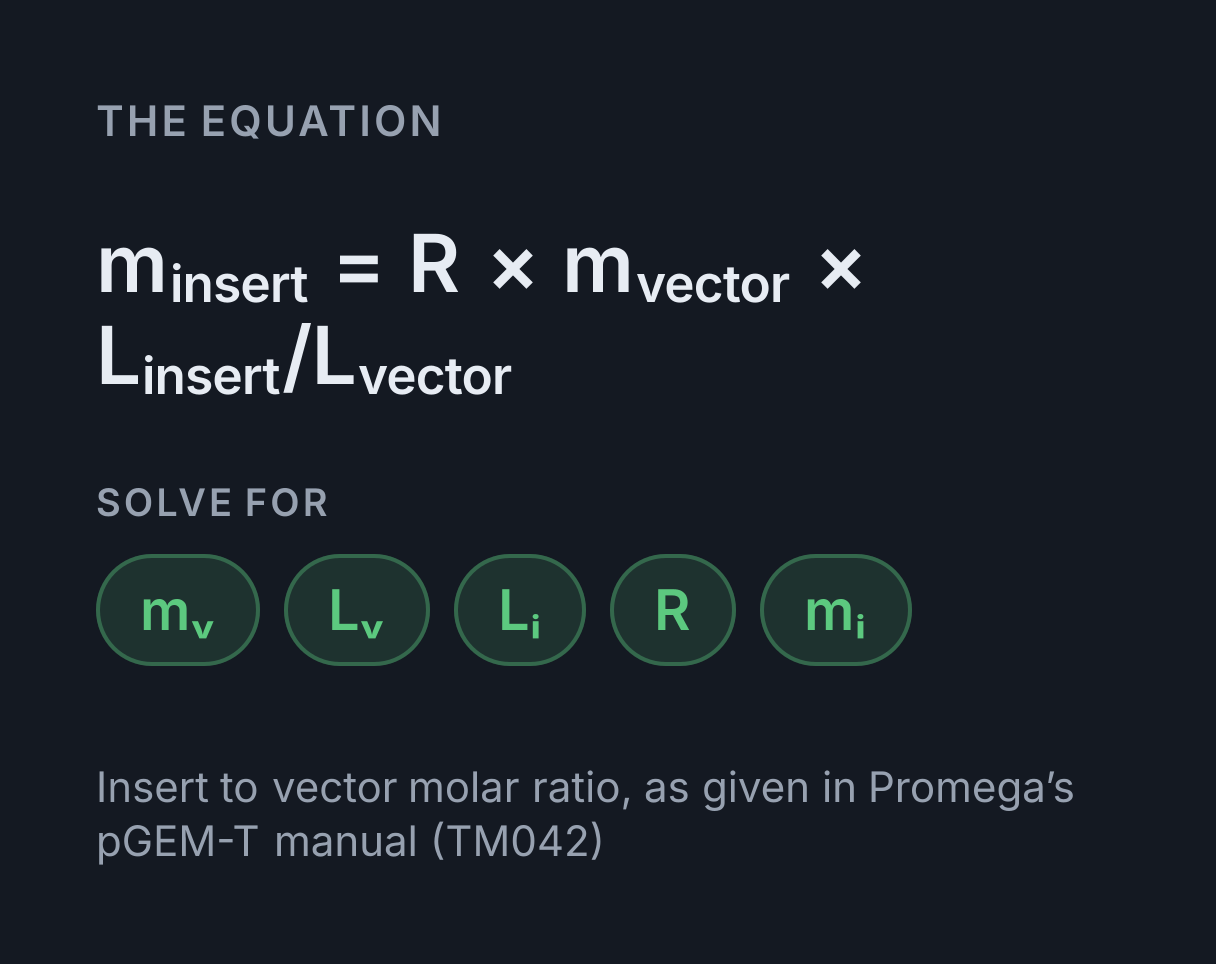
Insert to vector molar ratio, as given in Promega’s pGEM-T manual (TM042)
How much insert a ligation needs
The insert mass for a ligation is the insert:vector molar ratio times the vector mass times
the insert length divided by the vector length:
insert ng = ratio × vector ng × insert bp ÷ vector bp. So 50 ng of a 3000 bp
vector at 3:1 needs 3 × 50 × 500 ÷ 3000 = 25 ng of a 500 bp insert.
The ratio counts molecules, not nanograms. A molecule of double-stranded DNA weighs its length times an average mass per base pair, about 650 g/mol, and because that average is the same for the insert and the vector it cancels, leaving only the ratio of the two lengths. A short insert therefore needs far less mass than the vector for the same number of molecules, and at 3:1 an insert a third of the vector’s length needs exactly the vector’s mass: 50 ng of a 1000 bp insert for 50 ng of a 3000 bp vector. Addgene points out that what really matters is the number of DNA ends available to join, but every linear fragment has two ends however long it is, so counting molecules gives the same ratio.
Using the calculator
Enter the mass of cut vector you plan to use, the lengths of the linearised vector and of the insert in base pairs, and the ratio as one number: 3 for 3:1. The insert mass appears in the answer field. Any field can be the unknown, so you can solve for the ratio to check a ligation you have already set up, or for the vector mass when the insert is the piece in short supply.
Under the answer are the vector and insert in pmol, the total DNA going into the reaction, and the insert mass at 1:1, which times any ratio gives the mass for that ratio. To turn a mass into a volume, divide it by the concentration of the stock, which the nucleic acid quantification calculator works out from an A260 reading.
Worked example: a 500 bp PCR product at 3:1
Promega’s pGEM-T manual asks how much of a 0.5 kb PCR product to add to 50 ng of its 3.0 kb vector for a 3:1 insert:vector ratio.
-
Length ratio:
500 bp ÷ 3000 bp = 0.1667, so one insert molecule weighs a sixth of one vector molecule. - Insert mass:
3 × 50 ng × 0.1667 = 25 ng. -
At 1:1 the same insert would be
50 ng × 0.1667 = 8.33 ng, the 8.3 ng the manual gives. -
In moles, at 650 g/mol per base pair, the vector is
50 ng ÷ (3000 × 650 g/mol) = 0.0256 pmoland the insert 0.0769 pmol, three times as much.
The reaction then holds 75 ng of DNA. If the PCR product is at 12.5 ng/µL, the 25 ng is 2 µL.
A much smaller volume is hard to pipette accurately, so dilute a concentrated prep first:
C1V1 = C2V2 holds for ng/µL exactly as it does in the molar units of the
dilution calculator.
Choosing a ratio
3:1 insert to vector is the usual starting point. It is the ratio in NEB’s T4 DNA ligase protocol, and Addgene calls it usually sufficient when the insert is smaller than the vector. If a ligation gives few colonies, NEB’s troubleshooting guide suggests trying ratios from 1:1 to 10:1, going to 20:1 only for short adaptors, while Promega reports ratios from 1:8 to 8:1 working with its pGEM-T vectors and suggests 1:3 to 3:1 as starting points. The calculator shows a caution above 10:1 and below 1:1.
Check which way round a protocol writes the ratio. NEB’s T4 DNA ligase protocol puts the vector first, as 1:3 vector to insert, and Promega’s pGEM-T manual puts the insert first, as 3:1 insert:vector, and both mean three insert molecules for every vector molecule. This calculator takes the insert:vector form, so both are entered as 3.
What this does not cover
The calculation assumes every molecule you weighed can take part. It cannot see how much of the vector was actually cut, whether the ends are compatible, or whether at least one of the two pieces carries a 5′ phosphate for the ligase to join, which NEB’s troubleshooting guide asks you to check. Any of these changes the effective ratio without changing a single nanogram.
It also leaves the rest of the reaction to the kit. NEB’s T4 DNA ligase protocol builds 20 µL from 2 µL of 10X buffer, the DNA, water and 1 µL of ligase, and Promega’s pGEM-T protocol builds 10 µL around 5 µL of its 2X buffer. NEB also suggests keeping total DNA under 10 ng/µL, which is 200 ng in a 20 µL reaction, so the total under the result is worth a glance.
The pmol figures use 650 g/mol per base pair. Published values run from about 607 to 660 g/mol per base pair, depending on the source and on whether the counter-ions are counted, so another calculator’s pmol can differ by up to about 7 percent. The insert mass does not change at all, because the same figure cancels from both sides of the ratio.
Common mistakes
- Setting up equal masses and calling it 1:1. Equal nanograms are equal numbers of molecules only when the pieces are the same length. 50 ng of a 500 bp insert with 50 ng of a 3 kb vector is 6:1.
- Entering the ratio the wrong way round. 1:3 insert to vector in place of 3:1 puts in a ninth of the insert you meant. NEB’s 1:3 vector to insert is 3 here.
- Mixing kb and bp. The lengths only enter as a ratio, so both in kb still gives the right mass, but one in kb and the other in bp is out by a factor of 1000. The calculator warns about a vector under 1000 bp.
- Using the uncut plasmid length. The vector length is what goes into the tube. Cutting a 1.5 kb fragment out of a 6 kb plasmid leaves a 4.5 kb backbone, and entering 6000 bp gives a quarter less insert than the ratio needs.
- Trusting an A260 reading on a PCR product. Leftover primers and nucleotides absorb at 260 nm too, so the insert is overstated and the real ratio comes out lower than planned. Promega suggests estimating a PCR product against mass standards on a gel or with a fluorescent assay.
Converting units first? Use the mass conversion table.
Worked examples
Each one runs through the calculator above, so the arithmetic here is the arithmetic it does.
How much 1 kb insert goes with 50 ng of a 4 kb vector at a 3:1 ratio?
- mi = R x mv x Li / Lv
- = 3 x 50 ng x 1000 bp / 4000 bp
- = 3 x 50 ng x 0.25
- = 37.5 ng
37.5 ng, the amount in NEB’s own T4 DNA ligase protocol. NEB’s table gives the vector as 0.020 pmol, which is these 50 ng at about 618 g/mol per base pair, the DNA without its counter-ions; at the 650 used here it is 0.0192 pmol. The pmol figure depends on that choice, and the insert mass does not.
Is 50 ng of a 500 bp insert with 50 ng of a 3 kb vector a 1:1 ratio?
- R = (mi / Li) / (mv / Lv)
- = (50 ng / 500 bp) / (50 ng / 3000 bp)
- = 0.1 / 0.01667
- = 6, a 6:1 ratio of insert to vector
No, it is 6:1. Equal masses hold equal numbers of molecules only when the two pieces are the same length, and this insert is a sixth of the length of the vector, so each nanogram of it carries six times as many molecules. A true 1:1 would take 8.33 ng of insert.
How much 5 kb vector goes with just 10 ng of a 250 bp insert at 5:1?
- mv = mi x Lv / (R x Li)
- = 10 ng x 5000 bp / (5 x 250 bp)
- = 50,000 / 1250
- = 40 ng
40 ng. When the insert is the scarce piece, a faint band cut from a gel for instance, solve for the vector instead of the insert: the ratio and the two lengths fix how much vector matches what you have. Ten nanograms of a 250 bp fragment holds five times as many molecules as the 40 ng of 5 kb vector.
Practise this with Lab and Clinical Calculation Practice Problems, questions generated from this calculator and 9 other calculators in Biology.
Common questions
What insert to vector ratio should I use for a ligation?
Start with 3:1 insert to vector, the ratio in NEB’s T4 DNA ligase protocol and the one Addgene calls usually sufficient when the insert is smaller than the vector. If colonies are few, NEB suggests trying ratios from 1:1 to 10:1, and up to 20:1 for short adaptors, while Promega reports ratios from 1:8 to 8:1 working in its pGEM-T system. The ratio counts molecules, which is why the mass of insert it calls for depends on the two lengths.
Is 1:3 vector to insert the same as 3:1 insert to vector?
Yes. Both mean three insert molecules for every vector molecule: NEB’s T4 DNA ligase protocol writes the vector first and Promega’s pGEM-T manual the insert first. This calculator takes the insert to vector form, so enter 3 for either. Entering the ratio the wrong way round, as 1:3 insert to vector, puts in a ninth of the insert you meant.
Why does the formula use lengths rather than molecular weights?
Because the molecular weight of double-stranded DNA is its length times an average mass per base pair, and that average is the same for the insert and the vector, so it cancels from the ratio. Dividing each mass by its length is enough to compare numbers of molecules. The mass per base pair only matters when converting to pmol, which is why pmol figures from different calculators disagree by a few percent while the insert mass does not.
How much DNA should go into a ligation?
About 50 ng of vector is the usual starting point: NEB’s T4 DNA ligase protocol and Promega’s pGEM-T protocol both use it, with the insert added at the ratio you choose. Addgene suggests around 100 ng of DNA in total for a standard ligation, and NEB’s troubleshooting guide keeps total DNA below 10 ng/µL, which is 200 ng in a 20 µL reaction. The calculator shows the total under the result.
Why do calculators give different pmol for the same DNA?
Because they assume different average masses for a base pair, depending mainly on whether the counter-ions are counted. NEB’s nucleic acid data page gives 617.96 g/mol for the DNA alone, Promega’s conversions use 660, close to the sodium salt, and this calculator uses 650, the round figure in NEB’s formula for a double-stranded molecule. So 50 ng of a 3000 bp vector is 0.0270, 0.0253 or 0.0256 pmol depending on the source. The insert mass does not depend on that choice, because the mass per base pair cancels from the ratio.