Centrifuge RCF Calculator
Convert between RPM and relative centrifugal force for any rotor radius, so a protocol written in × g can be run on your own centrifuge.
Calculator
Distance from the spindle to the tube. Check your rotor’s spec. It is not the tube length.
Working, with your numbers
- RCF = 1.11824 × 10⁻⁵ x r(cm) x RPM^2
- r = 8.5 cm
- = 1.11824 × 10⁻⁵ x 8.5 x 13,000^2
- = 1.11824 × 10⁻⁵ x 8.5 x 1.69 × 10⁸
- = 16,064 x g
Values are converted into the units the equation is worked in before the arithmetic.
- Angular velocity
- 1361 rad/s
- Rim speed
- 115.7 m/s
- Revolutions per second
- 216.7 Hz
Citing this tool
Last updated . Add the date you accessed it as well, which a citation of a page that can change asks for. If a specific result matters, cite the permalink from the tool’s share row instead of this page: it reproduces the exact parameters.
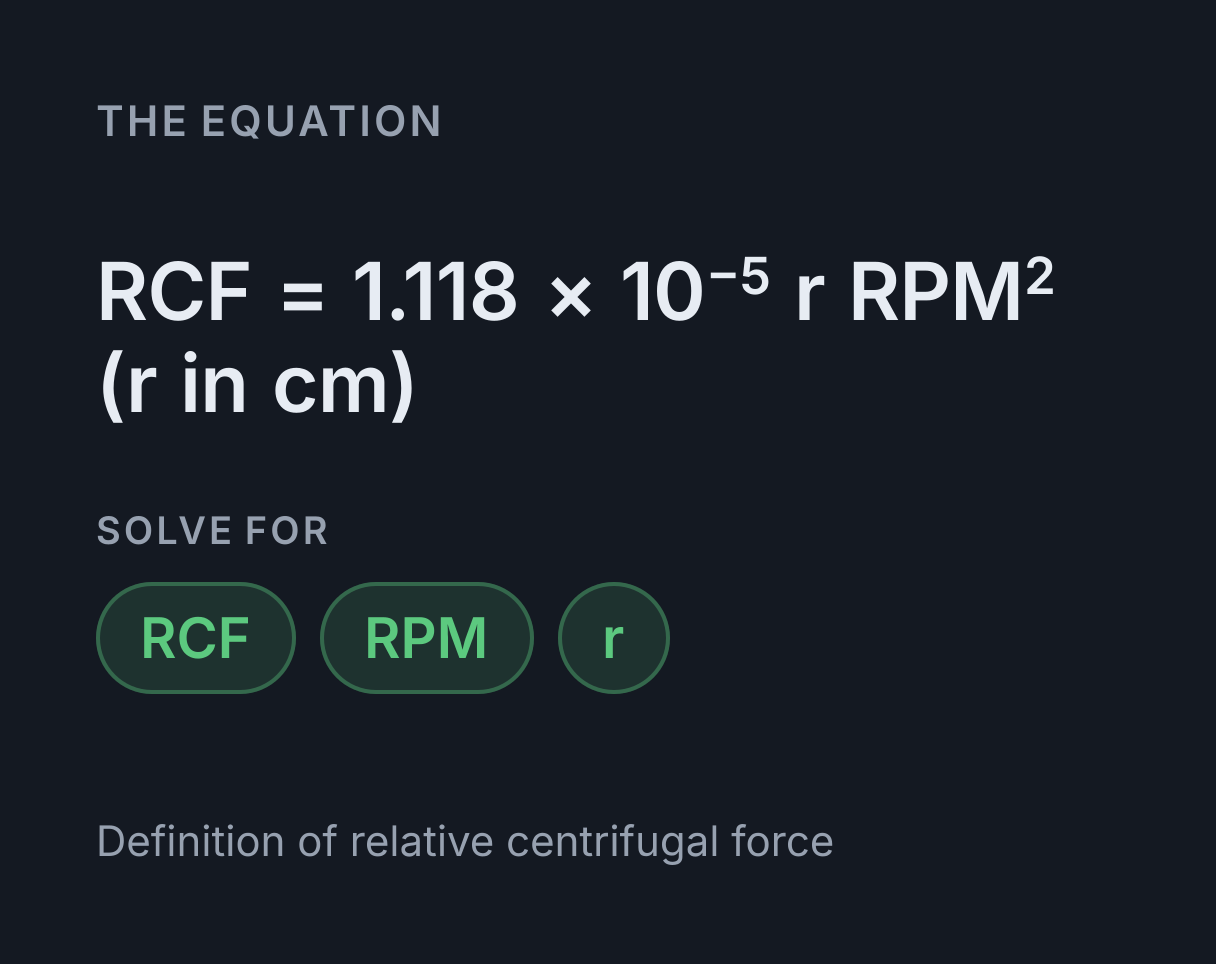
The equation
Definition of relative centrifugal force
What relative centrifugal force measures
Relative centrifugal force is the acceleration felt by a sample in a
spinning rotor, expressed as a multiple of gravity. The underlying physics
is RCF = ω²r / g, where ω is the angular speed in
radians per second and r is the distance from the axis of
rotation. Substituting ω = 2π × RPM / 60, converting the radius
to centimetres and dividing by g = 9.80665 m/s² collapses every
constant into one number, giving
RCF = 1.11824e-5 × r × RPM². Manuals round that constant to
1.118e-5, which changes nothing at three significant
figures.
Two features of the equation matter in practice. The force scales with the square of the speed, so doubling the rpm quadruples it. It scales only linearly with radius, so doubling the radius doubles it.
Worked example
What force does 13,000 rpm produce in a rotor with a radius of 8.5 cm?
- Square the speed:
13000² = 169,000,000. RCF = 1.11824e-5 × 8.5 × 169000000RCF = 16,064 × g.
Halving the speed to 6500 rpm in the same rotor gives
1.11824e-5 × 8.5 × 42250000 = 4016 × g, one quarter of the
original force rather than half.
Why protocols are written in × g
A published method specifies a force in × g because rpm on its own does not describe what the sample experiences. The same 13,000 rpm in a rotor of radius 4 cm produces about 7560 × g, less than half the figure above. An rpm value copied between laboratories with different rotors therefore reproduces the speed and not the separation, which is why pellets come out loose or over-packed when the number is transferred directly. Converting the published × g to the rpm your own rotor needs is the step that makes the method portable.
The radius to use is the one documented for the rotor, and which radius depends on the goal. Use r-max, measured from the spindle centre to the bottom of the tube, when pelleting, because that is where the pellet forms and the force is highest. Use r-min or the average radius when the specification concerns the top of the liquid column or a mean field, as in some density gradient work. Rotor manuals list these figures, and measuring a tube instead is not a substitute.
Common mistakes
- Copying rpm from another lab’s protocol. Convert the published force in × g into the rpm your rotor requires. Matching the speed instead of the force changes the result.
- Guessing the radius. The value belongs to the rotor and is stated in its manual. Tube length, tube position or an estimate from the outside of the machine all give the wrong field.
- Ignoring the rotor type. Swing-out and fixed-angle rotors hold tubes at different angles, so their effective radii differ even at identical nominal sizes.
- Assuming a uniform force along the tube. RCF varies with radius, so r-min and r-max give different values and the sample sees a gradient rather than one figure.
Converting units first? Use the length conversion table.
Worked examples
Each one runs through the calculator above, so the arithmetic here is the arithmetic it does.
What rpm gives 300 × g in a rotor with a 10 cm radius?
- RPM = sqrt(RCF / (1.11824 × 10⁻⁵ x r(cm)))
- = sqrt(300 / (1.11824 × 10⁻⁵ x 10))
- = sqrt(300 / 0.00011182)
- = 1637.9 rpm
About 1640 rpm, the gentle spin commonly used to pellet mammalian cells. Force grows with the square of speed, so running this rotor at a habitual 3000 rpm would give about 1006 × g, more than three times what the protocol asked for, which is how a spin meant to be gentle ends up compacting the pellet.
What g force does 12,000 rpm give 4 cm from the centre of the rotor?
- RCF = 1.11824 × 10⁻⁵ x r(cm) x RPM^2
- r = 4 cm
- = 1.11824 × 10⁻⁵ x 4 x 12,000^2
- = 1.11824 × 10⁻⁵ x 4 x 1.44 × 10⁸
- = 6441.1 x g
About 6440 × g. Force is proportional to radius, so in a rotor that holds the top of the liquid 4 cm from the axis and the bottom of the tube at 8 cm, the surface feels half the force the pellet does. That gradient is why a protocol names the radius it means, usually r-max for pelleting.
Practise this with Lab and Clinical Calculation Practice Problems, questions generated from this calculator and 9 other calculators in Biology.
Common questions
Why do protocols specify × g instead of RPM?
Because RPM alone does not describe the force applied. The same speed in a larger rotor produces a much stronger field, since RCF is proportional to radius. Quoting × g makes a protocol reproducible on any centrifuge, which is why RPM figures copied between labs so often fail.
Which radius should I enter?
The distance from the centre of the spindle to the point of interest in the tube, taken from your rotor’s documentation. Use r-max for pelleting, since that is where material collects. Using the tube length or guessing typically introduces a 20 to 50 percent error.