Photoelectric Effect Simulator
A photoelectric effect simulation: light frees electrons from a metal only above its threshold frequency, φ/h, and the stopping potential is (hf − φ)/e.
Simulator
- Stopping potential K_max divided by e. Set the anode to minus this and even the fastest electron is turned back.
- 0.74 V
- Maximum kinetic energy hf − φ, the energy the fastest electron leaves with, which is 1.18 × 10⁻¹⁹ J.
- 0.74 eV
- Photon energy hf, the same for every photon of this light however intense it is.
- 3.1 eV
- Work function Kaye and Laby’s photoelectric value for sodium. Other tables differ by tenths of an electronvolt.
- 2.36 eV
- Threshold frequency φ/h. Light below this frequency frees no electrons at any intensity.
- 570.6 THz
- Threshold wavelength hc/φ, in vacuum. Any longer wavelength frees nothing.
- 525.4 nm
- Frequency c/λ for the wavelength you set.
- 749.5 THz
- Fastest electron From ½mv² = K_max with the electron’s mass. Classical, which is within 0.001 percent here.
- 510 km/s
- Relative current The current reaching the anode as a fraction of the saturation current at full intensity: the intensity times the share of electrons that get through.
- 0.5
Stopping potential 0.74 volts. Relative current 0.5.
- This intensity
- Full intensity
- Stopping potential
- Extended below the threshold
Citing this tool
Last updated . Add the date you accessed it as well, which a citation of a page that can change asks for. If a specific result matters, cite the permalink from the tool’s share row instead of this page: it reproduces the exact parameters.
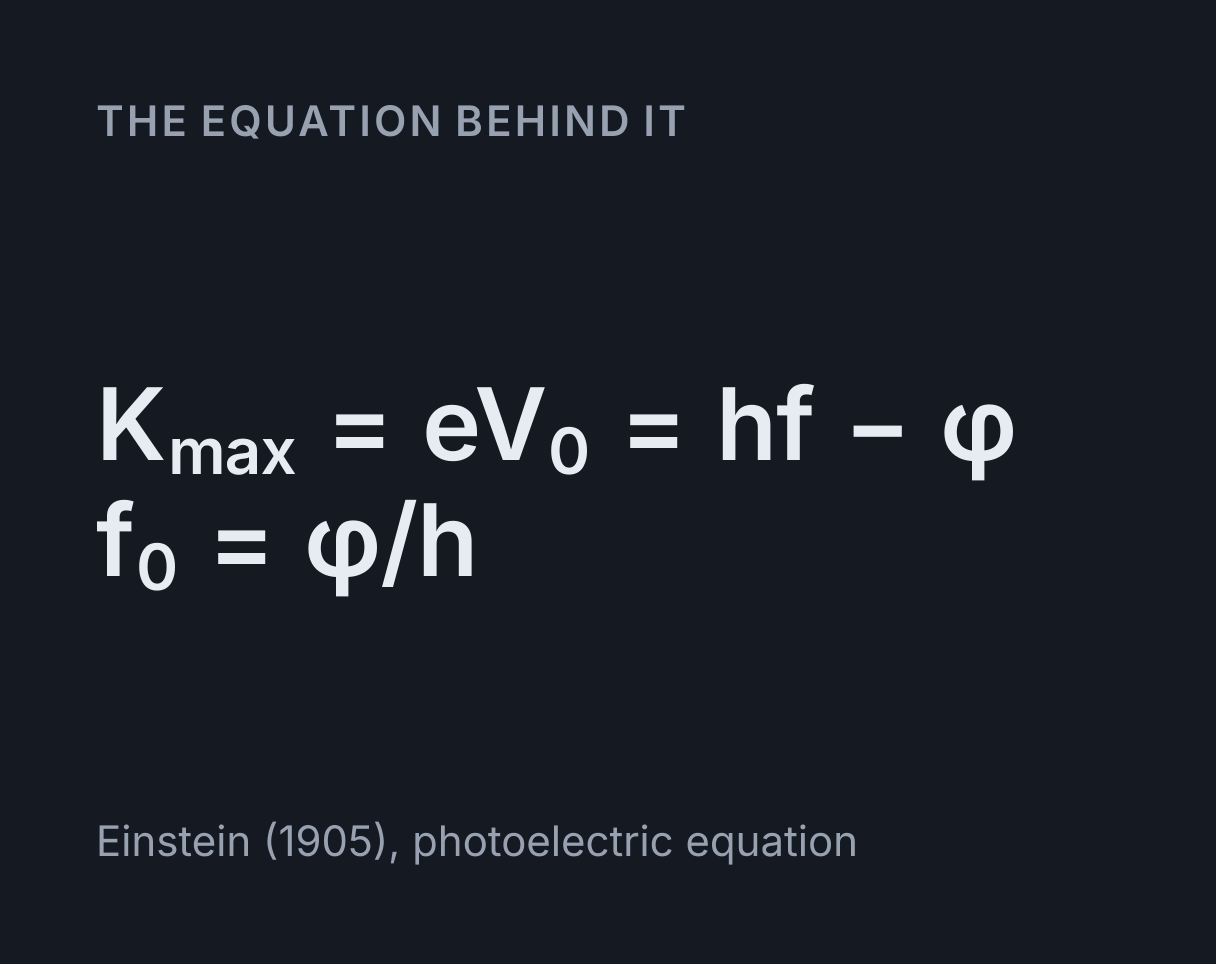
The equation
Einstein (1905), photoelectric equation
What the photoelectric effect is
The photoelectric effect is the release of electrons from a metal by light, and this
simulation shows its two rules at work: below the metal’s threshold frequency no electron
escapes however bright the light, and above it the fastest electron leaves with
K_max = hf − φ. Here hf is the energy of one photon of frequency
f and φ is the work function, the least energy that frees an
electron from that surface. Each electron takes in a single photon, so the threshold is
f₀ = φ/h.
The stopping potential, also called the cut-off voltage, measures what is left. Make the
anode negative relative to the metal and it pushes the electrons back; at
V₀ = K_max/e not even the fastest reaches it and the current stops. An energy in
electronvolts and a voltage in volts are the same number, so an electron that leaves with
0.74 eV is stopped by 0.74 V. The
Photon Energy Calculator turns any wavelength
into electronvolts on its own.
How to use the simulation
Set the light by wavelength or by frequency, choose the intensity and the metal, then move the anode voltage and watch the current. The readouts give the stopping potential, the maximum kinetic energy, the photon energy, the work function, the threshold frequency and wavelength, the fastest electron’s speed and the current reaching the anode. The Wavelength and Frequency Calculator converts between the two ways of describing the light.
- Intensity counts photons per second. It changes how many electrons leave, and so the size of the current, but never their energy.
- Metal sets the work function from Kaye and Laby’s table, and Custom takes any value from 1.20 eV to 6.00 eV, so a textbook problem can be set up exactly.
- Anode voltage runs from −5 V, which holds electrons back, to +2 V, which pulls every one across. Every stopping potential the settings can produce lies inside that range.
- The current against voltage plot shows the current falling to zero at minus the stopping potential, with the full-intensity curve dashed behind it whenever the intensity is lower.
- The stopping potential against frequency plot is a straight line of slope h/e, with a dot on the light you have set.
- The picture frees one electron for every photon so that the exchange can be
seen. Coloured electrons are heading for the anode and grey ones have been turned back. The
bar on the right is Einstein’s equation drawn to scale: the photon’s energy
hf, the partφspent escaping and the partKleft over.
Worked example: violet light on sodium
What does 400 nm light do to sodium, whose work function Kaye and Laby give as 2.36 eV? These are the simulation’s opening settings.
-
Photon energy:
E = hc/λ = 1239.84 eV·nm ÷ 400 nm = 3.0996 eV, at a frequency ofc/λ = 749.5 THz. -
Maximum kinetic energy:
K_max = 3.0996 − 2.36 = 0.7396 eV, which is 1.185 × 10⁻¹⁹ J. -
Stopping potential:
V₀ = K_max/e = 0.7396 V, so the anode must sit at −0.74 V to stop the current. -
Threshold:
f₀ = φ/h = 570.6 THz, a wavelength of 525.4 nm. Green light longer than that, and all yellow, orange and red light, frees nothing from sodium. - Fastest electron:
v = √(2K_max/m) = 5.10 × 10⁵ m/s, or 510 km/s. -
At −0.37 V, about half the stopping potential, the share of electrons that still get through
is
(1 − 0.37/0.7396)² = 0.25, a quarter, so at the opening intensity of 50 percent the relative current reads 0.125.
The readouts show the same figures to the precision the work function supports: 0.74 V, 570.6 THz, 525.4 nm and 510 km/s.
Worked example: caesium lit at 6 × 10¹⁴ Hz
An exercise in NCERT’s Class 12 physics textbook takes the work function of caesium as 2.14 eV and lights it at 6 × 10¹⁴ Hz. What are the maximum kinetic energy, the stopping potential and the fastest electron’s speed? Set the light by frequency to 600 THz and choose Custom at 2.14 eV.
hf = 4.1357 × 10⁻¹⁵ eV·s × 6 × 10¹⁴ Hz = 2.4814 eV.-
K_max = 2.4814 − 2.14 = 0.3414 eV, so the stopping potential is 0.341 V. -
v = √(2 × 0.3414 eV × 1.602 × 10⁻¹⁹ J/eV ÷ 9.109 × 10⁻³¹ kg) = 3.47 × 10⁵ m/s.
NCERT’s worked examples take h = 6.63 × 10⁻³⁴ J·s and e = 1.6 × 10⁻¹⁹ C, which give 2.49 eV and 0.346 eV here and put caesium’s threshold at 5.16 × 10¹⁴ Hz, where the exact constants give 517.4 THz, or 5.174 × 10¹⁴ Hz. That is why a textbook answer and the simulation can differ in the third figure.
Why intensity changes the current but not the stopping potential
Intensity is the number of photons arriving each second, and each photon acts on one electron.
More photons free more electrons and a larger current, but each electron still gets one
photon’s worth of energy, so the fastest leaves with hf − φ at any brightness.
Raise the intensity from 50 to 100 percent and the saturation current doubles while the
current still falls to zero at the same voltage. Below the threshold even full intensity frees
nothing.
A wave picture of light predicts the opposite on both counts: brighter light should give faster
electrons, and any frequency should work if the light is bright enough for long enough. Neither
happens, and emission starts within about 10⁻⁹ s even in dim light. Einstein’s 1905 proposal
that light arrives in quanta of energy hf explains all three. Interference, which
the Double Slit Simulator shows, needs light to
behave as a wave; the photoelectric effect needs it to arrive in photons, and both are true.
Power is a different matter. At the same power, shorter wavelengths bring fewer photons, because each carries more energy: one watt of 400 nm light is 2.01 × 10¹⁸ photons a second and one watt of 600 nm light is 3.02 × 10¹⁸. The intensity control here counts photons, so the saturation current depends on it alone.
Stopping potential against frequency: a slope of h/e
Written as V₀ = (h/e)f − φ/e, Einstein’s equation says that a plot of stopping
potential against frequency is a straight line with the same slope for every metal,
h/e = 4.136 × 10⁻¹⁵ V·s, the
Planck constant divided by the
elementary charge. It crosses zero at the threshold
frequency, and extended back to zero frequency it meets the voltage axis at
−φ/e, so one line gives both Planck’s constant and the work function. The lower
plot draws it for the chosen metal. Read the other way, a measured slope gives
h: the 4.12 × 10⁻¹⁵ V·s of an NCERT exercise means
h = 4.12 × 10⁻¹⁵ V·s × 1.602 × 10⁻¹⁹ C = 6.60 × 10⁻³⁴ J·s.
Millikan measured that line for sodium, and in 1916, using the known value of the electron’s charge, obtained a Planck constant close to the value found in an entirely different context, which confirmed Einstein’s equation. Einstein’s 1921 Nobel Prize in Physics was awarded for his services to theoretical physics, and especially for his discovery of the law of the photoelectric effect.
Where the work functions come from
The metals listed use the photoelectric values in the National Physical Laboratory’s online edition of Kaye and Laby’s Tables of Physical and Chemical Constants, which selected them from reviews by Rivière (1969) and by Hölzl and Schulte (1979) and gives their typical error as 0.02 eV. A work function belongs to the surface as much as to the metal. The same table gives potassium 2.30 eV by the photoelectric method and 2.01 eV by contact potential difference, notes that different crystal faces differ and that contamination usually lowers the value, and so textbooks disagree. NCERT’s worked example gives caesium 2.14 eV where Kaye and Laby have 1.95 eV; choose Custom to use the figure a problem states. The table gives lithium, beryllium and magnesium no photoelectric value, so they are not listed.
| Metal | Work function | Threshold frequency | Threshold wavelength |
|---|---|---|---|
| Caesium | 1.95 eV | 471.5 THz | 635.8 nm |
| Rubidium | 2.05 eV | 495.7 THz | 604.8 nm |
| Potassium | 2.30 eV | 556.1 THz | 539.1 nm |
| Sodium | 2.36 eV | 570.6 THz | 525.4 nm |
| Barium | 2.52 eV | 609.3 THz | 492 nm |
| Calcium | 2.87 eV | 694 THz | 432 nm |
| Zinc | 3.63 eV | 877.7 THz | 341.6 nm |
| Lead | 4.25 eV | 1028 THz | 291.7 nm |
| Silver | 4.26 eV | 1030 THz | 291 nm |
| Aluminium | 4.28 eV | 1035 THz | 289.7 nm |
| Tungsten | 4.55 eV | 1100 THz | 272.5 nm |
| Iron | 4.60 eV | 1112 THz | 269.5 nm |
| Copper | 4.65 eV | 1124 THz | 266.6 nm |
| Gold | 5.10 eV | 1233 THz | 243.1 nm |
| Nickel | 5.15 eV | 1245 THz | 240.7 nm |
| Platinum | 5.63 eV | 1361 THz | 220.2 nm |
Caesium, rubidium, potassium, sodium and barium respond to visible light, calcium only to violet light, and zinc and every metal below it in the table need ultraviolet.
What this simulation leaves out
- Temperature. The current is modelled at absolute zero, where it reaches zero
exactly at the stopping potential along a parabola that touches the axis, DuBridge’s result of
1933. At room temperature a few electrons carry a little more than
hf − φ, so a measured curve creeps towards the axis instead, and DuBridge put the resulting uncertainty in the stopping potential at several hundredths of a volt. - Contact potential. Both plates are treated as having the metal’s work function. In a real tube the anode’s is different, and the contact potential difference between the two metals shifts the whole curve along the voltage axis.
- How many electrons each photon frees. The current is shown relative to the saturation current at full intensity because the model does not know it in amperes. In a real metal the number of electrons freed per photon depends on the metal and the frequency, and close to the threshold it falls smoothly to zero, as the Fowler equation quoted in the same section of Kaye and Laby describes; here the saturation current is the same at every frequency above the threshold.
- The shape of the tube. Flat parallel plates sort electrons by the energy they carry normal to the surface, which gives the parabola drawn here. A small emitter at the centre of a spherical collector sorts them by their total energy, and for that case DuBridge’s curve cuts the axis at a large angle instead. Textbook graphs also show the current still rising a little above zero volts before it saturates; here every emitted electron is collected from zero volts up.
- Two photons at once. Light intense enough for one electron to absorb two photons, as a focused pulsed laser can be, frees electrons below the threshold frequency. The model allows one photon per electron.
- Time. The picture is slowed enormously so that electrons can be followed: at the opening settings the fastest real electron crosses a centimetre in about 20 ns. Near the threshold the picture is also sped up, uniformly, so that the slowest electrons still move, and it says so.
- Light shorter than 200 nm. That is the vacuum ultraviolet, named because the oxygen in air absorbs it, and it is left out.
Common mistakes
- Expecting brighter light to give faster electrons. Intensity sets how many electrons leave. Only the frequency and the metal set how fast the fastest one moves.
- Leaving the wavelength in nanometres. With h and c in SI units,
E = hc/λneeds λ in metres. Putting in 400 rather than 4 × 10⁻⁷ makes the energy 10⁹ times too small. - Mixing electronvolts and joules. 1 eV is 1.602 × 10⁻¹⁹ J.
K_maxin electronvolts is the stopping potential in volts, but in joules it has to be divided by e first. - Getting the threshold backwards. Light has to be above the threshold
frequency, which means below the threshold wavelength. Wavelengths longer than
λ₀ = hc/φfail at any intensity. - Assuming the same power means the same number of photons. At one watt, 400 nm light delivers fewer photons than 600 nm light, so with a lamp’s power held fixed the saturation current changes with the colour even above the threshold.
- Giving the stopping potential the wrong sign. The anode sits at −V₀ relative to the metal. The stopping potential is quoted as a positive number, the size of that retarding voltage.
- Expecting four-figure agreement with a textbook. Answers worked with h = 6.63 × 10⁻³⁴ J·s, c = 3 × 10⁸ m/s and e = 1.6 × 10⁻¹⁹ C drift in the third figure from ones worked with the exact constants, as the second example shows.
Model and assumptions
- Method
- Exact expression, no time stepping
- Repeatability
- Deterministic. The same link gives the same numbers on any machine.
What it assumes
- Each electron absorbs exactly one photon, and every number shown follows in closed form from Einstein’s equation, K_max = hf − φ.
- One work function per metal, the photoelectric value from Kaye and Laby, and both plates share it, so there is no contact potential and the current saturates at exactly 0 V.
- Between minus the stopping potential and zero the current follows DuBridge’s 1933 result for flat parallel plates at absolute zero, a parabola touching the axis at the stopping potential, from an assumed spread of electron energies in a free electron metal.
- The saturation current is proportional to the photon rate and the same at every frequency above the threshold, so the current is shown relative to its value at full intensity.
- The animated electrons are drawn from the same energy spread by fixed irrational sequences rather than a random number generator, so the picture is repeatable, and no number on the page reads it.
Where it stops holding. Close to the threshold at room temperature, where warm electrons blur the cut-off by several hundredths of a volt, and in light intense enough for one electron to absorb two photons, which frees electrons below the threshold frequency. The Photon Energy Calculator is the right tool there.
Numerical accuracy
No method error to report: the result is a closed-form expression evaluated directly, with no time stepping to accumulate error. What remains is double-precision rounding, of order one part in 10^16 per operation.
Common questions
What is the photoelectric effect?
It is the release of electrons from a metal when light of high enough frequency falls on it. Einstein explained it in 1905: each electron absorbs a single photon of energy hf, spends at least the work function φ escaping, and leaves with at most hf − φ. Light below the threshold frequency, φ/h, frees no electrons however bright it is.
How do you calculate the stopping potential?
Subtract the work function from the photon energy and divide by e: V₀ = (hf − φ)/e, which in volts is the same number as the maximum kinetic energy in electronvolts. A 400 nm violet photon carries 3.10 eV, so on sodium, with φ = 2.36 eV, the stopping potential is 0.74 V. In the experiment it is the retarding voltage at which the photocurrent falls to zero.
What is the threshold frequency of a metal?
It is the lowest frequency of light that can free an electron from it, f₀ = φ/h. For sodium, with a work function of 2.36 eV, that is 571 THz, a wavelength of 525 nm, so sodium responds to light shorter than 525 nm but not to yellow or red light. Below the threshold the current is zero at any intensity.
Why does brighter light not raise the stopping potential?
Because brightness sets how many photons arrive each second, not how much energy each one carries. Every electron still absorbs a single photon, so the fastest leaves with hf − φ whatever the intensity. Doubling the intensity doubles the saturation current while the current still falls to zero at the same stopping potential, which the wave theory of light could not explain.
Why do books give different work functions for the same metal?
Because the work function belongs to the surface as well as the metal: the crystal face, the cleanliness of the surface and the method of measurement all move it. Kaye and Laby list potassium at 2.30 eV measured photoelectrically and 2.01 eV by contact potential, and NCERT’s worked example uses 2.14 eV for caesium where Kaye and Laby’s photoelectric value is 1.95 eV. Choose Custom to use your textbook’s figure.