Reynolds Number Calculator
Find the Reynolds number of a pipe flow from density, speed, diameter and viscosity, and whether it is laminar, transitional or turbulent.
Calculator
Water 998.2 at 20 °C, seawater 1025, air 1.20 at 20 °C and sea level.
The volume flow rate divided by the pipe’s cross-sectional area, not the faster speed on its axis.
For a duct that is not round, the hydraulic diameter: 4 × area ÷ wetted perimeter.
Water 1.0016 mPa·s at 20 °C, air about 0.018 mPa·s. 1 cP = 1 mPa·s.
Working, with your numbers
- Re = rho x v x D / mu
- = 998.2 kg/m3 x 1 m/s x 0.025 m / 0.0010016 Pa s
- = 24.955 / 0.0010016
- = 24,915
Values are converted into the units the equation is worked in before the arithmetic.
- Flow in a round pipe Laminar below 2300 and turbulent above 4000: the usual textbook convention for a long, straight round pipe, not a sharp physical limit.
- Turbulent
- Kinematic viscosity, ν = μ/ρ 1 mm²/s is 1 centistoke (cSt). vD/ν gives the same Reynolds number.
- 1.003 mm²/s
- Speed at Re = 2300 The fastest mean speed that counts as laminar by the 2300 convention, in this fluid and pipe.
- 0.09231 m/s
- Volume flow rate Q = v × πD²/4. That is 7.781 US gal/min.
- 0.4909 L/s
Citing this tool
Last updated . Add the date you accessed it as well, which a citation of a page that can change asks for. If a specific result matters, cite the permalink from the tool’s share row instead of this page: it reproduces the exact parameters.
On the syllabus: MCAT, 4B: Importance of fluids for the circulation of blood, gas movement, and gas exchange.
The equation
Reynolds, Philosophical Transactions of the Royal Society (1883)
What is the Reynolds number?
The Reynolds number is Re = ρvD/μ = vD/ν, the ratio of inertial to viscous forces in a flow, where ρ is density (kg/m³), v the mean flow speed (m/s), D the pipe diameter (m), μ the dynamic viscosity (Pa·s) and ν = μ/ρ. It has no units. Round pipe flow is usually laminar below 2300.
Inertia against viscosity
The numerator, ρvD, grows with the momentum the fluid carries and with the size
of the pipe it moves through; the denominator, μ, measures how strongly
adjacent layers of fluid drag on each other. At a low Reynolds number viscosity wins, any small disturbance is
damped out, and the fluid slides along in smooth layers. At a high one the disturbances
grow into eddies faster than viscosity can smooth them, and the flow becomes turbulent,
mixing across the pipe and losing far more pressure to friction.
The units cancel, kg/m³ times m/s times m divided by Pa·s, so the number means the same thing in any unit system. Two incompressible flows around the same shape with the same Reynolds number have the same pattern of flow, which is why a scale model in a wind tunnel or a water channel is ideally run at the Reynolds number of the full-size object rather than at its speed.
The 2300 and 4000 limits are conventions
The regime readout uses the convention of engineering fluid mechanics texts such as Çengel and Cimbala’s: below 2300 a round pipe flow is called laminar, above 4000 turbulent, and in between transitional. Other books draw the lines elsewhere. OpenStax College Physics, a free introductory text, gives below about 2000 for laminar and above about 3000 for turbulent, and writes the number with the radius, NR = 2ρvr/η, which is the same quantity.
None of these is a sharp physical limit. Osborne Reynolds found in 1883 that the change depends on how disturbed the water is as it enters the pipe, and a careful experiment with a still inlet and a smooth pipe can keep the flow laminar far above 4000. Avila and colleagues showed in 2011 that turbulence becomes self-sustaining in a pipe from about Re = 2040. In the transitional range the flow can be laminar, turbulent or switch between the two, so the calculator warns there instead of choosing.
Dynamic and kinematic viscosity
Dynamic viscosity μ is in Pa·s, or in centipoise, where 1 cP is exactly 1 mPa·s. Kinematic viscosity ν is the dynamic viscosity divided by the density, in m²/s or in centistokes, where 1 cSt is 1 mm²/s. Water at 20 °C is 1.0016 mPa·s and 1.003 mm²/s, which is why water is often quoted as about 1 cP and 1 cSt. Lubricating oils are graded by kinematic viscosity at 40 °C, so an ISO VG 46 oil is about 46 mm²/s, and the dynamic viscosity the calculator takes is that figure in m²/s times the oil’s density.
Viscosity depends strongly on temperature. Hot water at 80 °C is about a third as viscous as at 20 °C, so the same pipe flow at 80 °C has a Reynolds number nearly three times higher. Take the viscosity at the temperature of the flow, not the temperature of the table.
Ducts that are not round, and flows outside pipes
For a duct of any other cross section, replace D with the hydraulic diameter,
4A/P, four times the flow area over the wetted perimeter. For a square duct of
side a that is a itself. The pipe limits do not carry over to other kinds
of flow, which use their own length and their own thresholds: flow along a flat plate uses
the distance from its leading edge and is conventionally taken to turn turbulent near
Re = 5 × 10⁵. The speeds that go into Re in a pipe come from the
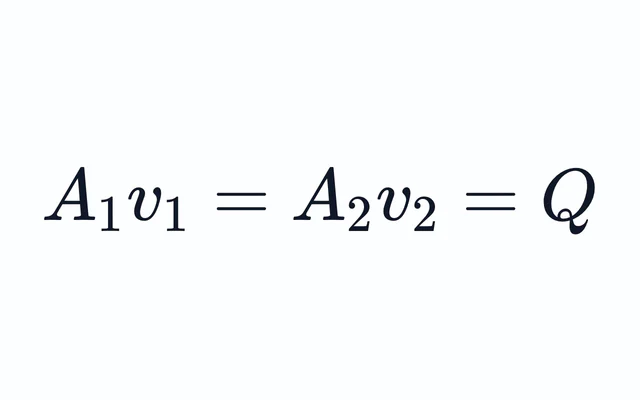
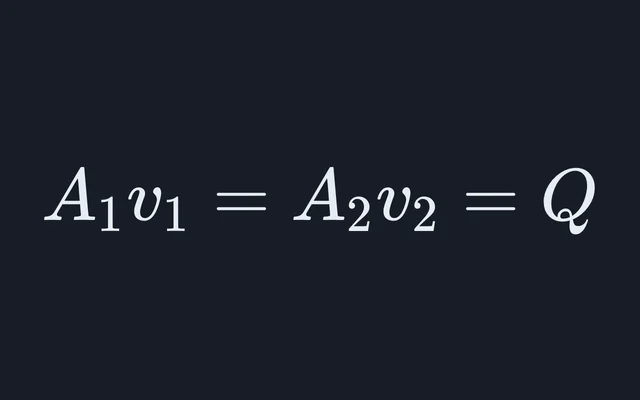
continuity equation, and the pressure
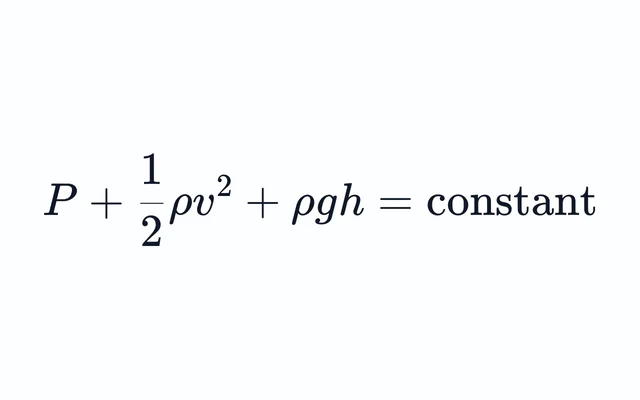
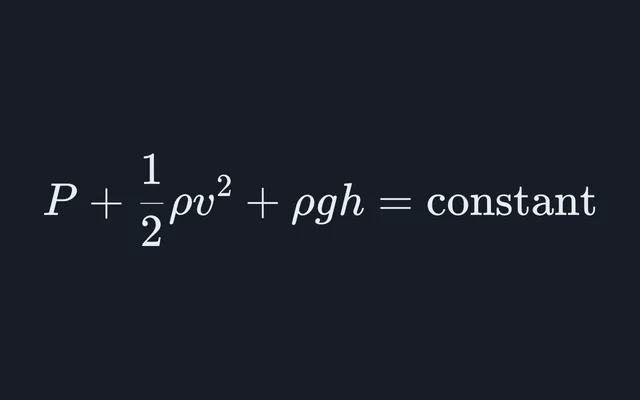
changes along it from the Bernoulli
equation, which ignores the friction losses a turbulent flow makes largest.
Common mistakes
- Using the radius. The usual form takes the diameter. Using the radius halves Re, unless the formula is written with 2r, as OpenStax writes it.
- Mixing cP and Pa·s. Water’s viscosity entered as 1 Pa·s instead of 1 mPa·s makes Re a thousand times too small. The viscosity menu takes cP, mPa·s, Pa·s, poise and the two US units directly.
- Entering a kinematic viscosity as the dynamic one. The field takes μ. A figure in cSt or mm²/s is ν and has to be multiplied by the density first.
- Using the speed on the axis. The formula takes the mean speed, the flow rate over the area. In laminar flow the speed on the axis is twice the mean.
- Taking viscosity at the wrong temperature. A table value at 20 °C for a flow at 60 °C can put the answer on the wrong side of a regime limit.
Converting units first? Use the length, speed and density conversion tables.

How to calculate the Reynolds number
- Write down the formula:
Re = ρvD ÷ μ -
Gather the values it needs. The calculator above starts with these:
- Fluid density: ρ = 998.2 kg/m³
- Mean flow speed: v = 1 m/s
- Pipe inside diameter: D = 2.5 cm
- Dynamic viscosity: μ = 1.0016 mPa·s
-
Substitute them and work through the arithmetic:
- Re = rho x v x D / mu
- = 998.2 kg/m3 x 1 m/s x 0.025 m / 0.0010016 Pa s
- = 24.955 / 0.0010016
- = 24,915
-
To find one of the other values instead, rearrange the formula for it:
- Fluid density:
ρ = Re · μ ÷ (vD) - Mean flow speed:
v = Re · μ ÷ (ρD) - Pipe inside diameter:
D = Re · μ ÷ (ρv) - Dynamic viscosity:
μ = ρvD ÷ Re
- Fluid density:
Worked examples
Each one runs through the calculator above, so the arithmetic here is the arithmetic it does.
What is the fastest water can flow in a 2 cm pipe and stay laminar?
- v = Re x mu / (rho x D)
- = 2300 x 0.0010016 Pa s / (998.2 kg/m3 x 0.02 m)
- = 2.3037 / 19.964
- = 0.11539 m/s
About 0.115 m/s, under half a foot per second. Almost every pipe flow in a home is far faster, so it is turbulent. Re grows with v × D, so halving the diameter doubles the speed limit. Exactly 2300 sits on the line, which the regime readout calls transitional.
Is water at 0.1 m/s in a 1 cm tube laminar or turbulent?
- Re = rho x v x D / mu
- = 998.2 kg/m3 x 0.1 m/s x 0.01 m / 0.0010016 Pa s
- = 0.9982 / 0.0010016
- = 996.61
Re is about 1000, laminar by every textbook convention, so a thread of dye would stay a thread, as in Reynolds’s own experiment. Speed the flow up tenfold, to 1 m/s, and Re is about 10,000: turbulent, since Re is proportional to the speed.
What viscosity keeps an 880 kg/m³ oil laminar at 2 m/s in a 5 cm pipe?
- mu = rho x v x D / Re
- = 880 kg/m3 x 2 m/s x 0.05 m / 2300
- = 88 / 2300
- = 0.038261 Pa s = 38.261 mPa s
About 38 mPa·s, 38 times water’s viscosity at 20 °C. Divided by the oil’s density it is 43 mm²/s, a kinematic viscosity inside the ISO VG 46 grade, which oils are graded by at 40 °C.
Practise this with Mechanics Practice Problems, questions generated from this calculator and 18 other calculators in Mechanics.
Common questions
Is water in a household pipe laminar or turbulent?
Almost always turbulent. Water at 20 °C moving at 1 m/s in a 25 mm pipe, the calculator’s starting values, has a Reynolds number near 25,000, and staying below 2300 in that pipe needs a mean speed under about 9 cm/s. Laminar flow is the rule only in narrow tubes, slow flows and viscous liquids such as oils and syrups.
Does a higher Reynolds number mean more friction?
Not as a friction factor. In laminar flow the Darcy friction factor is 64/Re, so it falls as Re rises, and in turbulent flow it falls more slowly and then levels off at a value set by the roughness of the pipe. The pressure lost to friction still grows with speed: in proportion to it in laminar flow, and closer to its square in turbulent flow.
How do I calculate the Reynolds number with kinematic viscosity?
Use Re = vD/ν with ν in m²/s. A figure in cSt or mm²/s needs multiplying by 10⁻⁶ first: water at 20 °C, 1.003 mm²/s, at 2 m/s in a 5 cm pipe gives 2 × 0.05 ÷ (1.003 × 10⁻⁶), about 99,700. This calculator takes the dynamic viscosity, so multiply ν by the density to enter μ.