Bernoulli Equation Calculator
Solve Bernoulli’s equation for pressure, flow speed, height or density at either point, in kPa, psi, m/s or ft/s, with every line of the working shown.
Calculator
Absolute or gauge, as long as P₂ is the same kind. A gauge pressure can be negative, down to −101.325 kPa.
0 for the still surface of a large tank.
Measured from any level you choose, the same level for both points.
Absolute or gauge, the same kind as P₁.
Water 1000 as textbooks round it (998 at 20 °C), seawater 1025, air about 1.2.
Standard gravity, 9.80665 m/s². AP Physics 1 uses 9.8.
Working, with your numbers
- P2 = P1 + 0.5 x rho x (v1^2 - v2^2) + rho x g x (h1 - h2)
- = 200,000 Pa + 0.5 x 1000 x (1.5^2 - 6^2) + 1000 x 9.80665 x (0 - 3)
- = 200,000 - 16,875 - 29,420 Pa
- = 153,705 Pa = 153.71 kPa
Values are converted into the units the equation is worked in before the arithmetic.
- P + ½ρv² + ρgh at 1 and at 2 The energy per unit volume. Bernoulli’s equation says it is the same at both points, so the two figures agree.
- 201.13 / 201.13 kPa
- Pressure drop, P₁ − P₂ Positive when the pressure falls from point 1 to point 2.
- 46.295 kPa
- Pressure drop in psi
- 6.715 psi
- Dynamic pressure at 2, ½ρv₂² The rise in pressure if the flow at point 2 were brought to rest, which is what a Pitot tube measures.
- 18 kPa
Citing this tool
Last updated . Add the date you accessed it as well, which a citation of a page that can change asks for. If a specific result matters, cite the permalink from the tool’s share row instead of this page: it reproduces the exact parameters.
On the syllabus: AP Physics 1, Unit 8: Fluids; MCAT, 4B: Importance of fluids for the circulation of blood, gas movement, and gas exchange.
The equation
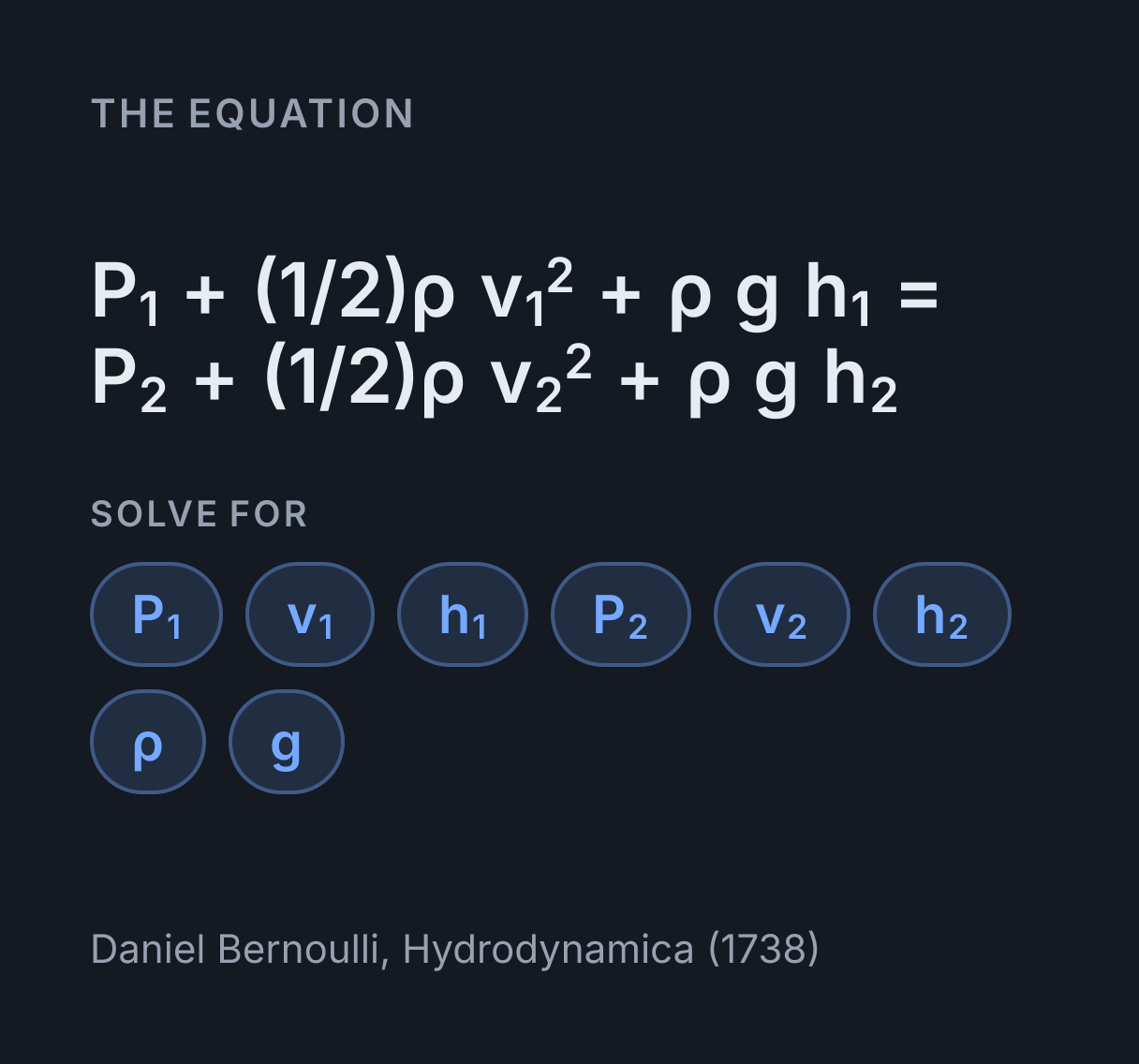
Daniel Bernoulli, Hydrodynamica (1738)
What is Bernoulli’s equation?
Bernoulli’s equation is P₁ + ½ρv₁² + ρgh₁ = P₂ + ½ρv₂² + ρgh₂. Along a streamline of steady, incompressible, frictionless flow, the pressure P (Pa) plus the kinetic and potential energy per unit volume stays constant, where ρ is density (kg/m³), v flow speed (m/s) and h height (m). Faster or higher fluid has lower pressure.
What each term means
All three terms are energies per unit volume, measured in J/m³, which is the same unit as the
pascal. ½ρv² is the kinetic energy of a unit volume of moving fluid and
ρgh its gravitational potential energy above whatever level you measure height
from. The pressure term is the work the surrounding fluid does pushing that volume along.
With no friction to turn any of it into heat, the total can only be traded between the
three, and that bookkeeping is the whole equation.
The first readout under the calculator adds the three terms at each point. The answer is
the value that makes the two totals agree, so they are a check on hand working: if your own
totals at the two points differ, one of the terms is wrong. The other readouts give the pressure drop in kPa and psi and the dynamic pressure,
½ρv², at point 2, which is what a Pitot tube on an aircraft or in a duct
measures to find the speed.
Why faster flow has lower pressure
In a horizontal pipe nothing but a pressure difference can push a parcel of fluid forward,
so a fluid that speeds up must be moving from higher pressure toward lower. Newton’s second
law and Bernoulli’s equation say the same thing in two ways. Where a pipe narrows, the
continuity equation sets how much
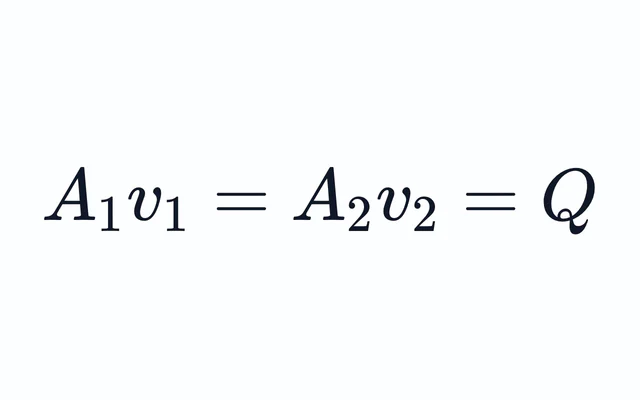
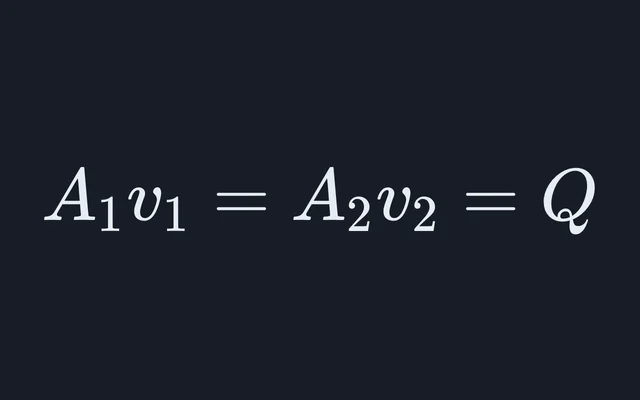
faster the flow must go, A₁v₁ = A₂v₂, and Bernoulli’s equation then says how
far the pressure falls. That pressure drop in a narrowing is the Venturi effect, and a
Venturi meter reads a flow rate from it.
The calculator starts on a pipe whose area falls to a quarter, so the speed rises from
1.5 to 6 m/s, while it also climbs 3 m. Both changes take their share of the pressure, and
the working shows each one as its own term. Set the two heights equal to see the narrowing
alone, or the two speeds equal to see the climb alone. With both speeds at zero the
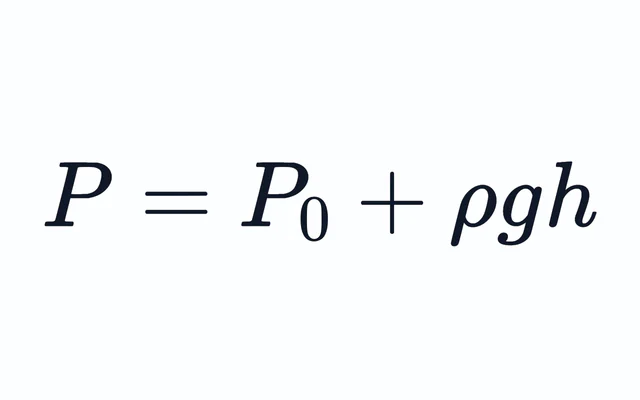
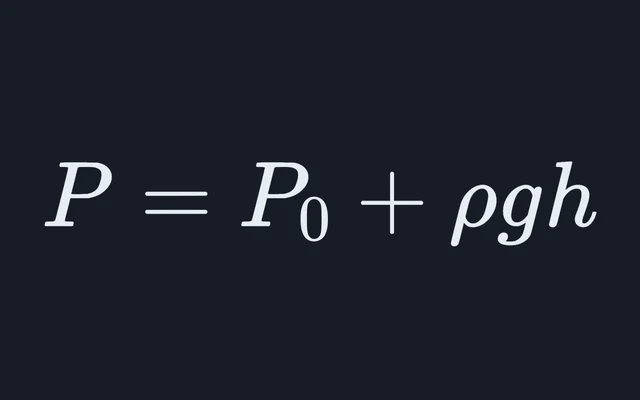
equation becomes the hydrostatic law, P = P₀ + ρgh, which the
hydrostatic pressure calculator solves
directly.
When Bernoulli’s equation does not apply
- Friction. Viscosity takes pressure out of a real pipe flow over its whole length, so the downstream pressure is lower than the equation predicts, and more so in a long, narrow pipe. Whether that flow is laminar or turbulent changes how much, which is what the Reynolds number tells you.
- A pump, fan or turbine between the points. These add or remove energy, so the totals at the two points are no longer equal.
- Fast gas flow. Above about Mach 0.3, roughly 100 m/s in air, the density of a gas changes by several percent along the flow and the constant-density form fails. The calculator warns when a light fluid is that fast.
- Unsteady flow. A valve slamming shut sends a pressure wave back along a pipe, the water hammer, which the steady equation cannot describe.
- Two different streamlines. The total is constant along one streamline. It takes the same value on other streamlines only when the flow has no rotation.
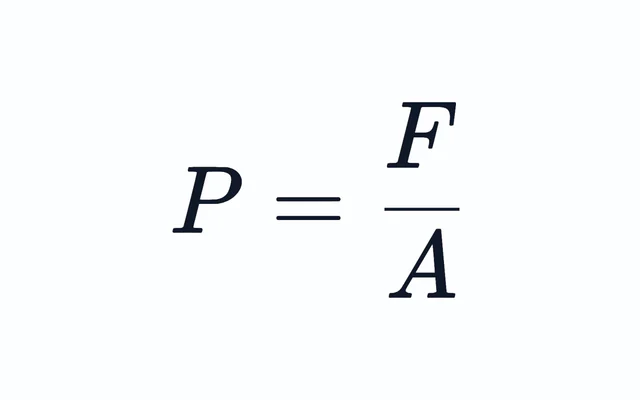
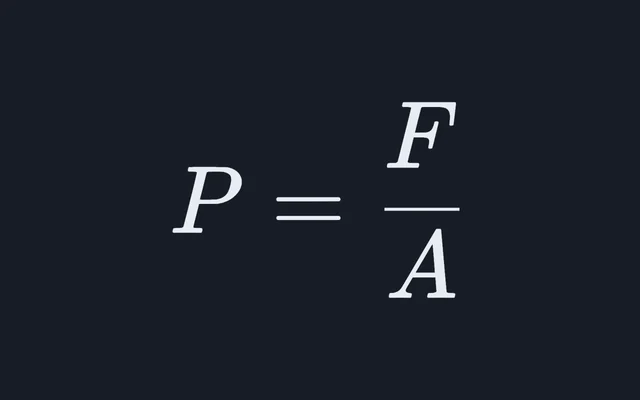
Pressure acting on a surface makes a force, F = PA, which the
pressure calculator works out for any area, and
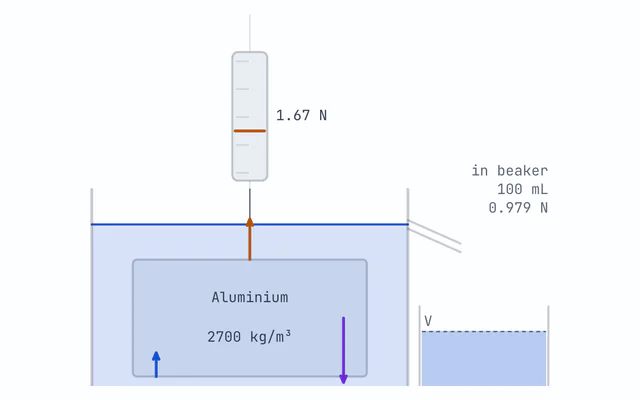
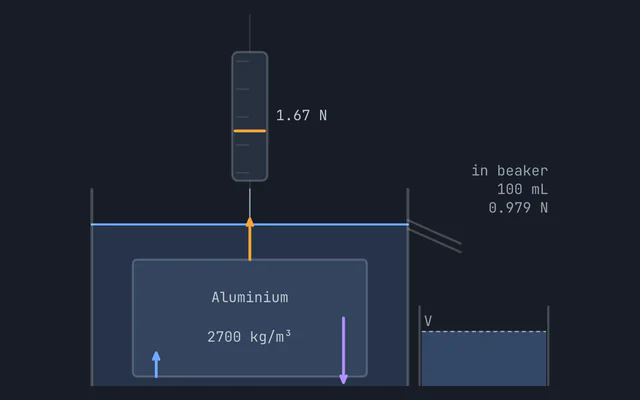
the rise of pressure with depth, the ρgh term, is what lifts a submerged block
in the buoyancy simulator.
Common mistakes
- Mixing gauge and absolute pressure. One of each puts an error of 101.325 kPa, 14.7 psi, into the answer. Use the same kind at both points.
- Measuring height downward. h is height above a level of your choosing, so a point below that level has a negative height. A depth entered as a positive height turns a drop into a climb.
- Guessing the speeds. In a pipe they come from the flow rate and the
areas,
v = Q/A. The surface of a large open tank moves so slowly that its speed is taken as zero. - Density in g/cm³ where kg/m³ is meant. Water entered as 1 kg/m³ instead of 1000 makes the kinetic and height terms a thousand times too small. Pick the unit in the density field’s menu instead of converting by hand.
Converting units first? Use the pressure, length, speed, acceleration and density conversion tables.
Constants used: Standard gravity (g₀).
How to calculate pressure with Bernoulli’s equation
- Write down the formula:
P₂ = P₁ + ½ρ(v₁² − v₂²) + ρg(h₁ − h₂) -
Gather the values it needs. The calculator above starts with these:
- Pressure at point 1: P₁ = 200 kPa
- Flow speed at point 1: v₁ = 1.5 m/s
- Height of point 1: h₁ = 0 m
- Flow speed at point 2: v₂ = 6 m/s
- Height of point 2: h₂ = 3 m
- Fluid density: ρ = 1000 kg/m³
- Gravitational acceleration: g = 9.80665 m/s²
-
Substitute them and work through the arithmetic:
- P2 = P1 + 0.5 x rho x (v1^2 - v2^2) + rho x g x (h1 - h2)
- = 200,000 Pa + 0.5 x 1000 x (1.5^2 - 6^2) + 1000 x 9.80665 x (0 - 3)
- = 200,000 - 16,875 - 29,420 Pa
- = 153,705 Pa = 153.71 kPa
-
To find one of the other values instead, rearrange the formula for it:
- Pressure at point 1:
P₁ = P₂ + ½ρ(v₂² − v₁²) + ρg(h₂ − h₁) - Flow speed at point 1:
v₁ = √[v₂² + 2(P₂ − P₁) ÷ ρ + 2g(h₂ − h₁)] - Height of point 1:
h₁ = h₂ + (P₂ − P₁) ÷ (ρg) + (v₂² − v₁²) ÷ (2g) - Flow speed at point 2:
v₂ = √[v₁² + 2(P₁ − P₂) ÷ ρ + 2g(h₁ − h₂)] - Height of point 2:
h₂ = h₁ + (P₁ − P₂) ÷ (ρg) + (v₁² − v₂²) ÷ (2g) - Fluid density:
ρ = (P₁ − P₂) ÷ [½(v₂² − v₁²) + g(h₂ − h₁)]
- Pressure at point 1:
Worked examples
Each one runs through the calculator above, so the arithmetic here is the arithmetic it does.
How fast does water leave a hole 5 m below the surface of a tank?
- v2 = sqrt(v1^2 + 2 x (P1 - P2) / rho + 2 x g x (h1 - h2))
- = sqrt(0^2 + 2 x (101,325 - 101,325) / 1000 + 2 x 9.80665 x (5 - 0))
- = sqrt(0 + 0 + 98.066)
- = sqrt(98.066)
- = 9.9029 m/s
About 9.9 m/s, Torricelli’s law, v = √(2gh): the speed a stone reaches falling the same 5 m. Both points are open to the air, so the pressures cancel, and the surface of a wide tank barely moves, so v₁ is zero. The density cancels too, so mercury would leave just as fast.
What is the pressure where a horizontal water pipe narrows to a quarter of its area?
- P2 = P1 + 0.5 x rho x (v1^2 - v2^2) + rho x g x (h1 - h2)
- = 300,000 Pa + 0.5 x 1000 x (2^2 - 8^2) + 1000 x 9.80665 x (0 - 0)
- = 300,000 - 30,000 + 0 Pa
- = 270,000 Pa = 270 kPa
270 kPa, 30 kPa lower. A quarter of the area means four times the speed by the continuity equation, and the kinetic term grows with the square of the speed, so it is 16 times larger at point 2. That pressure drop is the Venturi effect, and a Venturi meter turns it back into a flow rate.
How high can 60 psi of water pressure push water?
- h2 = h1 + (P1 - P2) / (rho x g) + (v1^2 - v2^2) / (2 x g)
- = 0 + (413,685 - 0) / (1000 x 9.80665) + (0^2 - 0^2) / (2 x 9.80665)
- = 0 + 42.184 + 0
- = 42.184 m
About 42.2 m, or 138 ft: 2.31 ft of water for every psi. Both pressures here are gauge readings, which works as long as both are, and with the water at rest at both points Bernoulli’s equation becomes the hydrostatic law. Friction in a real pipe that is flowing takes some of that height.
Practise this with Mechanics Practice Problems, questions generated from this calculator and 18 other calculators in Mechanics.
Common questions
Can I use gauge pressure in Bernoulli’s equation?
Yes, as long as both pressures are gauge pressures. Only the difference between them enters the equation, so adding the same 101.325 kPa to both changes nothing. What a gauge reading hides is the floor: an absolute pressure cannot fall below zero, and water at 20 °C boils at 2.34 kPa absolute, which is why a suction pump cannot lift water more than about 10 m.
What is the difference between static, dynamic and total pressure?
Static pressure is the P in Bernoulli’s equation, the pressure a moving fluid exerts on a wall it flows along. Dynamic pressure is ½ρv², the kinetic energy per unit volume. Their sum is the total, or stagnation, pressure, reached where the flow is brought to rest at the tip of a Pitot tube. The difference between total and static pressure gives the speed: 1 kPa in air at 1.2 kg/m³ is about 41 m/s.
Does Bernoulli’s equation explain how a wing makes lift?
Only in part. Air does flow faster over the top of a wing, and Bernoulli’s equation correctly turns that into lower pressure there. The popular reason given for the faster flow, that air over the top must meet the air underneath at the trailing edge, is false: the air over the top arrives first. A wing makes lift by turning the airflow downward, and the pressure difference and the downward turning are two descriptions of the same flow.