Hydrostatic Pressure Calculator
Find the pressure at any depth with P = P₀ + ρgh, absolute and gauge, in kPa, psi or atm, for fresh water, seawater, mercury or any liquid you enter.
Calculator
Absolute pressure. The gauge pressure, what a pressure gauge reads, is shown below.
101.325 kPa (1 atm, 14.696 psi) for a surface open to the air at sea level. 0 for a vacuum above the liquid, as in a barometer.
Fresh water 1000 as textbooks round it (998 at 20 °C), seawater 1025, mercury 13,534 at 25 °C.
Standard gravity, 9.80665 m/s². AP Physics 1 uses 9.8.
Measured straight down from the free surface. The shape of the container does not matter.
Working, with your numbers
- P = P0 + rho x g x h
- = 101,325 Pa + 1000 x 9.80665 x 10
- = 101,325 + 98,066.5 Pa
- = 199,391.5 Pa = 199.392 kPa
Values are converted into the units the equation is worked in before the arithmetic.
- Gauge pressure, P − 1 atm What a pressure gauge reads with a standard atmosphere, 101.325 kPa, outside. Below zero is a partial vacuum.
- 98.067 kPa
- Gauge pressure in psi Pounds per square inch gauge (psig). The absolute pressure in psi is psia.
- 14.22 psi
- Added by the fluid, ρgh The gauge pressure whenever the surface is open to a standard atmosphere.
- 98.067 kPa
- Pressure rise with depth, ρg That is 0.4335 psi per foot of depth.
- 9.807 kPa/m
Citing this tool
Last updated . Add the date you accessed it as well, which a citation of a page that can change asks for. If a specific result matters, cite the permalink from the tool’s share row instead of this page: it reproduces the exact parameters.
On the syllabus: AP Physics 1, Unit 8: Fluids; MCAT, 4B: Importance of fluids for the circulation of blood, gas movement, and gas exchange.
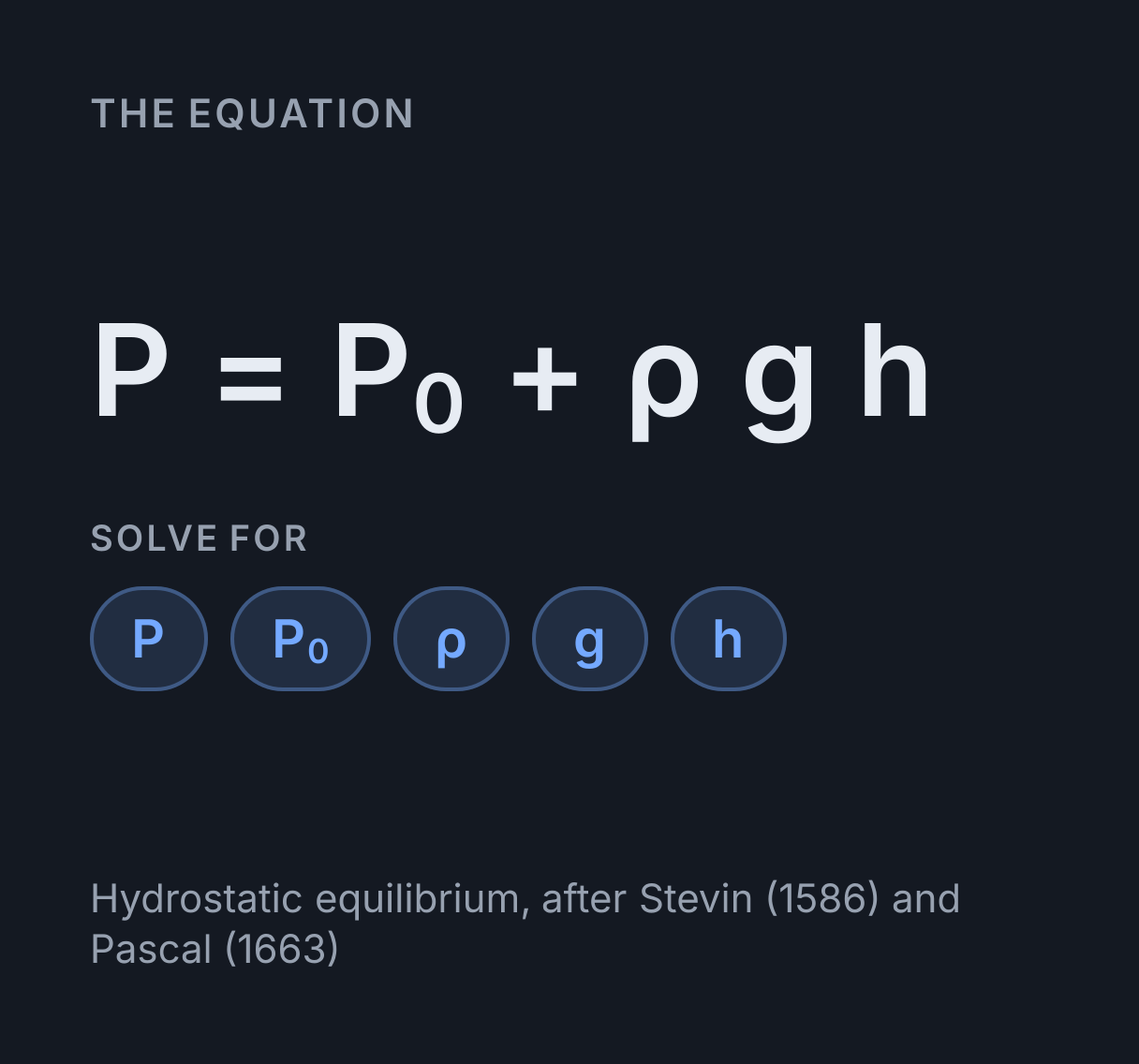
The equation
Hydrostatic equilibrium, after Stevin (1586) and Pascal (1663)
What is the hydrostatic pressure formula?
The hydrostatic pressure formula is P = P₀ + ρgh: the absolute pressure at a depth h (m) in a fluid at rest is the surface pressure P₀ plus the weight of the fluid above, ρgh, with density ρ in kg/m³ and g = 9.80665 m/s². With the surface open to the air, the gauge pressure is ρgh alone.
Where ρgh comes from
Picture a vertical column of the fluid of height h and cross section A,
with its top at the surface. It weighs ρAhg, and since it is not moving, the
pressure pushing up on its base must exceed the pressure pushing down on its top by exactly
enough to hold that weight: (P − P₀)A = ρAhg. The area cancels, which leaves
the formula and says something more: the pressure depends on how far below the surface a
point is and on nothing else, not the width of the container and not the amount of fluid
in it. Simon Stevin published that conclusion in 1586.
The calculator solves for the pressure at depth, the surface pressure, the density or the
depth, with g held at standard gravity unless you change it. AP Physics 1 problems
use 9.8 m/s², and entering that reproduces their answers. The readouts give the gauge
pressure in kPa and psi, the share the fluid adds, ρgh, and how fast pressure
rises with depth, ρg, which for fresh water at 1000 kg/m³ is 9.807 kPa/m, or
0.4335 psi per foot.
Absolute pressure for gas laws and diving
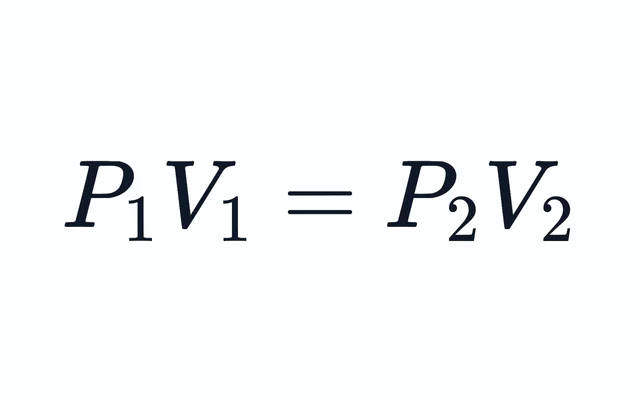
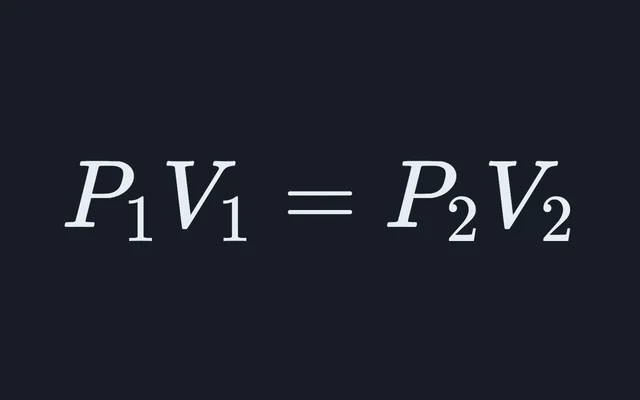
The absolute pressure is the one that acts on a gas. A diver’s lungs, or a bubble rising from the bottom, change volume with the absolute pressure around them, so air breathed in at about 10 m of depth, under roughly twice the surface pressure, expands to nearly twice its volume on the way up, which is why a scuba diver breathes out while rising. That is Boyle’s law, and it needs the absolute figure this calculator gives as its answer, not the gauge figure in the readouts.
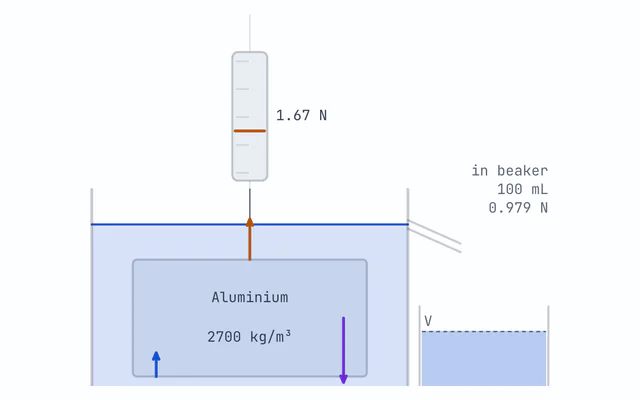
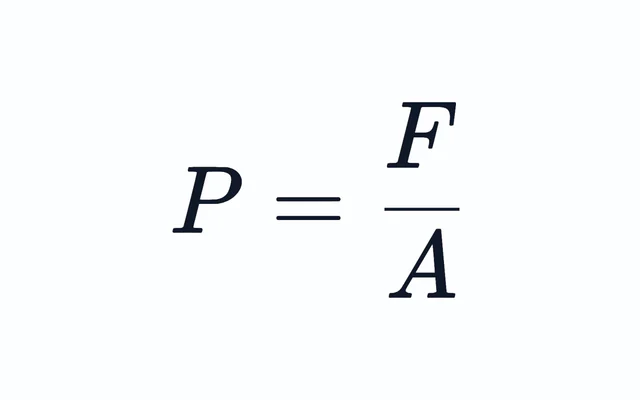
A pressure acting on an area makes a force, so the push of water on a submerged hatch or a dam is the pressure times the area, which the pressure calculator works out. The difference between the pressure on the bottom of a submerged object and on its top is the buoyant force, which the buoyancy simulator shows lifting a block hung from a spring balance.
Where the formula needs care
- Gases. The density of air falls with height, so one density gives a good answer only over a height small enough for the density to stay nearly constant. The calculator warns when the fluid is light enough to be a gas.
- Very deep water. Water is slightly compressible, about 0.45 percent denser for each 1,000 m of depth, so a surface density underestimates the pressure in the deep ocean. The calculator warns deeper than 1,000 m.
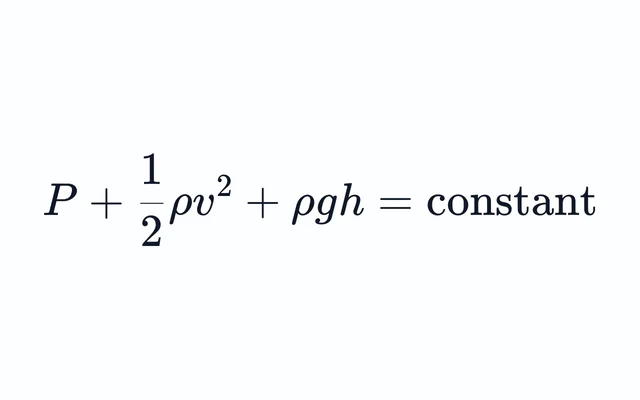
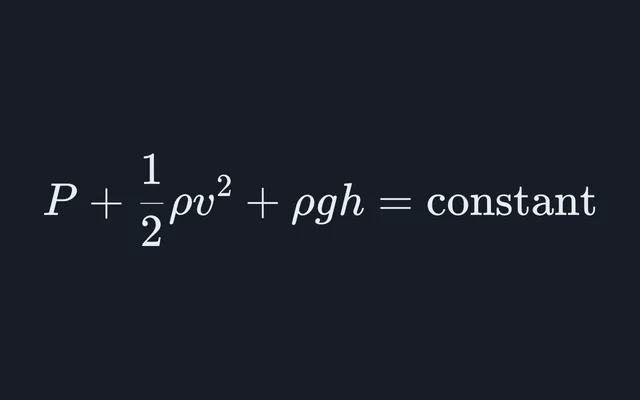
- Moving or accelerating fluid. The formula is for a fluid at rest. In a flowing pipe use the Bernoulli equation, which reduces to this one when both speeds are zero. In a container that is accelerating, such as a tank in an elevator, the effective g changes.
- Layers of different density. Oil floating on water, or fresh water over
brine, needs one
ρghterm per layer, added from the top down.
Common mistakes
- Putting gauge pressure into a gas law. Add the atmosphere back first. The answer field here is already absolute.
- Measuring along a slope. h is the vertical depth below the free surface. A point 10 m along a ramp inclined at 30° is only 5 m down.
- Leaving out the surface pressure. A sealed tank with gas above the liquid, or a lake at high altitude, does not have 1 atm at its surface. Enter the actual surface pressure, or 0 for a vacuum, as in a barometer tube.
- Density in the wrong unit. Water typed as 1 in a kg/m³ field makes
ρgha thousand times too small. Choose g/cm³ in the density menu, or enter 1000.
Converting units first? Use the pressure, length, acceleration and density conversion tables.
Constants used: Standard gravity (g₀).
How to calculate hydrostatic pressure at a depth
- Write down the formula:
P = P₀ + ρgh -
Gather the values it needs. The calculator above starts with these:
- Pressure at the surface: P₀ = 101.325 kPa
- Fluid density: ρ = 1000 kg/m³
- Gravitational acceleration: g = 9.80665 m/s²
- Depth below the surface: h = 10 m
-
Substitute them and work through the arithmetic:
- P = P0 + rho x g x h
- = 101,325 Pa + 1000 x 9.80665 x 10
- = 101,325 + 98,066.5 Pa
- = 199,391.5 Pa = 199.392 kPa
-
To find one of the other values instead, rearrange the formula for it:
- Pressure at the surface:
P₀ = P − ρgh - Fluid density:
ρ = (P − P₀) ÷ (gh) - Depth below the surface:
h = (P − P₀) ÷ (ρg)
- Pressure at the surface:
Worked examples
Each one runs through the calculator above, so the arithmetic here is the arithmetic it does.
What is the water pressure at the bottom of a 12 ft pool?
- P = P0 + rho x g x h
- = 101,325 Pa + 1000 x 9.80665 x 3.6576
- = 101,325 + 35,868.8 Pa
- = 137,193.8 Pa = 137.194 kPa
137.2 kPa absolute, 5.2 psi on a gauge. The 5.2 psi is the water alone, and it is what the eardrums feel, since the air behind them stays at surface pressure until the swimmer clears their ears. The other 14.7 psi is the atmosphere, pressing on the water and on the swimmer alike.
How deep can a diver go in seawater before the pressure reaches 3 atm?
- h = (P - P0) / (rho x g)
- = (303,975 - 101,325) / (1025 x 9.80665)
- = 202,650 / 10,051.8
- = 20.161 m
About 20.2 m, or 66 ft. Seawater adds an atmosphere every 10.08 m, the 33 ft divers learn, and the first atmosphere is the air above the surface, so 3 atm absolute is only two atmospheres of water.
What liquid density makes a 760 mm column balance one atmosphere?
- rho = (P - P0) / (g x h)
- = (101,325 - 0) / (9.80665 x 0.76)
- = 101,325 / 7.45305
- = 13,595 kg/m3
13,595 kg/m³, the density of mercury at 0 °C. The surface pressure is zero because the space above the mercury in a barometer tube is close to a vacuum, and a 760 mm column of mercury at that density is how the mmHg and the torr were tied to the standard atmosphere.
Practise this with Mechanics Practice Problems, questions generated from this calculator and 18 other calculators in Mechanics.
Common questions
What is the difference between psia and psig?
psia is absolute pressure in pounds per square inch, measured from a perfect vacuum, and psig is gauge pressure, measured from the atmosphere around the gauge. Under a standard atmosphere psia is psig plus 14.696, so a gauge reading 0 psig is at 14.696 psia. Gas laws, Boyle’s law for a diver among them, need psia.
How much does water pressure increase with depth?
In fresh water at 20 °C, 998 kg/m³, pressure rises 9.79 kPa/m, 0.433 psi per foot, or one atmosphere for every 10.35 m (34 ft). Seawater, at about 1025 kg/m³, adds an atmosphere every 10.08 m, the 33 ft divers count. The rise is the same for every step down, so pressure grows in equal steps rather than doubling.
Does the shape of a container change the pressure at the bottom?
No. The pressure at a depth depends only on the depth, the density and the surface pressure, so a narrow tube and a wide tank filled to the same height have the same pressure at the bottom, though the tank holds far more water. This is the hydrostatic paradox. The total force on the bottom does differ, because force is pressure times area.