Free Fall Calculator
Free fall time is t = √(2h/g) and impact speed v = √(2gh). Get both for any height, beside the answer with air resistance and the terminal velocity.
Calculator
Cd is about 0.47 for a smooth sphere, 1.28 for a flat plate face on and 0.295 for a bullet. A is the area of the shadow the object casts straight down.
| Quantity | No air | With air |
|---|---|---|
| Time to fall | 2.02 s | 2.941 s |
| Distance fallen | 20 m | 20 m |
| Impact speed | 19.81 m/s | 8.535 m/s |
| Impact speed, km/h | 71.3 | 30.73 |
- Terminal speed Where drag equals weight and the body stops speeding up: vt = √(2mg/(ρ Cd A)).
- 8.555 m/s
- Time to 99% of it The body never quite reaches terminal speed, so this is the usual stand-in for when it gets there.
- 2.309 s
- Distance to 99% of it Drops shorter than this end before the body is anywhere near terminal speed.
- 14.62 m
- Energy lost to drag The share of m g h that went into the air rather than into speed. The mass cancels.
- 81.4%
- No air
- With air
- Terminal speed
Working
- Without air, the only force is the weight, so the acceleration is g throughout.
- time to fall, no air = sqrt(2 x 20 / 9.8067) = 2.0196 s
- impact speed, no air = sqrt(2 x 9.8067 x 20) = 19.806 m/s
- With air, drag grows as v squared until it equals the weight, at the terminal speed.
- terminal speed = sqrt(2 x 0.0027 x 9.8067 / (1.225 x 0.47 x 0.0012566)) = 8.5553 m/s
- time to fall, with air = (8.5553 / 9.8067) x arcosh(exp(2.6797)) = 2.9414 s
- impact speed, with air = 8.5553 x sqrt(1 - exp(-2 x 2.6797)) = 8.5352 m/s
- With air the final speed is 43.1% of the vacuum speed, and drag took 81.4% of the potential energy released.
arcosh, tanh and ln cosh come from solving m dv/dt = mg − ½ρCdAv² exactly from rest. With no air they reduce to t = √(2h/g) and v = gt.
Citing this tool
Last updated . Add the date you accessed it as well, which a citation of a page that can change asks for. If a specific result matters, cite the permalink from the tool’s share row instead of this page: it reproduces the exact parameters.
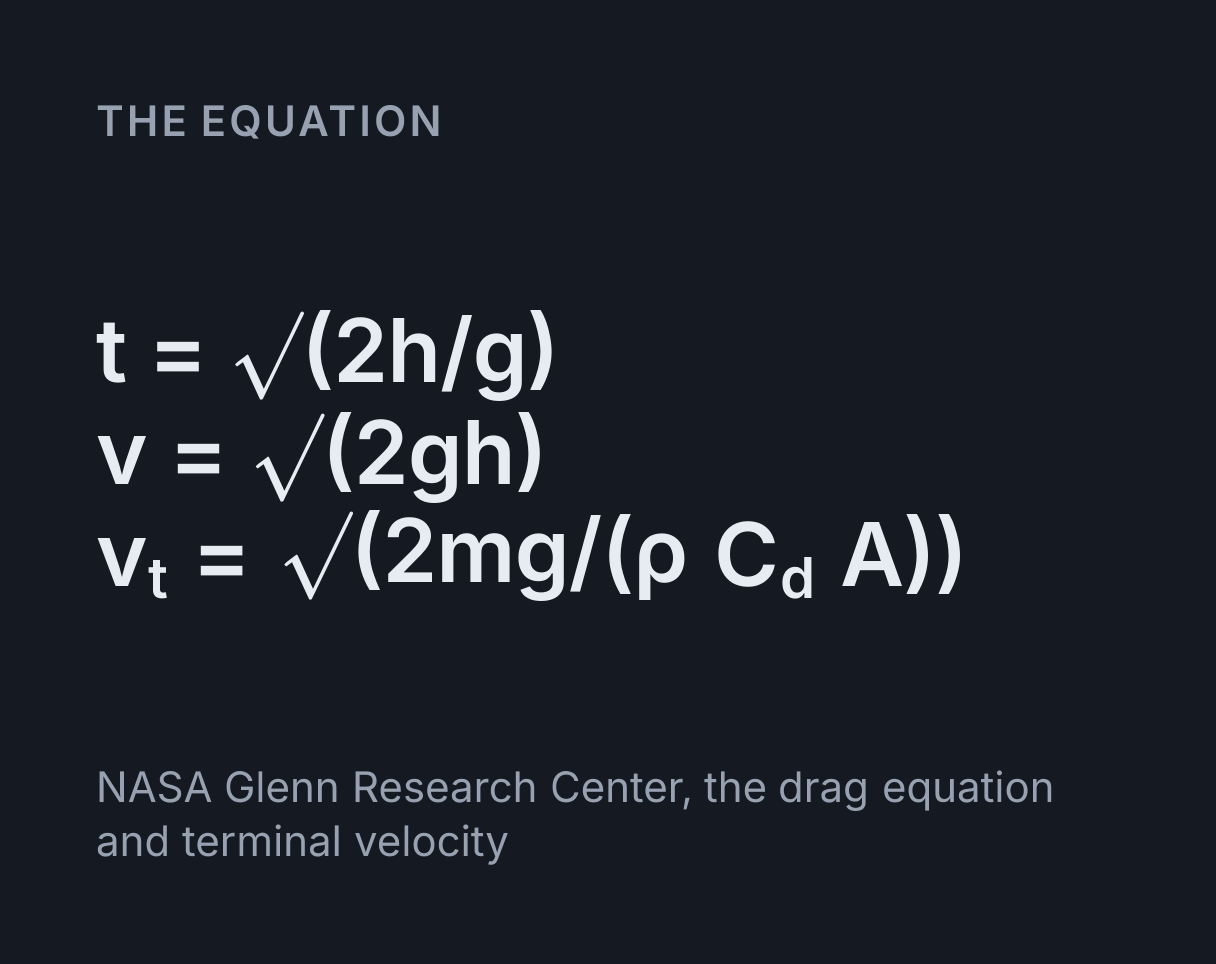
The equation
NASA Glenn Research Center, the drag equation and terminal velocity
How long does it take an object to fall?
Without air, an object dropped from rest falls a height h in t = √(2h/g) and hits
the ground at v = √(2gh), whatever its mass: from 20 m on Earth that is 2.02 s and
19.8 m/s. With air it takes longer and lands slower, because drag grows with speed until it
balances the weight at the terminal speed vt = √(2mg/(ρ Cd A)). This calculator
gives both answers side by side, so you can see how much the air matters for your object.
Choose whether you know the drop height or the time the object has been falling, pick Earth, the Moon or Mars, and choose an object or type its mass, drag coefficient and the area it presents to the air. The table gives the time, distance and final speed with no air and with air, the readouts give the terminal speed and how soon it is nearly reached, and the plot draws speed against time for both falls on the same axes.
The free fall equations with air resistance
Drag on a body moving through air is F = ½ ρ Cd A v², where ρ is the air density,
Cd the drag coefficient and A the cross-sectional area. Falling from rest, the equation of motion
is m dv/dt = mg − ½ ρ Cd A v², and setting the right-hand side to zero gives the
terminal speed. That equation has an exact solution, which is what this calculator uses:
- speed after time t:
v = vt tanh(gt/vt) - distance after time t:
h = (vt²/g) ln cosh(gt/vt) - time to fall a height h:
t = (vt/g) arcosh(e^(gh/vt²)) - speed after falling a height h:
v = vt √(1 − e^(−2gh/vt²))
For short times, tanh x ≈ x and the first line becomes v = gt, the
vacuum answer. For long ones tanh approaches 1 and the speed levels off at vt. The body never
quite gets there, so the calculator also reports the time and distance to reach 99% of it.
Worked example: a table tennis ball dropped from 20 m
A table tennis ball is 40 mm across and 2.7 g. Its area is π × 0.02² = 0.0012566 m²,
and taking Cd = 0.47 for a smooth sphere in sea-level air of 1.225 kg/m³:
-
terminal speed:
vt = √(2 × 0.0027 × 9.80665 / (1.225 × 0.47 × 0.0012566)) = 8.555 m/s -
time to fall 20 m:
gh/vt² = 9.80665 × 20 / 8.555² = 2.680, sot = (8.555 / 9.80665) × arcosh(e^2.680) = 2.941 s - impact speed:
v = 8.555 × √(1 − e^(−5.359)) = 8.535 m/s
In a vacuum the same drop takes 2.020 s and ends at 19.81 m/s. The air adds almost a second and takes away more than half the speed, and 81.4% of the potential energy the ball gives up goes into the air rather than into motion. The ball is at 99% of its terminal speed after 2.309 s and 14.62 m, so for most of the last few metres it is barely speeding up at all.
Worked example: a steel ball dropped from 100 m
A steel ball 50 mm across, at 7850 kg/m³, has a mass of 0.514 kg and the same Cd. Its terminal speed is 94.41 m/s, eleven times the table tennis ball’s, because it has far more weight for the area the air pushes on. From 100 m it lands after 4.599 s at 41.96 m/s, against 4.516 s and 44.29 m/s in a vacuum: the fall takes under 2% longer. That is why the vacuum answer is good enough for a dense, compact object over a short drop, and why it fails badly for a light one.
Free fall on the Moon and Mars
Surface gravity is 1.62 m/s² on the Moon and 3.73 m/s² on Mars, from the NASA planetary fact sheets. The Moon has no air to speak of, so the vacuum answer is the whole answer: a 20 m drop takes 4.969 s and ends at 8.050 m/s, which is why the Apollo 15 hammer and feather landed together. Mars has an atmosphere about 1.3% as dense as Earth’s at sea level, 0.016 kg/m³, and it still matters for a light object. The table tennis ball’s terminal speed there is 46.17 m/s, so a 20 m drop takes 3.294 s against 3.275 s in a vacuum.
What this does not cover
- Changing air and gravity. ρ and g are held constant. Near Earth, g is 0.3% lower 10 km up and the air there is about a third as dense, so the calculator warns past a 10 km fall.
- A drag coefficient that changes. Cd is taken as fixed. For a sphere it is close to 0.47 only over a middle range of speeds; a heavy ball falling fast enough can pass the drag crisis, where Cd drops sharply, and above about 100 m/s the air begins to compress.
- A thrown start. The object starts from rest. For an object thrown upwards or sideways, use the kinematics calculator (no air) or the projectile motion simulator.
- Tumbling and changing shape. A falling person, a leaf or a sheet of paper changes the area it presents as it falls, so no single Cd times A describes it.
Common mistakes
- Expecting heavier objects to fall faster in a vacuum. They do not: t and v contain no mass. With air they do, because mass appears in the terminal speed.
- Using the diameter for A. A is an area. For a ball it is πr², the area of its shadow, not its diameter or its surface area.
- Grams in a formula that wants kilograms. The terminal speed uses m in kg. A 2.7 g ball typed as 2.7 has a terminal speed about 32 times too high.
- Treating terminal speed as reached at once. The speed approaches it gradually; in the first worked example the ball needs 14.6 m to get within 1% of it.
For the energy side of the same drop, where the vacuum impact speed comes from setting mgh equal
to ½mv², see the gravitational
potential energy calculator. The weight and the net force behind each curve are
F = ma problems for the Newton’s
second law calculator.
Common questions
How do you calculate free fall time?
With t = √(2h/g) when air resistance can be ignored, where h is the height and g is 9.80665 m/s² on Earth, so a 20 m drop takes √(40/9.80665) = 2.02 s. With air resistance the time is t = (vt/g) arcosh(e^(gh/vt²)), which is always longer: a table tennis ball dropped from the same height takes 2.94 s.
What is terminal velocity?
The speed at which drag equals weight, so a falling object stops accelerating. With drag growing as the square of speed it is vt = √(2mg/(ρ Cd A)). A table tennis ball’s is about 8.6 m/s in sea-level air and it is within 1% of it after 15 m; a 50 mm steel ball’s is 94 m/s, which, with its drag coefficient held at 0.47, it only gets within 1% of after about 1.8 km.
Do heavier objects fall faster?
Not in a vacuum, where every object falls with acceleration g and the time √(2h/g) contains no mass. In air they can, because for a given shape and size the terminal speed grows with the square root of the mass: a 50 mm steel ball and a 40 mm table tennis ball dropped 20 m land about 0.9 s apart.
How fast does something hit the ground after falling?
At v = √(2gh) if air resistance is negligible, which is 19.8 m/s, or 71 km/h, after a 20 m drop on Earth. Air lowers it towards the terminal speed and never above it. The calculator gives both figures and the share of the potential energy that drag took.
Is g the same on the Moon and Mars?
No. Surface gravity is 1.62 m/s² on the Moon and 3.73 m/s² on Mars in NASA’s planetary fact sheets, against a standard 9.80665 m/s² on Earth. In a vacuum a 20 m drop takes 4.97 s on the Moon and 3.27 s on Mars, and the Moon has no air to slow anything down.