Water Potential Calculator
Water potential calculator: ψs = −iCRT and ψ = ψs + ψp for a cell in a beaker, which way water moves, and whether it ends turgid, flaccid or plasmolysed.
Calculator
- Water moves Water moves from the higher water potential to the lower: the solution is at −2.435 bar and the cell at −4.304 bar.
- Into the cell
- Cell ends up The solution’s ψ is above the cell’s ψs, so water moves until the wall pushes back with ψp = ψ(solution) − ψs(cell).
- Turgid
- Solution ψ ψ = ψs + ψp, and an open beaker has ψp = 0, so this is the solute potential, −iCRT.
- −2.435 bar
- Cell ψ ψ = ψs + ψp: the cell’s solute potential plus its pressure potential, before any water moves.
- −4.304 bar
- Cell ψs ψs = −iCRT for the cell sap, before any water moves.
- −7.304 bar
- Final ψp The pressure potential once water stops moving: ψ(solution) − ψs(cell) when that is positive, and 0 otherwise.
- 4.87 bar
Working
- T = 20 + 273 = 293 K
- Solution ψs = −iCRT = −(1)(0.1)(0.0831)(293) = −2.4348 bar
- The beaker is open to the air, so the solution’s ψp is 0.
- Solution ψ = ψs + ψp = −2.4348 + 0 = −2.4348 bar
- Cell ψs = −iCRT = −(1)(0.3)(0.0831)(293) = −7.3045 bar
- Cell ψ = ψs + ψp = −7.3045 + 3 = −4.3045 bar
- ψ(solution) − ψ(cell) = −2.4348 − (−4.3045) = 1.8697 bar
- Positive, so water moves into the cell: from the higher water potential to the lower.
- Water stops moving once the cell’s ψ equals the solution’s. Taking the wall as rigid, the cell’s ψs stays at −7.3045 bar and ψp makes up the difference.
- Final ψp = ψ(solution) − ψs(cell) = −2.4348 − (−7.3045) = 4.8697 bar
- That is above 0, so the cell ends up turgid.
Potentials in bar, with R = 0.0831 L bar/(mol K) and T = °C + 273, as on the AP Biology equation sheet.
Citing this tool
Last updated . Add the date you accessed it as well, which a citation of a page that can change asks for. If a specific result matters, cite the permalink from the tool’s share row instead of this page: it reproduces the exact parameters.
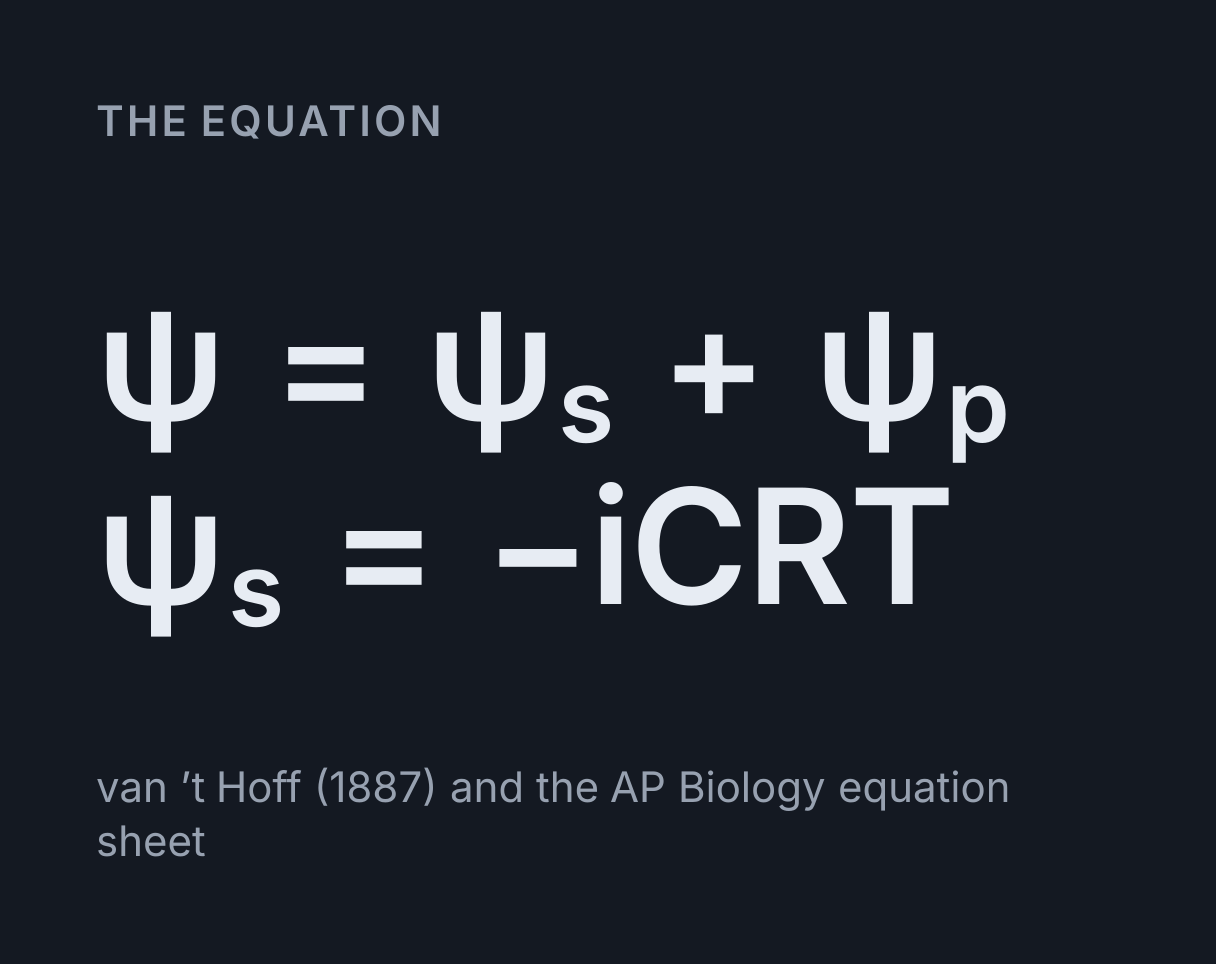
The equation
van ’t Hoff (1887) and the AP Biology equation sheet
What is water potential and how do you calculate it?
Water potential, ψ, is the potential energy of water per unit volume, compared with pure water
at the same temperature and atmospheric pressure, so it is measured as a pressure. The net
movement of water is always from a higher water potential to a lower one. It has two parts,
ψ = ψs + ψp. The solute potential, ψs, comes from dissolved particles and is
worked out with ψs = −iCRT. The pressure potential, ψp, is the push of a cell wall
on the water inside, and it is zero in an open beaker. Pure water at atmospheric pressure is the
zero of the scale, so every solution in an open beaker has a negative water potential, and a
higher water potential means a less negative one.
In ψs = −iCRT, i is the ionisation constant, the number of particles each formula
unit gives in water; C is the molar concentration in mol/L; R is the pressure constant,
0.0831 L bar/(mol K); and T is the temperature in kelvin, °C + 273.
These are the constants on the AP Biology equation sheet, which writes the same equations with a
capital psi, as Ψ = ΨP + ΨS and ΨS = −iCRT. The equation itself is van ’t Hoff’s law for osmotic
pressure, from 1887, with a minus sign in front.
Using the calculator
Set up the beaker and the cell, and the readouts, diagram and working update together. For each, pick a solute and its concentration, or pick Enter ψs directly when a question gives a solute potential instead. The cell’s pressure potential is 0 for a flaccid cell and positive for a turgid one. The beaker is open to the air, so its pressure potential is fixed at 0, and the temperature slider goes away once both solute potentials are typed in, because temperature only enters through −iCRT.
The diagram draws the cell as it ends up, with arrows for the net movement of water across its
membrane: inwards, outwards, or both ways when the two water potentials are equal. The pressure
unit can be bar, kPa or MPa, and R changes with it, to 8.31 L kPa/(mol K) or
0.00831 L MPa/(mol K), so the working stays in one unit throughout. To watch water
cross a membrane rather than work out where it ends up, try the
diffusion and osmosis simulator.
Worked example: a turgid cell in 0.1 M sucrose at 20 °C
The calculator opens on a plant cell whose sap matches 0.3 mol/L sucrose and whose wall is already pushing back at 3 bar, in a beaker of 0.1 mol/L sucrose at 20 °C.
- Temperature:
T = 20 + 273 = 293 K. -
Solution:
ψs = −(1)(0.1)(0.0831)(293) = −2.435 bar. The beaker is open, soψp = 0and the solution’sψ = −2.435 bar. - Cell sap:
ψs = −(1)(0.3)(0.0831)(293) = −7.304 bar. - Cell:
ψ = −7.304 + 3 = −4.304 bar. - Direction: −2.435 bar is higher than −4.304 bar, so the net movement of water is into the cell.
-
End state: water stops moving once the cell’s ψ reaches the solution’s. Taking the wall as
rigid, ψs stays at −7.304 bar, so
ψp = −2.435 − (−7.304) = 4.87 bar. That is above zero, so the cell ends up turgid, pressing on its wall harder than before.
Now raise the beaker’s concentration. At 0.18 mol/L its water potential is −4.383 bar, just below the cell’s −4.304 bar, and the arrows turn outwards: the cell loses water but stays turgid, because the solution is still above its solute potential. At 0.3 mol/L the solution matches the cell’s solute potential and the cell ends exactly flaccid, and from 0.31 mol/L up it plasmolyses.
Turgid, flaccid and plasmolysed
Which way water moves depends on the cell’s whole water potential, ψs + ψp. Where the cell ends up depends on how the solution compares with the cell’s solute potential alone, because water keeps moving until the two water potentials match, and a wall can push on the protoplast but cannot pull.
- Turgid. If the solution’s ψ is above the cell’s ψs, the cell matches it with
pressure, ending at
ψp = ψ(solution) − ψs(cell). In pure water its ψ rises all the way to 0 and it is fully turgid, with ψp equal to −ψs. - Flaccid. If the solution’s ψ equals the cell’s ψs, the cell ends with ψp at 0: the membrane touches the wall without pressing on it. This point is called incipient plasmolysis.
- Plasmolysed. If the solution’s ψ is below the cell’s ψs, ψp falls to 0 and the protoplast keeps losing water, shrinking away from the wall until its own ψs falls to the solution’s ψ. The gap fills with the outside solution, which passes straight through the wall.
An animal cell has no wall, so its ψp stays close to zero. In a solution of higher water potential it keeps taking in water until it bursts, which is why red blood cells burst in pure water, and in a solution of lower water potential it shrinks.
Checking against the AP Biology example
A classic AP Biology example is a 1.0 M sucrose solution at 22 °C:
ψs = −(1)(1.0)(0.0831)(295) = −24.5 bar. Set the beaker to 1 mol/L and 22 °C and
the readout gives −24.51 bar, which is −2451 kPa or −2.451 MPa, since 1 bar is exactly
100 kPa.
The potato-core practical runs the equation the other way. Cores are weighed, left in a range of sucrose solutions and weighed again, and the concentration at which their mass would not change is read off a graph. That solution has the same water potential as the potato tissue, so −iCRT at that concentration gives the tissue’s water potential. The molarity calculator gives the mass of sucrose to weigh out for each solution, and the ionisation constant is the same van ’t Hoff factor that the freezing point depression calculator uses.
The same counting of particles applies to blood, where it is measured in mOsm/kg and the
serum osmolality calculator works it out from
sodium, glucose and urea. Taking plasma at about 290 mOsm/kg as 0.29 mol/L of particles at
37 °C, its solute potential is −(0.29)(0.0831)(310) = −7.47 bar.
What this model leaves out
- Solutions that are not ideal. −iCRT is van ’t Hoff’s law for dilute solutions. Concentrated sucrose has a more negative water potential than it predicts, so measured tables for sucrose run more negative than this calculator at high concentrations.
- Salts that do not split completely. i = 2 for NaCl treats every formula unit as two independent particles. The ions interact, and the measured osmotic coefficient of 0.1 mol/kg NaCl at 25 °C, 0.932, puts its effective value nearer 1.9.
- Dilution of the sap. Water that enters a cell dilutes its sap a little, so the true final ψp is lower than ψ(solution) − ψs(cell), by an amount that depends on how far the wall stretches. The calculator, like most textbook questions, treats the wall as rigid.
- A beaker that never changes. The solution is taken as large enough that the water the cell gains or loses does not change its concentration.
- Matric and gravity terms. Water held on surfaces, as in soil or in cell walls, adds a matric potential, and the height of a tall plant adds a gravitational one. Neither matters for a cell in a beaker.
- Rounded constants. R is
0.08314 L bar/(mol K)to four figures, and 0 °C is 273.15 K. The AP values used here make every answer about 0.1 percent less negative.
Common mistakes
- Losing the minus sign. A solute potential is never positive, since dissolving anything lowers water potential. A positive ψs means a sign went missing.
- Leaving T in degrees Celsius. At 20 °C, using 20 in place of 293 gives
−(1)(0.1)(0.0831)(20) = −0.166 barinstead of −2.435 bar. - Forgetting i for a salt. 0.1 mol/L NaCl has a solute potential twice as negative as 0.1 mol/L sucrose, because each formula unit becomes two ions.
- Taking higher to mean a bigger number. −2 bar is higher than −5 bar, and water moves towards the more negative value.
- Comparing solute potentials instead of water potentials. Pressure raises a turgid cell’s water potential, so a cell can lose water to a solution more dilute than its own sap. In the opening example, a 0.2 mol/L beaker, at −4.87 bar, draws water out of the cell at −4.304 bar, although the cell’s sap matches 0.3 mol/L.
- Mixing units. 1 bar is 100 kPa, not 1000, and a ψs in bar cannot be added to a ψp in kPa until one of them is converted.
Common questions
How do you calculate water potential?
Add the solute potential and the pressure potential: ψ = ψs + ψp. Work out the solute potential first with ψs = −iCRT, using R = 0.0831 L bar/(mol K) and the temperature in kelvin, then add the pressure potential, which is 0 for a solution in an open beaker. For 0.1 mol/L sucrose at 20 °C, ψs = −(1)(0.1)(0.0831)(293) = −2.43 bar, so its water potential is −2.43 bar. A plant cell with ψs = −7.30 bar and ψp = 3 bar has ψ = −7.30 + 3 = −4.30 bar, so water moves from that solution into the cell.
What is the formula for solute potential?
ψs = −iCRT. Here i is the ionisation constant, 1 for sucrose or glucose, which stay whole in water, and 2 for NaCl, which splits into Na⁺ and Cl⁻; C is the molar concentration in mol/L; R is the pressure constant, 0.0831 L bar/(mol K); and T is the temperature in kelvin, °C + 273. A 1.0 mol/L sucrose solution at 22 °C has ψs = −(1)(1.0)(0.0831)(295) = −24.5 bar. The minus sign is there because dissolved solute always lowers water potential below that of pure water, which is 0.
Which way does water move between a cell and a solution?
From the higher water potential to the lower one, which means towards the more negative value. In a classic AP Biology question, root tissue with a water potential of −3.3 bar is put in 0.1 mol/L sucrose at 20 °C in an open beaker. The solution’s water potential is −(1)(0.1)(0.0831)(293) = −2.43 bar, which is higher than −3.3 bar, so the net movement of water is into the root tissue. Water molecules cross the membrane both ways all the time; the direction of osmosis is the difference between the two flows.
Is osmotic potential the same as solute potential?
Yes. Osmotic potential and solute potential are two names for the same term, ψs, which some books write as ψπ. It is the osmotic pressure with a minus sign: 0.1 mol/L sucrose at 20 °C has an osmotic pressure of 2.43 bar and a solute potential of −2.43 bar. The osmotic pressure is the pressure that would have to be applied to the solution to stop pure water crossing a membrane into it.
What do turgid, flaccid and plasmolysed mean?
They describe how a plant cell’s protoplast sits against its wall. A turgid cell has a positive pressure potential, with its membrane pressed against the wall. A flaccid cell has a pressure potential of 0, with the membrane touching the wall but not pressing on it. A plasmolysed cell has lost so much water that the protoplast has pulled away from the wall. A cell put in a solution ends up turgid if the solution’s water potential is above the cell’s solute potential, flaccid if the two are equal, and plasmolysed if it is below.
Why does 0.1 M NaCl have a lower water potential than 0.1 M sucrose?
Because solute potential depends on the number of dissolved particles, not the number of formula units. Each NaCl gives two ions, so i = 2, while sucrose stays whole, so i = 1. At 25 °C, 0.1 mol/L sucrose has ψs = −(1)(0.1)(0.0831)(298) = −2.48 bar and 0.1 mol/L NaCl has ψs = −(2)(0.1)(0.0831)(298) = −4.95 bar, twice as negative. Real NaCl falls a little short of double, because its ions do not behave as fully independent particles.