Mass Spring Simulator
Oscillate a mass on a spring with adjustable stiffness, damping and driving force. See the three damping regimes and a real resonance curve with its peak.
Simulator
Drag the block to set where it is released, or move it with the up and down arrow keys. Space plays and pauses.
- Natural period T = 2π√(m/k). Independent of amplitude, and unchanged by gravity.
- 0.9935 s
- Natural frequency
- 1.007 Hz
- Damping regime Set by the damping ratio: below 1 it oscillates, at 1 it returns fastest without overshooting, above 1 it crawls back.
- Undamped
- Damping ratio ζ Critical damping for this mass and spring is 6.325 kg/s.
- 0
- Static extension How far gravity stretches the spring before it oscillates. This is how a lab measures k.
- 0.2453 m
- Displacement
- 0 m
- Displacement (m)
Citing this tool
Last updated . Add the date you accessed it as well, which a citation of a page that can change asks for. If a specific result matters, cite the permalink from the tool’s share row instead of this page: it reproduces the exact parameters.
The equation
Hooke’s law (1678) with simple harmonic motion
Why the period ignores how far you pull it
A spring pulls back in proportion to how far it is stretched, F = −kx.
Pull the mass twice as far and the restoring force doubles, so it accelerates twice as
hard and covers twice the distance in the same time. The amplitude cancels, leaving
T = 2π√(m/k), which contains no amplitude term at all.
That proportionality is the definition of simple harmonic motion, and it is exactly
what a pendulum lacks. A pendulum’s restoring force goes as sin θ, which
is only proportional to θ while θ is small, which is why its period does creep up with
amplitude. Run the pendulum simulator at
90° and the two behave visibly differently.
Gravity moves the middle, not the timing
Hang the mass on and the spring stretches by mg/k before anything
oscillates. For 0.5 kg on a 20 N/m spring that is 24.5 cm. It is tempting to think this
changes the motion, and it does not: substitute x = mg/k + u into the
equation of motion and the mg term cancels exactly, leaving the same
equation in u. The mass oscillates about the new equilibrium with the same
period it would have on a frictionless horizontal table.
This is why every displacement here is measured from equilibrium rather than from the
unstretched spring, and why gravity appears in only one place: the static extension
readout. That extension is not a footnote either, it is the standard way to measure a
spring constant. Hang a known mass, measure how far it drops, and
k = mg/e.
The three damping regimes, and the surprise
Add a resistance proportional to velocity and everything depends on how it compares
with one particular value, the critical damping 2√(km). The ratio of the
two is the damping ratio ζ.
- Underdamped, ζ < 1. Still oscillates, with the amplitude decaying
as
e^(−ζω₀t). The period is slightly longer than the undamped one, by a factor1/√(1 − ζ²). - Critically damped, ζ = 1. Returns to equilibrium as quickly as possible without ever crossing it. This is what a door closer and a car suspension aim for.
- Overdamped, ζ > 1. Returns more slowly than critical. This is the part that catches people out: past the critical value, adding damping makes the return take longer, not shorter. Set the damping to three times critical and watch it crawl.
The boundary is sharp and the readouts name the critical value for whatever mass and spring you have chosen, so you can drive the damping to it and watch the last oscillation disappear.
Resonance, and why it does not peak at the natural frequency
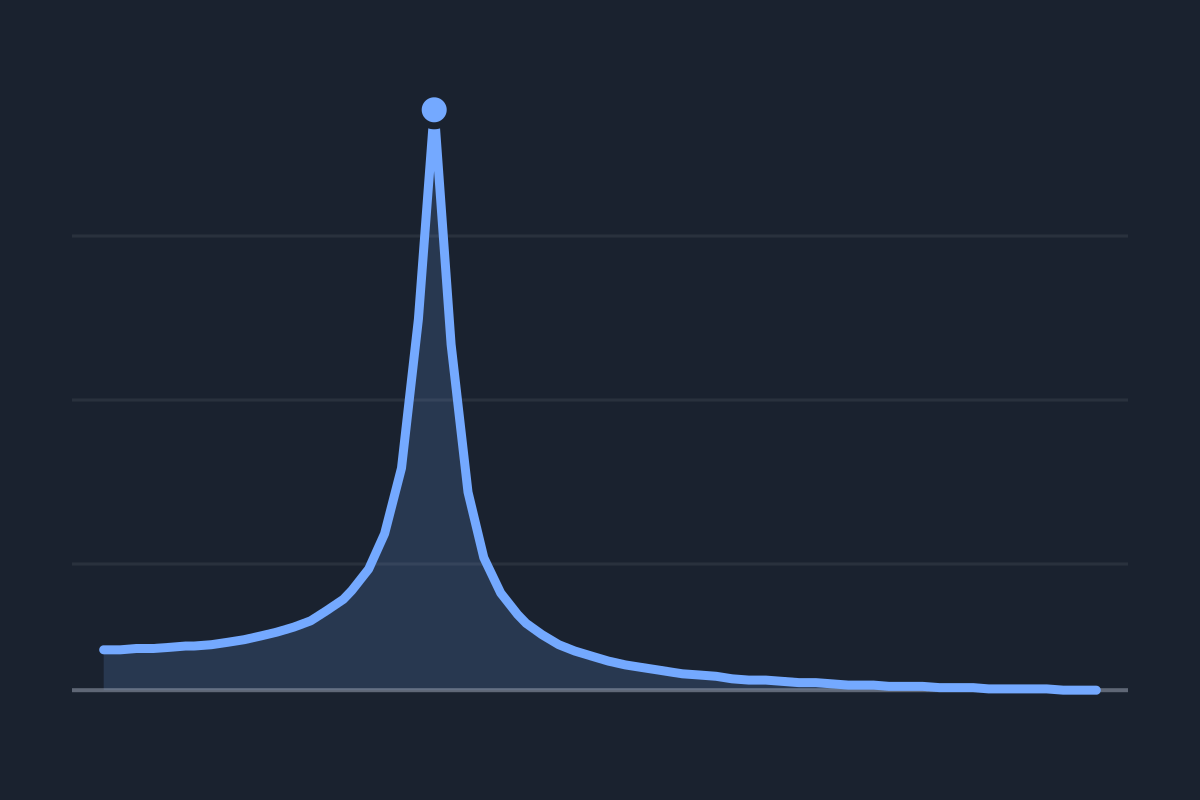
Turn the driving force above zero and a second plot appears: steady-state amplitude
against driving frequency. The peak is resonance, and its position is
f₀√(1 − 2ζ²), which is always below the natural frequency
f₀. With light damping the difference is negligible and calling the peak
f₀ is harmless. At ζ = 0.3 it is already 9 percent low.
Past ζ = 1/√2 ≈ 0.707 the peak vanishes entirely and the response falls
away monotonically from its value at zero frequency. There is no resonance to find. That
threshold is the whole design goal of a well-damped instrument: a moving-coil meter
needle that resonated would be useless.
With no damping at all and driving exactly at resonance, the amplitude grows without limit. The curve here leaves a gap at that frequency rather than capping it at some invented ceiling, because a finite peak would teach that resonance has a maximum.
Where this model stops describing reality
Three assumptions, all of them reasonable and all of them breakable. The spring obeys
Hooke’s law, which holds up to its limit of proportionality; stretched past its elastic
limit, which comes at or after that, it deforms permanently. The damping is proportional
to velocity, which describes a body moving slowly through a fluid and not dry friction,
where the force is roughly constant and the amplitude decays linearly rather than
exponentially. And the spring itself is
massless, which stops being true when the spring weighs a noticeable fraction of the
load; the usual correction is to add a third of the spring’s mass to m.
Common mistakes
- Using the extended length instead of the extension. In
k = mg/e, e is how much longer the spring got, not how long it is. - Expecting a heavier mass to oscillate faster. It oscillates slower.
Period goes as
√m, so four times the mass doubles the period. - Thinking more damping always settles things sooner. Broadly true well below critical, but the quickest settling to within 2 percent comes a little under it, at ζ around 0.8, and past critical more damping only slows it.
- Quoting the natural frequency as the resonant frequency. Fine for light damping, wrong by a measurable margin otherwise.
- Mixing grams with newtons per metre. A mass of 500 g with k in N/m gives a period out by a factor of √1000, about 32.
- Comparing a driven amplitude before the transient has died. The steady-state figure is what the formula predicts, and it takes a few time constants to get there.
Model and assumptions
- Method
- Runge-Kutta 4th order
- Largest step
- 0.002 s
- Repeatability
- Deterministic. The same link gives the same numbers on any machine.
What it assumes
- Hooke’s law is exact, so the restoring force is strictly proportional to displacement at any amplitude.
- Displacement is measured from the equilibrium position, not from the unstretched length, which is what removes gravity from the equation.
- Damping is viscous and linear in velocity, and the drive is a pure cosine.
Where it stops holding. A real spring stiffens or softens away from equilibrium, and dry friction does not scale with velocity.
Numerical accuracy
- Estimated error
- 1.0e-9 m in the displacement, about 1.3e-8 of the largest value reached
- How that was obtained
- Running the same problem again at half the step changed the answer by at most 9.8e-10 m over 10 s, about ten cycles. Richardson extrapolation of that difference gives the figure above.
- Observed order
- 4.00, measured from a second halving rather than assumed
- Conditions
- 0.5 kg, 20 N/m, 80 mm release, undriven and undamped, the shipped defaults
Common questions
Does gravity change the period of a vertical spring?
No. Gravity stretches the spring to a new equilibrium, by mg/k, and the oscillation then happens about that point with exactly the period T = 2π√(m/k) it would have horizontally. Substituting x = mg/k + u into the equation of motion cancels the gravity term completely. That static extension is worth measuring for its own sake, since it is how a lab finds k, and it is reported here for that reason.
What are the three damping regimes?
They are separated by the critical damping value, 2√(km). Below it the system is underdamped and oscillates with a decaying amplitude. Exactly at it the system is critically damped and returns to equilibrium as fast as possible without ever crossing it. Above it the system is overdamped and returns more slowly than critical, which is the counterintuitive part: adding damping past critical makes the return take longer, not shorter.
Is the resonant frequency the same as the natural frequency?
Only when there is no damping. The amplitude peaks at f₀√(1 − 2ζ²), which is always below the natural frequency f₀, and once the damping ratio ζ passes 1/√2, about 0.707, the response has no peak at all and simply falls away from its value at zero frequency. Quoting f₀ as the resonant frequency is a common shortcut and it is wrong for anything noticeably damped.
Why does the period not depend on how far I pull it?
Because the restoring force is proportional to the displacement. For simple harmonic motion that proportionality makes the period independent of amplitude: pull it twice as far and it moves twice as fast, covering twice the distance in the same time. That is exactly what fails for a pendulum at large angles, where the restoring force stops being proportional to the displacement.