Snell’s Law Calculator
Apply Snell’s law to find the refraction angle between two media, with the critical angle for total internal reflection and a warning when no ray refracts.
Calculator
Vacuum 1, air 1.0003, water 1.333, crown glass 1.52, diamond 2.417.
Measured from the normal, not from the surface.
Working, with your numbers
- n1 sin(t1) = n2 sin(t2)
- sin(t2) = 1 x sin(30 deg) / 1.333
- sin(t2) = 0.37509
- t2 = 22.03 deg
Values are converted into the units the equation is worked in before the arithmetic.
- Critical angle Only exists when travelling into a less dense medium.
- n/a
- Speed in medium 2
- 224.9 ×10⁶ m/s
- Bends
- Toward normal
Citing this tool
Last updated . Add the date you accessed it as well, which a citation of a page that can change asks for. If a specific result matters, cite the permalink from the tool’s share row instead of this page: it reproduces the exact parameters.
The equation
Snell (1621), published by Descartes (1637)
What refractive index actually measures
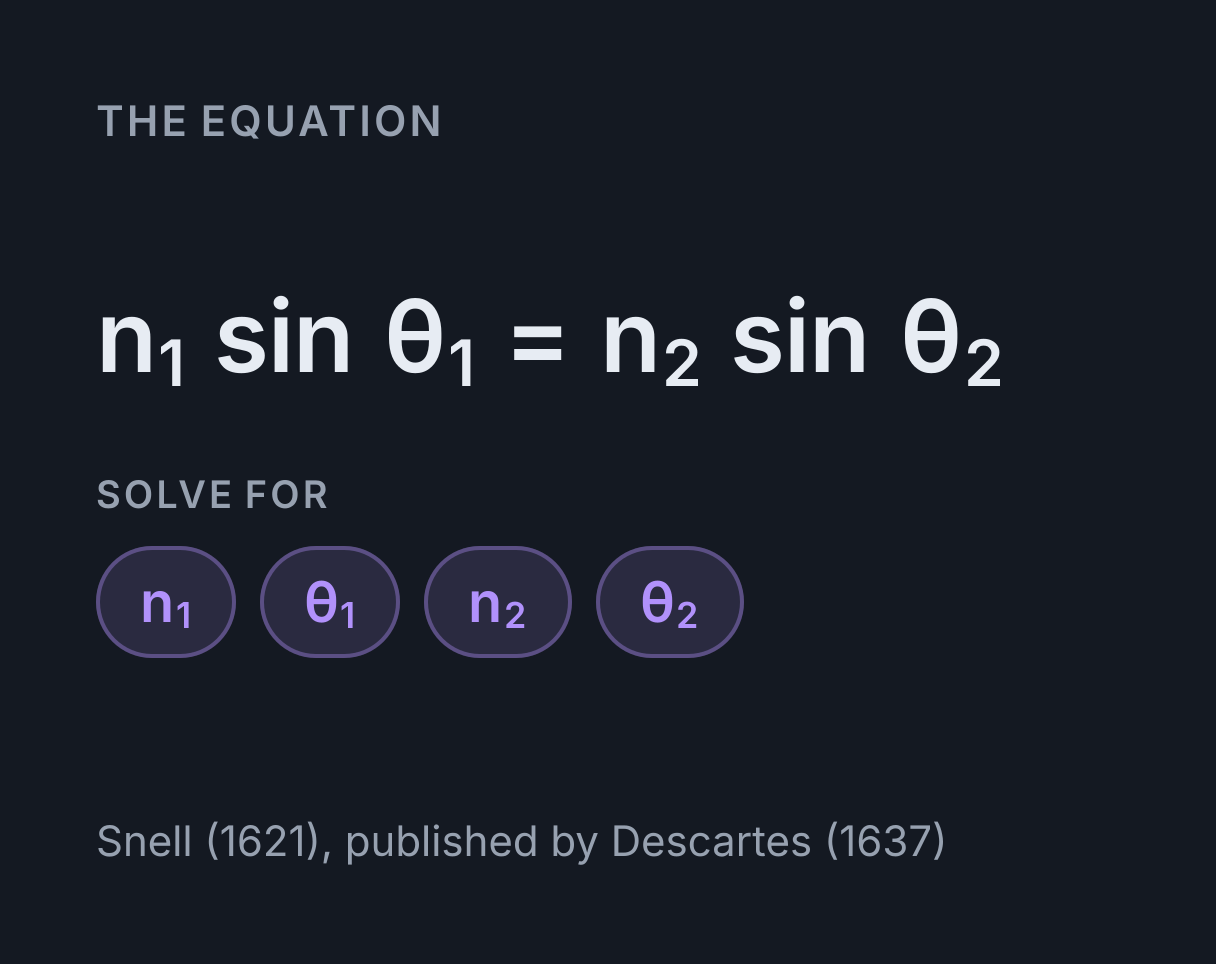
Snell’s law, n₁ sin θ₁ = n₂ sin θ₂, relates the angle of
incidence θ₁ and the angle of refraction θ₂, both
measured from the normal, to the refractive indices n₁ and
n₂ of the two media. Light travels at c in vacuum
and more slowly in matter. The
refractive index is just the
ratio of those two speeds, so
n = 1.52 for crown glass means light crawls through it at
197 million metres per second instead of 300 million. Snell’s law follows
from that slowdown. When a wavefront meets a boundary at an angle, the edge
that crosses first slows first, and the whole front pivots. A marching band
turns the same way when the players on one side shorten their stride.
Because the bending depends only on the ratio of the two indices, the
relation is symmetric: n₁ sin θ₁ = n₂ sin θ₂. Going into a
denser medium bends the ray toward the normal. Coming out of one bends it
away by exactly the same amount, which is why a lens works identically in
either direction and why a ray traced backwards retraces its own path.
Worked example
A laser in air strikes a crown glass block at 40° from the normal. Where does the beam go inside the glass?
- Air is
n₁ = 1.000, crown glass isn₂ = 1.52. sin θ₂ = n₁ sin θ₁ / n₂ = 1.000 × 0.6428 / 1.52sin θ₂ = 0.4229, soθ₂ = 25.0°
The beam has bent 15 degrees toward the normal. Send the same ray back out of the glass at 25.0° and it emerges into the air at 40° again.
The critical angle and total internal reflection
Going the other way, from dense to less dense, there is a limit. As the angle of incidence grows, the refracted ray swings further from the normal until it lies flat along the boundary. Past that point there is no refracted ray at all and the surface behaves as a perfect mirror. The threshold is θc = arcsin(n₂/n₁): 48.6° for water into air, 41.1° for crown glass into air, and only 24.4° for diamond, which is why cut diamonds bounce light around so many times before releasing it.
Optical fibre is the same effect made useful. Light entering the core at a shallow enough angle can never escape through the cladding, so it zigzags down kilometres of glass with almost no loss. Ask this calculator for the refraction angle beyond the critical angle and it tells you no solution exists rather than returning a meaningless number.
Common mistakes
- Measuring from the surface. Angles in Snell’s law are measured from the normal. A ray described as hitting glass at 20° to the surface has an angle of incidence of 70°. This single confusion accounts for most wrong answers in refraction problems.
- Using the ratio of the angles. It is the ratio of the sines that is fixed, not the ratio of the angles. Doubling the angle of incidence does not double the angle of refraction, and the gap between the two widens as you approach grazing incidence.
- Expecting a critical angle in the wrong direction. Total
internal reflection only happens when
n₁ > n₂. Air into water has no critical angle at any angle of incidence. - Treating n as a single number for all colours. Index varies with wavelength. That is dispersion, and it is why a prism makes a spectrum. For crown glass n runs from about 1.514 in the red to 1.526 in the violet, so a precise calculation needs the index at your wavelength.
Converting units first? Use the angle conversion table.
Worked examples
Each one runs through the calculator above, so the arithmetic here is the arithmetic it does.
What is the critical angle in an optical fibre with a 1.48 core and 1.46 cladding?
- n1 sin(t1) = n2 sin(t2)
- 1.48 x sin(80.57) = 1.46 x sin(90)
80.6 degrees from the normal, found by setting the refraction angle to 90 degrees and solving for the angle of incidence. With indices this close the critical angle is nearly grazing, so a ray has to run within about 9.4 degrees of the fibre’s axis to stay trapped in the core. Anything steeper leaks into the cladding.
What is the refractive index of a liquid if light at 45 degrees refracts to 32?
- n1 sin(t1) = n2 sin(t2)
- 1 x sin(45) = 1.3344 x sin(32)
1.33, the refractive index of water. It is the ratio of the sines that is fixed, not the ratio of the angles: dividing 45 by 32 gives 1.41, which would point to a different liquid, and the gap between the two methods widens as the angles grow.
Practise this with Waves Practice Problems, questions generated from this calculator and 4 other calculators in Waves & Optics.
Common questions
Are the angles measured from the surface or from the normal?
From the normal, the imaginary line perpendicular to the surface at the point where the ray strikes it. This is the single most common error in refraction problems: a ray described as hitting the glass at 20 degrees to the surface has an angle of incidence of 70 degrees, not 20. If your answer bends the wrong way, check this first.
What is the critical angle and when does it exist?
It is the angle of incidence at which the refracted ray grazes along the boundary, given by θc = arcsin(n₂/n₁). It only exists when light travels from a denser medium into a less dense one, so water to air has one at 48.6 degrees while air to water has none. Past the critical angle nothing refracts and all the light reflects internally, which is how optical fibres work.
Why does light bend at all?
Because it travels more slowly in a denser medium, at c/n rather than c. The part of a wavefront that enters first slows first, which pivots the wavefront. Entering a denser medium bends the ray toward the normal; entering a less dense one bends it away.