Scientific Notation Converter
Convert numbers to scientific notation, E notation, engineering notation or decimal and back, keeping significant figures, with the steps shown.
Calculator
Type a decimal, E notation such as 4.56e-4, or a power of ten as 4.56 × 10^-4 (x or * work for ×). Zeros are kept as typed, so 0.000456 and 0.0004560 give different answers.
- Scientific notation A digit term from 1 to under 10, times a power of ten.
- 4.560 × 10⁻⁴
- E notation How a calculator or a spreadsheet writes it: the E, for exponent, is read as “times ten to the”. A spreadsheet may show the same number as E+04 or E-04.
- 4.560E-4
- Engineering notation The power of ten kept to a multiple of 3, so the digit term runs from 1 to under 1000.
- 456.0 × 10⁻⁶
- SI prefix The prefix that stands for the engineering power of ten, as in kilo for 10³.
- micro (µ)
- Written out
- 0.0004560
- Significant figures
- 4
Working
- Move the decimal point 4 places to the right in 0.0004560, to just after the first non-zero digit: 4.560
- The zeros in front only placed the point, so they go
- Each place to the right takes 1 from the power of ten: 10⁰ becomes 10⁻⁴
- 0.0004560 = 4.560 × 10⁻⁴
- Engineering notation: lower the power to a multiple of 3, 10⁻⁶, and move the point 2 places right: 456.0 × 10⁻⁶, the prefix micro (µ)
Citing this tool
Last updated . Add the date you accessed it as well, which a citation of a page that can change asks for. If a specific result matters, cite the permalink from the tool’s share row instead of this page: it reproduces the exact parameters.
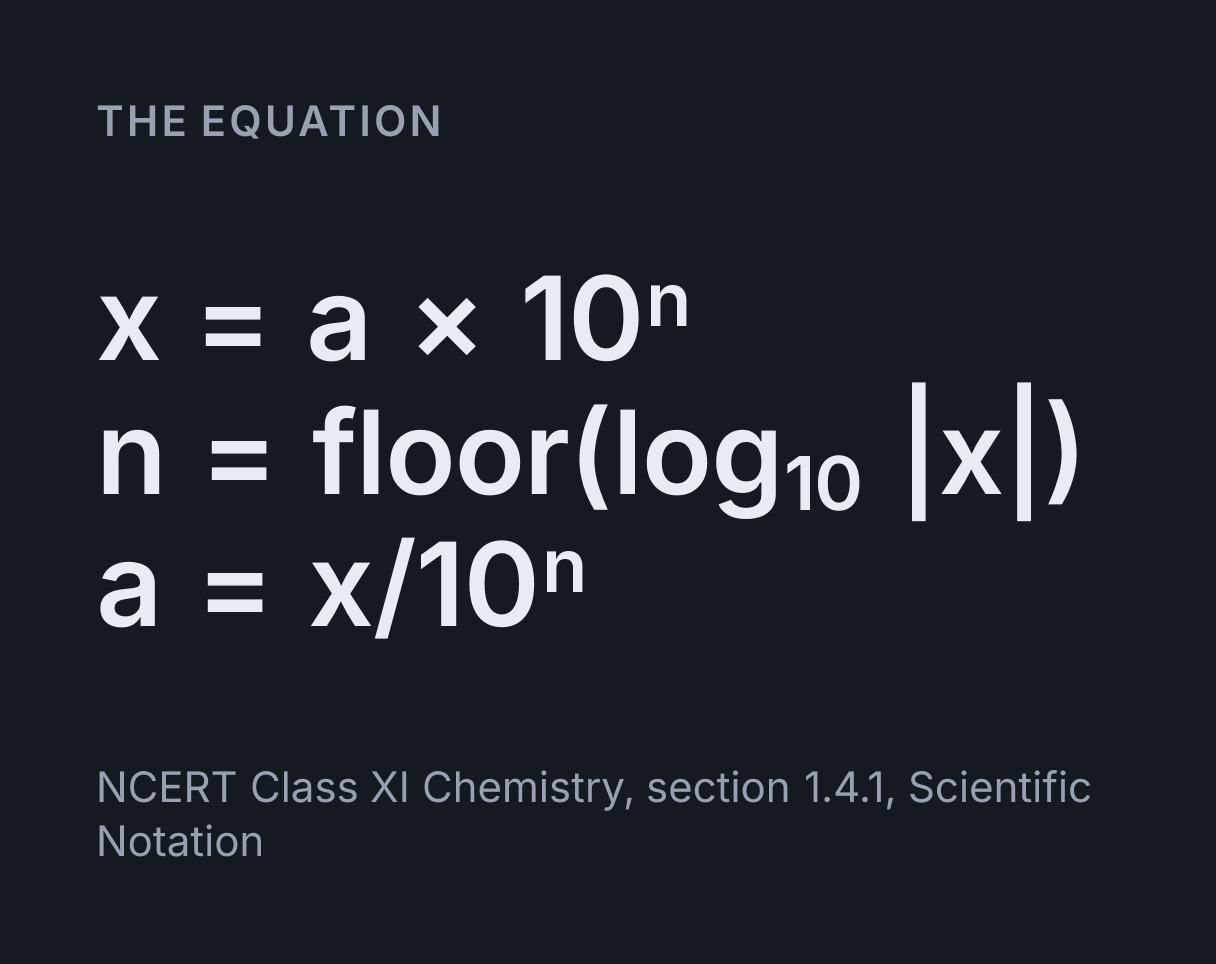
The equation
NCERT Class XI Chemistry, section 1.4.1, Scientific Notation
How to convert a number to scientific notation
To write a number in scientific notation, move its decimal point until exactly one non-zero
digit is in front of it, and count the places it moved: that count is the power of ten,
positive when the point moved left and negative when it moved right. The result has the form
a × 10ⁿ, with a digit term a from 1 to under 10 and a whole number n, so
0.000456 = 4.56 × 10⁻⁴ and 45,600 = 4.56 × 10⁴. As a formula,
n = floor(log₁₀|x|) and a = x ÷ 10ⁿ.
Type a number into the converter in any form: an ordinary decimal, E notation such as
4.56e-4, or a power of ten written 4.56 × 10^-4. It gives the same
number in scientific notation, in E notation, in engineering notation with its SI prefix, and
written out in full, with the working in the steps a textbook shows. It keeps the significant
figures you typed, so 0.0004560 and 0.000456 give different answers, and it can round to any
number of significant figures you ask for. The Arithmetic option multiplies, divides, adds or
subtracts two numbers in scientific notation and rounds the answer by the significant figure
rules.
The four ways of writing one number
- Scientific notation,
4.56 × 10⁻⁴. NCERT calls the digit term N and says it “varies between 1.000... and 9.999...”. In the UK and in Indian school maths the same form is called standard form. American school books often use standard form to mean the ordinary written-out number instead, so check which is meant. - E notation,
4.56E-4. The same number as a calculator display or a spreadsheet writes it: the E, for exponent, is read as “times ten to the”. A spreadsheet may show it as 4.56E-04, which is the same value. - Engineering notation,
456 × 10⁻⁶. The power of ten is kept to a multiple of 3, so the digit term runs from 1 to under 1000 and each power has an SI prefix: 456 × 10⁻⁶ m is 456 µm. - Written out,
0.000456, the ordinary decimal form, sometimes called standard notation or decimal notation.
Worked example: 0.0004560 in scientific notation
-
Move the decimal point 4 places to the right, to just after the 4:
4.560. The zeros in front only placed the point, so they go. -
Each place to the right takes 1 from the power of ten, so 10⁰ becomes 10⁻⁴ and
0.0004560 = 4.560 × 10⁻⁴. - The final zero stays. It comes after the decimal point, so it was measured and is one of the number’s 4 significant figures.
-
In E notation that is
4.560E-4. For engineering notation, lower the power to 10⁻⁶ and move the point 2 more places right:456.0 × 10⁻⁶, where 10⁻⁶ is the prefix micro (µ).
A large number goes the other way. For 45,600 the point moves 4 places left,
giving 4.56 × 10⁴, or 45.6 × 10³ in engineering notation with the
prefix kilo. The two zeros at the end have no decimal point after them, so by the usual
convention they are placeholders and 45,600 has 3 significant figures. If they were measured,
the number is 4.5600 × 10⁴, and scientific notation is the way to say so.
Multiplying and dividing in scientific notation
Multiply the digit terms and add the exponents; divide the digit terms and subtract the exponents. Then put the digit term back between 1 and 10, and round to the fewest significant figures of the two numbers.
Worked example: (5.6 × 10⁵) × (6.9 × 10⁸)
- Multiply the digit terms:
5.6 × 6.9 = 38.64. - Add the exponents:
5 + 8 = 13, so the product is 38.64 × 10¹³. -
38.64 is 10 or more, so move the point 1 place left and add 1 to the power:
3.864 × 10¹⁴. - Both numbers have 2 significant figures, so the answer is 3.9 × 10¹⁴.
Division works the same way with the signs turned round: (2.7 × 10⁻³) ÷ (5.5 × 10⁴)
is 0.4909… × 10⁻⁷, which is 4.909… × 10⁻⁸ once the digit term is brought back above 1, and
4.9 × 10⁻⁸ to 2 significant figures.
Adding and subtracting in scientific notation
Numbers can only be added or subtracted in scientific notation once they have the same power
of ten. Rewrite the one with the smaller power to match the larger, add or subtract the digit
terms, and keep the power. For 6.65 × 10⁴ + 8.95 × 10³:
-
8.95 × 10³ = 0.895 × 10⁴: the point moves 1 place left and the power goes up by 1. (6.65 + 0.895) × 10⁴ = 7.545 × 10⁴.- A sum keeps the coarsest last place of its terms. 6.65 × 10⁴ is known to the nearest 100, so 75,450 is rounded to the hundreds. The 50 dropped is exactly half, a tie, which goes to the even digit, and the answer is 7.54 × 10⁴. Rounding half up would give 7.55 × 10⁴.
These are the examples of NCERT’s Class XI Chemistry textbook, section 1.4.1, which gives the unrounded results; the rounding follows its section 1.4.2, and the tie rule, half to even, is the one NCERT and NIST SP 811 state.
Engineering notation and SI prefixes
Engineering notation keeps every power of ten to a multiple of 3 because those are the powers the SI prefixes name, so a value in engineering notation reads straight off as a prefixed unit: 4.7 × 10³ Ω is 4.7 kΩ and 2.2 × 10⁻⁹ F is 2.2 nF. The prefixes for multiples of 3 run from quecto (10⁻³⁰) to quetta (10³⁰), the last four added in 2022; the converter names the prefix for each result, and the full list is in the SI units and prefixes table. Engineering notation has one weakness: a significant zero can end up with no decimal point after it, as in 40 × 10³ for 4.0 × 10⁴, where it reads as a placeholder. The converter says so when it happens.
Significant figures in scientific notation
Every digit of the digit term is significant and the power of ten never is, which is why scientific notation is the way to state a number’s precision without doubt. 1.5 × 10³, 1.50 × 10³ and 1.500 × 10³ have 2, 3 and 4 significant figures, while 1500 written out cannot say which it means. The significant figures calculator reads a number digit by digit with the same rules, and the two tools read what you type in the same way.
Common mistakes
- The sign of the exponent the wrong way round. A number below 1 has a negative power of ten: 0.0052 is 5.2 × 10⁻³, not 5.2 × 10³.
- Leaving the digit term outside 1 to 10. 38.64 × 10¹³ is a correct value but not scientific notation; it is 3.864 × 10¹⁴.
- Adding digit terms with different powers. 6.65 × 10⁴ + 8.95 × 10³ is not 15.6 × 10⁴. Match the powers first.
- Typing 10E5 for 10⁵. On a calculator E already means “times ten to the”, so 10E5 is 10 × 10⁵, which is 10⁶. Type 1E5.
- Reading E as the number e. The E of E notation has nothing to do with Euler’s number, 2.718…; 2E3 is 2000.
- Dropping a measured zero. 0.0004560 is 4.560 × 10⁻⁴, not 4.56 × 10⁻⁴. The final zero is a significant figure.
What this converter does not cover
It reads numbers, not quantities, so leave units and prefixes out: type 4.7e3 rather than 4.7k, and convert between units with the unit converter. Zero has no scientific notation form, since no power of ten brings it to a digit term from 1 to under 10. Powers of ten are accepted up to 400 either way, and a number is written out in full only up to 10³⁰ either way, the range the SI prefixes cover. Arithmetic takes two numbers and one of the four operations; for longer calculations with significant figures use the significant figures calculator, and for the values of the constants that are usually written in scientific notation see the physical constants table.
Common questions
How do you convert a number to scientific notation?
Move the decimal point until one non-zero digit is in front of it, and use the number of places it moved as the power of ten: positive for a move to the left, negative for a move to the right. So 45,600 is 4.56 × 10⁴, the point having moved 4 places left, and 0.00016 is 1.6 × 10⁻⁴, the point having moved 4 places right. Zeros that only placed the point disappear, while a zero after the point at the end, as in 0.0004560, is kept as a significant figure.
What is E notation?
It is scientific notation as calculators and spreadsheets write it, with the E, for exponent, read as “times ten to the”. 4.56E-4 means 4.56 × 10⁻⁴, or 0.000456, and 6.02E23 means 6.02 × 10²³. The E has nothing to do with Euler’s number e, and 10E5 means 10 × 10⁵, which is 10⁶, so a power of ten on its own is typed as 1E5.
What is the difference between scientific and engineering notation?
Engineering notation keeps the power of ten to a multiple of 3, so the digit term runs from 1 to under 1000 rather than from 1 to under 10. 45,600 is 4.56 × 10⁴ in scientific notation and 45.6 × 10³ in engineering notation, which reads directly as 45.6 thousand, or 45.6 k with an SI prefix. Every multiple of 3 from 10⁻³⁰ to 10³⁰ other than 10⁰ has a prefix, from quecto to quetta.
How do you multiply and divide numbers in scientific notation?
Multiply the digit terms and add the exponents, or divide the digit terms and subtract the exponents, then bring the digit term back between 1 and 10. (5.6 × 10⁵) × (6.9 × 10⁸) is 38.64 × 10¹³, which is 3.864 × 10¹⁴, and 3.9 × 10¹⁴ to the 2 significant figures of the data. (2.7 × 10⁻³) ÷ (5.5 × 10⁴) is 0.4909… × 10⁻⁷, which is 4.9 × 10⁻⁸ to 2 significant figures.
How do you add numbers in scientific notation?
Give both numbers the same power of ten first, then add the digit terms and keep the power. For 6.65 × 10⁴ + 8.95 × 10³, rewrite the second number as 0.895 × 10⁴, and the sum is 7.545 × 10⁴. A sum is only as precise as its coarsest term, here the hundreds of 6.65 × 10⁴, and 75,450 to the hundreds is a tie: 7.54 × 10⁴ by the half to even rule NCERT and NIST use, or 7.55 × 10⁴ rounding half up.
Is standard form the same as scientific notation?
In the UK and in Indian school maths, yes: standard form means a × 10ⁿ with a from 1 to under 10, so 45,600 in standard form is 4.56 × 10⁴. In American school maths standard form usually means the ordinary written-out number instead, such as 45,600, so the meaning depends on where the question was set.