Significant Figures Calculator
Count significant figures with the rule for each digit shown, round to n sig figs, and add, subtract, multiply or divide keeping the right precision.
Calculator
Type it exactly as written, zeros and decimal point included: 1500 and 1500. are different claims. Scientific notation works as 1.5e3 or 1.5 × 10^3.
- Significant figures Counted by the rules listed under the digits. Trailing zeros with no decimal point are left out, because they may only be placeholders.
- 4
- Decimal places
- 5
- Scientific notation
- 4.070 × 10⁻²
- Known to the nearest The place value of the last significant digit: how finely the number says it was measured.
- 0.00001
Digit by digit
- 0, leading zero, does not count
- decimal point
- 0, leading zero, does not count
- 4, non-zero digit, counts
- 0, captive zero, counts
- 7, non-zero digit, counts
- 0, trailing zero after a decimal point, counts
- Leading zeros, 2: never count. They only place the decimal point.
- Non-zero digits, 2: always count.
- Captive zero, 1: always counts, because it sits between non-zero digits.
- Trailing zero, 1: counts, because the number has a decimal point, so the zero was written to show a measured place.
Round it
- Rounded to 2 significant figures
- 0.041
- Scientific notation
- 4.1 × 10⁻²
Working
- Keep 2 significant figures: 0.040
- First digit dropped: 7, above 5, so the last kept digit goes up
- Rounded: 0.041
Citing this tool
Last updated . Add the date you accessed it as well, which a citation of a page that can change asks for. If a specific result matters, cite the permalink from the tool’s share row instead of this page: it reproduces the exact parameters.
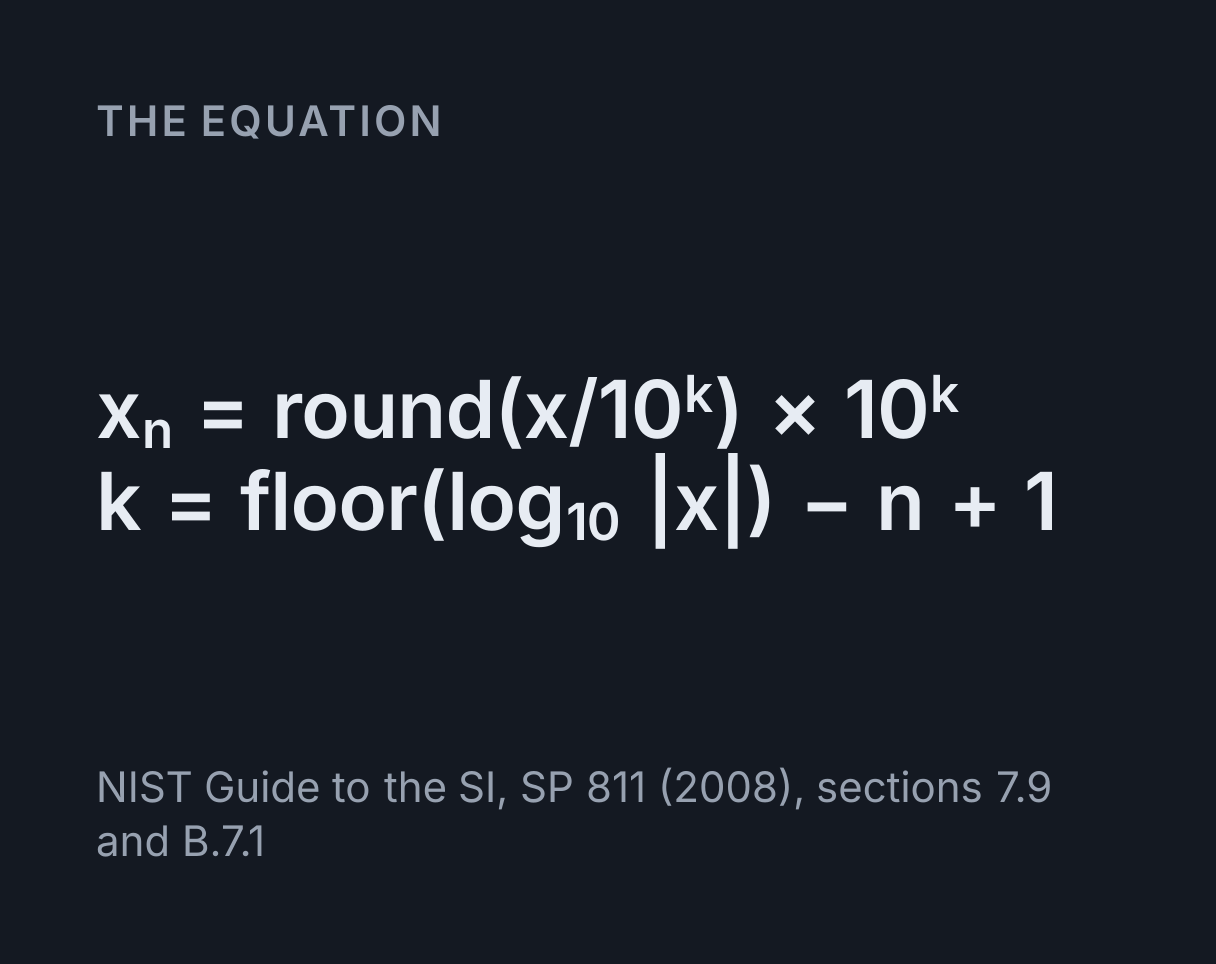
The equation
NIST Guide to the SI, SP 811 (2008), sections 7.9 and B.7.1
How to count significant figures
Significant figures, or sig figs, are the digits of a number that its measurement vouches
for. Every non-zero digit counts, every zero between non-zero digits counts, zeros before
the first non-zero digit never count, and zeros at the end count only when the number has a
decimal point. So 0.04070 has 4 significant figures: the 4, the zero between
the 4 and the 7, the 7 and the final zero. The two zeros in front only place the decimal
point.
Type a number into the calculator exactly as it was written and it marks every digit with
the rule that decides it, then gives the count, the decimal places and the scientific
notation. It also rounds the number to as many significant figures as you ask for: x rounded
to n figures is round(x / 10^k) × 10^k, where
k = floor(log₁₀|x|) − n + 1 is the place of the last digit kept.
The Calculate option takes a whole calculation, such as (25.36 − 18.2) ÷ 2.45,
and rounds the answer by the rules for combining measurements, showing each step.
The five rules, with an example of each
- Non-zero digits always count.
285has 3 significant figures. - Captive zeros always count. A zero between non-zero digits was measured
like any other digit, so
2.005has 4 significant figures. - Leading zeros never count.
0.0052has 2 significant figures. The zeros only say where the decimal point goes, which is why they vanish when the number is written as 5.2 × 10⁻³. - Trailing zeros count after a decimal point.
0.200has 3 significant figures, because nobody writes zeros after the point unless those places were read. - Trailing zeros in a whole number are ambiguous.
1500has 2 significant figures by convention, though it may be good to the nearest unit, and the calculator says it could have up to 4.
These are the rules as NCERT’s Class XI Physics (section 1.3) and Chemistry (section 1.4.2) texts and OpenStax Chemistry 2e (section 1.5) set them out.
Trailing zeros, and how to write what was measured
A whole number that ends in zeros cannot say how many of them were measured. NIST’s guide to the SI, Special Publication 811, makes the point in section 7.9 with 1200 m, where it is not possible to tell whether the last two zeros are significant, while 1.200 km says they are. Three ways to remove the doubt:
- Scientific notation.
1.5 × 10³has 2 significant figures,1.50 × 10³has 3 significant figures and1.500 × 10³has 4 significant figures. The power of ten never counts. The scientific notation converter rewrites a number in that form, or in E notation, keeping the figures it was typed with. - A decimal point after the number.
1500.has 4 significant figures in the textbooks that use this mark. Not all do, so scientific notation is the safer choice in anything written for someone else. - A larger unit. 1500 g measured to the gram is 1.500 kg.
When only the written number is available, the calculator follows the convention NCERT states and OpenStax calls prudent: trailing zeros with no decimal point are not counted. It says so beside the count and gives the range, 2 and up to 4 for 1500.
Rounding to significant figures
To round to n significant figures, keep the first n digits, counting from the first
non-zero one, and look at the first digit dropped. Below 5, the kept digits stay as they
are. Above 5, or a 5 with any non-zero digit after it, the last kept digit goes up by one.
As a formula, the last digit kept sits at the place
k = floor(log₁₀|x|) − n + 1, and the rounded value is
round(x / 10^k) × 10^k.
A 5 with nothing after it, or only zeros, is exactly halfway, a tie, and the rule for a
tie is a convention. NCERT’s physics and chemistry texts, OpenStax Chemistry 2e and NIST SP
811 (section B.7.1) all round a tie to the even digit, so 2.745 to 3
significant figures is 2.74, and 2.735 to 3 significant figures is 2.74 as
well. Rounding half up gives 2.75 for the first. The calculator rounds half to even unless
you choose half up, and says what the other rule gives whenever the two disagree.
When rounding up carries into a new digit, the figures move with it. 9.96 to
2 significant figures is 1.0 × 10¹, and it has to be written that way, because a plain 10
reads as one significant figure. In the same way 1996 to 3 significant figures
is 2.00 × 10³, which 2000 cannot show.
Worked example: counting and rounding 0.04070
- The zero before the point and the zero after it are leading zeros, and neither counts.
- The 4 and the 7 are non-zero and count, the zero between them is captive and counts, and the final zero counts because the number has a decimal point.
-
That makes 4 significant figures and 5 decimal places:
4.070 × 10⁻²in scientific notation, known to the nearest 0.00001. -
0.04070to 2 significant figures is 0.041. The kept digits are 0.040, and the first digit dropped is 7, above 5, so the last kept digit goes up. -
0.04070to 3 significant figures is 0.0407, since the only digit dropped is a zero.
Significant figures in addition, subtraction, multiplication and division
The two kinds of operation have different rules, because they carry uncertainty differently.
- Adding and subtracting keep the fewest decimal places. A sum is only as
fine as its coarsest term:
12.11 + 18.0 + 1.012 = 31.122, and 18.0 is known only to the tenths, so the sum is 31.1. The rule is about places, not figures:0.307 − 0.304 = 0.003keeps 3 decimal places but only 1 significant figure, which is what subtracting two close measurements does. - Multiplying and dividing keep the fewest significant figures. A product
is only as precise, in proportion, as its least precise factor:
2.5 × 1.25 = 3.125, and 2.5 has 2 significant figures, so the product is 3.1.
All three are NCERT’s own examples. For numbers in scientific notation the addition rule reads as the coarsest last significant place, so 1.2 × 10³ + 3.45 × 10² is 1545 known only to the hundreds, which is 1.5 × 10³.
Worked example: (25.36 − 18.2) ÷ 2.45
A sample’s mass is found by difference, 25.36 g in its container less 18.2 g for the container, and divided by its volume, 2.45 mL.
-
25.36 − 18.2 = 7.16. 18.2 has 1 decimal place, so the difference is good to 7.2, which is 2 significant figures, although neither measurement had fewer than 3. -
7.16 ÷ 2.45 = 2.92244897959…, with every digit of the difference carried. The fewest significant figures is now 2, from the difference, not the 3 of 2.45. - Rounded once, at the end, the density is 2.9 g/mL.
Applying the multiplication rule to the three numbers as typed would give 2.92, a figure the data do not support: the subtraction, not the division, decides the precision. The calculator’s working shows each step with the rule that set it.
Exact numbers and π
Counted and defined numbers are exact and have unlimited significant figures, so they never
limit an answer: 12 eggs, 100 cm in a metre, the 2 in a circumference of 2πr. Tick them in
the calculator’s list of numbers. π itself is always exact, carried to 50 decimal places.
With the 2 marked exact, 2 × π × 0.52 is 3.3, set by the 2 significant figures
of 0.52. Left unmarked, the 2 counts as a measurement with 1 significant figure and the
answer becomes 3.
Carry every digit, round once
Rounding at each step throws information away, and the losses build up. NCERT’s example is the reciprocal of 9.58: 1 ÷ 9.58 to 3 significant figures is 0.104, and 1 ÷ 0.104 to 3 significant figures is 9.62, not 9.58. Kept as 0.1044, one digit longer, its reciprocal is 9.579, which rounds back to 9.58. The 1 of a reciprocal is exact, so tick it in the list of numbers to get these figures from the calculator. It carries every digit of every intermediate result, shows how precisely each is known (“good to 7.2”), and rounds only the answer, which is what NCERT’s advice to keep one extra digit approximates.
Common mistakes
- Counting leading zeros.
0.0045has 2 significant figures. A change of unit makes the point, 0.0045 g being 4.5 mg: a unit cannot change how precisely something was measured. - Losing a significant trailing zero.
2.50has 3 significant figures and 2.5 has 2, yet stored as a value they are the same number. That is why this calculator reads the digits you type rather than the value they make. - Using the multiplication rule on a sum.
436.32 + 227.2 + 0.301 = 663.821is 663.8, to the tenths of 227.2, not 664, which is NCERT’s warning example. - Rounding at every step. As the reciprocal of 9.58 shows, the answer can move in its last figure.
- Treating an exact number as a measurement. The 2 in 2πr, or the 100 that turns a fraction into a percentage, would otherwise cut the answer to 1 significant figure.
- Writing a rounded whole number that hides its figures. 2000 cannot say it has 3 significant figures; 2.00 × 10³ can.
- Trusting a floating-point rounding on a tie. 2.675 cannot be stored
exactly in binary floating point, which is why Python’s
round(2.675, 2)gives 2.67, as its documentation warns. Read as written,2.675to 3 significant figures is 2.68 by either tie rule.
What this calculator does not cover
Significant figures are a shorthand for uncertainty, not a measure of it: 1.0 and 9.9 both have 2 significant figures, yet one unit in the last place is 10 percent of the first and about 1 percent of the second. When a measurement comes with a stated uncertainty, propagate it with the error propagation calculator and round the result to match that uncertainty rather than by counting figures. To compare a result with an accepted value, use the percent error calculator, and for the spread of repeated readings the standard deviation calculator.
The calculator does the four arithmetic operations. A power is a repeated product, so it keeps the significant figures of its base: a cube with a side of 7.203 m has a volume of 373.7 m³, to the 4 significant figures of the side, as in NCERT’s example. A logarithm keeps as many decimal places as its argument has significant figures (OpenStax Chemistry 2e, section 14.2), so a hydronium ion concentration of 1.2 × 10⁻³ M gives a pH of 2.92. Report the pH calculator’s answer to the decimal places that rule allows.
Common questions
Do zeros count as significant figures?
Sometimes. Zeros between non-zero digits always count, zeros before the first non-zero digit never count, and zeros at the end count only when the number has a decimal point. So 0.0450 and 405 each have 3 significant figures, while 450 is counted as 2, because its final zero may only be a placeholder.
How many significant figures does 1500 have?
Two by the usual convention, but the number itself cannot say. Trailing zeros in a whole number with no decimal point may be placeholders, so 1500 could have 2, 3 or 4 significant figures. Writing 1.5 × 10³, 1.50 × 10³ or 1.500 × 10³ says which, and so does 1500. with a decimal point, in the textbooks that use that mark for all 4.
How do you round a number to significant figures?
Keep the first n digits, counting from the first non-zero one, and look at the first digit dropped: below 5 the kept digits stay, while above 5, or a 5 with any non-zero digit after it, the last one goes up, so 0.04070 to 2 significant figures is 0.041. A dropped 5 with nothing after it, or only zeros, is a tie, which NCERT, OpenStax and NIST round to the even digit, so 2.745 to 3 significant figures is 2.74. Rounding half up would give 2.75.
What are the significant figure rules for adding and multiplying?
Adding and subtracting keep the fewest decimal places, and multiplying and dividing keep the fewest significant figures. So 12.11 + 18.0 + 1.012 is 31.1, limited by the tenths of 18.0, and 2.5 × 1.25 is 3.1, limited by the 2 significant figures of 2.5. In a mixed calculation, apply each rule at its own step, carry every digit, and round only the final answer.
Do exact numbers limit significant figures?
No. A counted number, such as 12 eggs, or a defined one, such as 100 cm in a metre, is exact and has unlimited significant figures, so it never limits an answer. The same holds for the 2 in 2πr and for π itself. Mark such numbers as exact in the calculator; otherwise a whole number like 2 is read as a measurement with 1 significant figure.