Decibel Calculator
Convert sound intensity to decibels and back, with how many times the hearing threshold it is, the level at twice the distance and safe exposure.
Calculator
Whisper 1e-10, conversation 1e-6, traffic 1e-3, jet at 30 m 1e2 W/m².
The threshold of hearing, 1e-12 W/m². Leave this alone unless you know why you are changing it.
Working, with your numbers
- L = 10 log10(I / I0)
- I0 = 1 × 10⁻¹² W/m2, the threshold of hearing
- = 10 log10(1 × 10⁻⁶ / (1 × 10⁻¹²))
- = 10 log10(1 × 10⁶)
- = 60 dB
Values are converted into the units the equation is worked in before the arithmetic.
- Times the threshold How many times more intense than the quietest audible sound.
- 1 × 10⁶
- At twice the distance Intensity falls with the square of distance, which is 6.02 dB per doubling.
- 53.98 dB
- Safe exposure Using the 85 dB, 3 dB exchange-rate convention.
- 8 h or more
Citing this tool
Last updated . Add the date you accessed it as well, which a citation of a page that can change asks for. If a specific result matters, cite the permalink from the tool’s share row instead of this page: it reproduces the exact parameters.
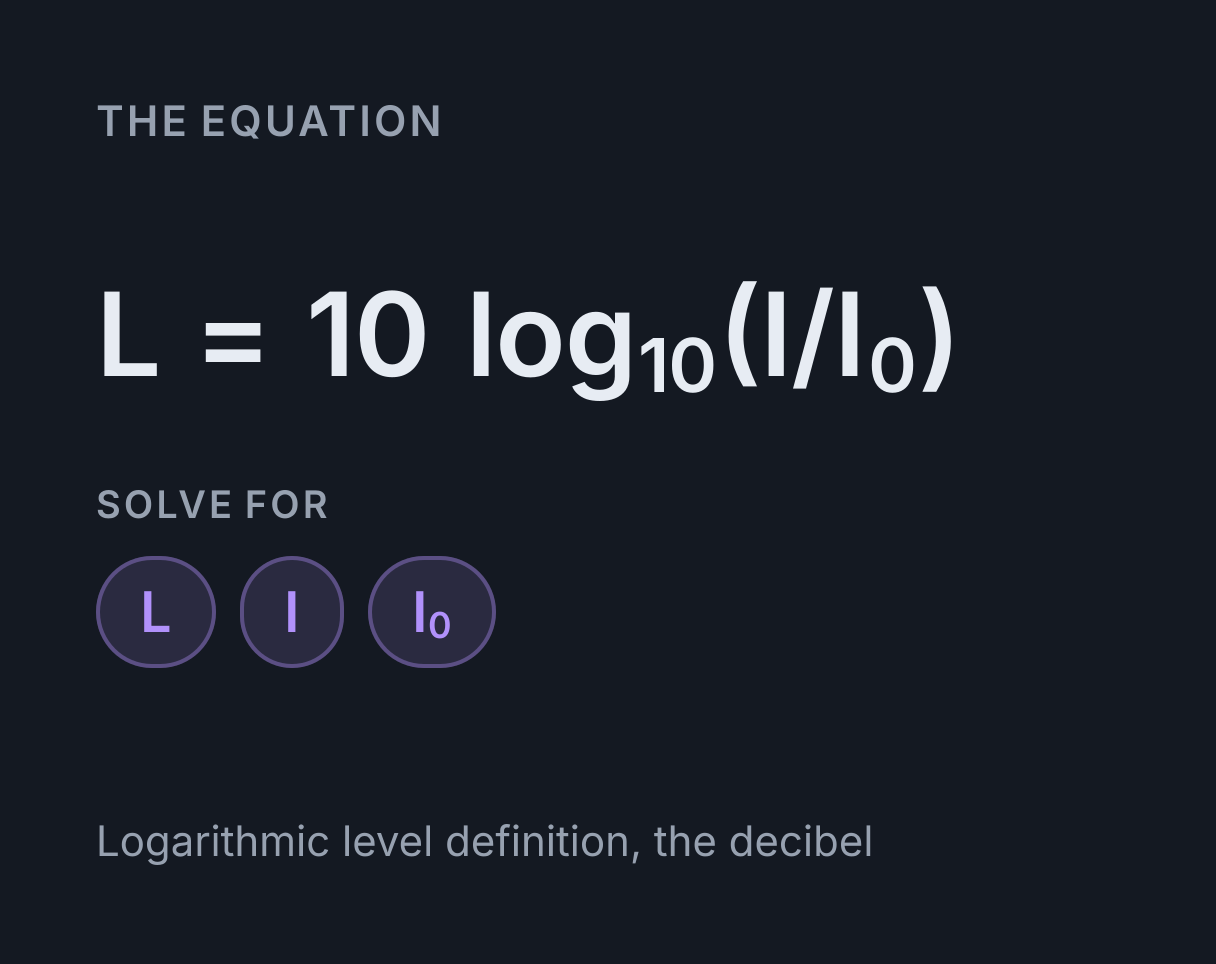
The equation
Logarithmic level definition, the decibel
A decibel is a ratio, not an amount
L = 10 log₁₀(I/I₀) never reports an intensity. It reports how
many times larger one intensity is than a reference, compressed
logarithmically. The reference I₀ is fixed by convention at
1 × 10⁻¹² W/m², the faintest sound a healthy young ear
detects, so a decibel figure for airborne sound is meaningful without anyone
restating the reference. Change I₀ and the same physical sound
gets a different number, which is why the reference field here starts at the
standard threshold and is never the one solved for.
The logarithm is there because hearing spans an absurd range. From the threshold to the onset of pain is about twelve orders of magnitude, and taking the log turns that into a scale running from 0 to roughly 120. It also means 0 dB is the reference, not silence. A sound quieter than the threshold has a negative level: 1 × 10⁻¹³ W/m² is −10 dB, and it is perfectly real. True silence has no decibel value at all, because the logarithm of zero is undefined, so the scale is unbounded below.
Worked example
The default intensity is 1 µW/m², about the level of ordinary conversation, measured against the standard threshold.
- Convert both to SI:
I = 1 × 10⁻⁶ W/m²,I₀ = 1 × 10⁻¹² W/m² - Form the ratio:
I/I₀ = 10⁻⁶ / 10⁻¹² = 1 × 10⁶ - Take the logarithm:
log₁₀(10⁶) = 6 L = 10 × 6 = 60 dB
A conversation is therefore a million times as intense as the
quietest audible sound, and the scale renders that as the tidy number 60. Step
back to twice the distance from the speaker and the reading falls to
53.98 dB, because intensity spreads over four times the area
and 10 log₁₀(4) = 6.0206 dB.
What the round numbers actually are
Two shortcuts are worth knowing exactly. A tenfold rise in intensity is
10 log₁₀(10) = 10 dB, exact by construction. A doubling is
10 log₁₀(2) = 3.0103 dB, close to 3 but not equal to it, and the
difference accumulates if you chain several doublings by hand. Perceived
loudness follows neither cleanly: ten decibels sounds roughly twice as loud,
while the 3 dB from doubling a sound source is barely detectable. That is why
twice the traffic on a road changes the measured level so little.
The distance rule follows from geometry rather than acoustics. Intensity from a point source falls with the square of distance, so every doubling of distance costs 6.0206 dB and every halving gains the same. Four times the distance costs 12.04 dB, which is why a measurement is meaningless without the range it was taken at.
Exposure limits use the same arithmetic. The usual convention allows about
85 dB for an eight-hour day, and since 3 dB doubles the
intensity, every 3 dB above halves the permitted time. At 100 dB that is
fifteen decibels over, five halvings, so 8 h ÷ 2⁵ = 0.25 h, about
fifteen minutes. Above roughly 120 dB the damage stops being cumulative and
can happen at once. It is also permanent, because the hair cells in the
cochlea do not regrow.
Common mistakes
- Adding decibels arithmetically. Two 60 dB sources do not
make 120 dB. Add the intensities, not the levels: doubling gives
63.01 dB. - Treating 0 dB as silence. It is the threshold of hearing, 1 × 10⁻¹² W/m². Negative levels exist and describe sounds below that threshold.
- Using the 20 log formula for intensity. The factor of 20 belongs to amplitude quantities such as sound pressure. Intensity is a power quantity and takes the factor of 10, and mixing them doubles or halves the answer.
- Quoting a level without a distance. A jet engine at 30 m and the same engine at 300 m differ by 20 dB. Without the range the number describes nothing.
Converting units first? Use the intensity conversion table.
Worked examples
Each one runs through the calculator above, so the arithmetic here is the arithmetic it does.
How many decibels is a sound intensity of 100 W/m²?
- L = 10 log10(I / I0)
- I0 = 1 × 10⁻¹² W/m2, the threshold of hearing
- = 10 log10(100 / (1 × 10⁻¹²))
- = 10 log10(1 × 10¹⁴)
- = 140 dB
140 dB, twenty decibels above the 120 dB usually quoted as the threshold of pain. That gap is a factor of 100 in intensity, not the sixth more that 140 against 120 suggests, because every 10 dB is a tenfold step, so a difference in decibels has to be read as a ratio.
What is the sound intensity of an 85 dB noise in W/m²?
- I = I0 x 10^(L / 10)
- = 1 × 10⁻¹² x 10^(85 / 10)
- = 1 × 10⁻¹² x 10^8.5
- = 0.0003162 W/m2 = 316.23 uW/m2
About 3.2 × 10⁻⁴ W/m². The level divided by ten is a power of ten, so the half in 8.5 is not a small correction but a factor of 3.16: 85 dB is 3.16 times the intensity of 80 dB, and about 316 million times the threshold of hearing.
Practise this with Waves Practice Problems, questions generated from this calculator and 4 other calculators in Waves & Optics.
Common questions
Why is 0 dB not silence?
Because 0 dB is the reference intensity, not the absence of sound. It marks the quietest sound a healthy young ear can detect, 1 picowatt per square metre. Anything quieter has a negative decibel value, and true silence would be minus infinity, since the logarithm of zero is undefined.
Why does 10 dB louder sound only about twice as loud?
Because the scale measures intensity while your ear judges loudness, and the two are not proportional. Ten decibels is a tenfold increase in intensity but only about a doubling in perceived loudness. Three decibels doubles the intensity and is barely noticeable, which is why a doubling of traffic on a road changes the noise level so little.
How much noise is safe?
Around 85 dB for an eight-hour day, and every 3 dB above that halves the safe time, because 3 dB is a doubling of intensity. At 100 dB the limit is roughly 15 minutes. Damage above about 120 dB can be immediate rather than cumulative, and it is permanent: the hair cells in the cochlea do not regrow.